
Why Away Rotations Matter So Much for IMGs in Medicine-Psychiatry
For an international medical graduate (IMG), away rotations are often the single most powerful tool to bridge the gap between training abroad and matching into a U.S. medicine-psychiatry combined residency. This IMG residency guide focuses specifically on building a strategic approach, not just “doing some electives.”
Medicine-psychiatry is a small but highly competitive field. Programs take relatively few residents per year, and many know each other personally across institutions. That makes your visiting student rotations (also called away rotations or audition rotations) incredibly high-yield—if you choose them and execute them well.
In this guide, you’ll learn:
- How to choose programs and design an away rotation plan tailored for an IMG interested in med psych residency
- How many away rotations to aim for and in which settings (medicine vs psychiatry vs combined)
- How to prepare before you start so you can meet U.S. expectations from day one
- How to stand out clinically and professionally during rotations
- How to turn those rotations into strong letters of recommendation and interview invitations
This is written specifically for international medical graduates aiming for medicine psychiatry combined residencies, but much of it applies to categorical internal medicine and psychiatry as well.
Understanding the Role of Away Rotations in Medicine-Psychiatry for IMGs
Away rotations have different purposes depending on your background. For U.S. MD/DO students, they’re important; for many IMGs, they’re critical.
Why They Matter More for IMGs
As an international medical graduate, away rotations help you:
Demonstrate U.S. clinical competence
- Show you can function in a U.S. hospital system with its pace, documentation style, and multidisciplinary teams.
- Prove that you can handle both internal medicine and psychiatric complexity—key for medicine-psychiatry combined training.
Overcome limited or unknown school reputation
- Program directors may not know your medical school or its grading system.
- A strong performance at a respected U.S. institution gives them a concrete sense of your capabilities.
Secure strong U.S. letters of recommendation (LoRs)
- You need letters from U.S. faculty actively involved in residency training.
- For med psych residency, a letter from someone known in the medicine-psychiatry community is especially valuable.
Show genuine interest in medicine-psychiatry combined training
- Many applicants say they’re “interested in both medicine and psychiatry,” but programs want to see this in action.
- Thoughtfully chosen away rotations demonstrate that you understand—and are committed to—the dual training model.
Clarify your own career fit
- Seeing integrated care (e.g., consult-liaison, collaborative care clinics) helps you understand day-to-day life in this specialty.
- You can confirm whether you want medicine psychiatry combined vs categorical medicine or categorical psychiatry.
Combined vs Categorical: Strategic Positioning
A key concept in any IMG residency guide for med psych is portfolio flexibility. Because medicine-psychiatry slots are extremely limited, most strong applicants also apply to:
- Categorical Internal Medicine
- Categorical Psychiatry
- Occasionally, other combined programs (e.g., family medicine-psychiatry, pediatrics-psychiatry, neurology-psychiatry, depending on interest)
Your away rotation strategy should therefore:
- Support your primary goal: medicine-psychiatry combined
- Maintain a back-up framework: at least one categorical specialty you would genuinely be happy in
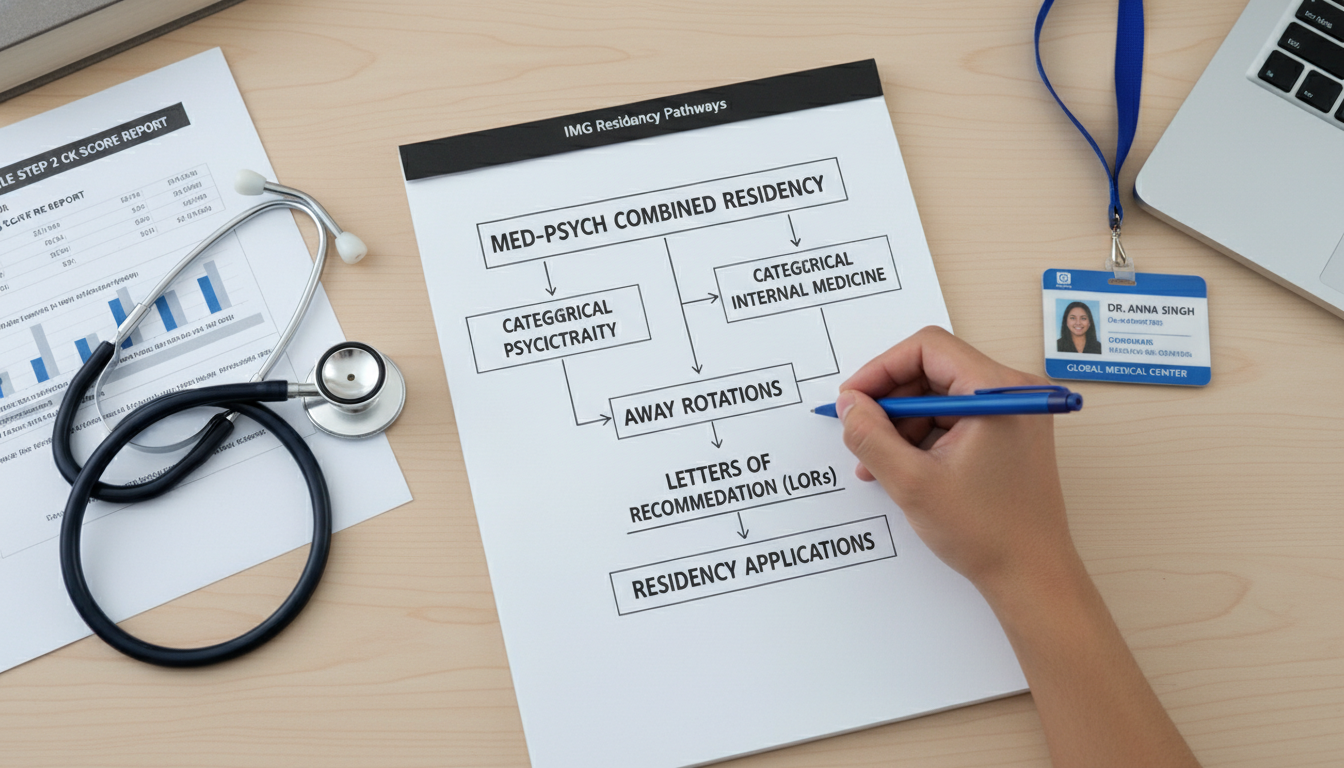
Planning Your Away Rotations: Where, When, and How Many
How Many Away Rotations Should an IMG Do?
There is no magic number, but for a serious IMG applicant in medicine-psychiatry combined:
- Target range: 2–4 away rotations in the U.S.
- If possible:
- 1–2 rotations at institutions with a medicine-psychiatry combined residency
- 1 medicine-heavy rotation (e.g., inpatient internal medicine, consult-liaison)
- 1 psychiatry-heavy rotation (e.g., inpatient psych, emergency psych, CL psych)
Constraints you must consider:
- Visa and travel limitations
- Finances (application fees, housing, travel)
- Your medical school’s graduation and elective policies
- Available visiting student rotations slots—especially competitive at well-known universities
If finances or visas limit you to only 1–2 away rotations, prioritize:
- A rotation at a medicine-psychiatry combined program if at all possible
- A rotation where you have the best odds of strong faculty interaction and letters
Timing: When in Your Training to Do Away Rotations
Ideal timing for U.S. students is usually final year (MS4) around May–October. For IMGs, things are more variable, but the principles are:
- Complete core clinical rotations first (internal medicine, psychiatry, surgery, etc.), so you have basic skills.
- Aim to do away rotations 6–12 months before you apply for residency if possible. This:
- Allows time to receive and upload letters of recommendation
- Gives you time to integrate feedback and improve performance for later rotations
- Ensures clinical experiences are recent enough to be relevant
If you’ve already graduated, you may need to target:
- Observerships → lower impact, usually no direct patient care, limited LoR strength
- Hands-on externships or non-degree clinical experiences → preferable, if available
For medicine-psychiatry combined programs, early final year or immediate post-graduation is ideal so your performance can influence the upcoming match cycle.
Choosing Where to Rotate: A Strategic Framework
To choose away rotations residency programs wisely, consider three overlapping goals:
Exposure to combined care
- Programs that have medicine-psychiatry, family-psychiatry, or strong consult-liaison services
- Hospitals with integrated behavioral health in primary care or collaborative care models
Feasibility and IMG-friendliness
- Check if their visiting student office or VSLO/AAMC listing mentions accepting IMGs or international visiting students
- Prior history of matching IMGs into medicine, psychiatry, or combined programs is a strong positive signal
Letter potential
- Smaller programs or services where attendings directly supervise students often yield stronger letters
- Rotations with clear evaluation structures (mid-rotation feedback, final evaluation, student presentations) usually give faculty more material for a detailed letter
High-Yield Rotation Types for Medicine-Psychiatry
To support a med psych residency application, consider these options:
On the medicine side:
- Inpatient internal medicine (teaching service)
- Consult-liaison psychiatry on a medicine-heavy team
- Addiction medicine service run by internists
- Medical ICU or step-down units (if you already have solid basic medicine experience)
On the psychiatry side:
- Inpatient psychiatry with medically complex patients
- Psychiatric emergency service linked to ED
- Consult-liaison psychiatry (strong bridge between medicine and psych)
- Addiction psychiatry rotations
A powerful combination for an IMG aiming at medicine psychiatry combined might be:
- Rotation 1 (4 weeks): Inpatient Internal Medicine + CL Psych exposure at a university hospital
- Rotation 2 (4 weeks): Inpatient Psychiatry with medically ill patients or CL Psych at a med-psych program
- Optional Rotation 3–4: Another medicine or psychiatry rotation where IMGs are historically welcomed and supervised well
Building a Strong Application Around Your Away Rotations
Your away rotations don’t exist in isolation—program directors consider them within your overall profile. As you plan, coordinate these elements:
Step 1: Academic Readiness
- Aim to complete USMLE Step 1 and (ideally) Step 2 CK before your first major away rotation.
- Strong Step 2 CK scores particularly help for medicine-psychiatry where internal medicine faculty may weigh them heavily.
- If Step scores are modest, exceptional rotation performance and strong letters become even more critical.
Step 2: Supporting Documents
Before you begin applying for visiting student rotations:
- Assemble a clean CV emphasizing:
- Clinical experience (home country + any prior U.S. exposure)
- Research or quality improvement in mental health, internal medicine, or integrated care
- Teaching, leadership, or community mental health work
- Prepare a brief personal statement or paragraph specifically for away rotation applications that highlights:
- Your interest in combined medicine-psychiatry practice
- Why U.S. clinical exposure is important for your training
- Collect transcripts, dean’s letters, immunization records, and background checks early—these often delay IMGs.
Step 3: Align Rotations With Your Narrative
Decide how you’ll tell your story as a future medicine-psychiatry physician:
- What patient populations are you passionate about? (e.g., patients with severe mental illness and chronic medical disease, addiction, psychosomatic conditions, primary care mental health)
- How have your prior experiences led you toward a combined approach?
- What skills do you want to develop during away rotations that reflect this combined focus?
Then choose rotations that visibly support that narrative:
- Example: If you’re interested in severe mental illness with metabolic syndrome, choose:
- Inpatient psych with strong focus on SMI
- Medicine rotation where diabetes, obesity, and cardiovascular risk are common themes
This coherence helps both during rotations and later in interviews.

How to Excel During Away Rotations as an IMG in Med-Psych
Once you’ve secured away rotations, performance becomes everything. You are auditioning in real time.
Understand Expectations Early
On day 1–2, clarify with your supervising resident and attending:
- What is the typical student role here?
- How many patients should I follow?
- What’s the team’s preferred note format (SOAP, APSO, etc.)?
- What time should I pre-round and have notes ready?
- How are presentations structured—brief bullet style, problem-based, or organ-system?
As an IMG, you may be unfamiliar with some U.S. conventions; asking early and adjusting quickly shows professionalism, not weakness.
Core Behaviors That Stand Out Positively
Reliability and punctuality
- Be early every day, never late to rounds, conferences, or sign-out.
- Complete tasks when promised and follow up without being reminded.
Clinical curiosity and preparation
- Read daily about your patients’ conditions, especially where medicine and psychiatry intersect
- Look up relevant guidelines (e.g., APA, AHA, ACP) and mention them judiciously when appropriate
Thoughtful integration of medicine and psych
- On medicine: Don’t ignore mental health. Ask about mood, substance use, coping, and cognition.
- On psychiatry: Don’t ignore physical health. Monitor vitals, labs, medical comorbidities, and side effects (e.g., metabolic syndrome, QTc, EPS).
- Suggest reasonable cross-disciplinary interventions (e.g., checking HbA1c in a long-term antipsychotic user, asking for a cardiology opinion when warranted).
Communication skills
- Clear, concise case presentations focused on assessment and plan
- Empathic communication with patients and families, especially in difficult psychiatric or medically complex situations
- Active listening to nurses, social workers, and allied health staff—they often informally report your professionalism.
Teachability
- When corrected, respond with appreciation and visible change in behavior.
- Ask for specific mid-rotation feedback: “Are there 1–2 things I can work on to better meet expectations?”
Special Considerations as an IMG
- Documentation style may differ significantly from your home country. Quickly learn institution-specific templates and wording for:
- Suicide risk assessments
- Capacity evaluations
- Restraint documentation
- Informed consent discussions
- Language/cultural nuances:
- If English is not your first language, rehearse patient interviews with colleagues and ask for feedback.
- Explain cultural frameworks when relevant, but align with U.S. standards of care.
Demonstrating Interest in Medicine-Psychiatry Combined Training
Subtly—but consistently—signal your interest in med psych residency:
- When discussing career plans with attendings, say:
- “I’m very interested in medicine-psychiatry combined training because…” followed by a concrete reason linked to patient experience.
- Volunteer to see patients where medical and psychiatric issues overlap:
- Delirium in medical patients
- Substance withdrawal with medical complications
- Medically ill patients with depression, anxiety, or psychosis
- Ask focused questions:
- “How do you coordinate with the other specialty when a patient has both serious heart disease and severe mental illness?”
- “Do you work with any medicine-psychiatry trained colleagues here?”
This helps faculty see you are not just “another psychiatry or medicine applicant,” but someone who understands the combined mission.
Converting Rotations Into Letters and Interviews
Performing well is only half the goal. You must also translate that performance into letters of recommendation and advocacy within the program.
Identifying Potential Letter Writers
Look for attendings who:
- Worked with you closely enough to observe your clinical reasoning and patient care
- Supervise residents or are program leaders (program directors, APDs, clerkship directors are ideal)
- Seem enthusiastic about teaching and provide feedback
In a medicine-psychiatry context, high-yield letter writers include:
- Faculty with combined training (if available)
- Consult-liaison psychiatrists
- Internists with a strong interest in mental health
- Psychiatry attendings who emphasize medical comorbidities
When and How to Ask for a Letter
Ask near the end of the rotation, after you have established your value:
Request in person if possible:
- “Dr. Smith, I’ve learned a lot on this rotation and I’m planning to apply for medicine-psychiatry combined residencies as an IMG. Would you feel comfortable writing a strong letter of recommendation for me?”
Provide:
- Updated CV
- Personal statement draft (even if rough)
- Brief “highlights” list: key patients or cases where you contributed meaningfully
- Specific note that you are applying to medicine-psychiatry combined and possibly categorical programs
Follow up by email with all documents and clear instructions (ERAS LoR portal).
Making Yourself Memorable to the Program
Residency selection is partly about who faculty and residents remember positively:
- Present a short-topic talk:
- Choose something at the intersection of medicine and psychiatry (e.g., “Managing metabolic side effects of antipsychotics in hospitalized patients”).
- Show up consistently at teaching conferences, noon lectures, and grand rounds.
- Ask residents about their experiences (without monopolizing their time), and express specific appreciation for what you’re learning.
Even if you don’t rotate at every program you apply to, strong performance at just one or two institutions can lead to supportive phone calls or emails between faculty that boost your application elsewhere—especially in a small field like medicine-psychiatry.
Practical Tips, Pitfalls, and Backup Strategies for IMGs
Logistical Tips
- Start applications early: Many visiting student programs open 6–9 months prior to rotation start dates.
- Budget carefully: Include application fees, immunizations, background checks, housing, transport, and living expenses.
- Visa considerations: Confirm whether a B-1/B-2, J-1, or other status is appropriate and accepted for the type of rotation (observership vs hands-on elective).
Common Pitfalls for IMGs
Doing only observerships when electives are possible
- Observerships have limited impact compared to hands-on rotations. Prioritize hands-on if your status allows.
Overloading on away rotations without quality
- Four mediocre rotations produce less benefit than two excellent, high-engagement ones.
Not clarifying your role
- Some IMGs remain too passive because they’re unsure what they’re allowed to do. Ask early and advocate respectfully for hands-on experience within institutional limits.
Neglecting categorical back-up planning
- Because medicine-psychiatry combined programs have limited seats, make sure your rotation choices and letters also support a categorical path you would accept.
If You Cannot Get Rotations at Combined Programs
Even if you can’t rotate at a medicine-psychiatry combined site, you can still build a strong profile:
- Combine rotations at:
- A categorical internal medicine program with strong consult-liaison psychiatry
- A psychiatry program with heavy internal medicine comorbidities
- Focus electives and research on:
- Integrated care, collaborative care models, or physical-mental health interfaces
- In your personal statement and interviews, explicitly tie your experiences to the med psych mission.
FAQs: Away Rotations for IMGs in Medicine-Psychiatry
1. As an IMG, how many away rotations should I aim to do for medicine-psychiatry?
Most IMGs targeting med psych residency should try for 2–4 U.S. away rotations, if possible. At least:
- 1 rotation that is medicine-heavy (or combined/integrated)
- 1 rotation that is psychiatry-heavy
If you can, include at least one rotation at a medicine psychiatry combined program. If limited by finances or visas, prioritize quality and fit over quantity.
2. Do I need a rotation specifically at a med psych residency program to match there?
It’s not absolutely required, but it is highly beneficial. A rotation at a medicine-psychiatry combined site:
- Demonstrates clear interest in the field
- Gives you access to faculty who know the combined model and can write targeted letters
- Lets the program assess your fit for dual training
If you cannot secure such a rotation, you can still be competitive by doing strong medicine and psychiatry rotations at other institutions and showing integrated-thinking in your application and interviews.
3. Are visiting student rotations or away rotations residency programs open to all IMGs?
Policies vary widely:
- Some institutions allow international visiting students in final-year clinical electives.
- Others limit hands-on rotations to U.S. MD/DO students and offer only observerships to IMGs.
- Many use VSLO (Visiting Student Learning Opportunities) but may have additional requirements for international students.
You should verify each program’s visiting student policy on their website or by contacting their office of medical education. Start early; paperwork and visa issues can take months.
4. Should I prioritize internal medicine or psychiatry away rotations if I can only do one?
If you can only choose one and are targeting medicine-psychiatry:
- Consider your overall application balance:
- If your CV is already psych-heavy (e.g., psych research, electives), a strong internal medicine rotation may provide balance and reassure programs of your medical competence.
- If your background is mostly medicine, a strong psychiatry rotation where you handle medically complex patients may help demonstrate your psych skills.
When in doubt, an internal medicine rotation with consult-liaison psychiatry exposure gives you excellent combined-skill visibility and is a strong choice for many IMGs.
By approaching away rotations with a clear, strategic plan—choosing sites thoughtfully, preparing academically and logistically, excelling on the wards, and actively converting experiences into letters and advocacy—you can significantly increase your chances of matching into a medicine-psychiatry combined residency as an international medical graduate.