Why Away Rotations Matter So Much for Non‑US Citizen IMGs in ENT
For a non-US citizen IMG aiming for otolaryngology, away rotations are often the most decisive part of your US application strategy. ENT is one of the most competitive specialties in the US, and as a foreign national medical graduate, you start with several disadvantages: limited US clinical exposure, fewer personal connections, and possible visa constraints.
Away rotations (also called visiting student rotations or sub-internships/sub‑Is) can help you:
- Demonstrate that you can function at the level of a US medical student
- Build relationships with ENT faculty who can write strong US letters of recommendation
- Get your name, work ethic, and face known to a specific department
- Signal genuine interest in the specialty and in specific programs
- Learn the expectations and workflow of US training environments
For a non-US citizen IMG, the goals of away rotations are not just “more clinical experience.” Your goals are strategic:
- Earn 2–3 strong US ENT letters of recommendation from academic faculty.
- Convert at least one rotation into an interview by that same program.
- Build a coherent story that explains your trajectory into ENT in the US.
- Show that visa and IMG status are worth the “extra steps” for a program.
This article walks you through a step-by-step away rotation strategy tailored specifically to non-US citizen IMGs targeting ENT residency.
Understanding Away Rotations in ENT as a Non‑US Citizen IMG
What Is an Away Rotation?
In the US system, “away rotations” or visiting student rotations are 2–4‑week clinical experiences at institutions other than your home medical school. For ENT, these are usually:
- Otolaryngology sub-internships (sub‑Is)
- Specialty electives (e.g., “Advanced Otolaryngology,” “Head & Neck Surgery”)
- Research-focused clinical electives with significant OR/clinic time
US MD/DO students typically use away rotations in ENT to:
- Get to know programs where they hope to match
- Obtain strong, specialty-specific letters
- Demonstrate performance under close observation
As a non-US citizen IMG, you will be judged by the same standards—but you often have less time and fewer slots available, and more administrative barriers (visas, institutional policies, fees).
Why ENT Is Especially Challenging for Non‑US Citizen IMGs
ENT is consistently among the most competitive specialties. For foreign national medical graduates:
- Many programs do not sponsor visas, or explicitly say “no IMGs.”
- Some institutions do not allow international visiting students on ENT rotations.
- Even when allowed, visiting students from US schools often get priority over IMGs.
- Departments may have limited rotation slots and strongly favor “home” or affiliated students.
This means your away rotation plan cannot be random. It must be targeted and realistic, focused on places where a non-US citizen IMG can rotate and has a plausible shot at an interview.
Pre-Planning: Eligibility, Timing, and “How Many Away Rotations?”
Before you send a single email, clarify three things: eligibility, timing, and volume.
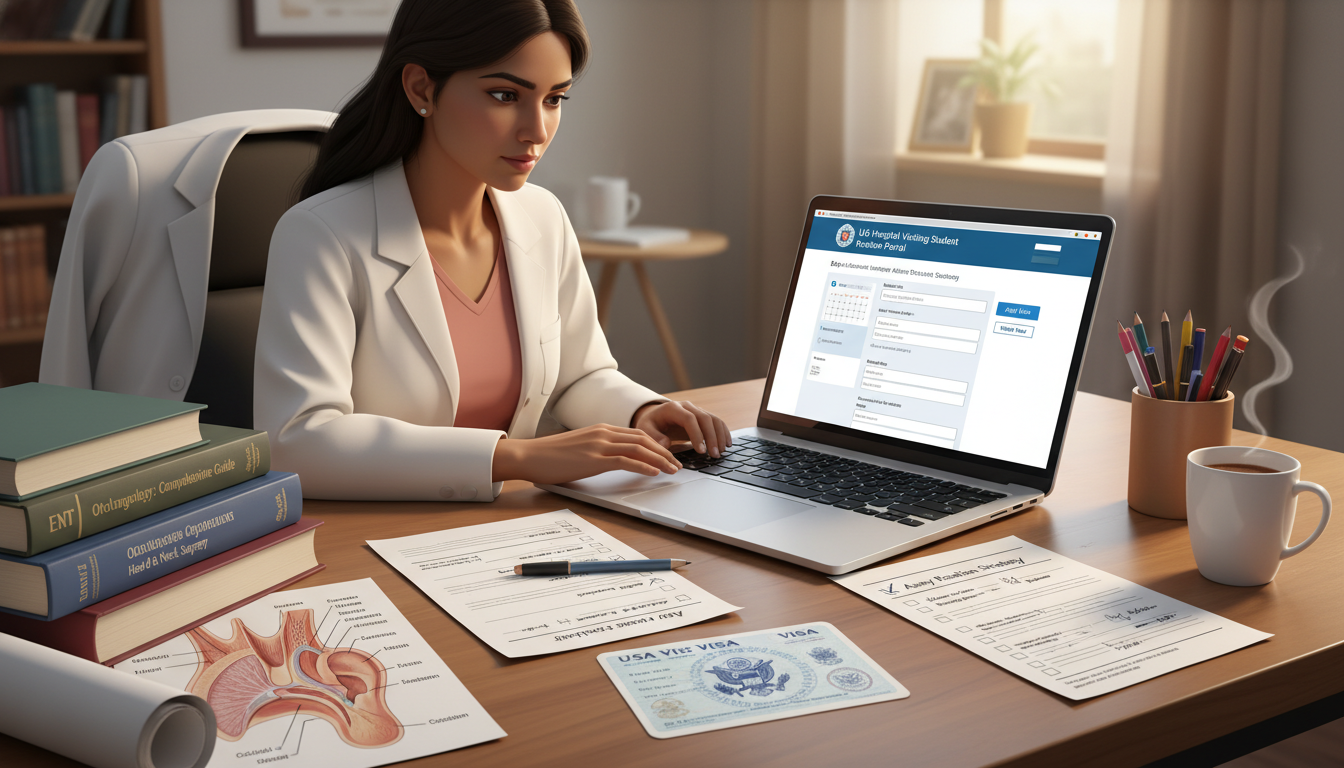
Step 1: Clarify Eligibility as a Non‑US Citizen IMG
Different institutions have different policies. As a non-US citizen IMG, check:
Does the institution allow non-US citizen IMGs for visiting student rotations?
- Some accept only LCME-accredited (US/Canadian) schools.
- Some accept international schools but only through specific agreements.
- Some require that the rotation be arranged as an “observership,” not a for-credit rotation.
What is the visa policy for students?
- Many schools require a B-1/B-2 or J-1 short-term scholar status for rotations.
- Some only accept students with existing F‑1 (from a US school) or permanent residency.
- Clarify whether the hospital will issue any necessary invitation letters.
What are the documentation and exam requirements?
Programs may ask for:- Passing USMLE Step 1 (sometimes Step 2 CK)
- Proof of English proficiency (TOEFL or institutional evaluation)
- Immunizations, background checks, drug testing
- Malpractice coverage from your home institution or purchased separately
Start compiling these requirements in a spreadsheet early (at least 12–15 months before your intended match year).
Step 2: Timing Your ENT Away Rotations
For a typical application timeline (you plan to apply in September of Year X):
- Ideal away rotation window: March–August of Year X
So that letters and evaluations are ready before ERAS submission. - Earliest planning: by January of Year X−1 (about 18–20 months before residency start).
For non‑US citizen IMGs, consider:
- Visa timelines: Embassies can have delays; factor in 1–3 months for appointments.
- Graduation timing: Some visiting student offices require that you not be graduated yet.
- USMLE timing: You may need Step 1 (and ideally Step 2 CK) before some programs will consider you.
If you are already graduated, your options for formal for-credit away rotations become more limited; you may need to shift toward:
- Research positions with integrated clinical exposure
- Formal observerships in ENT departments
These can still lead to valuable letters and networking for your otolaryngology match.
How Many Away Rotations Should a Non‑US Citizen IMG Aim For?
The question of “how many away rotations” is especially important for a foreign national medical graduate with limited resources.
For a non-US citizen IMG targeting ENT:
- Minimum goal: 1–2 ENT-focused US rotations
(To demonstrate real exposure and secure at least one strong ENT letter.) - Ideal target (if feasible): 3–4 ENT or ENT-related experiences
including:- 1–2 formal ENT visiting student rotations / sub‑Is
- 1 ENT-focused observership or shadowing block (if sub‑I not possible)
- 1 ENT research rotation/position or ongoing research collaboration
More than 4 clinical away rotations can become logistically and financially challenging, especially with visa issues. Instead of sheer number, focus on:
- Getting longer rotations (4 weeks vs 2 weeks)
- Staying at institutions where you have a realistic interview chance
- Maximizing impact at each site (letters, mentorship, research)
Choosing Programs: Where Should a Non‑US Citizen IMG Rotate?
Not every ENT program is a good target for away rotations as a non-US citizen IMG. Selection is a strategic step.
Criteria to Prioritize
Documented History of Matching IMGs or Foreign Nationals
- Review recent resident rosters and alumni pages.
- Look for residents who graduated from international schools or list non-US countries of origin.
- If a program has repeatedly taken a non-US citizen IMG, your odds are higher.
Visa-Friendliness
- Look at residency program websites: do they mention J‑1 / H‑1B sponsorship?
- Email the coordinator or GME office (once you’re a viable candidate) to confirm current policy.
- Programs that never sponsor visas are unlikely to invest heavily in IMGs during rotations.
Formal ENT Visiting Student Rotations That Allow International Students
- Some schools list explicit categories for “International visiting medical students.”
- Others state clearly: “Only accepting students from US/Canadian LCME-accredited schools.”
These are generally not worth heavy focus unless you have an inside connection.
Aligned Research or Clinical Interests
- If you have research experience in otology, rhinology, head and neck, or pediatric ENT, look for departments strong in those areas.
- It’s easier to build genuine connections and projects when your interests overlap.
Geographic and Financial Practicality
- Regions with lower cost of living can reduce financial strain.
- Programs within the same state/region minimize travel expenses if you do multiple rotations.
Tiers of Rotation Targets
It can help to categorize potential sites:
Tier 1: High-yield, IMG-friendly academic ENT programs
- History of accepting IMGs or foreign nationals
- Known visa sponsorship
- Robust visiting student infrastructure
Tier 2: Moderately receptive programs
- Some history of IMGs but not frequent
- Accept international visiting students but have strict caps
- Possible but not guaranteed visa support
Tier 3: Low-probability programs
- No visible IMGs in recent years
- No clear international visiting student policy, or explicit “no IMGs”
- Only consider if you have a strong personal or research connection there
Aim to secure at least one Tier 1 rotation if at all possible, and use Tier 2 as backup options.
Maximizing Each ENT Away Rotation: Day-to-Day Strategy
Once you secure an ENT rotation, what you do on-site determines whether you gain a powerful advocate or just “a line on your CV.”
Core Behaviors That Programs Expect
During any ENT away rotation, aim to:
Be Early, Visible, and Prepared
- Arrive before the team; review patients and imaging ahead of rounds.
- Keep a small notebook: key details, learning points, attending preferences.
- Read about tomorrow’s OR cases the night before.
Demonstrate Enthusiasm Without Being Overbearing
- Volunteer for tasks: writing notes (if allowed), calling consults under supervision, preparing presentations.
- Ask thoughtful clinical questions—after you’ve done a quick literature check.
Own Your Patients (Within Student Limits)
- Know “your” patients’ histories, labs, and post-op progress better than anyone else on the team.
- Anticipate next steps: dressing changes, orders, discharge planning (as allowed by local rules).
Be Teachable and Culturally Adaptable
- Respond calmly to feedback; never argue about criticism.
- Watch how residents and staff interact; adjust your communication style accordingly.
- Recognize that hierarchy, documentation, and consent processes may differ from your home country.
Specific to Non‑US Citizen IMGs: Addressing Hidden Concerns
Programs may subconsciously worry about:
- Your communication with patients and team (language, cultural nuances)
- Your ability to adapt to a US health system
- The perceived burden of visa sponsorship
You can counter these concerns by:
- Speaking clearly and slowly, especially when presenting or counseling.
- Asking for clarification on documentation norms and applying feedback quickly.
- Showing that you are administratively reliable: paperwork, compliance modules, and hospital policies are handled promptly without reminders.
Building Relationships That Lead to Letters
You need 2–3 strong US ENT letters ideally from:
- Department chair or vice chair
- Program director or associate program director
- Research mentor within ENT (especially if you have sustained collaboration)
During your rotation:
Identify 1–2 key faculty members early.
- Those who work with you frequently.
- Those who are influential in the program.
Request mid-rotation feedback.
- A short conversation: “I’m very interested in ENT. Are there specific areas where I can improve during the rest of this rotation?”
- Then, visibly implement the feedback.
Ask for letters near the end of rotation, but only if they know you well.
- Phrase it directly and respectfully:
“I will be applying to ENT residency this coming cycle as a non-US citizen IMG. If you feel you know my work well enough, would you be comfortable writing a strong letter of recommendation for my application?”
- Phrase it directly and respectfully:
Provide a concise “letter packet.”
- Updated CV
- Brief personal statement/draft
- Summary of your activities and cases during the rotation
- Any relevant research abstracts or publications
The quality and enthusiasm of these letters often matter more than your exact away rotation count.
Combining Clinical Rotations, Research, and Observerships into a Coherent Strategy
Not every non‑US citizen IMG will be able to obtain multiple for-credit ENT away rotations. You may need to blend several experiences into a strong narrative.
Clinical Away Rotations (Sub‑Is / Electives)
Use these to prove:
- You function at or above the level of a US graduating student.
- You can handle the pace of ENT services.
- Faculty and residents enjoy working with you.
Actionable tips:
- Keep a log of procedures you observed/assisted (flexible laryngoscopy, nasal endoscopy, tracheostomy care, post-op wound checks).
- Volunteer to give a short presentation (10–15 minutes) on an ENT topic.
- If there is a resident teaching conference, attend consistently.
ENT Research Involvement
Research can be a powerful complement, especially for a foreign national medical graduate with a non-US background.
Goals of ENT research experience:
- Show long-term engagement with the specialty.
- Produce posters, manuscripts, or presentations that strengthen your CV.
- Create relationships with faculty who can write detailed letters.
Options include:
- Pre- or post-graduation research fellowships in US ENT departments (6–24 months).
- Shorter research electives combined with limited shadowing.
- Remote collaboration on systematic reviews or data projects if in-person work is not possible.
Try to align research and clinical rotations at the same institution when possible; this makes you more visible and more valuable.
Observerships and Shadowing
If you cannot secure for-credit visiting student rotations (common for non-US citizen IMGs who are already graduates), observerships or structured shadowing can still:
- Familiarize you with US clinical culture.
- Provide opportunities to show professionalism and reliability.
- Lead to letters from ENT faculty who see your commitment.
To maximize observerships:
- Treat them with the same seriousness as formal rotations.
- Show up consistently, read about cases, and follow up with faculty on clinical questions.
- Ask explicitly whether they have any teaching or research tasks you can assist with beyond observation.
When you describe these experiences in your application, emphasize:
- Duration (longer, continuous exposure is more persuasive).
- Depth of involvement (clinic, OR, conferences, research tasks).
- Mentorship (who supervised you and what you learned).
Putting It All Together: Example Away Rotation Roadmaps
Below are two example strategies tailored for non-US citizen IMGs at different stages.
Scenario A: Current International Medical Student, 1 Year Before Application
Profile:
- Still enrolled in non-US medical school
- Step 1 passed, Step 2 CK planned in 6–8 months
- Minimal prior US exposure
Proposed 12–18 month strategy:
Months 1–3: Research and Outreach
- Build a spreadsheet of ENT programs:
- International student policies
- Visa and IMG openness
- ENT visiting student links
- Email 10–15 programs’ visiting student offices asking about eligibility as a foreign national medical graduate.
- Build a spreadsheet of ENT programs:
Months 4–8: Secure 1–2 US ENT Rotations
- Aim for 2–4 week rotations between March–August of your application year.
- If possible, choose IMG- and visa-friendly academic centers with some history of matching IMGs.
Months 9–12: Add Research/Observership if Needed
- Arrange a 4–8 week ENT research elective or observership at one of the same institutions or another visa-friendly site.
- Start a small research project (e.g., chart review, case series).
During Rotations:
- Focus on strong performance and relationship-building.
- Collect 2 ENT letters from US faculty who worked closely with you.
Scenario B: Graduated Non‑US Citizen IMG, No Previous US Experience
Profile:
- Graduated 1–2 years ago
- Steps completed with competitive scores
- No US clinical or research experience yet
Proposed 18–24 month strategy:
Months 1–3: Identify Research-Friendly ENT Departments
- Target programs known for taking research fellows (often larger academic centers).
- Apply for a 1‑year ENT research fellowship.
Months 4–15: Research Fellowship with Clinical Exposure
- Aim for regular OR and clinic shadowing integrated into the research role.
- Present at national/regional ENT meetings, co-author at least 1–2 projects.
Months 10–15: Short ENT Observerships/Sub‑Is (If Eligible)
- While on fellowship, negotiate 2–4 weeks of more intensive clinical exposure at the same or partner institution.
- Request letters from:
- Your research mentor
- An attending who observed you clinically
- Possibly the department chair (if they know your work)
Months 16–18: ERAS Application
- Highlight the continuity: multiple months in ENT research + clinical shadowing, strong letters from US ENT faculty, and demonstrated commitment to US otolaryngology.
FAQs: Away Rotations for Non‑US Citizen IMGs in ENT
1. As a non-US citizen IMG, can I match into ENT without any US away rotations?
It is technically possible but highly unlikely. ENT is extremely competitive, and programs strongly prefer applicants with direct US otolaryngology exposure and US letters from ENT faculty. If you cannot secure formal visiting student rotations, prioritize ENT research positions and structured observerships that still allow meaningful faculty interaction and potential letters. But having at least one substantive US ENT experience significantly improves your otolaryngology match chances.
2. What if I can only afford one away rotation due to cost and visa limitations?
If you can do only one US ENT rotation, make it:
- At a program that is known to be IMG- and visa-friendly, and
- Long enough (ideally 4 weeks) for faculty to know you well.
Prepare thoroughly before you arrive, perform at your absolute best, and explicitly seek feedback and mentorship during the rotation. Then supplement this single rotation with remote or local ENT research, home-country ENT experience, and strong overall application components.
3. Should I prioritize away rotations at “top 10” ENT programs or mid-tier programs more likely to rank a non‑US citizen IMG?
For most foreign national medical graduates, it is more strategic to prioritize programs that have a realistic history of taking IMGs or sponsoring visas, even if they are not in the perceived “top 10.” A mid-tier program that has matched IMGs and values your rotation performance is far more likely to interview and rank you than an elite program with no history of taking IMGs. One exception: if you already have a strong connection (e.g., ongoing research) at a highly ranked program, that may justify a rotation there.
4. Do away rotations in other surgical specialties (e.g., general surgery) help my ENT application if I cannot get ENT rotations?
Non-ENT surgical rotations can help indirectly by:
- Showing US surgical exposure and team functioning
- Providing US letters that speak to your OR and inpatient performance
However, they do not replace true otolaryngology exposure. If ENT rotations are limited, a mix of:
- One general surgery or related surgical rotation,
- One ENT observership or shadowing block, and
- ENT research involvement
is better than surgical rotations alone. Your application still needs a clear ENT focus, not just general surgical interest.
By approaching away rotations with a deliberate, program-targeted, and performance-focused strategy, a non-US citizen IMG can significantly strengthen their candidacy for an ENT residency in the US. For many foreign national medical graduates, these rotations become the bridge between “strong on paper” and “someone this program knows, trusts, and is willing to fight for in the match.”