Why Away Rotations Matter So Much for US Citizen IMGs
For a US citizen IMG or American studying abroad, away rotations (also called visiting student rotations or electives) are one of the highest-yield tools you have to strengthen your residency application.
You’re competing in a system that heavily values:
- Recent, hands-on US clinical experience (USCE)
- Letters of recommendation (LORs) from US faculty known to program directors
- Evidence that you understand and can function in the US healthcare system
- A clear “fit” with specific programs and regions
Well-planned away rotations can help you:
- Earn strong, US-based LORs in your desired specialty
- Demonstrate you can function like a US medical student on the wards
- Show programs you’re serious about their region, hospital type, or specialty
- Potentially turn a rotation into an interview and match at that institution
For a US citizen IMG, the right away rotation strategy can partially offset disadvantages in school name recognition or limited home-institution connections. But away rotations are expensive and logistically complex. You need to be strategic—where, when, and how many away rotations you do all matter.
This guide will walk you through a complete, step-by-step strategy tailored to US citizen IMGs: planning, selecting sites, optimizing performance, and integrating away rotations into your overall residency application plan.
Understanding Away Rotations as a US Citizen IMG
Before strategy, it’s important to be very clear about what away rotations are—and are not.
What is an Away Rotation?
An away rotation (or visiting student rotation) is:
- A temporary clinical rotation you complete at a US teaching hospital that is not your primary medical school’s home site
- Typically 2–4 weeks long
- Often in a specific specialty: Internal Medicine, Family Medicine, Pediatrics, Psychiatry, General Surgery, or a subspecialty
- Designed to mirror the experience of a US fourth-year medical student
Key terms:
- Away rotation / VSLO rotation / visiting student rotation – generally the same concept
- Elective vs. Sub‑internship (“Sub‑I”) – a Sub‑I often gives you responsibilities similar to an intern and can be especially valuable for IMGs looking to prove readiness
Why They Matter Even More for US Citizen IMGs
Program directors often worry about:
- Whether IMGs understand US medical culture
- How much supervision and rigor their prior training included
- Whether they can fit into the team workflow and communication style
- Whether their clinical evaluations and grades are comparable to US students
If you’re an American studying abroad, you have one major advantage: cultural familiarity and often native-level English. Still, you must demonstrate competence in a US clinical environment.
Away rotations do this by:
- Putting you side‑by‑side with US MD/DO students on the same service
- Allowing attendings to directly compare you to their usual students
- Producing narrative assessments and LORs that residency programs trust
Common Myths About Away Rotations
“If I do an away rotation, I’ll automatically get an interview.”
- Not guaranteed. Performance, timing, and program competitiveness matter.
“More away rotations are always better.”
- Not necessarily. Quality > quantity. Poor or average rotations can hurt more than help.
“I can fix a weak profile completely with away rotations.”
- They help, but do not erase low Step scores, major gaps, or professionalism concerns.
“Any USCE is enough; away rotation site doesn’t matter.”
- Not true. Rotations at ACGME‑affiliated teaching hospitals in your target specialty are much more valuable than scattered observerships or non-teaching settings.
Planning Your Away Rotations: Timing, Number, and Specialty Focus
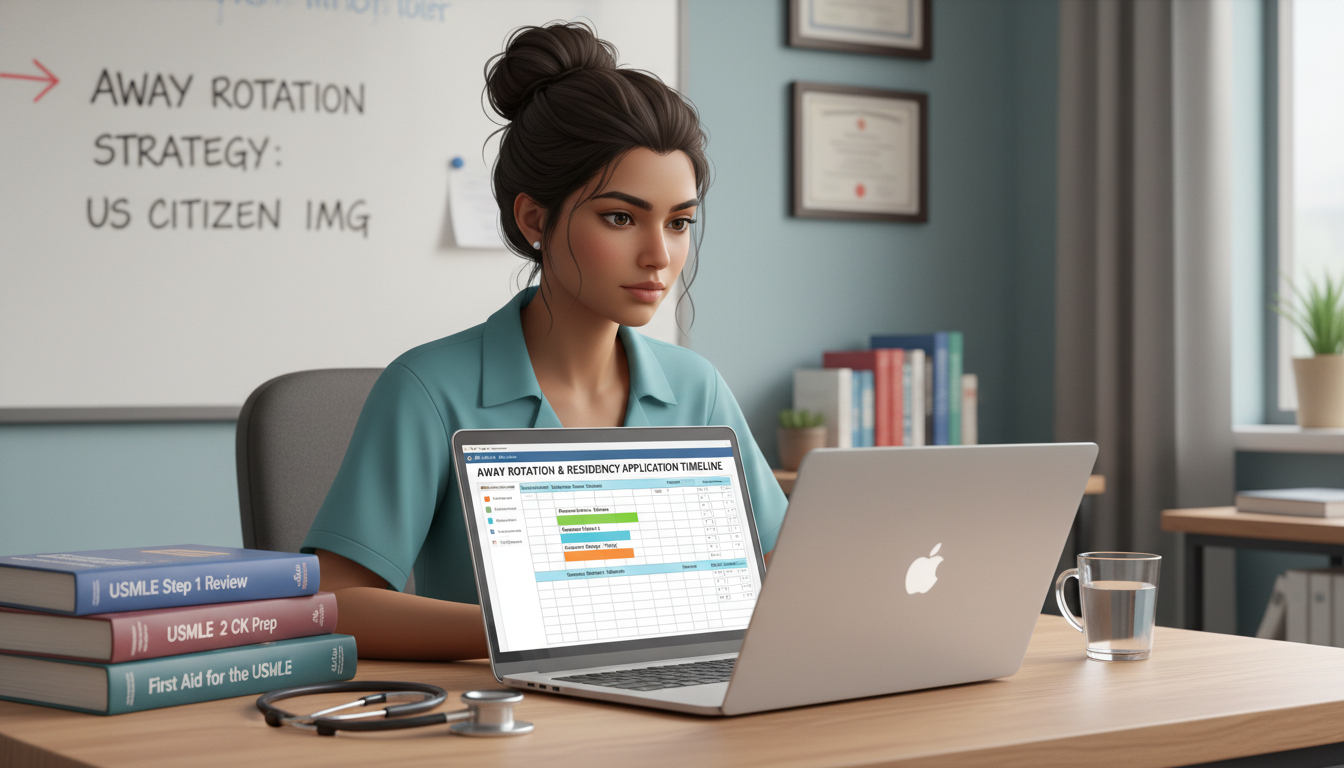
A strong away rotation strategy begins 9–12 months before you plan to start residency applications.
Step 1: Get Your Timeline Right
For the typical applicant targeting July residency start:
- USMLE Step 1: Ideally completed before intensive away rotations
- USMLE Step 2 CK: Often taken before or early during the application season; strong scores can compensate for some disadvantages
You want away rotations to:
- Occur before or early in ERAS application season
- Allow enough time for letters to be written and uploaded
Ideal timing:
- Start away rotations between March–September of the calendar year before you’ll begin residency
- Aim for at least one rotation ending by August, so the LOR is ready for use in September ERAS submission
For example, if you plan to match into residency in 2027:
- Step 1: Completed by late 2025 / early 2026
- Step 2 CK: Target by spring–summer 2026
- Away rotations: March–September 2026
- ERAS application: Opens and is submitted around September 2026
Step 2: How Many Away Rotations Should You Do?
A very common question is: “How many away rotations?”
For US citizen IMGs, a general guideline:
- Minimum target: 2 strong US‑based core specialty rotations (e.g., Internal Medicine, Family Medicine, Pediatrics, Psychiatry, or your chosen specialty)
- Solid target: 2–3 substantive, graded, hands‑on away rotations in your target specialty (e.g., 2 Internal Medicine Sub‑I/ward electives + 1 ICU or specialty month)
- Upper limit: 4 months of away rotations in one application cycle is usually enough for most IMGs; beyond that, cost and fatigue can outweigh benefits
Focus on quality:
- 2 excellent rotations with strong LORs and high evaluations beat 5 rotations where you are average and exhausted.
Step 3: Choosing Your Specialty Focus
If you’re undecided between specialties, away rotations can help clarify. But for residency strategy:
- You should know your primary specialty target (e.g., Internal Medicine, FM, Psych) by the time you commit to away rotations.
- Programs value consistent specialty exposure:
- 2–3 months in the same or closely related specialty are powerful signals of commitment.
Examples:
Internal Medicine–focused US citizen IMG:
- 1–2 months of IM ward Sub‑I or acting internship at US teaching hospitals
- 1 month of ICU or cardiology/nephrology elective in the US
Family Medicine–focused applicant:
- 2 FM months (one at a community program, one at a university-affiliated program)
- 1 month outpatient clinic or rural rotation to align with FM philosophy
Psychiatry–focused applicant:
- 1–2 months inpatient psychiatry at ACGME programs
- 1 outpatient or consult-liaison psych elective
Align rotations with your realistic match goals. Highly competitive specialties (Derm, Ortho, Plastics, ENT) are extremely difficult for IMGs regardless of away rotations. Core specialties (IM, FM, Peds, Psych, Path, some Anesthesia programs) are more open.
Selecting Programs and Sites Strategically
Once you know when and how many away rotations you’ll do, the critical question is: Where?
Target Institutions That Actually Match IMGs
As a US citizen IMG, your away rotations should not be random. Focus on:
Programs that already have IMGs in their residency
- Review current residents’ medical school backgrounds on program websites
- If they have multiple IMGs (especially Caribbean or other international schools), that’s a good sign
Regions where you have ties or long-term interest
- Programs favor applicants who are likely to stay in their region
- Leverage: family in the area, prior work, college, or long-term residence
ACGME-accredited, teaching environments
- Community-based university-affiliated programs can be IMG-friendly and high yield
- Avoid pure observerships unless no other options are available; they are much weaker than hands‑on visiting student rotations
Using VSLO and Non‑VSLO Pathways
Many US schools use the Visiting Student Learning Opportunities (VSLO) platform (formerly VSAS) for applications, but as a US citizen IMG, your eligibility can vary.
- Check if your school participates in VSLO. If not:
- Search each target hospital’s website for “Visiting Students” or “International Medical Students”
- Many community and some university programs have direct application processes for IMGs
Be ready with:
- Immunization records
- Titers and TB testing
- Current CV and transcript
- USMLE scores (Step 1, Step 2 CK if available)
- Proof of malpractice coverage (sometimes via your school)
- BLS/ACLS certification, if requested
Choosing Rotation Type: Sub‑I vs. Elective
When available, Sub‑I or acting internship rotations are particularly valuable:
- You function more like an intern, with:
- Higher responsibility
- Daily progress notes
- Admission H&Ps
- Presenting in rounds
- Program directors can see if you’re truly “residency-ready”
Electives (e.g., cardiology consults, outpatient endocrinology) are still useful, especially if:
- You cannot secure a Sub‑I
- You want breadth or subspecialty exposure
But try to prioritize at least one strong inpatient Sub‑I in your target specialty.
Balancing “Reach,” “Realistic,” and “Safety” Rotations
Just as you’ll balance your residency application list, you should balance your away rotation choices:
- “Reach” rotations: Slightly more competitive academic centers where you might impress and get interviews, but acceptance to the rotation may be harder.
- “Realistic” rotations: Programs that frequently take IMGs and align with your Step scores and experiences.
- “Safety” rotations: Community programs or less competitive regions that are more open to IMGs, where you are more likely to be accepted and stand out.
Aim for:
- 1 reach + 1–2 realistic + 0–1 safety rotations, depending on your profile and budget.
Maximizing Impact: How to Excel During Visiting Student Rotations

Getting the rotation is only step one. The real value comes from stellar performance and strong letters.
Before the Rotation: Prepare Like It’s an Exam
Review core clinical knowledge for your specialty:
- For Internal Medicine: hypertension, diabetes, heart failure, pneumonia, sepsis, CKD, etc.
- For FM: chronic disease management, preventive care, common outpatient complaints.
- For Psych: mood disorders, schizophrenia, substance use, risk assessment.
Know US documentation and workflow basics:
- SOAP note structure
- Admission H&P components
- Standardized sign-out format (e.g., I-PASS)
Clarify expectations with the site coordinator:
- Start/end dates, required orientation, dress code
- Whether you’ll be allowed to write notes in the EMR (even if “student notes”)
On the Rotation: Behaviors That Impress Program Directors
You’re being evaluated on more than knowledge. Focus on:
1. Reliability and work ethic
- Show up early, never late
- Stay until work is done, not just until a posted time
- Anticipate needs: look up results, follow up on tests, prep for rounds
2. Teamwork and communication
- Be kind and respectful to nurses, residents, staff, and patients
- Ask residents how you can best help the team
- Keep your intern and senior updated on patient changes
3. Clinical reasoning and curiosity
- Ask thoughtful questions:
- “Can I clarify why we chose this antibiotic over that one?”
- Form your own assessments before asking for help:
- “I’m concerned this might be early sepsis because…”
4. Initiative with boundaries
- Volunteer for tasks:
- “I can start the admission note on the new patient if that’s okay.”
- But always check your level of independence is appropriate.
5. Professionalism
- Maintain confidentiality, don’t complain about hours, avoid gossip
- Dress professionally and maintain a clean, calm demeanor
- Respond promptly to emails and pages
Securing Strong Letters of Recommendation (LORs)
For US citizen IMGs, away rotation LORs are often the most important letters in your entire application.
Who should write your LORs?
- Preferably US academic faculty (Assistant/Associate/Full Professors)
- Ideally in your target specialty at ACGME-accredited programs
- Someone who directly observed your clinical performance
How to set up a strong letter:
Perform consistently well for at least 2–3 weeks before asking.
Ask directly and professionally, near the end of the rotation:
- “Dr. Smith, I’ve greatly appreciated working with you. I’m applying to Internal Medicine this cycle. Would you feel comfortable writing a strong letter of recommendation for my residency application?”
Provide:
- Your CV
- Personal statement draft (if available)
- A brief summary of your contributions on the rotation
Follow up with a thank‑you email and gentle reminders if needed (especially if ERAS deadlines are close).
Aim to secure:
- At least 2 US specialty-specific LORs from away rotations
- Possibly 1–2 additional letters from home institution or long-term supervisors
Integrating Away Rotations into Your Overall Match Strategy
Away rotations should be part of a coherent plan, not random experiences.
Aligning Rotations with Your Application Story
Programs will read your ERAS application, see your away rotations, and ask:
- Does this candidate show consistent interest in this specialty?
- Has this person had enough exposure to know what they’re signing up for?
- Do their rotation locations and LORs support their regional and program fit?
For example:
- A US citizen IMG with:
- 2 Internal Medicine Sub‑Is in the Midwest
- LORs from IM faculty in those programs
- A personal statement mentioning family ties and long-term plans in the Midwest
…presents a clear, focused story to Midwest IM programs.
Considering Cost and Logistics as a US Citizen IMG
Away rotations are expensive:
- Application fees (VSLO or institutional)
- Housing (short-term rentals)
- Transportation and food
- Possibly exam registrations around the same time
Be realistic about your finances:
- Prioritize fewer, higher-yield rotations over many scattered ones
- Consider staying with family/friends if rotations are near them
- Coordinate rotations to minimize back-and-forth travel (e.g., two months in the same city/region)
Backup and Parallel Strategies
Even with optimal away rotations, as a US citizen IMG you should:
- Apply broadly within your specialty (and possibly a backup specialty if risk is high)
- Ensure Step scores, OET/English requirements, and ECFMG certification are on track
- Consider prelim/TY positions as a secondary path in some fields
Remember: away rotations are powerful, but they work best as part of a well-rounded, realistic match plan.
Practical Examples of Effective Away Rotation Strategies
To put this into concrete terms, here are sample strategies for different US citizen IMG profiles.
Case 1: US Citizen IMG in Caribbean School Targeting Internal Medicine
Background:
- Step 1: Pass
- Step 2 CK: 230
- Goal: Match into community or community-university IM program in the Midwest or Southeast
Away Rotation Strategy:
- Month 1 (June): Internal Medicine Sub‑I at a Midwest community hospital with a university affiliation known to take Caribbean grads
- Month 2 (July): Internal Medicine wards at a Southeast program where the applicant’s cousin lives and where many IMGs are residents
- Month 3 (September): Cardiology consult elective at one of the two prior sites (whichever rotation went better and showed more interest in the student)
Outcome Aims:
- 2–3 strong LORs from IM faculty
- Demonstrated fit and regional ties in two regions
- At least one program where the student is a known quantity before interview invitations go out
Case 2: American Studying Abroad in Europe Targeting Psychiatry
Background:
- US citizen IMG from a European med school
- Step 1: Pass, Step 2 CK: strong (240+)
- Interested in urban Psychiatry programs
Away Rotation Strategy:
- Month 1 (April): Inpatient Psychiatry at an East Coast academic center that accepts IMGs for residency
- Month 2 (May): Outpatient/community psychiatry rotation at a community-based program in the same city
- Month 3 (August): Consult-liaison psychiatry at a Midwestern academic hospital that lists prior IMGs in their roster
Outcome Aims:
- 2 specialty-specific US LORs
- Evidence of work in both inpatient and outpatient settings
- Improved familiarity with US mental health systems and documentation
FAQs About Away Rotations for US Citizen IMGs
1. As a US citizen IMG, do I really need away rotations, or is any USCE enough?
For residency programs, not all USCE is equal. Observerships or shadowing are much weaker than formal visiting student rotations where:
- You have defined responsibilities
- You participate in rounds, notes, and presentations
- Faculty can evaluate you like a US senior medical student
If possible, you should aim for at least 2 away rotations in your target specialty. They provide stronger LORs and clearer evidence of readiness than most other forms of USCE.
2. How many away rotations should I do?
For most US citizen IMGs asking “how many away rotations” is optimal:
- Aim for 2–3 high-quality, hands-on away rotations
- More than 4 months is rarely necessary and may drain your time and finances
- Prioritize rotations at ACGME residency sites that actually consider IMGs
Quality and fit matter more than sheer number.
3. How can I find visiting student rotations that actually accept US citizen IMGs?
Strategies include:
- Checking program websites under “Students,” “Visiting Students,” or “International Medical Students”
- Looking at current residents’ medical schools—if they include IMGs, that’s a green flag
- Using VSLO if your school participates; filter by your specialty and location
- Emailing program coordinators or student affairs offices to ask if they allow American studying abroad students to rotate
Always confirm:
- Whether IMGs or non‑LCME schools are eligible
- Application deadlines and required documentation
4. If I do an away rotation at a program, will I definitely get an interview there?
No, an interview is not guaranteed, even with a successful rotation. However:
- Away rotations significantly increase your visibility
- Strong performance and a vocal faculty advocate can strongly improve your odds
- Some programs explicitly state that they prefer to interview visiting students in their specialty
Your focus should be on outstanding performance, professional behavior, and building genuine relationships—those are what move you from “visiting student” to “serious applicant.”
Well-planned, targeted away rotations are one of the most powerful levers you control as a US citizen IMG. By choosing the right sites, timing your rotations intelligently, excelling clinically, and integrating your experiences into a coherent application story, you can significantly strengthen your position in the residency match—even as an American studying abroad.