Why Away Rotations Matter So Much for Caribbean IMGs in Med-Peds
For a Caribbean medical student aiming at a Medicine-Pediatrics (Med-Peds) residency in the United States, away rotations are not just “nice to have”—they’re one of your most powerful tools.
Because you’re coming from a Caribbean medical school, residency programs have:
- Less direct familiarity with your home institution
- More questions about your clinical training environment
- More applicants than they can meet in person
Well-planned visiting student rotations can:
- Show programs you can thrive in a U.S. academic hospital
- Generate strong U.S. letters of recommendation (LORs)
- Demonstrate genuine interest in Med-Peds specifically
- Help overcome bias against Caribbean medical school residency applicants
For Med-Peds in particular, away rotations help you:
- Show you understand the culture of combined training
- Display comfort with both adult and pediatric patients
- Meet Med-Peds faculty who can advocate for your medicine pediatrics match
This article will walk you through a step-by-step away rotation strategy tailored specifically to Caribbean IMGs targeting Med-Peds, including how many away rotations to do, when, where, and how to maximize every day on service.
Understanding Med-Peds and the Role of Away Rotations
What Makes Med-Peds Unique
Medicine-Pediatrics is a four-year combined residency that leads to board eligibility in both Internal Medicine and Pediatrics. Programs are relatively small (often 4–8 residents per year) and highly community-oriented.
For a Caribbean IMG, this has two implications:
Small applicant pool, but high competition per spot
Programs can scrutinize each application closely. An away rotation helps them see you as a person, not just a file.Culture fit matters
Med-Peds values adaptability, humility, holistic thinking, and genuine excitement about dual training. These qualities are hard to show on paper, but very visible on an away rotation.
Why Away Rotations Carry Extra Weight for Caribbean IMGs
Compared to U.S. MD/DO students, you’re often:
- Less likely to have Med-Peds faculty at your home school
- Less likely to have a home Med-Peds program
- More dependent on demonstrating U.S. clinical readiness
Therefore, your Caribbean medical school residency strategy should treat away rotations as:
- Clinical audition: “Can I function like an intern on a U.S. wards team?”
- Fit interview: “Do I fit the Med-Peds style of communication and team dynamics?”
- Networking sprint: “Can I get champions who will vouch for me in the selection committee?”
A thoughtfully planned set of visiting student rotations can neutralize the “unknown” factor that sometimes disadvantages applicants from Caribbean schools.
Planning Your Away Rotation Portfolio: How Many, Where, and When
How Many Away Rotations Should a Caribbean IMG Do?
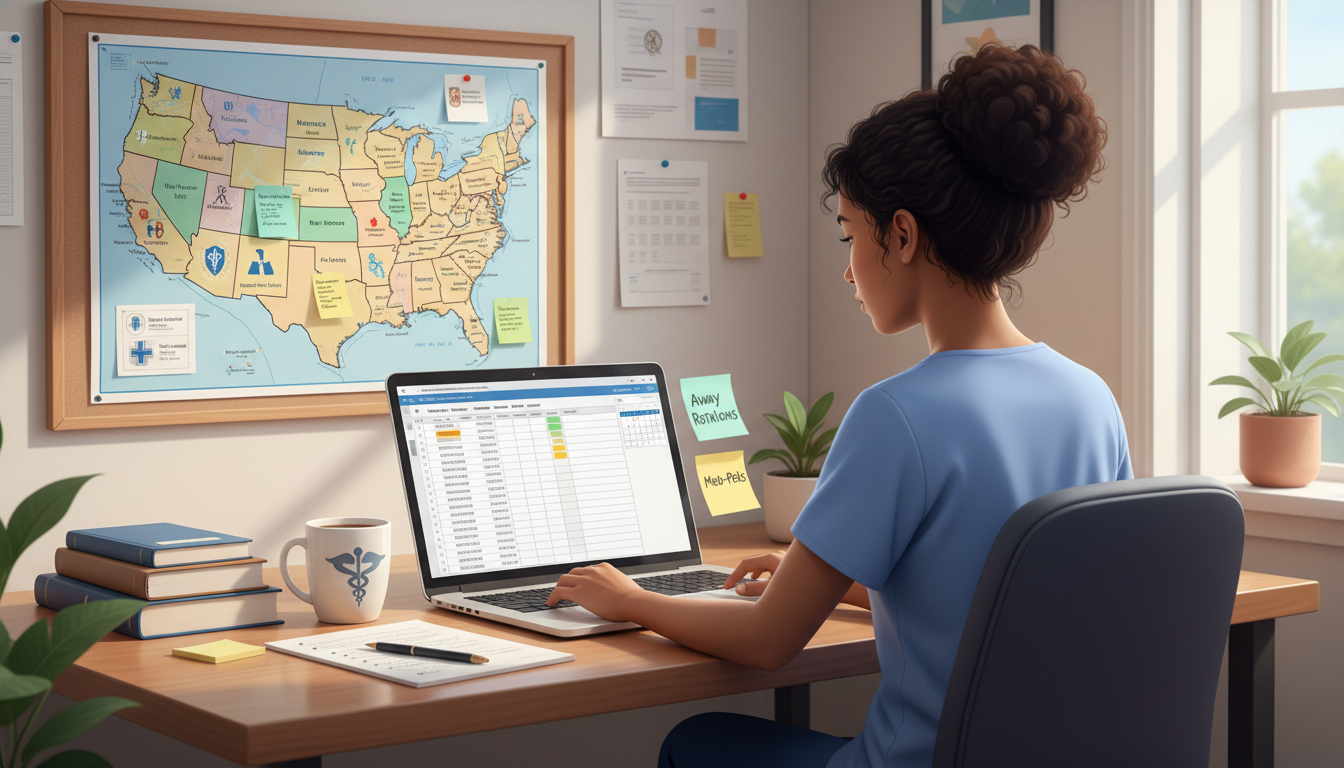
For a Caribbean IMG aiming for a medicine pediatrics match, a common, realistic target is:
- Total: 2–3 away rotations in the U.S.
- 1–2 Med-Peds–relevant rotations (ideal)
- 1 Internal Medicine or Pediatrics sub-internship (if Med-Peds spots are limited)
If your finances, visa, and scheduling allow, consider:
- Ideal “strong” portfolio:
- 1 Med-Peds rotation at a program you’d love to match at
- 1 sub-internship (IM or Peds) at another Med-Peds institution
- 1 rotation at a solid mid-tier program where you’re likely to be ranked highly
If heavily constrained (cost, visa, family):
- Minimum strategy:
- 1 strong, well-chosen Med-Peds or IM/Peds inpatient sub-I at a program that is historically IMG friendly
Quality, not just quantity, matters. Doing one rotation where you are memorable, hardworking, and supported by faculty can be more powerful than three rotations where you are invisible.
Timing: When to Do Away Rotations for Med-Peds
For a traditional U.S. cycle, aim for:
- Core Med-Peds/IM/Peds away rotations:
- June–October of your final clinical year (often 4th year equivalent)
For Caribbean IMGs, consider:
- Your school calendar (which may not align perfectly with U.S. timelines)
- Visa timing and travel logistics
- USMLE exam schedule
Suggested sequence:
Before away rotations:
- Complete USMLE Step 1 (and ideally Step 2 CK) with competitive scores for Med-Peds (programs often expect at least mid-220s+ for Caribbean IMG; higher is better).
- Do at least a couple of U.S. clinical rotations in IM or Peds at community or academic hospitals, even if not at target Med-Peds sites, to get used to system expectations.
Early away (June–August):
- If you can secure a Med-Peds–specific rotation early, this gives you time to secure a strong LOR before ERAS submission.
Later away (September–October):
- These rotations are still helpful for programs you’re already applying to; they may influence your interview invitation and rank list later in the year.
If your timeline is shifted (e.g., you finish core clerkships late), prioritize:
- An away rotation before ERAS submission if possible
- If not, then one shortly after submission can still affect interview decisions and late invites
Choosing Where to Rotate: Building a Target List
Think of your target rotation programs in three tiers:
Reach programs
- Highly academic, competitive Med-Peds programs
- May have fewer IMGs in recent classes
- Rotation here is high risk/high reward: if you excel, they may “make room” for you; if not, it may not move the needle much.
Target programs
- Solid academic or community-based Med-Peds programs
- Some prior history of taking Caribbean IMGs
- Reasonable step score expectations, balanced workload, good training.
Safety/IMG-friendly programs
- Clear history of matching Caribbean IMGs
- Med-Peds or categorical IM/Peds programs that regularly accept IMGs
- Strong chance that a good rotation leads to an interview and a realistic shot at matching.
For a Caribbean IMG, your away rotation strategy should have:
- At least one rotation at a program that truly matches your competitiveness (steps, experiences, visa needs).
- At least one rotation at a program that has previously matched Caribbean IMGs.
When evaluating where to rotate, research:
- Program websites: check current residents’ medical schools
- FREIDA and program social media for IMG presence
- Alumni from your Caribbean school who may have matched there
Types of Rotations That Help Most for a Med-Peds Match

High-Yield Rotation Types
For Med-Peds, the most valuable away rotations are those that:
- Mimic intern responsibilities
- Put you in front of Med-Peds faculty
- Include direct observation of your clinical reasoning and work ethic
Recommended rotation types:
1. Sub-Internship (Sub-I) in Internal Medicine
- Inpatient general medicine or hospitalist service
- You’ll carry your own patients, write notes, present on rounds
- Shows you can do the work of an intern on the medicine side
For Caribbean IMGs, a strong IM sub-I at a Med-Peds institution can:
- Secure a powerful LOR from IM faculty who work closely with Med-Peds
- Demonstrate that any concerns about your training background are unfounded
2. Sub-Internship in Pediatrics
- Inpatient general pediatrics, wards, or sometimes NICU/step-down units
- Displays your ability to manage pediatric patients safely and thoughtfully
If the Med-Peds program shares pediatrics faculty with the categorical program, this rotation can:
- Introduce you directly to faculty who sit on the Med-Peds selection committee
- Generate a LOR that speaks to your dual-interest and adaptability
3. Dedicated Med-Peds Rotation (If Available)
A few programs offer:
- Med-Peds inpatient services
- Med-Peds continuity clinics
- Med-Peds-specific electives (e.g., transition care, complex care)
These are golden opportunities for:
- Direct mentorship by Med-Peds attendings
- Exposure to the culture, humor, and lifestyle of dual-trained physicians
- Letters that specifically say, “This student is a great fit for Med-Peds.”
Even if a Med-Peds-labeled rotation isn’t available, working with Med-Peds faculty on IM or Peds wards is still valuable.
Where to Fit in Other Electives
Beyond sub-Is, you may also consider:
Outpatient combined clinics (if offered):
Great to understand continuity and transitions of care, but usually less impactful than inpatient sub-Is for LORs.Specialty electives (cardiology, NICU, ED, etc.):
Helpful if they align with future interests, but don’t let them crowd out crucial core sub-I experiences in IM and Peds.
Your rotation schedule should prioritize:
- At least one U.S. IM or Peds sub-I
- Any available Med-Peds-specific rotations at programs of interest
- Additional electives only after those are secured
Applying for Away Rotations as a Caribbean IMG
Platforms and Processes
Most U.S. schools use one of the following:
- VSLO (Visiting Student Learning Opportunities) – AAMC platform used by many allopathic schools
- Institution-specific applications – Some hospitals or schools have their own forms
- Affiliation agreements – Occasionally facilitated through your Caribbean medical school’s partnerships
As a Caribbean IMG, start early because:
- Some programs limit or exclude international/Caribbean students
- You may need extra documentation (transcripts, Dean’s letter, immunizations, background check, visa-related documents)
- Slots fill quickly, especially June–September
Key Application Components
Typical requirements:
- Transcript and proof of core clerkship completion
- CV and personal statement (short version)
- USMLE Step 1 (and sometimes Step 2 CK) scores
- Immunization records, drug screen, background check
- Proof of malpractice insurance (often arranged via your school)
Tips specific to Caribbean IMGs:
Be transparent but strategic about your status.
Don’t hide that you’re from a Caribbean medical school; instead, emphasize your maturity, adaptability, and U.S. clinical experience to date.Tailor short statements to Med-Peds where possible.
Briefly explain why both adults and children matter to you, and how your background brings value to Med-Peds teams.Apply broadly and early.
For competitive months (July–September), submit applications as soon as they open (often 4–6 months in advance).
Handling Visa and Logistical Barriers
If you are not a U.S. citizen or permanent resident, you may face extra hurdles:
- Some institutions do not accept visiting students who require visas
- Others may accept but can’t sponsor J-1/B-1 student visas for electives
Steps to mitigate:
Clarify your status early.
Email the student affairs or visiting student office:- State your school, year, and visa situation.
- Ask directly if they accept your category of student.
Prioritize IMG-friendly and visa-friendly institutions.
Programs that are comfortable matching IMGs are often (though not always) more open to elective students from abroad.Plan travel carefully.
Avoid booking nonrefundable flights/accommodations until you have written confirmation of the rotation.
Succeeding on the Rotation and Converting It into a Med-Peds Match Advantage
Away rotations are powerful, but only if you perform at a consistently high level and convert them into tangible advantages—namely interviews and strong LORs.
Professionalism and Work Ethic: Non-Negotiable Foundations
As a Caribbean IMG, some faculty may initially watch you more closely to gauge your training level. You want them to conclude within a few days: “This student operates like a solid, reliable sub-intern.”
Focus relentlessly on:
Punctuality:
- Always arrive early. If rounds start at 7:30, you’re there by 7:00.
- Never be late for conferences, sign-out, or teaching sessions.
Ownership of your patients:
- Know every lab, vital sign, imaging result.
- Anticipate plan changes (discharge planning, consults, follow-ups).
Communication:
- Clear, concise presentations.
- Close loops with nurses, consults, and families.
- Update your resident/attending proactively if a patient’s status changes.
Clinical Performance: Demonstrating Readiness
You’re not expected to be an intern already, but Med-Peds programs are assessing whether you can grow rapidly into a safe, thoughtful resident.
Concrete behaviors:
Use structured presentations.
- Problem-based or system-based structure
- Short assessment and prioritized plan
- Evidence of independent thinking, but deference to team decisions
Show curiosity with purpose.
- Ask questions that reveal you’re thinking about differential diagnoses and management, not just memorizing facts.
- After a teaching point, look it up and apply it on the next day’s rounds.
Embrace feedback.
- When corrected, respond with “Thank you, I’ll adjust” and demonstrate the change quickly.
Fitting the Med-Peds Culture
Med-Peds faculty often look for:
- Flexibility and comfort with uncertainty
- A team-focused, humble style
- Genuine enjoyment of working with both adult and pediatric populations
Show this by:
- Expressing interest in continuity and transitions of care
- Demonstrating similar enthusiasm on the adult and pediatric sides
- Speaking explicitly (when appropriate) about how treating the whole lifespan resonates with you (without sounding rehearsed).
Securing Strong Letters of Recommendation (LORs)
LORs are where a stellar away rotation becomes a concrete asset in your Caribbean medical school residency application.
Aim for:
- 1–2 letters from U.S. academic IM or Peds attendings
- Ideally 1 letter from a Med-Peds faculty member, or IM/Peds faculty who work closely with the Med-Peds program
How to set this up:
Identify potential letter writers early.
- Attendings who see you present daily
- Faculty who supervise you on call or during critical decision-making moments
Ask directly, and ask well.
Near the end of the rotation, if feedback has been positive:- “Dr. X, I am applying to Medicine-Pediatrics residency and have really valued your mentorship. Do you feel you know my work well enough to write a strong letter of recommendation to support my application?”
- The phrase “strong letter” gives them a graceful exit if they’re hesitant.
Provide a helpful packet.
- Your CV
- Personal statement draft, emphasizing Med-Peds
- A brief paragraph with bullet points of cases or moments that reflect your performance (this helps them remember specific examples).
Clarify logistics.
- Confirm they will upload to ERAS via the Letter ID you generate.
- Ask if they would be comfortable mentioning your suitability for combined Med-Peds training specifically.
Using the Rotation to Support Your SGU Residency Match (or Other Caribbean Schools)
If you’re at SGU or a similar Caribbean medical school, you may have:
- Alumni networks at certain Med-Peds programs
- Established reputations at specific hospitals
Leverage this by:
- Asking your school’s Office of Career Guidance/Student Affairs which Med-Peds or IM/Peds programs have historically interviewed or matched your graduates.
- Prioritizing away rotations at those institutions when possible. An SGU residency match in Med-Peds is often strongly linked to past students who impressed on rotations there.
Practical Case Examples of Away Rotation Strategies
Example 1: “Limited Budget, One High-Stakes Rotation”
- 4th-year Caribbean IMG, strong Step 1 and Step 2 CK, but limited funds.
- Can only afford one away rotation in the U.S.
Strategy:
- Choose one Med-Peds–affiliated IM or Peds sub-I at an IMG-friendly institution.
- Perform at the level of a junior resident—prioritize ownership and communication.
- Secure one standout LOR from a Med-Peds or IM/Peds faculty.
- Reference that experience prominently in your personal statement and interviews.
Outcome:
- That single, powerful rotation plus a targeted application list can realistically support a medicine pediatrics match.
Example 2: “Three-Rotation Comprehensive Strategy”
- 4th-year Caribbean IMG, mid-to-high USMLE scores, moderate budget.
Plan:
- July: IM sub-I at Program A (known to match IMGs periodically).
- August: Med-Peds rotation at Program B (dream program, more competitive).
- September: Pediatric wards at Program C (safety/target program, strong Med-Peds).
Benefits:
- Three different settings to prove yourself
- 2–3 potential LORs
- Direct familiarity with multiple Med-Peds teams
- Option to triangulate your ranking strategy based on where you felt valued and supported.
Frequently Asked Questions (FAQ)
1. How many away rotations do I really need as a Caribbean IMG for Med-Peds?
Most Caribbean IMGs aiming for Med-Peds benefit from 2–3 away rotations, with at least:
- One U.S. Internal Medicine or Pediatrics sub-I, and
- Ideally one Med-Peds–specific or Med-Peds–affiliated rotation.
If you can only do one rotation, choose a high-yield IM or Peds sub-I at an IMG-friendly Med-Peds institution and focus on performing exceptionally well and obtaining a strong LOR.
2. Should I prioritize Med-Peds–specific rotations over categorical IM or Peds sub-Is?
If available, a Med-Peds–specific rotation is excellent for:
- Direct mentorship
- LORs from Med-Peds faculty
- Demonstrating culture fit
However, inpatient IM or Peds sub-Is are just as critical—programs need to see that you can function at the level of an intern in at least one core discipline. Ideally, mix one Med-Peds–specific experience with one sub-I in IM or Peds.
3. What if my Caribbean medical school doesn’t have strong connections to Med-Peds programs?
You can still build a competitive application by:
- Applying broadly for visiting student rotations at programs that appear IMG-friendly (check resident backgrounds).
- Using early rotations to prove your readiness and request personal introductions from enthusiastic attendings.
- Joining Med-Peds Interest Group webinars, national Med-Peds organizations, and virtual open houses to network outside your school’s usual channels.
Your school’s name is only one piece; your performance, LORs, and demonstrated fit carry major weight.
4. Do away rotations guarantee interviews or a match?
No rotation can guarantee an interview or match, especially in a competitive field. However, for Caribbean IMGs, a well-chosen and successful rotation can:
- Significantly raise the probability of receiving an interview at that program
- Strengthen your application overall via high-quality U.S. LORs
- Improve how selection committees perceive your clinical readiness and maturity
Think of away rotations as high-yield auditions: they don’t guarantee the role, but they give you a stage to show why you belong in a Medicine-Pediatrics residency.
A deliberate away rotation strategy—built around timing, smart program selection, and excellent on-the-ground performance—can transform your trajectory from “Caribbean IMG with uncertainty” to “proven, known quantity ready for Med-Peds.” Use each rotation not just to fill a CV line, but to build relationships, generate advocacy, and show the kind of physician you are becoming.