Why Away Rotations Matter So Much for Caribbean IMGs in Urology
Urology is one of the most competitive surgical subspecialties in the United States. For a Caribbean IMG, away rotations (also called visiting student rotations or audition electives) are not optional—they are central to your entire urology match strategy.
Away rotations are especially critical for Caribbean medical school residency applicants because:
- Program exposure: Many urology programs rarely take Caribbean IMGs without knowing them well. An away rotation is often the only way to become “known” to a program.
- Letters of recommendation (LORs): Strong urology-specific LORs from U.S. academic faculty (preferably program director or chair) carry huge weight in the urology match.
- Screening bias: Programs may be uncertain about the clinical training environment at Caribbean schools; a strong performance on an away rotation can override this.
- Interview chances: For urology, many programs reserve interview slots specifically for rotators who impressed them.
- Fit and networking: You learn the program culture, residents, and faculty—and they learn if you fit their team.
If you are at SGU or another Caribbean school, your away rotation strategy can make or break your SGU residency match outcomes (or match outcomes from any Caribbean medical school). The good news: with careful planning, you can use away rotations to offset some of the competitive disadvantages of being a Caribbean IMG.
This guide will walk you through how many away rotations to do, when and where to apply, how to choose programs wisely, and how to perform in a way that genuinely improves your odds in the urology match.
Planning Your Urology Away Rotations as a Caribbean IMG
When to Start Planning
For a urology residency application, you should begin planning 12–18 months before you intend to apply:
- If you want to apply in September of MS4 (final year):
- Start initial planning and research: early MS3
- Prepare documents, reach out to mentors, refine scores/portfolio: mid MS3
- Submit away rotation applications: late MS3 / early MS4, depending on the calendar of each host institution
Because you are at a Caribbean medical school, your scheduling may not align perfectly with U.S. schools. Start even earlier to coordinate your core rotations, visas (if applicable), travel, and housing.
Understanding Timing for Early vs Late Rotations
In urology, early rotations often matter more:
- May–August of the application year
- Prime months: Many applicants try to rotate then because:
- You can secure letters of recommendation in time for your application.
- Programs have more open interview spots and are actively assessing next year’s class.
- Prime months: Many applicants try to rotate then because:
- September–December rotations
- Still helpful, especially at your realistic “reach” programs.
- More beneficial for programs that interview later or for strengthening your network and backup plans.
- January–February rotations (after ERAS submission)
- Less direct impact on that same year’s urology match.
- Still useful if you consider reapplication, preliminary surgery, or general surgery.
As a Caribbean IMG, try to secure at least one urology away rotation before ERAS submission so that your urology LORs can be uploaded on time.
How Many Away Rotations Should a Caribbean IMG Do?
Programs don’t publish a strict rule, but a reasonable strategy for a Caribbean IMG targeting the urology match is:
- Target: 2–3 urology away rotations
- Minimum: 1 strong, well-chosen urology rotation
- Upper limit: 3, possibly 4 if your finances and schedule allow, but diminishing returns after 3 and risk of burnout.
Why 2–3 away rotations residency-wise?
- You diversify your chances: if you don’t click with one program, another might be a better fit.
- You can obtain 2–3 strong urology letters from different faculty.
- You avoid exhausting yourself and sending mixed signals (too many short rotations at too many places can appear unfocused).
If you have only one away rotation available (common with scheduling constraints from Caribbean schools), choose that rotation extremely strategically (we’ll cover how below).
Choosing the Right Programs for Urology Away Rotations
Step 1: Understand Your Applicant Profile Honestly
Before picking where to rotate, take an honest inventory:
- USMLE / Step Scores:
- Urology is score-sensitive. As a Caribbean IMG, you’ll often need above-average Step 2 CK to be competitive.
- Preclinical & clinical performance:
- Honors in surgery or strong comments from surgical attendings help.
- Research experience:
- Urology or surgical research, abstracts, posters, manuscripts—even case reports—strengthen your profile.
- Visa status:
- If you need a visa (J-1 or H-1B), some programs simply won’t sponsor; don’t waste rotation slots there.
Your away rotation targets should align with your profile. A mid-tier applicant applying only to ultra-elite programs is risky.
Step 2: Target Programs That Historically Consider Caribbean IMGs
Not all urology programs are equally open to Caribbean IMGs. To increase your odds:
- Check past match lists from your Caribbean school (e.g., SGU, AUC, Ross) to identify:
- Which urology programs have matched Caribbean graduates recently.
- Whether those were direct categorical urology matches or via research/other pathways.
- Browse program websites and resident bios:
- Look for non-U.S. or Caribbean medical schools among current or recent residents.
- Talk to recent Caribbean grads in urology:
- Ask where they rotated and which programs were receptive.
Prioritize programs that:
- Have at least one IMG or Caribbean grad in the current or recent classes.
- Are in regions more IMG-friendly (Midwest, some Southern states, parts of the East Coast).
- Have moderate competitiveness rather than only top 10 research powerhouses.
Step 3: Balance Reach, Target, and Safety Rotations
Think of your away rotations as a portfolio:
1 “reach” rotation:
- A stronger or more prestigious program where your chances are lower but not impossible.
- Choose it only if you have some hook (strong research, connection to faculty, or excellent scores).
1–2 “target” rotations:
- Programs with characteristics that match your profile and show some history of taking IMGs.
- These should be places where a strong away performance could realistically earn you an interview and serious consideration.
Optional 1 “safety” rotation:
- A program more open to IMGs, possibly smaller or less well-known.
- Useful if you want a higher probability of an interview from your away site.
Remember, “safety” in urology is relative—this is still a very competitive specialty—but IMG-friendly programs with prior Caribbean matches are more practical targets.
Step 4: Consider Logistics and Rotation Quality
When selecting where to do visiting student rotations, think beyond name recognition:
Rotation structure:
- Will you work directly with attendings and senior residents?
- Are students allowed in the OR regularly?
- Is there a defined student curriculum or evaluation process?
Size and culture of the program:
- Smaller programs may get to know you better.
- Programs that emphasize teaching may be more receptive to committed, hardworking students.
Location and cost:
- Major coastal cities may be more expensive (housing, transportation).
- Less expensive regions may make it easier to stay focused and calm.
Timing availability:
- Some programs are over-subscribed in summer and early fall.
- Being flexible with dates can improve your chances of getting accepted.
Application Process for Urology Away Rotations as a Caribbean IMG
Know the Application Pathways
Most U.S. schools use one of these systems:
VSLO (Visiting Student Learning Opportunities)
- AAMC platform used by many medical schools.
- Some Caribbean schools have VSLO access; others don’t. Confirm with your deans’ office.
Institution-specific portals or paper applications
- Many institutions allow non-VSLO applicants via their own application systems, especially for international schools.
If your Caribbean medical school doesn’t participate in VSLO:
- Create a spreadsheet of target programs and note:
- Whether they accept international or Caribbean students.
- What alternative application pathway they use.
- Deadlines and document requirements.
Key Documents You’ll Need
Most away rotation applications require:
- Dean’s letter or “good standing” letter from your school.
- Official transcript (often including clinical clerkships and grades).
- USMLE Step 1 / Step 2 CK scores (or COMLEX; but for urology, Step scores are important).
- Immunization records, TB test, flu shot, etc.
- Proof of malpractice insurance (often arranged through your home school).
- CV and sometimes a brief personal statement (1 page) explaining your interest in urology and that specific institution.
As a Caribbean IMG, organize this early—some schools have slower administrative processes.
Timeline and Deadlines
Urology away rotation deadlines vary:
- Many institutions open applications 3–6 months before the rotation start date.
- For May–August rotations, applications often open January–March.
- Highly desired spots fill quickly—submit as soon as applications open.
Build a working calendar:
- List each target program with:
- Application open date
- Application deadline
- When you plan to submit
- Required documents and status (requested/received)
Dealing with Common Caribbean-Specific Barriers
1. School Affiliation & VSLO Access
- If your Caribbean school doesn’t have formal affiliation, focus on:
- Programs that explicitly allow international visiting students.
- Community programs with academic affiliations that are more flexible.
2. Visa Requirements (If Non-U.S. Citizen)
- For clinical rotations, many schools do not sponsor separate visas if you are already on a student visa for your Caribbean school.
- If you need to enter the U.S. for the rotation:
- Clarify visa type (often B-1/B-2 or student-related), and confirm with:
- Your dean’s office
- The host U.S. institution
- Official immigration resources or lawyers, if needed
- Clarify visa type (often B-1/B-2 or student-related), and confirm with:
3. Malpractice and Health Insurance
- Caribbean schools may have variable malpractice coverage arrangements.
- Confirm that:
- Your policy is acceptable to the host institution.
- The coverage dates fully include your rotation period.
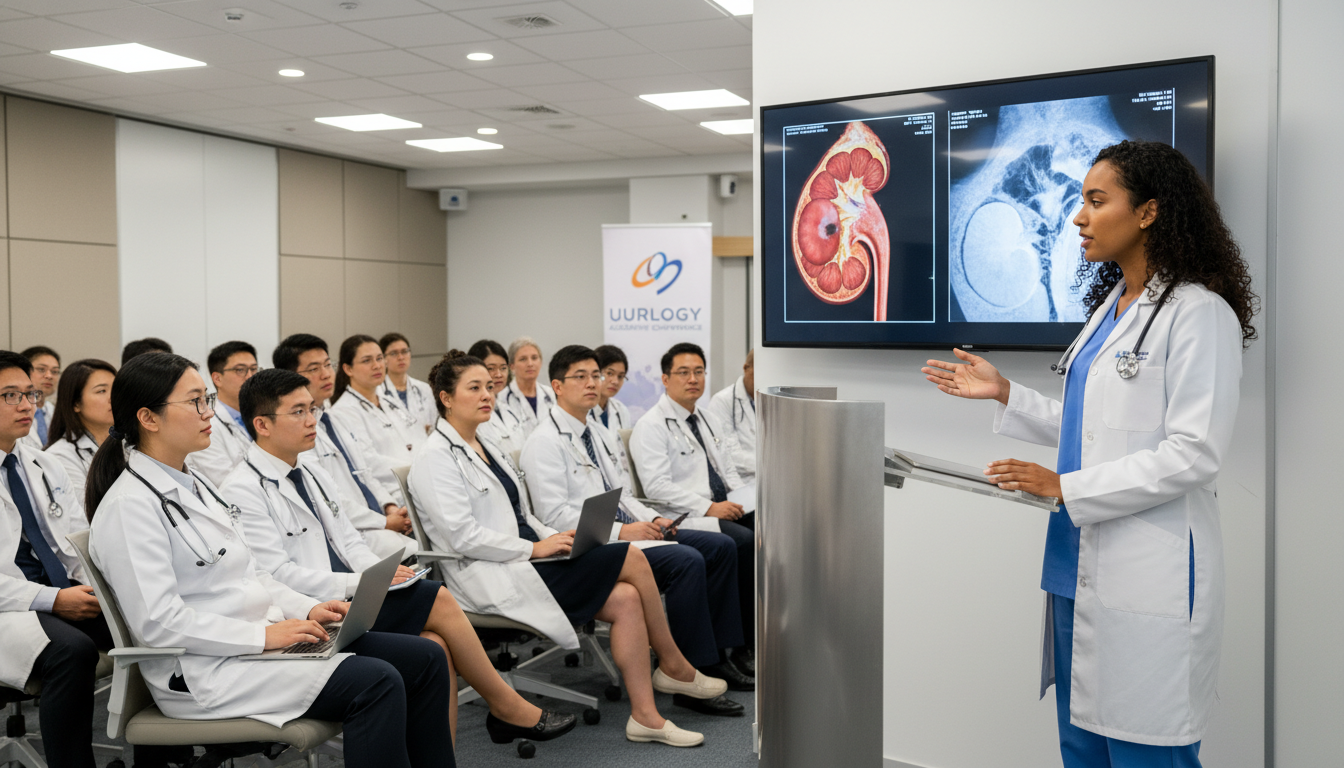
Maximizing Your Performance on a Urology Away Rotation
An away rotation is a four-week interview. For a Caribbean IMG, it may be the most important four weeks of your entire urology journey.
Know the Fundamentals Before You Arrive
To stand out, you must show that you’re clinically ready despite coming from a Caribbean medical school environment.
Before the rotation:
- Review core urology topics:
- BPH, prostate cancer, kidney stones, hematuria, urinary retention, incontinence.
- Basic pediatric urology issues (undescended testes, hypospadias).
- Know common post-op issues:
- Foley catheters, JP drains, hematuria management, early post-op complications.
- Learn basic urology instruments and terms:
- Cystoscope, ureteroscope, resectoscope, stents, TURP, PCNL.
Use quick resources:
- Urology pocket handbooks or concise review books.
- Recent AUA guidelines for common conditions.
- Short surgical videos (official or institutional) to understand procedures.
Behaviors That Impress Urology Faculty
In the urology match, faculty remember professionalism, reliability, and teachability. Focus on:
Punctuality and work ethic
- Arrive earlier than residents on day 1.
- Volunteer for tasks such as getting imaging, following up labs, prepping notes.
Proactive but respectful involvement
- Ask, “Is there anything I can help with?” at natural pauses.
- Offer to see consults with residents, follow up on post-op patients, and help with discharge summaries (within institution policies).
Prepared patient presentations
- Practice a concise surgical-style presentation:
- Chief complaint
- Key urologic history
- Brief relevant exam
- Labs/imaging
- Impression and plan
- Avoid rambling; know key details.
- Practice a concise surgical-style presentation:
Operating room etiquette
- Learn basic sterile technique beforehand.
- Introduce yourself to the OR staff, scrub techs, and circulating nurse.
- Know when to speak and when to stay quiet.
- Ask politely where you should stand and how you can help (e.g., holding camera, retracting).
Intellectual curiosity
- Ask thoughtful questions after cases, not during critical surgical steps.
- Read each night about cases you saw and cases you’ll see tomorrow.
Navigating “IMG Bias” Subtly and Professionally
As a Caribbean IMG, you may feel more scrutinized. You cannot control others’ biases, but you can control your response:
Never apologize for your school.
Instead, confidently highlight what you bring:- Adaptability from multiple clinical environments.
- Strong motivation and resilience.
Let your work speak.
If you are consistently prepared, kind, and reliable, residents and faculty are much more likely to advocate for you.Avoid defensiveness.
If someone questions your training, respond calmly:- “Our curriculum is structured differently, but I’ve worked hard to ensure I’m clinically ready. I appreciate any feedback on how I can improve.”
Securing Strong Urology Letters of Recommendation
Toward the end of your rotation:
Identify who knows you best
- Ideally, a urology attending or division chief who has:
- Seen you on the wards and in the OR
- Observed your presentations
- Received positive feedback from residents
- Ideally, a urology attending or division chief who has:
Ask directly and professionally
- In the final week, say:
- “Dr. Smith, I’ve really valued working with you and the team. I’m applying to urology, and this rotation has confirmed my interest in the field. Would you feel comfortable writing a strong letter of recommendation to support my urology residency application?”
- In the final week, say:
Provide supporting materials
- CV and personal statement draft
- Score reports
- A short summary of cases and responsibilities during the rotation
Ask for feedback too
- “Is there anything I should focus on improving before residency?”
This shows maturity and growth mindset.
- “Is there anything I should focus on improving before residency?”
Aim for 2–3 strong urology letters, ideally including:
- One from your home (or core) urologist, if available.
- One or two from away rotation attendings, especially PD or chair if they know you well.
Integrating Away Rotations Into Your Overall Urology Match Strategy
Away rotations are a tool, not the entire toolbox. To maximize their value, align them with the rest of your Caribbean medical school residency strategy.
Combine Rotations With Focused Urology Research
Even modest research can help:
- Ask rotation faculty if you can:
- Work on a case report or small retrospective review.
- Help with data collection or chart review for ongoing studies.
- If not feasible during the rotation, ask:
- “Is there any remote project I can help with after I leave?”
This maintains a relationship and may lead to posters or co-authorship.
- “Is there any remote project I can help with after I leave?”
Research does not guarantee a urology match—but it does:
- Signal commitment to the field.
- Give faculty additional reasons to remember you.
Build a Regional Strategy
Where you rotate and where you apply should be logically connected:
- If you rotate in the Midwest, apply broadly to many Midwest urology programs.
- Programs in the same region often talk to each other; a strong reputation at one site may indirectly help at neighboring institutions.
For Caribbean IMGs, clustering away rotations and applications in a few regions can:
- Reduce travel and cost.
- Improve your recognition among faculty networks.
Be Realistic, But Don’t Self-Eliminate
Urology is hard to match into, especially from a Caribbean medical school. Still:
- Some Caribbean graduates successfully match into urology each year.
- Away rotations residency experiences are often the single strongest factor when they do.
At the same time:
- Have backup plans:
- Preliminary surgery year
- General surgery or another surgical field
- Delayed urology application after a year of research
- Discuss realistic ranges of programs and pathways with:
- Urology mentors from your rotations
- Alumni from your own Caribbean school who matched into urology or surgery
Your goal: design a strategy that maximizes your chances without leaving you stranded if the first application cycle doesn’t work.
FAQs: Away Rotation Strategy for Caribbean IMG in Urology
1. How many away rotations should I do for a urology match as a Caribbean IMG?
Most Caribbean IMGs targeting the urology match should aim for 2–3 away rotations in urology:
- At least one before ERAS submission to secure a strong, timely LOR.
- A mix of targetable, IMG-friendly programs and perhaps one reach program.
- More than 3 away rotations usually has diminishing returns and may be financially and physically exhausting.
2. When is the best time to schedule urology away rotations?
Ideal timing:
- May–August of the application year:
- Best for getting letters in time and being “fresh” in faculty’s minds when they select interviewees.
- September–October rotations:
- Still helpful, especially for programs that interview later or if you could not secure early slots.
Try to have at least one completed away rotation and letter in hand by the time you submit your urology ERAS application.
3. What if my Caribbean medical school doesn’t participate in VSLO?
If your school is not on VSLO:
- Focus on programs that:
- Publicly state they accept international or non-VSLO students.
- Have their own visiting student application system.
- Work closely with your dean’s office to:
- Secure a letter of good standing, malpractice coverage confirmation, and transcripts.
- Start earlier, since institutional approvals may take longer.
You can still build a strong urology application without VSLO access, but it requires more targeted emailing, research, and organization.
4. How important is a urology away rotation compared to other parts of my application?
For a Caribbean IMG, a urology away rotation is critical and can sometimes outweigh other parts of the application if you perform exceptionally well. However, it does not replace:
- Competitive USMLE Step 2 CK score
- Solid clinical evaluations and core clerkship performance
- At least some evidence of interest in urology (e.g., research, shadowing, student groups)
Think of the away rotation as the stage where you prove that, despite coming from a Caribbean school, you can function at the level of any U.S. graduate in a demanding surgical specialty. When you design and execute your away rotation strategy thoughtfully, you significantly improve your odds in the urology match.