Understanding Away Rotations for the Aspiring Clinical Informatician
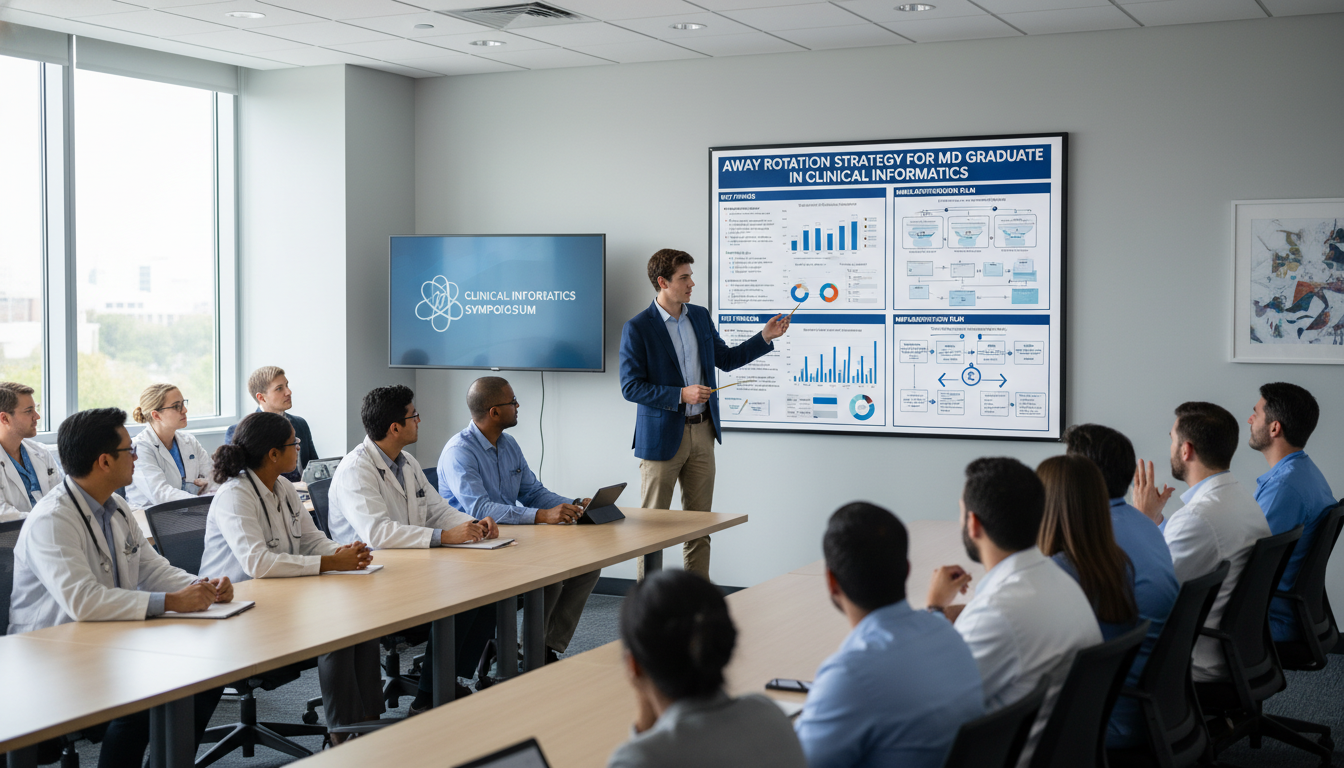
For an MD graduate targeting a career in clinical informatics, “away rotations” (also called visiting student rotations or audition electives) are powerful tools—but they work differently than in procedurally heavy specialties like orthopedics or neurosurgery. Clinical informatics is a subspecialty, so your away rotation strategy must help you:
- Match into a strong primary residency (often internal medicine, pediatrics, emergency medicine, pathology, or family medicine), and
- Build a portfolio that positions you for a clinical informatics fellowship, health IT leadership roles, or related positions in data science and digital health.
Because of this two-step pathway, the key question isn’t just “How many away rotations?”, but “Which away rotations and how do I structure them to support both residency and future informatics training?”
This guide breaks down how you, as an MD graduate, can use away rotations and related experiences to optimize your allopathic medical school match for a residency that supports future work in clinical informatics, health IT, and data-driven care.
1. Clarifying Your Path: From Residency to Clinical Informatics Fellowship
Clinical informatics in the US is currently a subspecialty fellowship that you pursue after completing an ACGME-accredited residency and board certification in a primary specialty. For an MD graduate, the usual steps are:
- Complete an MD degree at an LCME-accredited allopathic medical school (or equivalent international pathway).
- Match into a primary residency (e.g., Internal Medicine, Pediatrics, Emergency Medicine, Pathology, Anesthesiology, etc.).
- Develop an informatics track or portfolio during residency – EHR optimization projects, quality improvement (QI), data analytics, digital health.
- Apply to a clinical informatics fellowship, often at an academic medical center with substantial health IT infrastructure.
- Pursue roles in clinical informatics, health IT leadership, or technology-driven care delivery.
Because the allopathic medical school match process for primary residency is your immediate hurdle, away rotations are primarily tools for:
- Strengthening your candidacy at programs where you’d like to train clinically
- Demonstrating that you are a good fit for training environments that value informatics and health IT
- Building early relationships at institutions that also have a clinical informatics fellowship or strong health IT training track
In other words, you’re not doing “away rotations in clinical informatics” so much as you are doing:
- Away rotations in your target clinical specialty (e.g., IM, EM, Pathology), and
- Elective rotations that expose you to informatics, QI, and digital health projects at institutions with strong IT and data cultures.
If you design this thoughtfully, your away rotation strategy becomes a bridge from MD graduate to resident to future fellow in clinical informatics.
2. Strategic Goals for Away Rotations as a Future Informatician
Before deciding where to apply and how many away rotations to pursue, get very clear on what you want your rotations to accomplish. For a future clinical informatician, the most important goals are:
2.1 Strengthen Your Core Residency Match Odds
Residency program directors in your primary specialty will still prioritize:
- Clinical competence
- Work ethic and professionalism
- Teamwork and communication
- Fit with their program’s culture
A strong away rotation can increase your chances of matching by:
- Providing strong letters of recommendation from known faculty
- Allowing you to show, in person, that you are a capable, collegial intern-level physician
- Demonstrating your commitment to and understanding of that specialty
For example, an MD graduate interested in internal medicine + clinical informatics might complete an away sub-internship at a program known both for strong general internal medicine and an active informatics fellowship.
2.2 Align with Programs That Value Informatics and Health IT
Many residency programs do not formally advertise “informatics tracks,” but you can infer their culture from:
- Presence of a clinical informatics fellowship or faculty with informatics leadership roles
- Involvement in EHR optimization, big data projects, digital health pilots, or AI initiatives
- Visible investment in health IT training, resident QI dashboards, or data-driven curriculum components
Spending an away rotation at one of these institutions lets you:
- Meet informatics-oriented faculty (CMIOs, associate CMIOs, analytics leaders)
- Join ongoing projects, often as a short-term contributor
- Signal your long-term interest in clinical informatics fellowship and health IT careers
2.3 Build an Informatics-Relevant Portfolio
Even when your official rotation is labeled “Sub-I in Internal Medicine” or “Emergency Medicine Acting Internship,” you can often:
- Join a small EHR improvement or QI project (e.g., redesigning an order set, building a clinical decision support alert, analyzing fall risk data)
- Contribute to data analysis on a quality metric (e.g., sepsis bundle compliance, readmission rates)
- Collaborate with informatics teams on user testing, workflow mapping, or data visualization
This builds a concrete portfolio you can later discuss in:
- Residency interviews (to show your tech and systems thinking)
- Clinical informatics fellowship applications
- Future health IT or digital health opportunities
2.4 Network for Future Clinical Informatics Fellowship Opportunities
A thoughtfully chosen away rotation at an institution with a clinical informatics fellowship offers:
- Early exposure to fellowship directors or core faculty
- Insight into what they look for in applicants (types of projects, skills, collaborative traits)
- Potential to join a longitudinal or multi-site project that extends into residency
While the match for your primary residency is separate from a clinical informatics fellowship application, the personal and professional impression you make now can have downstream benefits.

3. Choosing Locations and Types of Away Rotations
With those goals in mind, you can plan your away rotation portfolio in a way that supports both residency match success and future informatics training.
3.1 Prioritize Your Primary Specialty Away Rotations
Your first priority is to secure a solid match in your chosen specialty. For an MD graduate seeking a future in clinical informatics, common base specialties include:
- Internal Medicine
- Pediatrics
- Emergency Medicine
- Family Medicine
- Pathology
- Anesthesiology
- Psychiatry (less common but increasingly relevant for digital mental health)
Identify 2–3 residency programs that:
- Are realistic to aspirational for your academic profile (USMLE/COMLEX scores, clinical grades, research, letters),
- Have a strong reputation in your base specialty, and
- Offer meaningful exposure to informatics or health IT (formal or informal).
Plan at least one, possibly two, away rotations at these programs, ideally in sub-internship/acting intern roles where you function close to intern level.
3.2 Evaluating Informatics and Health IT Strength of Programs
When researching programs for away rotations, look beyond the glossy brochures. Consider:
- Does the institution have a clinical informatics fellowship?
- Is there a CMIO or Associate CMIO who is visibly active and academically involved?
- Are there faculty with joint appointments in informatics, data science, or biomedical engineering?
- Does the program publish or present on topics like EHR usability, decision support, predictive analytics, or health IT implementation?
- Are residents involved in QI and data projects with real access to institutional data (under appropriate protections)?
You can often find these details on institutional websites, PubMed, faculty bios, and conference abstracts (AMIA, HIMSS, etc.).
If a program doesn’t have a named “clinical informatics fellowship,” look for:
- Informatics committees that residents can join
- A robust health IT team with clinician leadership
- Pilot projects in telehealth, remote monitoring, or patient portals
An away rotation at such a site is still strong preparation for an eventual clinical informatics fellowship.
3.3 Answering the Question: How Many Away Rotations?
There is no fixed rule, but for an MD graduate targeting a competitive, informatics-friendly environment:
- 1–2 away rotations in your chosen specialty are usually sufficient, and
- A total of 2–3 away rotations across all specialties/electives is typical for many applicants.
Consider the following when deciding:
- Highly competitive specialties (e.g., EM in some regions, certain IM programs) may benefit from 2 away rotations at target institutions.
- If your academic metrics are borderline, an away rotation can help you overcome “paper” concerns by demonstrating performance directly.
- Each away rotation competes with time you could spend at your home institution building deep projects, research, or informatics work.
For most MD graduates interested in clinical informatics, a reasonable strategy is:
- 1–2 specialty-specific away rotations at programs that are both strong clinically and informatics-friendly
- Optionally, 1 shorter elective with a specific informatics, QI, or data focus (if available)
Overloading yourself with 4–5 away rotations can dilute your efforts and limit opportunities to build substantial projects.
3.4 Types of Rotations That Support Future Clinical Informatics
You can support your future informatics career with several rotation types:
Sub-Internship (Acting Internship) in Your Chosen Specialty
- Core driver of the MD graduate residency match.
- Emphasize EHR usage, care coordination, workflow awareness.
Elective in Quality Improvement / Patient Safety
- Often housed in hospital administration or quality departments.
- Involves measurement, dashboards, and system-level thinking—very aligned with health IT training.
Clinical Informatics or Health IT Electives (If Offered)
- Some institutions offer formal rotations with informatics teams (EHR build, CDS, reporting).
- Even if not labeled as “clinical,” a health IT rotation (with IT/analytics) can be highly relevant.
Data Science / Population Health / Public Health Informatics Rotations
- May involve registries, risk prediction models, and reporting systems.
- Broadens your skill set beyond point-of-care EHR usage.
For each type, your away rotation strategy should include explicit conversation with faculty about opportunities to contribute meaningfully (not just shadow).
4. Making the Most of Visiting Student Rotations
Once you secure away rotations, how you perform is more important than where you go.
4.1 Core Clinical Performance: Non-Negotiable
Your informatics ambitions will not compensate for weak clinical performance. During away rotations:
- Show up early, be prepared, and know your patients well.
- Demonstrate solid clinical reasoning and safe decision-making.
- Ask for feedback early and adjust accordingly.
- Be the resident everyone wants on their team.
Clinical informatics fellowship directors consistently emphasize: they want solid clinicians who also think in systems, not tech experts with marginal bedside skills.
4.2 Subtle Ways to Demonstrate Informatics Thinking
Without overshadowing your clinical duties, you can naturally highlight your systems mindset:
- When presenting patients, mention how EHR data or decision support influenced care (appropriately).
- Raise thoughtful, constructive questions about workflow pain points, documentation burden, or duplicate processes.
- Offer to help with simple data pulls or chart reviews for team QI initiatives, if allowed.
- Learn the local EHR and clinical workflow rapidly and accurately—this sends a strong signal.
A resident who quickly understands order sets, documentation templates, alerts, and information flow stands out as someone naturally inclined toward clinical informatics.
4.3 Seek Mentorship and Micro-Projects
During your away rotation:
- Identify at least one attending or fellow with informatics or QI interests.
- Request a brief meeting to discuss your career goals and ask what small project you could help with in 4 weeks.
- Aim for a micro-project with a tangible output, such as:
- An annotated workflow map for a high-volume process
- A proposal for an improved clinical decision support alert
- A summary of data on a quality metric with simple analysis and recommendations
- A resident- or student-facing guide to optimizing use of a key EHR tool
These don’t need to become publications immediately but can later be built into posters, abstracts, or fellowship application talking points.
4.4 Letters of Recommendation with an Informatics Angle
Ask for letters from faculty who can speak both to:
- Your clinical ability and reliability
- Your systems thinking, comfort with technology, and analytic mindset
A strong letter for an MD graduate residency application might include statements like:
- “They rapidly mastered our complex EHR environment and helped the team streamline sign-out.”
- “They identified a documentation inefficiency and collaborated with the chief resident to propose a solution.”
- “They demonstrated genuine interest in data-driven care, asking insightful questions about how our dashboards are constructed.”
Such letters support both your primary residency match and future clinical informatics fellowship aspirations.
5. Integrating Away Rotations into a Broader Informatics Career Plan
Away rotations are only one component of your trajectory from MD graduate to clinical informatician. To fully optimize your positioning:
5.1 Build a Parallel Track of Informatics Skills
Alongside away rotations, invest in skill sets valued in clinical informatics fellowship and health IT training:
- Basic data analysis (R, Python, SQL, or at least Excel with pivot tables)
- Understanding of EHR architecture, data models, and clinical decision support principles
- Familiarity with quality improvement frameworks (PDSA cycles, Lean/Six Sigma concepts)
- Exposure to standards and interoperability concepts (e.g., FHIR, HL7, terminologies like SNOMED/LOINC/ICD)
You don’t need to be an engineer, but technical literacy sets you apart when discussing your projects during interviews.
5.2 Consider Longitudinal Projects at Your Home Institution
Residency programs and clinical informatics fellowships often value depth of involvement more than a string of brief experiences. At your home institution, aim for at least one project where you:
- Participate over several months
- See at least one PDSA cycle or implementation phase
- Contribute to a poster, abstract, or manuscript
Then use away rotations to augment this core experience rather than replace it.
5.3 Use Away Rotations to Explore Institutional Culture
Beyond data and technology, clinical informatics thrives in cultures that:
- Value interprofessional collaboration between clinicians, IT, nursing, and administration
- Embrace data transparency and measurement
- Encourage residents and fellows to contribute to improvement work
When on away rotations, observe:
- How responsive is IT to frontline issues?
- Do residents participate meaningfully in informatics committees or QI projects?
- Are there structured pathways for learners interested in tech and data?
This information can guide your rank list for the allopathic medical school match and inform where you might later apply for a clinical informatics fellowship.
5.4 Avoid Common Pitfalls
Some traps MD graduates fall into when planning away rotations with an informatics focus:
- Over-rotating at the expense of deeper work: Too many away rotations leave no time to build substantial projects or publishable work.
- Choosing prestige over fit: A famous name is less useful than a mid-sized institution where you can work closely with an engaged informatics mentor.
- Neglecting clinical fundamentals: If evaluations mention poor time management or weak clinical acumen, informatics interests will not compensate.
- Being “the tech person” but not a team player: Help with tech when appropriate, but don’t be dismissive of colleagues’ comfort levels or institutional constraints.
Staying grounded in patient care while showcasing your systems thinking is the balance that residency and clinical informatics fellowship programs seek.
6. Sample Away Rotation Strategy Templates
To make this actionable, here are sample strategies for different MD graduate profiles.
6.1 MD Graduate Targeting Internal Medicine → Clinical Informatics
Rotation 1 (Home Institution):
- IM Sub-I + longitudinal QI project on sepsis alert compliance.
- Join the hospital’s EHR optimization committee as a student representative.
Rotation 2 (Away, August/September):
- IM Sub-I at a program with a clinical informatics fellowship.
- Meet with CI faculty; assist with a small CDS refinement project.
Rotation 3 (Away or Home Elective, October/November):
- QI/Patient Safety elective focusing on readmission reduction.
- Help build a basic data report and present findings to the department.
6.2 MD Graduate Targeting Emergency Medicine → Clinical Informatics
Rotation 1 (Away, July/August):
- EM Acting Internship at a site with real-time ED analytics board.
- Express interest in ED operations, throughput, and data dashboards.
Rotation 2 (Away, September):
- EM rotation at a second program with strong digital health/tele-EM infrastructure.
- Shadow or assist with telehealth workflows and documentation optimization.
Rotation 3 (Home, Fall):
- Informatics/operations elective (ED or hospital-wide).
- Small project on ED triage documentation or decision support tools.
6.3 MD Graduate with Non-Traditional Background (e.g., Prior Tech Career)
Rotation 1 (Home):
- Core specialty Sub-I with clear excellence in clinical work to dispel concerns about “tech-first” focus.
Rotation 2 (Away):
- Specialty rotation at a program with clinical informatics fellowship; explicitly connect your tech background to clinical aims, not just coding or engineering.
Rotation 3 (Away or Home):
- Health IT or data science elective; collaborate on a small project that translates your technical skills into clinical workflow improvements.
In all these templates, note that away rotations remain clinically focused, while informatics is woven through projects, conversations, and elective choices.
FAQs: Away Rotations and Clinical Informatics Pathways
1. Are there dedicated “away rotations” in clinical informatics for MD graduates?
Formal, month-long clinical informatics away rotations are relatively rare but do exist at some institutions, usually labeled as informatics or health IT electives. More commonly, you will:
- Complete standard specialty rotations (e.g., IM, EM, Pathology) at informatics-rich institutions
- Add an elective or mini-rotation with the informatics or QI team
It’s often more effective to do a strong clinical away rotation at a place with informatics faculty than to chase a pure informatics elective with little patient-care exposure.
2. How many away rotations should I do if I want to pursue clinical informatics?
For most MD graduates, 2–3 away rotations total is a practical upper limit. Within that:
- 1–2 rotations should be in your primary specialty at target programs
- Optionally, 1 elective may focus more explicitly on QI or informatics/health IT
Doing more can exhaust your schedule and finances while reducing time for deeper projects at your home institution.
3. Do residency programs care about my interest in clinical informatics during the match?
Yes, but primarily as a value-added interest, not a substitute for clinical skills. Programs may see informatics interest as a plus if:
- You present it as a way to improve patient care, safety, and efficiency
- You demonstrate strong core clinical competence and professionalism
- The institution has active data, QI, or digital health initiatives
Frame your interest as: “I want to be an excellent clinician who also helps build better systems,” not “I want to use residency to get back into tech.”
4. How do away rotations help me eventually get a clinical informatics fellowship?
Away rotations help indirectly by:
- Increasing your chance of matching at a residency that values data and health IT training
- Connecting you with mentors who may later support your CI fellowship application
- Giving you early experiences and micro-projects to showcase your informatics mindset
Many fellows match into clinical informatics where they did residency, but others move institutions; either way, your away rotations can seed relationships and experiences that strengthen your fellowship applications later.
By designing your away rotation strategy around both the immediate goal of a successful MD graduate residency match and the longer-term aim of a clinical informatics fellowship and health IT career, you can turn each rotation into more than just a check box. You are building the clinical credibility, systems awareness, and professional network that define an effective clinical informatician.