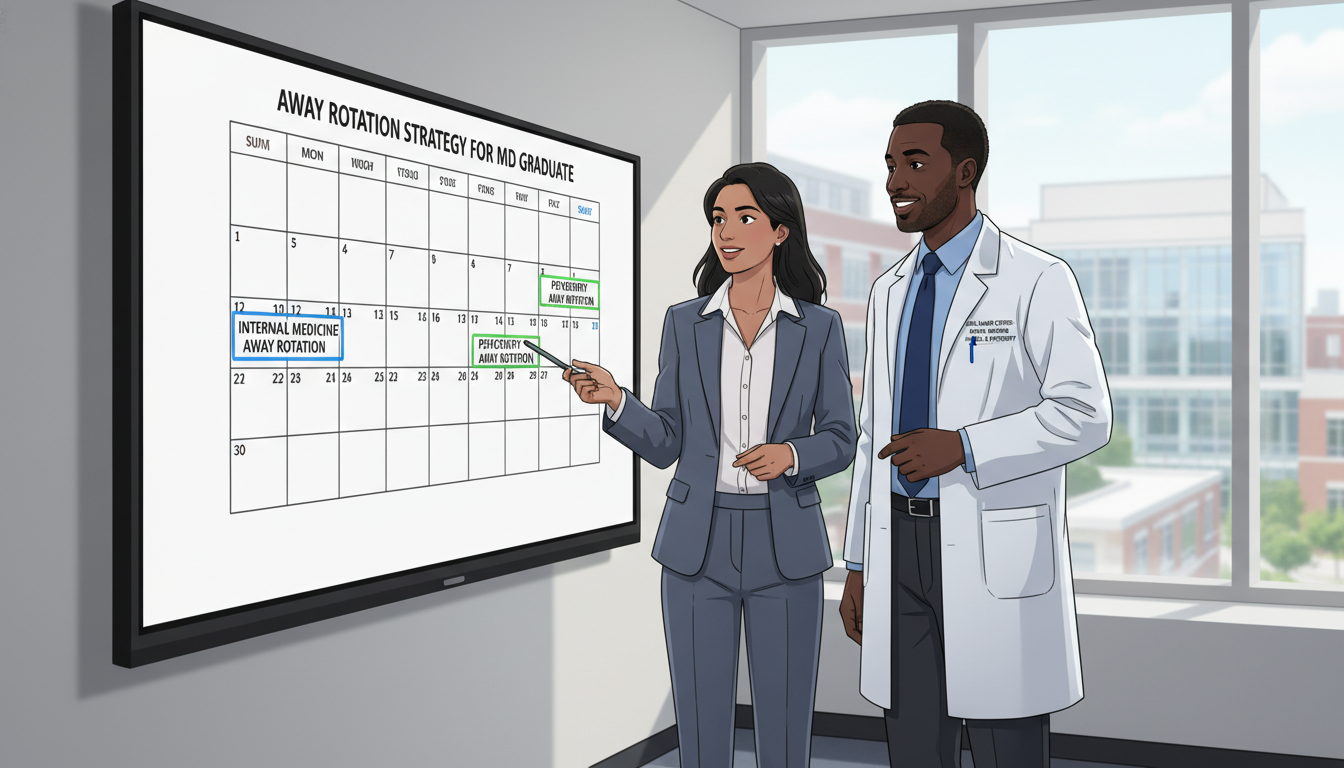
Understanding Away Rotations for Medicine-Psychiatry
Away rotations are one of the most strategic levers you can pull as an MD graduate interested in a med psych residency. Because medicine psychiatry combined programs are relatively few and competitive, visiting student rotations can significantly influence how programs perceive you—especially if your home institution doesn’t have a combined track.
In the context of the allopathic medical school match, away rotations serve several purposes:
- Letting programs see you in action beyond your ERAS application
- Demonstrating genuine interest in medicine-psychiatry combined training
- Filling in experience gaps (e.g., limited inpatient psych, lack of integrated care exposure)
- Building strong, specialty-specific letters of recommendation
- Helping you refine your own rank list with first-hand program knowledge
For MD graduate residency applicants, planning these rotations can be more complex than for current 3rd or 4th-year students, especially around timing, eligibility, and logistics. A thoughtful away rotation strategy is essential.
This guide will walk through how to:
- Decide how many away rotations to do
- Choose where and when to rotate
- Decide which services (medicine vs psychiatry vs combined) are highest yield
- Maximize each rotation for a stronger match application
Clarifying Your Goals and Constraints Before You Apply
Before looking at VSLO (or program-specific visiting student portals), clarify what you want your away rotations to accomplish. This is especially important as an MD graduate transitioning into a medicine psychiatry combined pathway.
Core Goals for a Med Psych Applicant
Most strong away rotation strategies for a med psych residency aim to:
Show commitment to integrated care
- Experience on combined medicine-psychiatry units, consult-liaison psychiatry, or medical units with high psychiatric comorbidity.
- Clear alignment with the philosophy of medicine psychiatry combined training.
Secure powerful letters of recommendation
- At least one letter from a psychiatrist.
- At least one from an internist or hospitalist.
- Ideally, one from a dual-boarded med psych faculty member or a program director in combined training.
Target specific programs of interest
- Rotating at institutions you’re highly likely to rank high.
- Experiencing different styles: e.g., academic tertiary center vs county safety-net hospital.
Fill clinical experience gaps
- Additional inpatient psych if you trained at a hospital with limited psychiatric services.
- More inpatient medicine or ICU if you’re perceived as stronger on the psych side than on medicine (or vice versa).
Demonstrate readiness as an MD graduate
- Show up as someone who already functions at an intern level in professionalism, work ethic, and communication.
- Reassure programs about any time between graduation and residency (research, other degrees, personal reasons).
Key Constraints for MD Graduates
As a graduate rather than a current student, your away rotation planning may be affected by:
- Eligibility for “visiting student” status
- Some institutions only accept current students via VSLO.
- Others have specific pathways for MD graduates (observer roles, prelim trainee, or short-term contracts).
- Licensing/credentialing
- Some states/hospitals require a limited or training license for post-graduate clinical work.
- Funding
- As a graduate, you often won’t have school-based financial aid for housing/travel.
- Some programs offer small stipends or housing support—these are worth seeking out.
Before applying, list your specific constraints (geography, family responsibilities, finances, graduation date, need for visa if IMG, etc.). These will shape what’s realistic.

How Many Away Rotations for a Med Psych Applicant?
Many applicants struggle with the question: how many away rotations are enough—and how many are too many?
Because medicine psychiatry combined programs are relatively few and heavily clustered in certain geographic regions, you gain more by being strategic than by doing many scattered rotations.
General Ranges
For an MD graduate targeting an allopathic medical school match in med psych residency, a typical range is:
- 1–2 away rotations at combined med psych programs
- 0–1 away rotation focused on general psychiatry at a strong academic program
- 0–1 away rotation focused on internal medicine or consult-liaison psychiatry
Most applicants do 2–3 total away rotations. More than 3 is usually not necessary and can introduce fatigue, cost, and scheduling conflicts with interview season or other obligations.
When 1–2 Away Rotations May Be Enough
You may only need 1–2 away rotations if:
Your home institution already has a medicine psychiatry combined program and:
- You’ve rotated with combined faculty.
- You have a strong combined med-psych letter or a clear integrated-care track record.
You have:
- Strong Step scores and academic records.
- Solid clinical evaluations in both medicine and psychiatry.
- Clear, documented interest in dual-board training (e.g., scholarly work, QI projects in integrated care).
In this scenario, one high-yield away rotation at your top med psych residency and perhaps one psychiatry or medicine-focused away can be sufficient to differentiate you.
When 3+ Away Rotations Might Be Reasonable
Consider 3 away rotations if:
- Your home institution:
- Has no med psych residency.
- Offers limited psychiatry or limited inpatient medicine exposure.
- You are an MD graduate with:
- A significant time gap between graduation and application.
- A notable red flag (failed Step, leaves of absence, professionalism concerns that are now resolved).
- You are changing direction (e.g., previously matched in another specialty, now reapplying into med psych).
In this situation, each rotation should have a specific strategic purpose—e.g.:
- Combined med-psych program #1 (top choice; aim for letter).
- Combined med-psych program #2 (different region; second letter and comparison point).
- Strong psychiatry (or consult-liaison) rotation to show robust psych skills and obtain a third letter.
Avoiding Over-Rotation
More rotations do not equal a better chance automatically. Pitfalls of doing too many:
- Emotional/physical burnout right before interview season.
- Financial strain from repeated moves and housing costs.
- Shallow connections at each program instead of deep, memorable impressions.
- Less time for ERAS polishing, personal statement refinement, research output, or Step 3 (if applicable).
Aim for intensity and quality over sheer quantity.
Where and When to Rotate: Building Your Rotation Calendar
Strategic timing and location choices help convert your away rotations into stronger odds of matching in a med psych residency.
Prioritizing Sites: Combined vs Single-Specialty
Organize potential away sites into three buckets:
Medicine-Psychiatry Combined Programs (Top Priority)
- Target at least 1, preferably 2, programs where you could genuinely see yourself training.
- These rotations show your seriousness about medicine psychiatry combined training.
- Aim for services like:
- Combined medicine-psychiatry inpatient units.
- Consult-liaison psychiatry with an emphasis on medically complex patients.
- Integrated primary care–behavioral health clinics.
Strong Psychiatry Programs or Rotations
- Examples:
- Inpatient psychiatry at a major academic center.
- CL psychiatry if a dedicated med-psych combined unit is not available.
- Emergency psychiatry or addiction psychiatry with medically complex patients.
- These highlight your interest in severe mental illness, comorbid substance use, and high-acuity care.
- Examples:
Strong Internal Medicine Rotations
- Examples:
- General inpatient internal medicine.
- Hospitalist service with emphasis on complex psychosocial needs.
- Transitional care or medically complex chronic disease clinics.
- These show that you are comfortable as a future internist and not “just” a psych-leaning applicant.
- Examples:
For most MD graduate residency candidates aiming at med psych, the highest-yield strategy is:
- 2 away rotations at combined med-psych or CL psychiatry-heavy sites.
- Optionally, 1 away rotation in general IM or high-acuity psychiatry if your narrative or background requires additional strength in one side of the combined curriculum.
Optimal Timing Relative to the Match
For the allopathic medical school match cycle, applicants commonly aim for:
- Core away rotation window: July–October of the application year.
- July–August: Best for being “on the radar” before applications open in September.
- September–October: Still valuable for letters and direct observations before the main interview wave.
As an MD graduate, consider:
- Licensing and paperwork take time. Start planning 6–9 months ahead.
- If you have a graduation date in May or June:
- Build in a 4–6 week buffer to complete any necessary paperwork, occupational health, and credentialing.
- Try to have at least one away completed before ERAS submission, so you can include that experience and potentially one letter.
Geographic Strategy
Integrate your personal and professional priorities:
Regions you would realistically live in for 4–5 years
- Rotating in a city or region you’d like to settle in carries obvious advantages.
Regional clusters of med psych programs
- Some states/regions have multiple medicine psychiatry combined residencies within a few hours’ drive.
- Example: If 3–4 programs are within one region, 1–2 away rotations there plus interviews can maximize exposure to that cluster.
Visa considerations (if applicable)
- Check which programs sponsor J-1 or H-1B and whether they accept international MD graduates for away rotations.
- Some institutions may allow only observerships for non-US graduates; clarify roles (hands-on vs shadow-only) before committing.

Choosing Specific Rotations and Maximizing Their Impact
Once you know where and when, you need to decide what type of rotation to do at each site and how to stand out while you’re there.
High-Yield Rotation Types for Med Psych Applicants
When selecting rotation descriptions, look for:
“Combined Medicine-Psychiatry” units or tracks
- Inpatient units with dual attending leadership.
- Programs that explicitly advertise integrated care or med-psych co-management.
Consult-Liaison Psychiatry
- High-yield because:
- You’re working at the interface of medicine and psychiatry.
- You interact with both psychiatrists and internists/hospitalists.
- You can showcase your ability to bridge teams and think “biopsychosocial.”
- High-yield because:
Integrated Primary Care / Behavioral Health Clinics
- Demonstrates comfort with chronic medical disease plus psychiatric comorbidities (e.g., depression in diabetes, adherence challenges in heart failure).
General IM with high psychosocial complexity
- If combined or CL rotations are not available, choose IM attendings or services known for caring for:
- Patients with substance use disorders.
- Homelessness or housing instability.
- Severe chronic mental illness.
- If combined or CL rotations are not available, choose IM attendings or services known for caring for:
Psychiatry units with medical complexity
- Inpatient psych units at general hospitals (rather than free-standing psych hospitals) often have more medical complexity.
Clarify Expectations Up Front
When arranging away rotations, especially as an MD graduate:
Clarify your role:
- Will you write notes and orders?
- Are you evaluated with the same tools as 4th-year students?
- Who can write you a formal evaluation and letter of recommendation?
Ask about:
- Opportunities to attend didactics, grand rounds, and med psych–specific conferences.
- Whether the program director or med-psych faculty will be involved in your rotation.
Align your expectations with the rotation’s structure: your goal is to be in clinical spaces where your combined interests can shine, not just “fill a slot.”
How to Excel on Rotation as a Med Psych Applicant
You need to be evaluated as more than just “a good visiting student.” You want staff to say, “This person would be an excellent medicine-psychiatry intern.”
Focus on these domains:
Clinical Reasoning at the Intersection
- On a patient with cirrhosis and psychosis, articulate:
- Medical differential (e.g., hepatic encephalopathy, substance withdrawal, metabolic derangements).
- Psychiatric differential (e.g., primary psychosis, mood disorder with psychotic features).
- How medical and psychiatric treatment plans interact (e.g., antipsychotic choice with QTc issues).
- Ask questions that demonstrate this integrated thinking rather than siloed medicine-or-psychiatry questions.
- On a patient with cirrhosis and psychosis, articulate:
Ownership and Reliability
- Arrive early, know your patients deeply, follow up on labs, imaging, social work notes.
- Proactively bridge communication gaps between medicine and psych teams—document clearly and hand off thoroughly.
Communication and Teamwork
- Med psych residency demands strong collaboration: demonstrate:
- Respect for nurses and allied health staff.
- Ability to explain psychiatric concepts to internists and vice versa in accessible language.
- Med psych residency demands strong collaboration: demonstrate:
Curiosity and Humility
- When you don’t know, say so and follow up with reading.
- Share one or two concise, high-yield teaching points per day (not lengthy lectures).
Professionalism and Cultural Humility
- Many med psych patients face homelessness, incarceration histories, trauma, and stigma.
- Show sensitivity to social determinants of health and structural barriers.
Turning a Strong Rotation into a Strong Letter
By the second week of a 4-week rotation, identify who might write your letter:
- Ideal letter writers:
- Med-psych program director.
- Dual-boarded med psych faculty.
- CL psychiatry attending who has seen your integrated thinking.
- Internal medicine attending who can speak to your readiness for intern-level responsibilities.
Approach them around week 3:
- Ask: “Would you feel comfortable writing me a strong letter of recommendation for medicine-psychiatry combined residency?”
- Offer:
- Updated CV.
- Draft personal statement.
- Brief bullet list of cases or contributions you’re proud of to jog their memory.
For MD graduates, a strong away-rotation letter can carry especially high weight, as it provides recent, US-based (if applicable) clinical validation of your skills.
Integrating Away Rotations into Your Overall Application Strategy
Away rotations are one part of a broader strategy for matching into a med psych residency. You’ll want to align them with the rest of your application components.
Aligning Rotations with Your Narrative
In your personal statement and interviews, you’ll need a coherent answer to:
- Why medicine psychiatry combined instead of just internal medicine or just psychiatry?
Use your away rotations to provide concrete stories:
- A patient on a CL service whose delirium and psychosis required nuanced medical and psychiatric management.
- A medically complex patient on an inpatient psych unit where you coordinated with medicine teams to optimize care.
- Integrated care experiences where you saw that treating medical and psychiatric illness together produced better outcomes.
These stories not only show your clinical experience but also confirm that you’ve “test-driven” the dual perspective central to med psych.
Coordinating with ERAS, Step Exams, and Interviews
Plan backwards from key dates:
- ERAS Application Opening/Submission
- Ideally, have at least one away rotation completed with an attending committed to writing a letter before submission.
- Step 3 (if applicable for MD graduates)
- Taking Step 3 before applications can be helpful, but not mandatory.
- Avoid scheduling Step 3 during your most important away rotation—divided focus can hurt performance.
- Interview Season (October–January)
- Avoid late-fall/winter away rotations that could interfere with interviews, unless:
- They’re local and flexible, or
- You’re mainly using them for extra experience rather than letters.
- Avoid late-fall/winter away rotations that could interfere with interviews, unless:
Communicating Interest to Programs Where You Rotated
After completing an away rotation:
- Send a thank-you email to key faculty and the program director.
- Consider a brief update a few weeks before rank lists are due:
- Reiterate your strong interest in medicine psychiatry combined training at their institution.
- Briefly reference specific aspects of their program that align with your goals.
- Avoid sounding presumptive (no “I will rank you #1” unless you are doing a formal, honest signal where appropriate).
Programs often rank applicants they’ve worked with more highly, particularly if those applicants were clearly invested in the rotation and fit their culture well.
Frequently Asked Questions (FAQ)
1. As an MD graduate, can I still do away rotations if I’m not a current student?
Yes, but options are more limited and processes vary by institution. Key steps:
- Check if the program accepts post-graduate visiting trainees or only enrolled medical students.
- Some hospitals may allow short-term clinical work under a limited training license; others may only offer observerships.
- Contact the program coordinator or GME office directly and clearly explain:
- You are an MD graduate seeking a hands-on visiting resident or advanced-student-equivalent rotation.
- Your goals (experience plus letters) for a med psych residency.
Plan early; credentialing for MD graduates can take longer than for current students.
2. Are away rotations absolutely necessary to match into a medicine psychiatry combined residency?
Not absolutely—but they are highly advantageous, especially if:
- Your home institution lacks a med psych program.
- You do not have faculty who can speak to your abilities at the medicine-psychiatry interface.
- You are an MD graduate or re-applicant needing fresh clinical evaluations.
Some applicants match successfully without away rotations, especially when they have strong clinical grades, compelling integrated-care experiences, and excellent letters. However, away rotations can significantly improve your visibility and perceived commitment.
3. Should I prioritize a medicine-heavy or psychiatry-heavy away rotation if I can only do one?
Choose based on your current portfolio and perceived weaknesses:
If your record looks psych-heavy (psychiatry electives, research, strong psych letters, but minimal medicine exposure):
- Prioritize a rotation where you can demonstrate strong internal medicine competence (e.g., med-psych unit, CL psych with heavy medical responsibility, or inpatient IM with complex psychosocial issues).
If your record looks medicine-heavy (IM sub-internships, strong IM letters, research in medical topics):
- Prioritize a rotation that shows your comfort managing serious mental illness, such as inpatient psych or CL psychiatry.
If possible, a combined or CL psychiatry rotation that showcases both domains is often the most strategic single choice.
4. How do I signal to programs that I’m specifically interested in medicine psychiatry combined, not just general psychiatry?
Use multiple channels:
- Personal statement: Explicitly address why dual-board training fits your goals and how your experiences (including away rotations) confirmed this.
- Letters of recommendation: At least one writer should clearly endorse you for combined medicine-psychiatry residency, not generic psychiatry or IM only.
- ERAS application: Highlight integrated-care experiences, med-psych electives, and projects at the medicine–psychiatry interface.
- Interviews: Reference your time on combined units or CL services and how that experience shaped your passion for dual training.
Away rotations are especially powerful here: rotating at a med psych residency and performing well is one of the clearest signals of your commitment to the medicine psychiatry combined path.
A deliberate away rotation strategy, tailored to your background as an MD graduate and your goals in medicine-psychiatry, can transform your application from solid to standout. Focus on high-yield combined or CL experiences, calibrate how many away rotations you truly need, and treat each rotation as both an audition and a learning laboratory for the unique, integrated practice you aim to build.