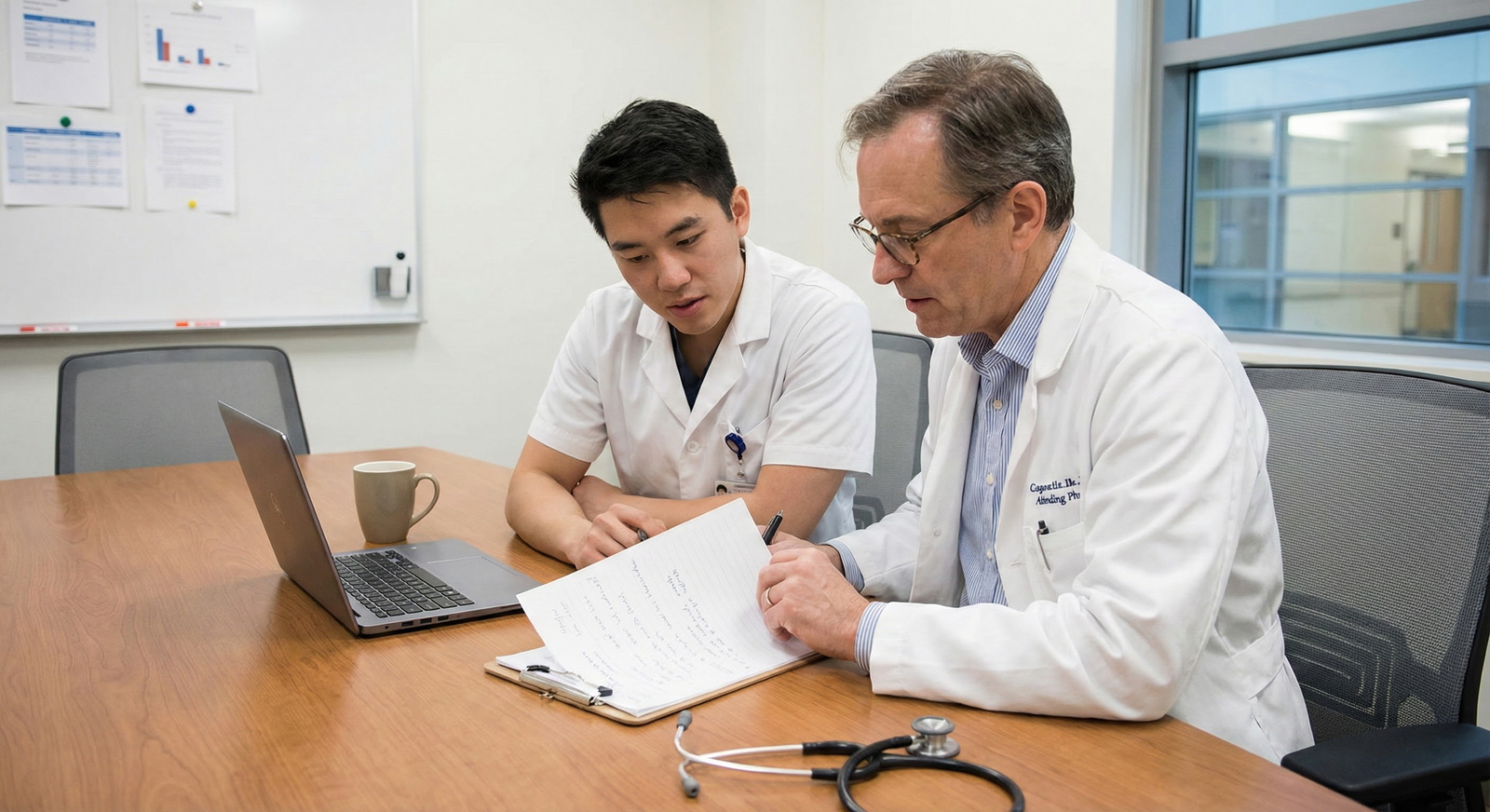
Why Away Rotations Matter So Much for Non‑US Citizen IMGs in EM–IM
For a non-US citizen IMG interested in Emergency Medicine–Internal Medicine (EM–IM) combined residency, away rotations are not optional “extras”—they are often the single most powerful tool you have to overcome lack of US clinical exposure, visa barriers, and program bias.
Away rotations (also called visiting student rotations or “audition rotations”) are short-term clinical experiences (usually 4 weeks) at US teaching hospitals outside your home institution. For you as a foreign national medical graduate, they fulfill four critical functions:
Prove you can function in the US system
You show that you can work with electronic medical records, respond to pages, present on rounds, and handle ED workflows at US pace and expectations.Generate US-based letters of recommendation (LoRs)
EM–IM programs care deeply about strong, detailed LoRs from US academic emergency medicine and internal medicine faculty—preferably from residency programs similar to where you want to match.Get you on the radar of EM–IM and EM/IM-friendly programs
Many program directors say they are more comfortable ranking someone they’ve seen clinically, especially when navigating visa issues.Allow programs to “de-risk” your application
As a non-US citizen IMG, you may be an unknown quantity to them. A strong performance on an away rotation reduces uncertainty about your clinical skills, professionalism, communication, and team-fit.
Because there are only a small number of EM–IM combined programs in the US, a smart away rotation strategy is about more than just “where can I rotate?”. It’s about where your time and money are most likely to convert into interviews and a match.
Understanding the EM–IM Landscape as a Non‑US Citizen IMG
Before planning away rotations, you need a realistic overview of the combined emergency medicine internal medicine training environment and where an IMG can fit.
1. What EM–IM Combined Programs Look For
EM–IM programs typically seek applicants who:
- Are genuinely dual-minded (interested in acute care and longitudinal internal medicine)
- Can handle high-intensity clinical loads over a 5-year period
- Demonstrate excellent communication skills and team leadership
- Have a track record of reliability and resilience
For a non-US citizen IMG, the additional unstated criteria include:
- Clear visa path (typically J-1; only a subset sponsor H-1B)
- Strong US clinical performance documented in LoRs
- No major remediation or unexplained gaps
2. How Your IMG and Visa Status Changes the Game
As a non-US citizen IMG, your constraints tend to be:
- Fewer schools willing or able to accept you for visiting student rotations
- Limited financial resources for multiple US trips, housing, and rotation fees
- Extra scrutiny from programs about communication skills and cultural adaptation
- Variable visa sponsorship policies that may rule out some otherwise appealing programs
This makes a blanket “do as many away rotations as possible” approach neither realistic nor efficient. Instead, you need a tightly targeted strategy that places you where:
- You can legally rotate
- You are likely to be seriously considered for interview and ranking
- Your rotation will produce high-yield letters of recommendation
Choosing Where to Rotate: EM–IM vs EM vs IM
A core strategic question is: Should you do away rotations strictly at EM–IM programs, or is it acceptable (or even better) to rotate at EM-only or IM-only programs?
1. Ideal Scenario: At Least One Rotation at an EM–IM Program
If possible, aim for at least one away rotation at a program that actually offers an EM–IM combined residency, especially one that:
- Has a history of interviewing or matching IMGs
- Sponsors the visa you need (usually J-1; sometimes H-1B)
- Explicitly allows non-US citizen IMG visitors
Benefits of rotating at an EM–IM site:
- You can work directly with EM–IM faculty and residents
- Your LoR can explicitly speak to your potential as a dual-trained physician
- You may gain an automatic interview at that institution (many programs informally prioritize rotators)
However, EM–IM programs are relatively few, and not all can accommodate foreign national medical graduates as visiting students. You need to cross-check each program’s:
- Visiting student policy
- Immigration/visa office policies
- Student health and malpractice coverage requirements
2. High-Yield Alternative: Strong EM Programs With EM–IM or IM–Critical Care Orientation
If you cannot secure an EM–IM-specific away, your next best option is to prioritize high-quality EM programs that are academically strong and friendly to IMGs, and that:
- Have dual-trained faculty (EM–IM or EM–critical care)
- Are located at institutions that also have strong Internal Medicine and subspecialty programs
- Produce LoRs recognized as high-signal across multiple programs
A strong EM letter from such a place is often better than a mediocre letter from a small EM–IM site that doesn’t know how to support IMGs.
3. Role of Internal Medicine Rotations
For an EM–IM applicant, one solid US Internal Medicine rotation can be extremely valuable, especially if:
- It’s at an academic IM program with a reputation for strong clinical training
- You work with faculty who understand combined training or critical care pathways
- The letter can validate your ability to manage complex, longitudinal medical patients—not just acute ED presentations
However, you do not need multiple IM visiting student rotations; one high-quality IM rotation plus one or two strong EM rotations is typically enough to demonstrate your dual interest and capability.
How Many Away Rotations Should a Non‑US Citizen IMG Do?
The question “how many away rotations?” has a different answer for a non-US citizen IMG compared to a US allopathic senior.
1. Typical Benchmarks
For US MD students applying EM–IM or EM only:
- 2 EM rotations (home + away) is standard
- Occasionally 3 EM rotations for highly competitive applicants
For a foreign national medical graduate, without a US “home” EM department:
- Aim for 2–3 total US clinical rotations in relevant specialties
- Try to ensure at least 2 are EM-focused, and 1 can be IM-focused if feasible
A realistic and effective structure is:
- Rotation 1: EM (academic, IMG-friendly, not necessarily EM–IM)
- Rotation 2: EM–IM program if possible; if not, another academic EM site
- Rotation 3 (optional): Academic IM inpatient rotation at a program that knows EM–IM and writes strong letters
2. When More Rotations Do Not Help
Beyond 3–4 US visiting student rotations:
- Each additional rotation has diminishing returns in terms of LoRs and interview yield
- The cost (travel, housing, fees) becomes difficult to justify
- You risk fatigue, which can actually worsen performance
Additional rotations might be reasonable if:
- Early rotations do not produce strong LoRs
- Your USMLE scores are marginal and you need every possible edge
- You are re-applying after an unsuccessful match cycle
But for a first-time applicant with limited finances, plan for quality over quantity and invest deeply in excelling on each rotation instead of simply accumulating more.

Building a High-Yield Away Rotation Plan: Step-by-Step
This section lays out a practical roadmap to design and execute your away rotation strategy as a non-US citizen IMG interested in EM–IM.
Step 1: Clarify Your Constraints and Goals
Before applying for any visiting student rotations, be explicit about:
Visa situation
- Do you already have a US visa (B1/B2 for observerships, or J-1 for electives/research)?
- Will you need the school to sponsor a J-1 student visa for the duration of your rotation?
Graduation timeline
- Many US schools require that visiting students be within 1 year of graduation or still enrolled.
Financial limits
- Total budget for application fees, background checks, rotation fees, travel, housing, and living costs.
Score profile and red flags
- USMLE Step 2 CK score, any failures, gaps, or remediation that may influence competitiveness.
Then define your away-rotation goals:
- Get 2–3 strong US LoRs, including at least one EM letter and ideally one IM letter
- Demonstrate clear dual interest in emergency medicine internal medicine training
- Build connections at IMG-friendly, visa-sponsoring academic programs
Step 2: Research and Shortlist Programs
Create three lists:
EM–IM programs that sponsor visas and may accept non-US citizen visitors
- Start from the official EM–IM program list (via EMRA, ACGME, or specialty societies)
- Check each program’s webpage for:
- Visa type sponsored for residency
- Any mention of IMG residents
- Visiting student policies (often via the medical school)
IMG-friendly EM programs with strong academic reputations
- Look for:
- EM residencies that currently have or historically had IMGs
- Programs that sponsor J-1 (and ideally H-1B if that’s your path)
- Evidence of faculty with critical care or EM–IM backgrounds
- Look for:
Academic IM programs open to visiting IMGs
- Focus on:
- Strong inpatient medicine or cardiology/ICU rotations
- Places known to write detailed, narrative letters
- Focus on:
For each program, build a spreadsheet with:
- Program name, location, and type (EM–IM, EM, IM)
- Visa sponsorship (J-1 / H-1B / none)
- Visiting student application system (VSLO/VSAS vs institutional portal)
- Eligibility criteria (year of training, affiliated schools, insurance, etc.)
- Deadlines and rotation blocks
- IMG/visa friendliness notes (from forums, alumni, or directly from coordinators)
Step 3: Understand Visiting Student Rotations vs Observerships
As a non-US citizen IMG, you may encounter:
Visiting student rotations
- You are considered a student with direct patient care responsibilities
- You can write notes, do presentations, and be evaluated like a local medical student
- These produce the most meaningful LoRs for residency
Observerships
- You are limited to watching; no orders, no notes
- Physicians may still write letters, but they often carry less weight
Prioritize full student electives in EM and IM whenever possible. If a site only offers observerships to foreign nationals, that program's letter will help, but it is less powerful than a true acting intern (AI/sub-I) evaluation.
Step 4: Apply Early and Communicate Clearly
Deadlines for visiting student rotations can be 6–9 months before the rotation start date. For a typical July–September residency application season:
- Aim to complete your key away rotations between May and October of the year before you apply (or the application year, if timing allows).
- Submit applications as soon as portals open—often February–April.
In your emails or application essays, briefly but clearly express:
- Your interest in EM–IM combined training
- Your status as a non-US citizen IMG and your visa situation
- Your motivation for that specific institution (e.g., strong critical care training, dual-trained faculty, history of IMG support)
Polite, concise communication with student affairs and clerkship coordinators can sometimes open doors that look closed on paper.
Step 5: Plan Rotation Order Strategically
If you expect your application to open in September:
Early rotation (May–July)
- Best for generating early LoRs that will be uploaded before ERAS submission
- Good time for your first high-yield EM rotation
Mid rotation (July–September)
- Good for a critical EM–IM or second EM rotation
- LoRs may come slightly later but can still influence mid-season interviews and program perceptions
Late rotation (October–December)
- More useful if you are re-applying or if letters are added for rank-list updates
- Consider an IM rotation here if you already have strong EM letters
If your school allows it, try to schedule:
- First rotation at a slightly less intense institution to adjust to US systems
- Second rotation at your dream EM–IM or high-prestige EM site once you are warmed up
- Optional IM rotation once your ED communication and presentation skills are solid
Maximizing Performance During EM and IM Away Rotations
Once you’ve secured away rotations residency slots, your focus must shift to execution. A non-US citizen IMG is often under extra scrutiny; you need to be intentional from day one.
1. Clarify Expectations Early
On the first day:
- Ask your senior or attending:
- “What are your expectations for students on this rotation?”
- “What does a top-performing student look like here?”
- Clarify:
- How to pre-chart and present
- Typical patient load for students
- Protocols for procedures (who can do what and when)
In an EM setting, also understand:
- How to take ownership of new patients
- When and how to call consults
- Local policies for imaging, labs, and discharges
2. Over-Prepare for Each Environment
For EM:
- Review common ED chief complaints: chest pain, shortness of breath, abdominal pain, headache, sepsis, trauma basics
- Memorize core emergency algorithms (ACS, stroke, sepsis, ACLS basics)
- Practice concise, structured ED presentations:
- Chief complaint, 1–2 line summary, focused HPI, key exam findings, differential (3–5 diagnoses), initial workup and plan
For IM:
- Review management of CHF, COPD, diabetes, cirrhosis, CKD, infections
- Practice full, organized inpatient presentations:
- Overnight events, vitals, labs/imaging, systems-based physical, problem list with assessment and plan
3. Demonstrate Professionalism and Cultural Adaptation
As a foreign national medical graduate, subtle professionalism issues can overshadow your clinical knowledge. Focus on:
- Punctuality: arrive early, never late
- Communication: speak clearly; ask for clarification when unsure
- Teamwork: help co-students with tasks, offer to assist nurses
- Accepting feedback: listen, thank the provider, change behavior quickly
If language or accent is a concern, practice patient interviews and presentations with peers, faculty, or standardized patient resources before and during the rotation.
4. Ask for Feedback and a Letter Proactively
Mid-rotation:
- Ask key faculty:
- “Could you give me feedback on how I’m doing and what I can improve over the rest of the rotation?”
End of rotation (if you’ve worked substantially with them):
- Ask directly:
- “I’m applying to Emergency Medicine–Internal Medicine combined programs. Based on our work together, would you feel comfortable writing a strong letter of recommendation for me?”
If they hesitate, it’s better to pivot to another faculty who can be more enthusiastic. For EM–IM aspirations, make sure at least one letter:
- Explicitly references your dual interest
- Highlights skills valued in both ED and IM settings (teamwork, resilience, clinical reasoning, communication)
Strategic Tips Specific to Non‑US Citizen IMGs
1. Address Visa and IMG Issues Transparently
During informal conversations (not necessarily formal interviews), program faculty may be trying to understand:
- Whether your immigration status is realistic for residency
- Whether you understand the limitations and obligations of J-1 or H-1B pathways
Be prepared with:
- A concise summary of your current visa situation
- Confirmation you’ve researched J-1 requirements and possible waiver strategies
- Assurance you are comfortable matching at J-1–sponsoring institutions if H-1B is limited
2. Leverage Alumni and Faculty Networks
If your home school or country has alumni who matched into EM–IM or EM/IM residencies:
- Reach out to them for program-specific guidance
- Ask where they rotated, how they approached away rotations, and which programs were most supportive to them as non-US citizens
A recommendation email from a known faculty member to an EM–IM program director can sometimes:
- Smooth your visiting student acceptance
- Prime the program to pay closer attention to your performance when you arrive
3. Balance EM–IM Focus With a Backup Plan
Because EM–IM combined spots are limited, maintain a realistic view:
- Your away rotations and letters should also position you well for:
- Categorical EM
- Categorical IM
Design away rotations that:
- Are impressive to EM–IM faculty, but
- Still remain valuable if you decide to rank EM-only or IM-only programs more heavily
FAQs: Away Rotations for Non‑US Citizen IMGs in EM–IM
1. How many away rotations are ideal for a non‑US citizen IMG interested in EM–IM?
For most non-US citizen IMGs, 2–3 away rotations in the US are ideal:
- 2 EM rotations (one of which, if possible, is at an EM–IM or IMG-friendly academic program)
- 1 IM rotation (optional but helpful to demonstrate your longitudinal medicine interest and obtain a strong IM letter)
More than three rotations rarely adds proportional value and can strain finances and energy. Focus on quality of performance and letters rather than quantity of rotations.
2. Is it mandatory to rotate at an EM–IM program to match into EM–IM?
It is not strictly mandatory, but having at least one rotation closely connected to the EM–IM world significantly strengthens your application. If you cannot rotate at an EM–IM program:
- Target EM programs with EM–IM or EM–critical care faculty
- Obtain letters that explicitly describe your potential as a physician suited for dual training
Many successful candidates match EM–IM with a combination of strong EM letters and one strong IM letter, even without a direct EM–IM away rotation, but a direct rotation certainly helps.
3. Can observerships help if I cannot get full visiting student rotations?
Observerships are better than no US experience, but they are less impactful than full visiting student rotations with direct patient care. If you must do an observership:
- Choose an institution with recognizable faculty and strong training programs
- Engage actively: attend conferences, read charts under supervision, discuss cases
- Request a letter only if the faculty member has seen you regularly and can describe your skills meaningfully
Whenever possible, prioritize true student electives with hands-on responsibilities over observerships.
4. What if my first away rotation doesn’t go well or doesn’t yield a strong letter?
If your initial rotation doesn’t produce a strong LoR:
- Reflect on feedback and adjust quickly—improve punctuality, presentations, and teamwork
- Use your next rotation as a “reset” opportunity, actively asking for feedback early and often
- If finances allow, consider adding one more targeted rotation at an IMG-friendly EM or IM program
You can also ask the first site for an “experience verification” letter (confirming your rotation and responsibilities) and rely more heavily on stronger LoRs from later, higher-performing rotations.
A thoughtful away rotation strategy—built around targeted EM and IM experiences, IMG- and visa-friendly programs, and deliberate performance—can significantly improve your chances of matching into Emergency Medicine–Internal Medicine as a non-US citizen IMG. With limited EM–IM spots nationwide, your choices of where and how you rotate are among the most important decisions you will make in your residency journey.