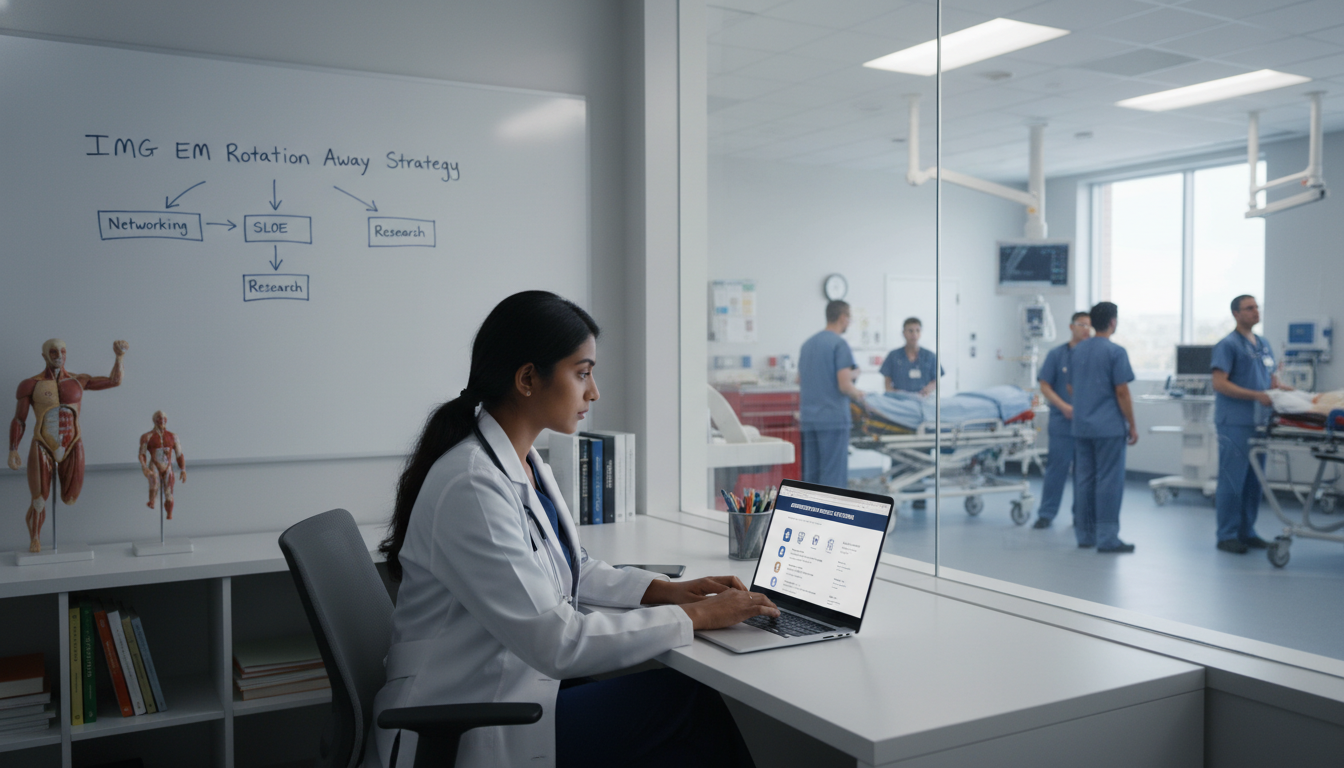
Why Away Rotations Matter So Much for Non‑US Citizen IMGs in Emergency Medicine
For a non-US citizen IMG trying to match into an emergency medicine residency, away rotations can be the single most powerful part of your application—sometimes even more influential than a strong Step score or research.
Emergency medicine is a small, relationship‑driven specialty. Program directors often say variations of the same thing: “We trust what we can see.” For a foreign national medical graduate, that means:
An away rotation is often the only way a program can directly observe your:
- Clinical reasoning
- Work ethic
- Communication skills
- Teamwork in a fast-paced environment
- Cultural adaptation to US healthcare
It’s also your best opportunity to:
- Earn a strong Standardized Letter of Evaluation (SLOE)—the single most important document in the EM match (EM Match)
- Demonstrate that you can function like a sub‑intern in a US emergency department
- Overcome concerns programs may have about visa needs and training background
For a non-US citizen IMG, away rotations residency strategy must be intentional, realistic, and early. This article will walk you through:
- Eligibility, timing, and visa/logistics challenges
- How many away rotations to aim for—and what type
- How to choose programs strategically (not just “any EM program”)
- How to excel during the rotation and earn a strong SLOE
- How to position your away experiences in your ERAS and interview conversations
Throughout, we’ll focus on what specifically matters for foreign national medical graduates, not just generic EM advice.
Understanding Eligibility, Timing, and Logistics as a Non‑US Citizen IMG
Before you plan how many away rotations or where to apply, you must honestly assess: Can I even be accepted for a visiting EM rotation at this institution?
1. Know the Key Definitions and Systems
You’ll see several terms used interchangeably:
- Away rotation / visiting student rotation – You rotate at an institution that is not your home or core hospital.
- Clerkship / Sub-I / Acting Internship – A senior-level rotation where you function at or near intern level.
- VSLO (VSAS) – The AAMC’s Visiting Student Learning Opportunities platform. Many US medical schools use this to manage applications for away rotations.
Important: Many (but not all) VSLO sites are restricted to students from LCME- or COCA-accredited schools, which usually excludes IMGs. However:
- Some US institutions accept international medical students directly outside VSLO via their own application portal.
- A few US schools are officially affiliated with foreign schools and accept those specific foreign national medical graduates.
2. Common Eligibility Barriers for Non‑US Citizen IMGs
You will frequently encounter:
“Must be enrolled in an LCME- or COCA-accredited medical school”
→ Automatically excludes most IMGs.“Must be a US citizen or permanent resident”
→ A direct problem for a non-US citizen IMG, even if otherwise qualified.“Must qualify for J-1 short-term scholar or student visa”
→ Some institutions will help; others will not sponsor rotation-specific visas.“Must have completed core clerkships in Internal Medicine, Surgery, Pediatrics, OB/GYN, Psychiatry”
→ This is usually feasible, but timing in your curriculum is important.
Action: Create a tracking spreadsheet with columns:
- Institution name
- EM program present? (Yes/No)
- IMGs accepted for visiting rotations? (Yes/No)
- Accept non‑US citizens? (Yes/No)
- Platform (VSLO vs. institutional portal)
- Visa support offered? (Yes/No/Unclear)
- Application window (open/close dates)
- Requirements (USMLE Step 1, immunizations, background check, etc.)
- Contact email for student affairs/visiting students
This spreadsheet will become your roadmap for where you can actually rotate.
3. Timing Your Away Rotations for the EM Match
Optimal timing is driven by two realities:
- You need SLOEs uploaded early enough to influence interview offers.
- As a non-US citizen IMG, you may need extra time for visa, credentialing, and document processing.
Typical US MD students try to complete their first EM away rotation between June and August of the application year. Non-US citizen IMGs should:
- Start planning 12–18 months in advance (no exaggeration).
- Aim for at least one EM away rotation completed by August–September of the year you apply, so the SLOE is ready when ERAS opens.
A common and effective timeline for a foreign national medical graduate:
Jan–Mar (year before applying):
- Identify IMG‑friendly EM programs and their rotation policies.
- Begin email outreach and checking portals.
- Clarify whether they accept non‑US citizens and what visa is needed for the rotation.
Mar–May:
- Submit rotation applications (many are first-come, first-served).
- Begin visa planning if needed (visitor visa vs. J‑1 short-term).
- Make sure immunizations, titers, background checks are ready.
Jun–Oct:
- Complete 1–3 EM rotations in the US.
- Request SLOEs soon after completing each rotation.
4. Visa and Documentation Considerations
As a non-US citizen IMG, you must manage two separate visa concerns:
- Short-term status for the rotation itself
- Future residency visa sponsorship (J‑1 or H‑1B)
Some programs will not take a visiting student who:
- Cannot come on a simple B-1/B-2 (visitor) status, or
- Requires complex sponsorship for a training visa just for a 4-week rotation.
Questions you can politely ask the visiting student office:
- “Do you currently host non‑US citizen international medical students for EM rotations?”
- “What visa category do visiting students typically use?”
- “Do you require proof of malpractice insurance and health insurance coverage from my home institution?”
Have ready:
- Dean’s letter or certificate of current enrollment
- Official transcript + clinical evaluation forms
- Immunization record and TB screening
- Proof of English proficiency, if requested (TOEFL/IELTS sometimes helpful)
- USMLE Step 1 score, if already taken (can strengthen your case)

How Many Away Rotations Should a Non‑US Citizen IMG Do—and Which Types?
A central question is how many away rotations you should aim for. The answer for a non-US citizen IMG in emergency medicine is usually:
- Ideal: 2 EM rotations in the US, both SLOE‑producing
- Acceptable if constrained: 1 strong EM rotation with a SLOE, plus other US clinical exposure
- Maximum practical: 3 EM rotations (beyond this shows diminishing returns and added cost)
1. Why 2 EM Rotations Is Often the Sweet Spot
The EM match relies heavily on SLOEs. Most competitive applicants (including US seniors) apply with:
- 1–2 departmental SLOEs from academic EM programs
- Possibly a third SLOE from a community EM faculty group
As a foreign national medical graduate, you often start with disadvantages:
- No home EM program (and thus no home SLOE)
- Less familiarity with US documentation expectations
Two well-executed EM rotations can:
- Provide 2 independent SLOEs, increasing program director confidence
- Show that your strong performance is consistent, not a one-time fluke
- Give you two different sets of faculty champions who can support you
2. Balancing EM vs. Non‑EM Rotations
Once you plan for 1–2 EM away rotations, consider complementary experiences:
US Internal Medicine or ICU rotation:
Demonstrates solid clinical foundation, especially if EM slots are limited.US observerships or shadowing:
Not as strong as hands-on rotations, but can:- Familiarize you with US systems and culture
- Provide letters (not SLOEs, but still useful if written well)
Prioritize at least one hands-on EM away rotation that explicitly states they will:
- Treat you as a senior student/sub‑I
- Allow direct patient care, presentations, notes, and order proposals
- Provide a departmental SLOE compatible with EM guidelines
3. Types of EM Rotations That Matter
Not all EM rotations carry equal weight in the EM match:
Academic EM program with an ACGME‑accredited residency
- Most desirable, especially if they produce standardized SLOEs using CORD/EMRA format.
- These SLOEs are what program directors trust most.
Large community EM site with an affiliated residency
- Also valuable if they use standardized SLOE forms.
- Check carefully if they routinely host visiting students, including IMGs.
Non‑SLOE EM electives (e.g., ultrasound, toxicology without ED shifts)
- Good exposure, but will not replace a core EM rotation for SLOE purposes.
- Use them as bonuses, not substitutes.
When comparing offers, prioritize rotations that:
- Explicitly state: “We provide SLOEs for visiting students who perform at a sub‑intern level.”
- Have a known reputation for IMG-friendliness and diverse residents/faculty.
Choosing the Right Programs: Strategic Targeting for IMGs
As a non-US citizen IMG, the choice of where you rotate can significantly affect your EM match prospects. Your goal is not just “to do an EM rotation,” but:
- To rotate at places that are realistic match options
- To earn SLOEs from programs that other PDs respect and recognize
- To avoid wasting time at sites unlikely to consider your application
1. Identify Programs That Actually Match Non‑US Citizen IMGs
Start by examining recent match data and program websites:
Look at current and past residents:
- How many are IMGs?
- Do any share your background (continent, country, similar degree)?
- Are there non‑US citizen residents (you can sometimes tell from LinkedIn or bios)?
Read program FAQ sections for:
- “Do you sponsor visas?” (J‑1 only vs. J‑1 and H‑1B)
- “Do you consider IMGs?” or “Requirements for IMG applicants”
For each program you’re considering for an away rotation, ask yourself:
- Would they realistically interview me given:
- My IMG status
- My need for visa sponsorship
- My academic profile (USMLE scores, attempts, etc.)?
If the answer is clearly no (e.g., they state “US citizens only”), an away rotation there is less strategically useful.
2. Geographic and Visa Considerations
Some regions have more experience and flexibility with IMGs and visas:
- Northeast and Mid-Atlantic (New York, New Jersey, Pennsylvania, Massachusetts, etc.)
- Midwest (Michigan, Ohio, Illinois)
- Parts of Texas and Florida
Consider:
- States and institutions where:
- There's a history of visa sponsorship for residents.
- The city has a strong immigrant physician community.
- Programs associated with safety net hospitals or those serving diverse populations often:
- Value multilingual skills
- Are more accustomed to international graduates
3. Target “Right-Fit” Programs for Your Profile
If you’re a foreign national medical graduate with:
Strong Step scores (> 235–240), no attempts, and some research:
- You can aim for a range of academic and academic-community EM programs.
- Use away rotations at aspirational but realistic places, not only “safety” programs.
Average Step scores (approx. 220–235) or a previous attempt:
- Focus on IMG-friendly programs that clearly state they evaluate applications holistically.
- A stellar away rotation performance can significantly elevate your application.
Lower scores or other red flags:
- Be more conservative.
- Target away rotations at programs known to train IMGs.
- Consider programs in regions with less saturated markets.
Always ask: If I impress them during the rotation, is there a path to interview and ranking?
If yes, that program is high-yield for an away rotation.

How to Excel on Your EM Away Rotation and Earn a Strong SLOE
Your away rotation is effectively a month-long interview. For a non-US citizen IMG, it’s also a test of your ability to function in a US emergency department.
1. Understand What SLOE Writers Are Looking For
SLOEs typically rate you relative to other students in areas such as:
- Clinical knowledge and reasoning
- Work ethic and reliability
- Initiative, independence, and efficiency
- Communication with patients, nurses, and consultants
- Ability to function at the level of an intern
- Overall global assessment: “Would you want this person in your residency?”
To earn a strong SLOE, you must:
- Show up early, leave late and be relentlessly dependable
- Take ownership of your patients—follow up labs, re‑evaluate, close the loop
- Be proactive but not pushy (“Can I see the next patient? Can I present to you in 5 minutes?”)
- Demonstrate steady growth week by week
2. Overcoming IMG-Specific Challenges on Shift
You may face:
- Accent or communication differences
- Different documentation norms
- Less familiarity with US outpatient culture and insurance issues
- Subtle bias or lower expectations initially
Strategies:
State your goals early:
“I’m a non-US citizen IMG aiming for emergency medicine here in the US. I’d be very grateful for feedback so I can reach the level of your best students.”Ask for micro-feedback:
After a shift: “Could you share one thing I did well and one thing I can improve for next shift?”Adapt to local culture quickly:
- Learn the preferred presentation style early (“one-liner, CC, focused HPI, problem-based plan”).
- Ask residents what “good” looks like at their program.
Be transparent but confident about your background:
You don’t need to overshare your IMG challenges. Instead, show:- You handle new systems and rules with resilience and curiosity.
- You’re already functioning at or near US senior student level.
3. Practical On-Shift Behaviors That Impress EM Faculty
Pre-round on your patients before sign-out, know:
- Latest vitals
- Pending labs/imaging
- Disposition plan
Re-evaluate your sick or borderline patients:
- “I just rechecked on Mr. X; he’s still hypotensive despite 2L fluids.”
Document efficiently:
- Ask residents for example notes (Epic, Cerner, etc.).
- Practice concise, problem-focused ED documentation.
Offer to help:
- “Can I help with any procedures?” (IVs, suturing, splinting)
- “Do you want me to call the admitting team or the consultant?”
Be a team player:
- Nurse satisfaction with students matters more than many realize.
- Small things—restocking, moving patients, helping with EKGs—are noticed.
4. Requesting and Maximizing Your SLOE
Near the end of the rotation:
- Politely ask the clerkship director or site director:
- “Will I be able to receive a SLOE from this rotation?”
- “Is there anything I should improve or clarify before my evaluation is finalized?”
You can say:
“As a non-US citizen IMG, I know the SLOE will be very important in my application. I want to be sure I’ve met expectations here. If there’s any area that could strengthen my evaluation, I’d appreciate knowing while I still have time to improve.”
Make sure you:
- Provide your AAMC ID and ERAS information clearly
- Confirm the timeline for SLOE upload (ideally by September or early October)
- Send a thank-you email to the clerkship director and key faculty, expressing gratitude and your interest in their program
Integrating Away Rotations Into Your Overall EM Match Strategy
Away rotations are powerful, but they must be integrated logically into your whole EM application:
- Scores, CV, and publications
- Personal statement
- Letters and SLOEs
- Geographic and visa plans
- Number and type of programs you apply to
1. Using Away Rotations to Build a Cohesive Story
In your ERAS application and personal statement, connect your away rotations residency experiences to:
- Why EM is right for you
- How you adapted quickly to US systems
- How your background as a non-US citizen IMG is a strength (e.g., multilingual, comfortable in resource-variable settings, skilled with diverse populations)
Example narrative elements:
- “During my rotation at [Program], managing undifferentiated chest pain in a crowded ED taught me how to rapidly synthesize data and communicate clearly under pressure.”
- “As a foreign national medical graduate, I initially worried I might struggle with documentation, but the rotation showed me I could learn the system quickly and contribute meaningfully to patient care.”
2. Signaling Interest in Programs Where You Rotated
Programs where you rotated are often:
- The most likely to interview you
- The programs where a SLOE writer can advocate for you internally
To strengthen your chances:
Send a brief update or thank-you email before ERAS submission:
- Express gratitude
- Reiterate that their program remains a top choice
- Mention key educational takeaways
During interview season, reference:
- Specific cases, teaching sessions, or mentors from your rotation
- How their environment matches your learning style and career goals
3. Planning for Backup and Contingencies
Even with perfect planning, you may face:
- Visa delays
- Last-minute rotation cancellations
- Fewer SLOEs than hoped
Build contingency plans:
If you can only secure 1 EM away rotation:
- Aim to absolutely excel and get the strongest possible SLOE.
- Add US-based IM or ICU rotations to show broader US clinical competency.
- Apply widely and emphasize your adaptability and rapid learning curve.
If you cannot secure any EM away rotation:
- Focus on:
- Strong Step scores
- Robust US clinical experience in other specialties
- High-quality non-SLOE letters from US faculty who can attest to your work ethic and clinical ability
- You may consider:
- Delaying your application by a year to pursue observerships and then visiting EM rotations
- Applying to prelim/transitional programs and aiming to re-apply to EM later
- Focus on:
FAQs: Away Rotations for Non‑US Citizen IMGs in Emergency Medicine
1. As a non-US citizen IMG, how many away rotations in emergency medicine do I really need?
Aim for 2 EM away rotations that generate standardized SLOEs if at all possible. This matches what many competitive US seniors present and gives you two independent evaluations. If limited by visas or availability, 1 strong EM rotation with a SLOE is still valuable—just support it with other US clinical experiences and a broad application strategy.
2. What if a program doesn’t use VSLO (VSAS)? Can I still apply for a visiting rotation there?
Yes. Some institutions that are open to foreign national medical graduates use their own visiting student portals or direct email applications. Carefully review each program’s website (often under “Visiting Students” or “Medical Education”). If unclear, email the student affairs or clerkship coordinator politely asking whether they host international visiting students, including non-US citizens, and what the application process is.
3. Will doing an away rotation at a program guarantee me an interview or a spot there?
No program can guarantee this. However, for EM, an away rotation often significantly increases your chance of receiving an interview, especially as a non-US citizen IMG. Programs are more comfortable interviewing and ranking applicants they have observed in action. Your performance, teamwork, and professionalism during the rotation will heavily influence whether you’re considered a strong candidate for their EM match list.
4. I’m worried about my accent and unfamiliarity with US systems. Will that hurt my SLOE?
Communication matters in EM, but what faculty care about most is whether you are understandable, safe, and adaptable. Many US-trained physicians also have accents; it is not a barrier by itself. Mitigate concerns by:
- Speaking clearly and at a moderate pace
- Confirming understanding with nurses, patients, and faculty
- Asking early for feedback on your communication style
- Learning local documentation and workflow quickly
Showing steady improvement and responsiveness to feedback will reflect positively in your SLOE, even if you start with some adaptation challenges.
By planning early, choosing rotations strategically, and performing at a consistently high level, a non-US citizen IMG can use away rotations to transform their emergency medicine residency application—from “unknown risk” to “trusted, proven colleague.”