Why Away Rotations Matter So Much for Non‑US Citizen IMGs in Family Medicine
For a non-US citizen IMG or foreign national medical graduate aiming for family medicine residency in the United States, away rotations (often called visiting student rotations or externships) are much more than “extra” clinical experience. They are:
- Your audition in front of program leadership
- Your chance to prove you can function in the US healthcare system
- A major source of strong US letters of recommendation
- A way to bypass some bias that may exist against non-US or IMG applicants
In family medicine—where “fit,” communication, and teamwork are central—your performance on away rotations can significantly shift your FM match prospects. Many programs heavily favor applicants they have seen in person; some implicitly or explicitly prioritize rotators when making their rank lists.
This article provides a detailed, step‑by‑step away rotation strategy specifically for the non-US citizen IMG targeting family medicine residency, with a focus on:
- How to choose the right rotations
- How many away rotations to realistically aim for
- Timing your rotations for maximum FM match impact
- Visa and eligibility considerations unique to foreign nationals
- How to convert a good rotation into a powerful letter and interview
Understanding Away Rotations: Definitions, Types, and Constraints
Before building a strategy, you need to be clear about what “away rotations” mean in your context as a non-US citizen IMG.
What Counts as an “Away Rotation” for You?
In US medical education, “away rotation” typically means a fourth-year US med student spending 2–4 weeks at another institution. For a non-US citizen IMG or foreign national medical graduate, the terminology is more varied:
Visiting Student Rotations
- Rotations where you enroll as a student (usually via VSLO/VSAS or a school-specific visiting student program).
- Typically require you to be a current student at an approved medical school.
- Often more structured and recognized similarly to home rotations.
Externships / Clinical Electives for Graduates
- Designed for already graduated IMGs.
- May be hands-on (direct patient care under supervision) or observership-style.
- Quality and credibility vary widely; academic hospital-based opportunities are usually more valuable than private-clinic-only experiences.
Observerships
- Shadowing without direct patient care.
- Helpful for exposure and networking but weaker than hands-on roles for letters and evaluation.
For FM match value: prioritize hands-on, supervised family medicine rotations at ACGME-accredited teaching hospitals or large community programs.
Institutional and Visa Constraints for Non‑US Citizen IMGs
Your strategy must be realistic about constraints:
Visa Status
- Many institutions only accept:
- US citizens or permanent residents, or
- Non-US citizens who already have acceptable work/visitor status (e.g., B1/B2, F-1 with CPT, etc.)
- A few offer specific support for J-1 sponsored visiting students, but this is more common for research than clinical rotations.
- Some hospitals explicitly state: “We cannot host international students who are not US citizens or permanent residents.”
- Many institutions only accept:
Student vs Graduate Status
- If you are still a student, you have more options (VSLO, school-to-school agreements).
- If you are a foreign national medical graduate, your opportunities will shift toward:
- University-affiliated IMG electives
- Structured “International Visiting Physician” programs
- Externships designed for IMGs (variable in quality)
Licensing and Institutional Requirements Programs may require:
- USMLE Step 1 (and sometimes Step 2 CK) scores
- Proof of malpractice coverage (often provided by your school; otherwise, you may need to purchase)
- Immunizations, physical exam, TB screening, drug test
- Background check and HIPAA/OSHA training
Plan at least 4–6 months in advance for rotations at large academic centers, and 2–3 months for smaller community or private programs.

Choosing the Right Away Rotations in Family Medicine
The most common question is not just “how many away rotations?” but also which away rotations will actually help your FM match competitively as a non-US citizen IMG.
Strategic Goals for Your Rotations
Each away rotation should serve at least two of these goals:
- Obtain strong US letters of recommendation from family medicine faculty.
- Demonstrate you can function as an intern-level team member in the US system.
- Show sustained interest in family medicine (not a “backup” specialty).
- Network with program leadership and residents for interviews and ranking.
- Target specific programs or geographic regions where you want to match.
When evaluating a rotation opportunity, ask:
“Will this site help me achieve at least two or three of these goals?”
If not, it may not be worth the cost and time.
Priorities for Non-US Citizen IMG Applicants
For a non-US citizen IMG targeting family medicine, the following rotation types tend to be most impactful:
Rotation at a Family Medicine Residency Program That Accepts and Matches IMGs
- Look for programs with:
- A visible track record of IMGs in their current or recent residents
- Explicit mention of J-1 sponsorship (almost universal in FM, but confirm)
- A history of ranking foreign national medical graduates high enough to match
- These are your best chances for:
- FM faculty letters
- Direct observation by program leadership
- A “pre-interview” impression of your clinical and interpersonal skills
- Look for programs with:
Academic or Large Community Family Medicine Departments
- University or large community-based FM programs often:
- Have structured student teaching
- Are comfortable evaluating and writing strong letters for IMGs
- May have more robust support systems (education office, student coordinators)
- University or large community-based FM programs often:
Rotations in Your Target Geographic Region
- Family medicine is often regionally oriented; programs and applicants care about community ties.
- Rotating in the same state/region:
- Signals commitment to that area
- Helps you understand local patient populations and health systems
- Can lead to multiple interviews within that region
How Many Away Rotations Should You Aim For?
There is no universal number, but in the context of family medicine and non-US citizen IMG status, consider the following general guidance:
Minimum meaningful exposure:
- 2 family medicine-focused away rotations (4 weeks each)
- Enough to:
- Have at least 2 strong FM letters
- Show repeated performance in US settings
Ideal target (if financially and logistically feasible):
- 3–4 away rotations with a strong FM component:
- 2 core family medicine outpatient rotations
- 1 inpatient family medicine or hospitalist/emergency with FM attending interaction
- 1 elective with heavy continuity or underserved/community health focus
- 3–4 away rotations with a strong FM component:
Upper limit (diminishing returns):
- More than 4–5 away rotations often adds limited extra advantage and can become financially and emotionally exhausting.
- Use extra time for:
- Focused Step 2 preparation and strong exam scores
- Meaningful research or community work that supports your FM interest
- Strengthening your application materials (personal statement, CV, etc.)
In short, if you ask, “how many away rotations?” the answer for most non-US citizen IMGs in FM is:
Aim for 2–4 high-quality, strategic rotations rather than many low-impact ones.
Timing Your Rotations Around the FM Match
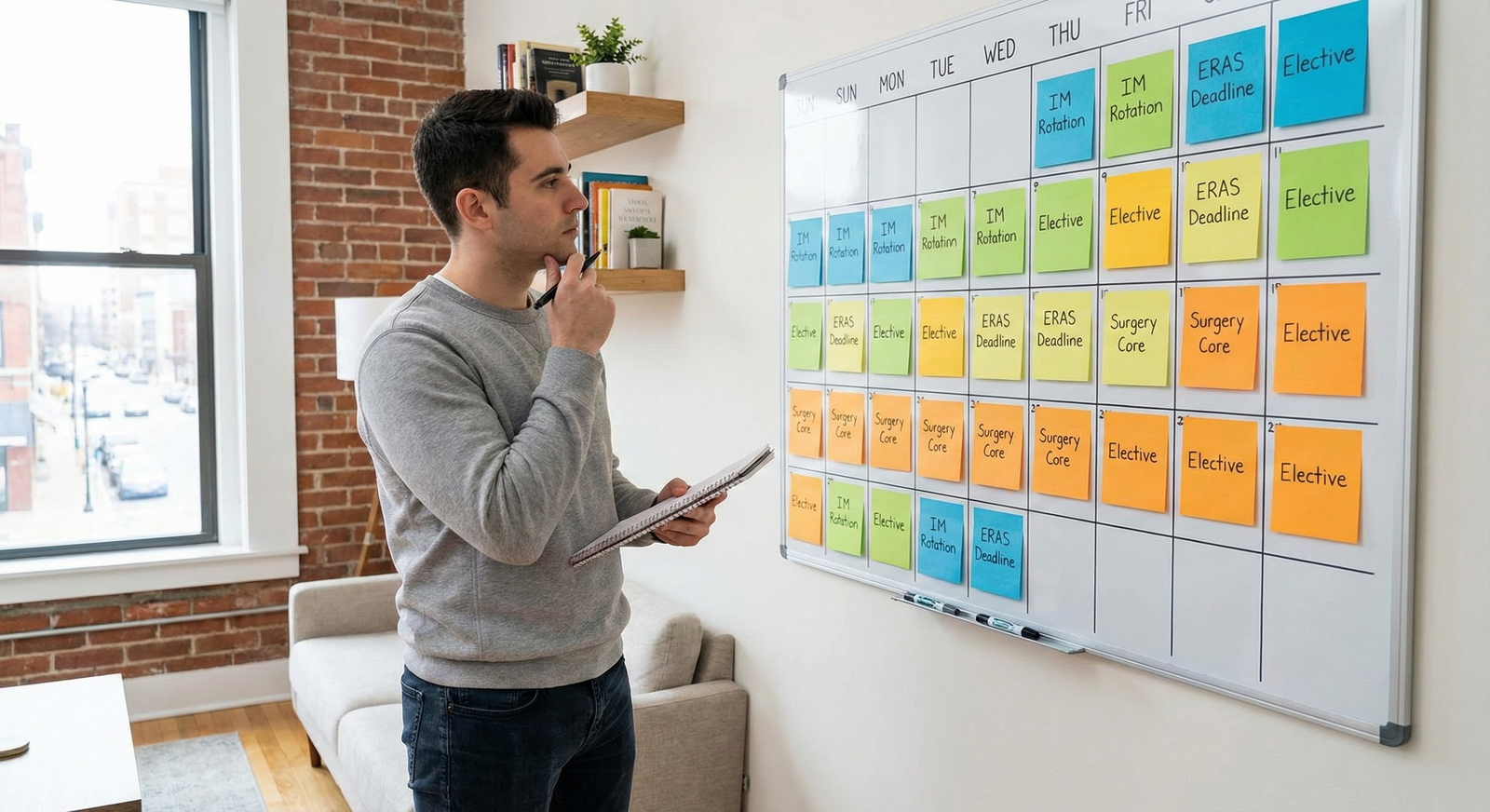
Timing is critical. An outstanding rotation is far more valuable if it occurs early enough to:
- Generate a letter of recommendation before ERAS submission
- Secure you a strong advocate within the program
- Leave room for follow-up communication prior to ranking
Ideal Timeline (for a Typical July–September ERAS Cycle)
Assuming you’re applying for a July start residency:
12–18 months before Match (Jan–June of the year before applying)
- Start researching:
- Family medicine residency programs friendly to non-US citizen IMGs
- Which programs offer visiting student/externship slots
- Contact program coordinators and international offices about eligibility:
- Ask specifically: “Do you accept non-US citizen IMGs for visiting rotations?”
6–12 months before ERAS (Sept–February)
- Submit rotation applications:
- VSLO/VSAS (if eligible)
- Direct application via institution websites
- Target rotations between March and August before the Match cycle.
3–6 months before ERAS opening (March–May)
- Complete at least one core family medicine away rotation:
- Seek feedback early, adjust, improve.
- Request a letter from a faculty member who has seen you extensively.
1–3 months before ERAS submission (June–August)
- Complete additional rotations (second or third FM rotation).
- Request letters immediately after each rotation:
- Give letter writers your CV, personal statement draft, and ERAS ID.
By ERAS Submission (September)
- Have at least two, ideally three US FM letters uploaded:
- From away rotations where you worked closely with attendings.
If You Are Late to Planning
If you cannot get rotations before ERAS:
- Still pursue rotations between September and January, because:
- Strong performance may trigger additional interview offers later in the season.
- You may gain advocates who can send “post-interview” or “update” emails on your behalf.
- Clearly mention ongoing rotations in:
- Your ERAS application
- Updates to programs
- Interview conversations

Maximizing Impact During Your Away Rotations
Once you secure rotations, the real work begins. As a non-US citizen IMG, you are often under closer scrutiny; you may not have the benefit of a US school’s reputation behind you. You must be deliberate about your performance and presence.
Behaviors That Programs Value in Family Medicine
Family medicine emphasizes interpersonal skills just as much as clinical knowledge. Programs look for:
Reliability and Work Ethic
- Arrive early, stay until work is complete.
- Volunteer for tasks: follow-up calls, discharge summaries, patient education.
- Submit notes and assignments on time, without needing reminders.
Teamwork and Communication
- Be respectful to nurses, MAs, front desk staff, and other students.
- Practice clear, concise communication when presenting patients.
- Ask clarifying questions rather than silently guessing.
Patient-Centered Care
- Demonstrate empathy and cultural sensitivity.
- Use layman’s terms when speaking with patients.
- Show interest in preventive care, social determinants of health, and chronic disease management.
Self-Directed Learning
- Identify your knowledge gaps and read about them the same day.
- The next day, mention briefly what you learned—this shows initiative.
Specific Actions to Take on Every Rotation
Clarify Expectations on Day 1
- Ask your attending or rotation director:
- “What are your expectations for a student at my level?”
- “How can I best contribute to the team?”
- This shows maturity and respect for structure.
- Ask your attending or rotation director:
Seek Feedback Early and Often
- Around mid-rotation, ask:
- “Could you give me feedback on how I’m doing and how I can improve for the rest of the rotation?”
- This opens the door for course-correction and demonstrates professionalism.
- Around mid-rotation, ask:
Signal Your Interest in Family Medicine and in the Program
- Tell your preceptors:
- “I am a non-US citizen IMG very interested in family medicine and in training in a community-focused program like this.”
- Ask about:
- The program’s culture
- Resident responsibilities
- Opportunities for underserved or global health work
- Tell your preceptors:
Build Relationships With Residents
- Residents often influence how attendings perceive you.
- Be helpful to residents: offer to pre-round, follow up labs, or prep discharge paperwork as allowed.
- Ask residents:
- “What do you think makes a student stand out on this rotation?”
Ask for a Letter of Recommendation the Right Way
- Near the end, if you have worked closely with an attending and received good feedback:
- “Dr. Smith, I’ve really valued working with you. I’m applying to family medicine residency. Would you feel comfortable writing me a strong letter of recommendation?”
- If they hesitate, ask another attending as well.
- Near the end, if you have worked closely with an attending and received good feedback:
Documenting and Showcasing Your Rotation Experience
Keep a simple log for each rotation:
- Dates, location, and supervising attendings
- Types of patients seen (e.g., chronic disease, pediatrics, geriatrics, OB)
- Procedures or skills you practiced (e.g., Pap smears, suturing, joint injections—if allowed)
- Feedback highlights and areas you improved
Use this information to:
- Tailor your personal statement to real experiences.
- Prepare concrete examples for interview responses (e.g., teamwork, conflict resolution, difficult patient encounters).
- Update your CV and ERAS details accurately.
Special Considerations: Programs, Visas, and Backup Strategies
Targeting Programs That Match Non‑US Citizen IMGs
Not every family medicine residency is equally open to foreign national medical graduates. To optimize the FM match, prioritize programs that:
- Have current or recent IMGs, especially non-US citizens.
- Clearly state that they sponsor J-1 visas (or rarely H-1B).
- Do not have strict cutoffs against older year of graduation if that applies to you.
Practical steps:
- Check program websites, resident bios, and social media.
- Use NRMP and FREIDA data to see:
- Percentage of IMGs in the program.
- Typical scores and preferences.
- Email the program coordinator briefly:
- “I am a non-US citizen IMG with [Step scores/highlights]. Does your program consider and sponsor foreign national medical graduates?”
Visa Planning for Rotations and Residency
You may face two levels of visa planning:
For the rotation itself:
- Some institutions accept B1/B2 visitors for short-term education.
- Others require specific educational or exchange visas.
- Clarify with each site’s international office:
- “Which visa types are acceptable for my visiting rotation as a foreign national medical graduate?”
For residency:
- Most family medicine programs sponsor J-1 visas through ECFMG.
- Fewer sponsor H-1B, and those may require all USMLE steps passed, including Step 3.
- If you strongly need H-1B, your away rotation strategy should target programs known to offer it.
Backup Approaches if Clinical Rotations Are Limited
If you cannot secure as many away rotations as you would like:
Maximize any US clinical experience you can obtain, even if not FM-specific:
- Internal medicine, pediatrics, urgent care, or community clinic rotations supervised by US attendings.
- Focus on letters that can comment on your work ethic, communication, and clinical reasoning.
Add non-clinical strengths:
- Research in primary care, population health, or quality improvement.
- Community volunteer work (free clinics, health education) that aligns with family medicine values.
Leverage home-country clinical leadership:
- If a US-style letter is not feasible, obtain a very detailed letter from a supervisor who can:
- Compare you to peers
- Highlight qualities valued in FM (compassion, continuity of care, adaptability)
- If a US-style letter is not feasible, obtain a very detailed letter from a supervisor who can:
FAQs: Away Rotation Strategy for Non‑US Citizen IMGs in Family Medicine
1. As a non-US citizen IMG, do I need away rotations to match into family medicine?
No, they are not absolutely required, but they are highly beneficial. For many non-US citizen IMGs, especially without significant prior US clinical experience, at least one or two high-quality US family medicine rotations greatly strengthen your application by providing:
- US clinical evaluation
- Strong US letters
- Familiarity with local systems and expectations
Without them, you will rely more on exam scores and non-US letters, which may be a disadvantage.
2. How many away rotations should I do if my budget is limited?
If your budget is constrained, prioritize 2 strong away rotations:
- Both directly in family medicine, at programs that:
- Accept and sponsor foreign national medical graduates
- Have a track record of matching IMGs
- Schedule them early enough to obtain letters before ERAS. Quality and timing matter more than doing 5–6 rotations that are weakly supervised or non-FM.
3. Should I choose away rotations only at my “dream” programs?
It’s wise to include some dream programs, but also:
- Choose a few programs where your profile (scores, graduation year, visa needs) matches their typical residents.
- Rotating at a slightly less competitive but IMG-friendly program may give you a better chance of a strong letter and higher ranking than rotating at a very prestigious place that rarely ranks IMGs highly.
4. Can observerships replace away rotations for FM match purposes?
Observerships are helpful but not equivalent to hands-on away rotations. They:
- Usually offer weaker opportunities to demonstrate independent clinical skills.
- May result in more generic letters.
If possible, use observerships as a supplement, not a replacement. If hands-on rotations are impossible, choose observerships at institutions with: - Active FM departments
- Attendings willing to observe and evaluate you closely
- Established history of working with IMGs
By choosing your rotations strategically, timing them well, and performing deliberately at each site, you can transform away rotations into one of the strongest pillars of your family medicine residency application as a non-US citizen IMG.