Why Away Rotations Matter So Much for US Citizen IMGs in Ophthalmology
For a US citizen IMG or American studying abroad, away rotations are one of the most powerful tools you have in the ophtho match. Ophthalmology is small, competitive, and relationship‑driven. As an international graduate, you often start with three disadvantages:
- Less name recognition of your medical school
- Fewer built‑in connections to US ophthalmology faculty
- Limited exposure to US clinical and evaluation systems
Well‑planned visiting student rotations can directly address all three. A strong away month:
- Lets programs see you as a real person, not just a score sheet
- Provides US-based ophthalmology letters of recommendation (LORs)
- Demonstrates that you can perform at the same level as US grads
- Helps you understand the culture and expectations of US training
This article walks through a step‑by‑step away rotation strategy for a US citizen IMG in ophthalmology: when to apply, where to rotate, how many away rotations to do, and how to perform in a way that actually changes your match odds.
Understanding the Role of Away Rotations in the Ophtho Match
What Away Rotations Actually Do for You
For ophthalmology, away rotations are almost a parallel application system. Programs often heavily favor applicants they’ve “seen”:
- Many residents matched at a program where they either did an away rotation or had a strong connection.
- Faculty frequently say, “We want people we know will do well here.”
- A strong rotation can convert a borderline paper application into a high‑priority interview and rank list candidate.
As a US citizen IMG, away rotations can:
Offset school name disadvantage
If you’re an American studying abroad at a lesser‑known school, a successful month at a well‑regarded US department shows that you can thrive in a high‑expectation environment, regardless of your school’s reputation.Generate crucial ophthalmology LORs
Competitive ophtho applications typically include:- 2–3 strong ophthalmology letters
- 1 additional letter (often medicine, surgery, or research mentor)
For IMGs, letters from non‑US faculty carry less weight. Away rotations let you secure letters from US ophthalmologists who are recognized within the specialty.
Give you a “home program substitute”
If your med school lacks a strong (or any) ophthalmology department, your main away rotation can function as a “pseudo‑home” program—a place where you are known to multiple faculty and residents.Provide US clinical experience (USCE) in your target specialty
Ophthalmology PDs worry whether IMGs understand US documentation, communication styles, and patient safety culture. Excellent performance on an away calms those concerns.
How Programs View Away Rotations for IMGs
Program directors and faculty often look for:
- Reliability and professionalism – showing up on time, appropriate communication, responding well to feedback.
- Clinical reasoning – not just memorized facts, but logical thinking about eye disease, systemic context, and work‑ups.
- Teachability – willingness to learn, humility, progressive improvement.
- Fit with the team – how well you integrate with residents and staff.
For IMGs, some programs may cautiously ask, “Will this person transition smoothly into our system?” A strong away rotation answers “yes” through your daily behavior.
Planning Your Away Rotations: Timing, Number, and Target Programs

When to Do Ophthalmology Away Rotations as a US Citizen IMG
The ideal timing depends on your school’s calendar, but some general principles apply.
Target window:
Late 3rd year to early 4th year (US PGY-0 equivalent)
For the SF Match (ophthalmology) with applications typically due around August–September:
Primary away rotation:
- Preferably March–May before application submission
- Allows time to secure and upload LORs for the ophtho match
Secondary away rotations:
- June–September can still be helpful
- Even if letters are late, they can influence interview invitations and rank decisions
- They also serve as “second looks” if you’re interested in that program.
As a US citizen IMG, you may face logistical delays (visa issues usually less of a problem for US citizens, but institutional clearance, immunization requirements, documentation from an international school, etc.). Start planning 9–12 months in advance.
How Many Away Rotations Should You Do?
The question “how many away rotations should I do?” is common, especially for those trying to overcome the IMG label. There’s no universal number, but some guidelines:
- Typical US MD/DO applicant:
- 1–3 ophthalmology away rotations total
- US citizen IMG / American studying abroad:
- 2–3 well‑chosen ophthalmology away rotations often makes sense
- Quality > quantity; 3 excellent rotations beats 5 rushed, mediocre ones
Over‑scheduling can backfire:
- Fatigue and burnout lead to weaker performance
- Less time to prepare for interviews, Step 2 CK, or research outputs
- Financial and logistical strain (travel, housing, visa letters from schools, etc.)
For most US citizen IMGs, a robust rotation strategy might look like:
- 1 “anchor” away rotation at a mid‑to‑high tier academic program that is relatively IMG‑friendly
- 1–2 additional away rotations at programs where:
- You have geographic or personal ties (e.g., your home state)
- They’ve previously accepted US citizen IMGs
- Your profile (scores, research, language skills) matches what they value
Choosing Target Programs Strategically
When deciding where to do visiting student rotations, consider:
IMG-Friendliness and Past Match Patterns
- Look at recent resident rosters on program websites:
- Are there IMGs?
- Are there US citizen IMGs specifically?
- If a program has never had an IMG resident, it may be a much steeper hill.
- Look at recent resident rosters on program websites:
Geographic Fit
Programs are more receptive when you can make a genuine case that you’d stay long-term:- “Grew up in this state”
- “Family in the area”
- “Spouse/partner works nearby”
Program Tier and Realistic Reach
- If you have excellent scores and research, include at least one higher‑tier program where an away could get you noticed.
- If your metrics are more average, focusing on mid‑tier, IMG‑friendly programs may yield more realistic offers.
Presence of a Home Ophthalmology Department
- If your international school has limited ophtho exposure, heavily prioritize US programs with strong teaching infrastructure (residents, fellows, regular teaching conferences, research).
Administrative Openness to IMGs
- Some VSLO/VSAS listings or program websites clearly state:
- “We accept international medical students” or
- “We only accept students from LCME- or COCA-accredited schools”
- As a US citizen IMG, you still count as an international student in most administrative systems, so be sure they will actually process your application.
- Some VSLO/VSAS listings or program websites clearly state:
Application Logistics for Visiting Ophthalmology Rotations as a US Citizen IMG
Using VSLO and Direct Applications
Many ophthalmology residency programs offer rotations through VSLO (Visiting Student Learning Opportunities). However, not all international schools are in VSLO. As a US citizen IMG, you may need a hybrid approach:
- Check if your school participates in VSLO
- If yes, apply normally through the portal, but double‑check programs’ policies on international schools.
- For non‑VSLO schools or programs
- Look on the program’s website for:
- “Visiting Students,” “International Students,” or “Clinical Electives” pages
- Email the medical student coordinator if details are unclear.
- Look on the program’s website for:
When emailing, be concise, professional, and specific. For example:
I am a US citizen medical student at [International School], interested in a visiting ophthalmology rotation between [dates]. I saw your department hosts visiting students and wanted to ask if you accept applications from US citizen IMGs trained abroad and what the process would be.
Documents Typically Required
Expect to provide:
- Dean’s letter or certification of good standing
- Transcript (translated and graded as needed)
- USMLE/COMLEX score reports (Step 1 often required; some may prefer Step 2 CK score if available)
- Immunization records and TB testing
- Proof of malpractice coverage (through your school or private insurance)
- Health insurance documentation
- Background check and/or drug screen (varies by institution)
- CV and personal statement (sometimes ophtho‑specific)
Start gathering these months in advance; international schools often need time to generate and verify documents.
Tuition, Fees, and Logistics
As a US citizen IMG, you often face:
- Application fees for each visiting rotation
- Tuition or administrative fees for the rotation itself (especially at private institutions)
- Housing and transportation in the rotation city
Build a realistic budget for 2–3 away rotations:
- Airfare or long‑distance travel
- Short‑term housing (student housing, extended‑stay hotels, or sublets)
- Daily costs (food, transit, etc.)
Financial planning matters: having to cancel a rotation due to costs can disrupt your entire ophtho match strategy.
How to Excel on Ophthalmology Away Rotations as a US Citizen IMG
Pre‑Rotation Preparation: Arrive Ready
Preparation is where you can close a lot of the IMG gap.
Review core ophthalmology topics:
- Common conditions: cataract, glaucoma, diabetic retinopathy, macular degeneration, retinal detachments, uveitis, pediatric eye disorders
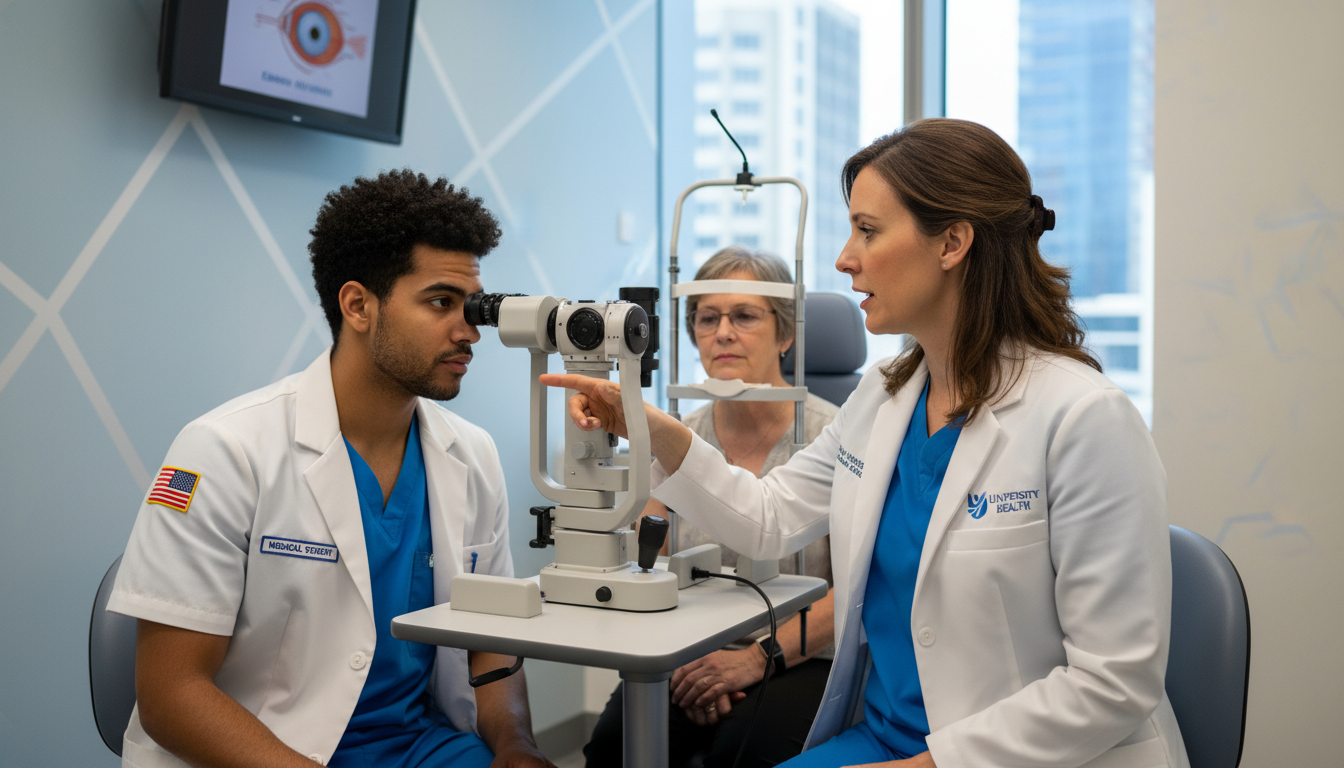
- Eye anatomy and exam techniques: visual acuity, tonometry, slit lamp basics, fundus exam, pupils and visual fields
Practice US‑style presentations:
- Focused, problem‑based, concise:
- “This is a 67‑year‑old with progressive, painless vision loss over 6 months, likely age‑related cataract; main question is timing of surgery and ruling out significant macular pathology.”
- Focused, problem‑based, concise:
Know basic systemic connections:
- Hypertension, diabetes, autoimmune disease, infectious causes (e.g., syphilis, TB, toxoplasmosis), and medications that affect the eye (steroids, hydroxychloroquine, etc.).
Review basic ophthalmology terminology and abbreviations:
- OD, OS, OU; IOP; C/D ratio; BCVA; VE; VF; etc.
Entering “cold” and expecting to learn everything from scratch in four weeks is risky, especially for an IMG.
What Residents and Attendings Expect from Visiting Students
You are not evaluated as a mini‑resident but as a learner with a lot of potential. To stand out, focus on:
Professionalism and reliability
- Arrive early, stay until the work is done (within reason)
- Be proactive in asking where you’re needed
- Communicate any absences or conflicts well in advance
Eagerness to learn
- Ask thoughtful, focused questions
- Accept feedback without defensiveness (“Thank you, I’ll work on that”)
- Read about your patients after clinic and show improvement the next day
Teamwork and humility
- Be kind to nurses, techs, and front desk staff—everyone’s feedback can reach the PD
- Offer help with simple tasks: rooming patients, checking vision, basic documentation (if allowed)
Consistent, gradual improvement
- If you struggle with the slit lamp on day 1, don’t panic. Show clear progress by week 2–3.
Clinical Skills to Focus On
You don’t need to be an expert, but you should work towards:
- Obtaining a focused history for common eye complaints
- Measuring and documenting visual acuity
- Performing basic pupil exams and confrontation visual fields
- Getting comfortable with slit lamp usage (even just anterior segment exam)
- Recognizing obvious pathology: hyphema, corneal ulcer, cataract, vitreous hemorrhage, retinal detachment “red flags”
Ask residents, “What’s reasonable for a student to learn and be able to do independently by the end of this month?” Then aim to exceed that.
Building Relationships and Signaling Interest
Relationships matter more than you might think—especially for US citizen IMGs with fewer natural connections.
- Introduce yourself early and clearly as a US citizen IMG:
- Some may assume you’re a US MD student if you don’t clarify, which can affect how they think about your application later.
- Express sincere interest in the program, but avoid sounding desperate:
- “I really enjoy the teaching and camaraderie here. This is the kind of environment I’d like for residency.”
- Attend conferences, grand rounds, and journal clubs consistently.
- Ask for feedback midway through the rotation:
- “Are there any areas I can improve on in these last two weeks to be as strong a student as possible?”
Faculty and residents who feel personally invested in you are more likely to advocate for your interview and ranking.
Securing Strong Letters of Recommendation
For a US citizen IMG, letters from US ophthalmologists may make or break your ophtho match.
Strategies:
Identify likely letter writers early:
- Attendings you work with frequently
- Faculty who see your progress and engagement
Ask explicitly and professionally:
- Toward the last week:
- “I’ve really valued working with you. I’m applying to ophthalmology as a US citizen IMG and your perspective would mean a lot. Would you feel comfortable writing me a strong letter of recommendation?”
- Toward the last week:
Provide support materials:
- Updated CV
- Brief personal statement or summary of your motivations for ophthalmology
- Bullet list of patients/cases or projects you were involved in with that attending
Clarify deadlines (SF Match vs ERAS timeline):
- Make sure they understand the ophtho match timing and where to upload letters (SF Match portal, institutional letter system, etc.).
Strong letters often mention:
- How you compare to US students they’ve worked with
- Specific examples of your initiative, growth, and bedside manner
- Their willingness to advocate for you as a resident
Integrating Away Rotations Into Your Overall Ophtho Match Strategy
Coordinating Ophtho Away Rotations with the Rest of Your Application
Away rotations are only one piece. As a US citizen IMG, you need a cohesive strategy:
Exams:
- Aim for strong Step 2 CK (Step 1 is now pass/fail, amplifying Step 2 importance).
Research:
- Any ophthalmology or vision‑science research is a plus; case reports, retrospective studies, or QI projects can all help.
- If possible, tie research to your away rotation institution—ask if you can contribute to ongoing projects during or after your month.
Personal Statement:
- Highlight:
- Why ophthalmology, specifically
- How your international training adds value (cultural competency, resilience, adaptability)
- How your away rotations confirmed your commitment
- Highlight:
Geographic signaling:
- Use your away rotations to show clear regional interest:
- “Completed visiting student rotations at X and Y in the Midwest, where my family lives and where I intend to practice.”
- Use your away rotations to show clear regional interest:
Using Away Rotations as “Auditions” and “Reconnaissance”
Think of each rotation as both:
An audition for them:
- They evaluate whether you are safe, teachable, professional, and a good fit.
Reconnaissance for you:
- You evaluate whether you can see yourself thriving in that program for 3–4 years:
- Resident happiness
- Faculty approachability
- Surgical volume and variety
- Support for research, global health, or subspecialty interests
- You evaluate whether you can see yourself thriving in that program for 3–4 years:
You are not obligated to love every program you rotate at. It’s better to learn that you and a program are not a good fit before the match than after.
Frequently Asked Questions (FAQ)
1. As a US citizen IMG, is it possible to match ophthalmology without any away rotations?
It is possible but significantly harder. Without US ophthalmology away rotations, you may lack:
- US‑based ophtho letters of recommendation
- Direct advocates within the field
- Evidence that you can function in a US eye clinic system
For most US citizen IMGs, at least one strong away rotation is highly recommended; two to three can substantially strengthen your ophtho match chances.
2. How many away rotations are too many for ophthalmology?
More than 3 ophthalmology away rotations is often unnecessary and may be counterproductive, especially if:
- Your performance declines due to fatigue
- You have no time to finalize applications, study for Step 2 CK, or complete research
- The later rotations don’t add new geographic or program‑type diversity
For most US citizen IMGs: 2–3 well‑planned away rotations is a strong strategy.
3. Should I choose an away rotation at a “top‑tier” program or a more IMG‑friendly mid‑tier program?
Balance both. As a US citizen IMG:
- Consider one reach rotation at a higher‑tier program where you are at least statistically competitive (good scores, solid research).
- Prioritize 1–2 rotations at clearly IMG‑friendly or mid‑tier programs where it is realistic to be interviewed and ranked highly.
Always review current resident rosters and ask mentors who know ophtho programs well.
4. When should I ask for letters during an away rotation, and what if I’m not sure a faculty member will be positive?
Ask in the last week of the rotation, after you’ve had significant contact with the attending. Use language that gently checks whether their letter will be supportive:
“Would you feel comfortable writing a strong letter of recommendation for my ophthalmology application?”
If they hesitate or respond vaguely, it may be better to seek a letter from someone who is clearly enthusiastic about your performance.
A carefully planned away rotation strategy can transform how programs perceive a US citizen IMG in ophthalmology. By selecting the right programs, preparing thoroughly, performing consistently, and securing strong letters, you can turn your status as an American studying abroad from a liability into a story of resilience and added value in the US ophthalmology workforce.