
Why Away Rotations Matter So Much in ENT
Otolaryngology–Head and Neck Surgery (ENT) is one of the most competitive specialties in the Match. For many programs, away rotations are “month‑long auditions” that can significantly influence interview offers and rank lists. Used thoughtfully, visiting student rotations can turn a solid application into a standout one; used haphazardly, they can drain time, money, and energy without much return.
This guide focuses specifically on away rotation strategy in otolaryngology—how to decide if, where, and how many away rotations to do, and how to maximize your impact once you’re on service.
We’ll walk through:
- Strategic goals of ENT away rotations
- Choosing programs and planning your rotation schedule
- Application logistics and timelines
- Performance strategies during your month
- How to leverage away rotations in the otolaryngology match
Throughout, you’ll find practical checklists and examples tailored to aspiring ENT residents.
1. Clarifying Your Goals: Why Are You Doing Away Rotations?
Before asking how many away rotations you should do, start with a more fundamental question:
What are you trying to achieve with visiting student rotations in ENT?
Most students have one or more of these goals:
- Get a strong ENT letter of recommendation (LOR) from a well‑known faculty member.
- Demonstrate “fit” and interest at specific target programs.
- Compensate for application weaknesses (limited ENT exposure, lower board scores, late career decision).
- Clarify what you want (academic vs community, strong operative experience vs research, geographic preferences).
- Network within the specialty to build relationships that outlast the match cycle.
Be candid with yourself: away rotations are stressful, expensive, and time‑intensive. Understanding your primary objectives helps you:
- Decide whether an away is necessary.
- Prioritize which programs to visit.
- Decide whether that third or fourth away is truly worth it.
Rule of thumb:
If you already have:
- A strong home ENT department
- 2–3 excellent ENT letters,
- Strong board scores and clinical grades, and
- Reasonable geographic flexibility
…your marginal benefit from many additional away rotations may diminish. On the other hand, if you lack a home ENT program or home‑institution letters, away rotations become almost essential.
2. How Many Away Rotations in ENT? Strategic Planning and Timing
2.1 Typical Number for Otolaryngology Applicants
In recent years, most competitive ENT applicants complete:
- 1 home ENT rotation (sometimes 2)
- 2 away rotations in ENT
Some do 3 away rotations, particularly if:
- They don’t have a home ENT program, or
- They are concerned about competitiveness (marginal Step scores, fewer honors, late switch to ENT).
However, more away rotations are not always better:
- You risk burnout before interview season.
- The quality of your performance may drop by your 3rd–4th month.
- Programs may wonder why you needed so many auditions.
For most applicants, an effective approach is:
- Strong home rotation + 2 targeted away rotations = a solid, balanced strategy.
2.2 Timing: When to Schedule ENT Away Rotations
For the current ERAS and otolaryngology match timelines, consider:
Core ENT/home rotation:
- Ideally: late 3rd year or very early 4th year (April–June)
- Purpose: confirm interest, get your first ENT letter, build foundational skills.
Away Rotations:
- Most students aim for: June–October of 4th year.
- Best months for maximum impact: July–September
- Attending faculty are back from spring/summer breaks.
- You can secure letters in time for ERAS submission.
- Programs remember you when building interview lists.
Avoid if possible:
- November–December aways for your first ENT exposure—too late for letters and for shaping your application. These months can still be useful for networking or late program discovery but won’t influence initial interview invitations much.

3. Choosing Where to Rotate: Building a Targeted ENT Away List
3.1 Start with Honest Self‑Assessment
Your ENT away rotation strategy should match your competitiveness profile. Consider:
- USMLE/COMLEX scores (or pass/fail context)
- Clinical grades, particularly in surgery/IM
- Research experience in ENT or related fields
- Strength of your home institution ENT department
- Geographic ties or limitations
- Underrepresented status or non‑traditional background (which may influence targeted programs or pathways)
Using this, categorize yourself roughly as:
- Highly competitive (strong scores or honors, strong research, home ENT program support)
- Average competitive (solid but not standout metrics)
- At‑risk/under the mean (one or more significant weaknesses, late decision to ENT, or no home program)
Your category doesn’t dictate whether you can match; it simply helps you be realistic and strategic about away rotation choices.
3.2 Types of Programs to Consider
When selecting specific away rotations, think in “buckets”:
Realistic “reach” programs
- Places that might be slightly above your statistical profile but still within range, especially if your personality and work ethic can shine in person.
- Example: Highly academic programs if you have strong research but slightly below‑average Step.
Target programs
- Institutions whose residents and match lists look similar to your profile.
- Programs in regions where you have strong geographic ties.
Safety/anchor programs
- Programs more likely to rank you highly after a successful audition.
- May be slightly less research‑heavy or more community‑based.
A typical structure for 2 away rotations:
- 1 “reach/target” academic program
- 1 “target/anchor” program with realistic match potential
3.3 Geographic Strategy
Think beyond “I like the coasts” or “I want a big city.” Instead:
- Identify where you would actually be happy to live for 5 years.
- Recognize that ENT is regional—programs often favor applicants with genuine ties to the area.
Examples:
- If you grew up in the Midwest and went to medical school on the West Coast, a Midwest away can reaffirm your commitment to returning.
- If your partner’s job is location‑dependent, away rotations in that region signal sincerity about staying.
3.4 Research Fit and Program Culture
Look for:
- Programs with faculty in your area of interest (pediatrics, head & neck, otology, facial plastics).
- A resident cohort whose culture matches your personality (highly academic vs clinically busy; collegial vs more hierarchical).
To assess this:
- Talk to your home ENT residents about places they know.
- Attend national ENT student/resident events (AAO‑HNSF, COSM, specialty interest group meetings).
- Read resident bios and fellowship outcomes on departmental websites.
3.5 Programs to Avoid or Approach with Caution
- Programs where your application is very far out of range (e.g., major step failures + ultra‑elite, research‑heavy programs with extremely low variance).
- Institutions with a historical reputation for heavy service load and minimal teaching, unless you’re sure you can thrive and still show your best self.
- Programs where you’ve received clear messaging from mentors that your profile is a poor fit for specific reasons (e.g., strong emphasis on pedigree and you lack that background).
4. Application Logistics: VSLO, Timing, and Preparation
4.1 Understanding the VSLO/VSAS Process
Most U.S. away rotations go through the AAMC Visiting Student Learning Opportunities (VSLO) system (formerly VSAS). Key points:
- Application windows often open February–April for rotations starting in summer and fall.
- Programs vary in their deadlines and response times; some are first‑come, first‑served, others review after a set date.
- Requirements may include:
- Immunization records and TB testing
- Background checks and drug screening
- Proof of malpractice coverage
- BLS/ACLS certification
- Transcript and Step scores
- Statement of interest or personal statement
4.2 Building a Timeline
Work backwards from your ideal rotation months. For example:
December–January (M3):
- Decide on your specialty (or narrow down to top 1–2).
- Meet with ENT faculty advisor or clerkship director.
- Roughly map out home rotation and away rotation months.
February–March (M3):
- Finalize your target list of away programs (including backup options).
- Collect documentation for VSLO (vaccines, certifications).
- Draft short statements of interest tailored to specific programs.
March–May (M3):
- Submit VSLO applications as early as each program allows.
- Be ready for rolling acceptances and potential schedule shuffling.
April–June:
- Confirm rotation months and arrange housing and travel planning.
- If needed, adjust your schedule for Step 2 CK and sub‑Is.
4.3 Contingency Planning and Backup Options
Away rotations can be unpredictable:
- You might not get your top choice months.
- Some programs over‑accept then revoke if they overfill.
- Scheduling conflicts may arise with home requirements.
To protect yourself:
- Apply to a few more programs than the minimum you think you need but be ready to decline excess offers quickly and professionally.
- Have backup plans such as:
- Another ENT away at a different institution.
- A strong general surgery or ICU sub‑I if an ENT away falls through.
- Communicate clearly with your dean’s office about schedule constraints.
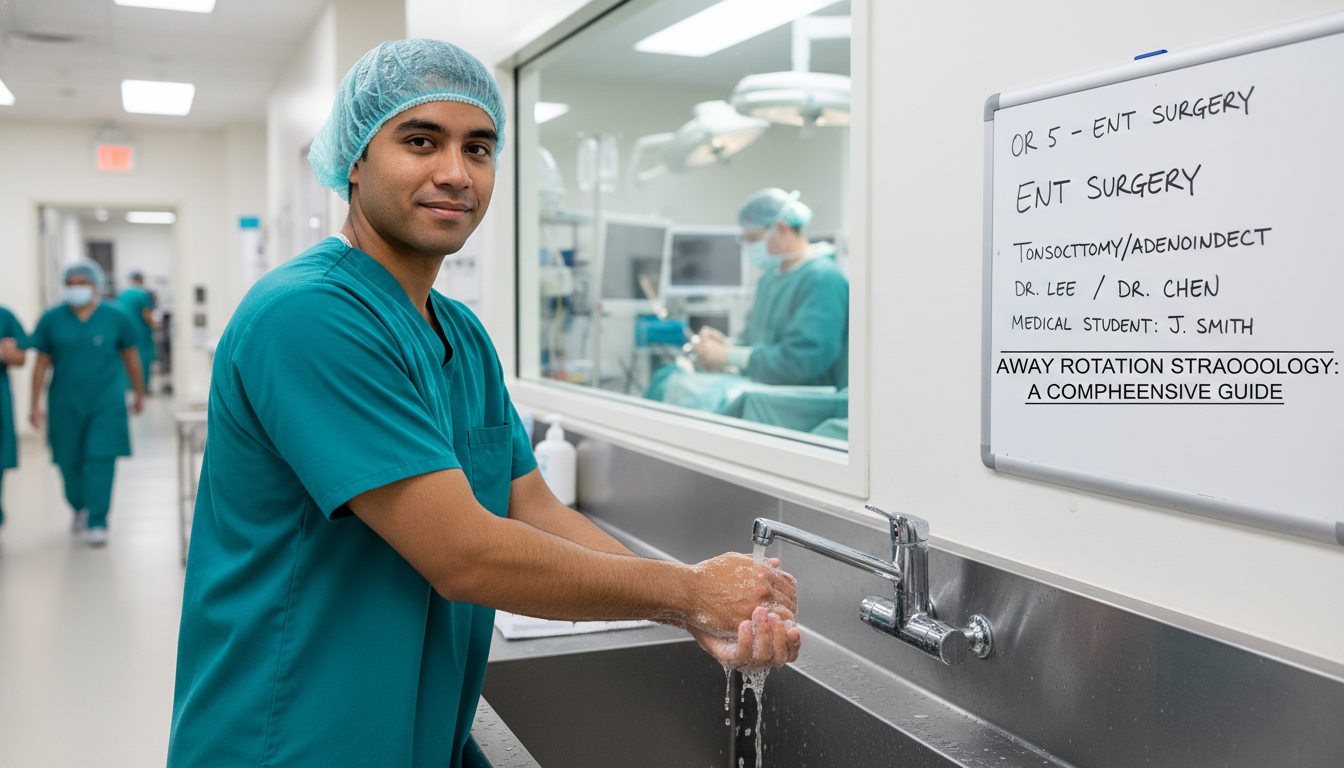
5. Succeeding on Your ENT Away: What Programs Look For
Once you arrive, every day is part of your informal interview. Your goal: become a trusted, low‑maintenance, high‑value member of the team.
5.1 Core Expectations of ENT Away Rotators
Faculty and residents are paying attention to:
Work ethic and reliability
- Arrive early, stay until work is done.
- Own your responsibilities (notes, pre‑rounds, follow‑up).
- Follow through on tasks without reminders.
Team attitude and professionalism
- Be pleasant, respectful, and adaptable.
- Support co‑students rather than compete openly.
- Accept feedback gracefully.
Coachability and growth
- Show that you improve week to week: in note‑writing, presentations, OR skills, and clinical reasoning.
- Ask for targeted feedback: “How can I make my presentations more efficient?”
Clinical reasoning and curiosity
- Read ahead on common ENT consults: epistaxis, airway obstruction, tonsillitis, neck masses, facial trauma, otitis media, sinusitis.
- Offer concise, evidence‑based assessments and plans appropriate to your level.
Genuine interest in ENT and the program
- Ask thoughtful questions about cases and management choices.
- Show that you understand what makes that particular program unique.
5.2 Practical Behavior Checklist
On day 1–3:
Learn the workflow and expectations:
- When and where does sign‑out happen?
- How are consults triaged and assigned?
- How does the team divide floor work vs OR?
Introduce yourself to residents, advanced practice providers, and nurses. These people will often be asked for informal opinions about you.
Ask your senior:
- “How can I be most helpful to the team?”
- “Are there particular attendings I’ll be working closely with that I should prepare for?”
Daily habits:
- Arrive early enough to pre‑round on your patients and be prepared for attending rounds.
- Pre‑chart on OR cases: know indications, brief anatomy, and steps of the procedure.
- Carry a small notebook or digital note system for tasks, teaching points, and questions.
In the OR:
Introduce yourself to everyone in the room (scrub tech, circulator, anesthesiologist).
Be proactive but not pushy about helping:
- Set up headrests, help position, know how to plug in the endoscope or microscope.
- Ask residents where to stand to avoid obstructing the view.
Ask one or two thoughtful questions per case—after demonstrating you’ve already read the basics.
5.3 Common Pitfalls and How to Avoid Them
Overcompensating with excessive assertiveness
- Pitfall: Interrupting, overly aggressive self‑promotion, or constantly asking to scrub when the case is packed.
- Fix: Focus on being helpful, not visible. The right people will notice substantive contributions.
“Shadowing” mindset
- Pitfall: Standing silently in the back, waiting to be told what to do.
- Fix: Ask the senior resident, “Is there a role I can play in this clinic/OR? Can I see new patients first or scribe for you?”
Complaining or gossiping
- Pitfall: Venting about long hours, schedules, or other students.
- Fix: Reflect frustration privately; present professional positivity on service.
Lack of follow‑through
- Pitfall: Not checking up on labs or consult recommendations you were assigned.
- Fix: Use checklists or reminders. Report back to the resident that tasks were completed.
5.4 How to Stand Out (for the Right Reasons)
Become the go‑to person for something small but valuable:
- Keeping an updated list of consults.
- Preparing a short 3–5 minute chalk talk (e.g., “Approach to Epistaxis” or “Initial Workup of a Neck Mass”) if your team likes learner presentations.
- Knowing where essential ENT instruments are in clinic or ED.
Build genuine relationships with residents:
- Ask about their path to ENT, what surprised them in residency, what they like about the program.
- These conversations often naturally lead to informal advocacy.
Demonstrate progress:
- If your first day’s consult note was too long, show by week 2 that you’ve become concise and structured.
- If your initial OR positioning was off, ask for tips and show visible improvement next case.
6. Turning Your Away Rotation into Match Momentum
6.1 Securing Strong Letters of Recommendation
ENT is a small community; letters from certain faculty carry significant weight. To maximize your chances:
- Identify 1–2 attendings you worked with consistently during the month.
- Ask your senior resident who might be the best letter writer based on your performance and exposure.
- Time your request:
- Ideally near the end of the rotation when your work is fresh in their mind.
- Be specific: “I really enjoyed working with you this month and learning in your clinic and OR. Would you feel comfortable writing a strong letter of recommendation for my otolaryngology application?”
Provide:
- Your CV
- A draft of your personal statement (even if evolving)
- A brief summary of cases or patients you were involved in that highlight your work ethic or growth
6.2 Communicating Continued Interest
After your rotation:
- Send a thank‑you email to key faculty and residents:
- Mention specific experiences or teaching moments you appreciated.
- Briefly affirm your interest in the program if it’s true.
Example:
“My month with your department strongly confirmed my interest in pursuing residency at [Program]. I was especially impressed by the collegial culture and the mentorship in head and neck oncology.”
Later, as interview season approaches, it’s acceptable to send one short update if there’s major news (e.g., new ENT publication, award, Step 2 score).
6.3 How Programs Use Away Rotations in Their Decisions
Different programs weigh away rotations differently, but common patterns include:
Programs may heavily favor rotators on their rank list if:
- They demonstrated strong work ethic, fit, and collegiality.
- They obtained an excellent internal letter.
Some programs expect that serious applicants will rotate there, especially highly competitive or geographically insular ones.
Conversely, a mediocre or poor performance on an away rotation can hurt more than not rotating at all.
Because of this, it’s better to:
- Do fewer rotations very well than many rotations where you are stretched thin and perform inconsistently.
6.4 Integrating Away Rotations into Your ERAS Application
Use your application to connect the dots:
- In your personal statement, mention specific experiences from your away rotations that shaped your view of ENT or your career goals.
- In your program‑specific signaling or preference communication (if available), highlight that you rotated at that institution and what you learned about their culture.
- During interviews, be ready with examples:
- “During my rotation at [Program], I saw how your residents managed complex airway cases and coordinated multidisciplinary care…”
FAQs About ENT Away Rotations and the Otolaryngology Match
1. How many away rotations should I do for ENT?
For most otolaryngology applicants, 2 away rotations in addition to a home ENT rotation is a strong strategy. Some students—especially those without a home ENT program or who decided on ENT late—may benefit from a 3rd away rotation. More than 3 generally has diminishing returns and increases risk of burnout. Quality of performance is more important than quantity.
2. Is it bad if I can only do one away rotation?
Not necessarily. If you:
- Have a home ENT program where you can obtain strong letters and mentorship, and
- Use your single away rotation at a strategically chosen program (ideally in your top geographic or academic preference area),
…you can still present a compelling application. Use other fourth‑year rotations (surgery sub‑Is, ICU, strong electives) to demonstrate readiness for residency and request non‑ENT letters that emphasize your surgical work ethic and clinical judgment.
3. Should I prioritize away rotations at “top‑tier” academic programs?
That depends on your goals and competitiveness. If you have strong metrics and research, a prestigious program away might help you match at that institution or similar ones. However:
- If a program is far above your profile, the away may not translate into an interview or high rank.
- Away rotations at mid‑tier or regionally strong programs where you are a better fit can often yield stronger advocacy and higher rank placement.
A balanced approach—one “reach” and one “target/anchor”—usually works best.
4. How do I know if my away rotation went well?
Signs you made a good impression include:
- Residents start trusting you with more responsibility and independent patient evaluations.
- Faculty call you by name and ask your opinions on plans.
- You’re invited to social events with residents.
- A faculty member readily agrees to write you a strong letter of recommendation.
Even without direct feedback, if you consistently worked hard, were teachable, stayed professional, and showed improvement over the month, your rotation likely helped your candidacy.
Thoughtful planning and execution of your ENT away rotation strategy can substantially strengthen your position in the otolaryngology match. By clarifying your goals, choosing rotations strategically, and performing at your best during each month, you convert “audition electives” into genuine opportunities for mentorship, learning, and ultimately, a successful match into otolaryngology.