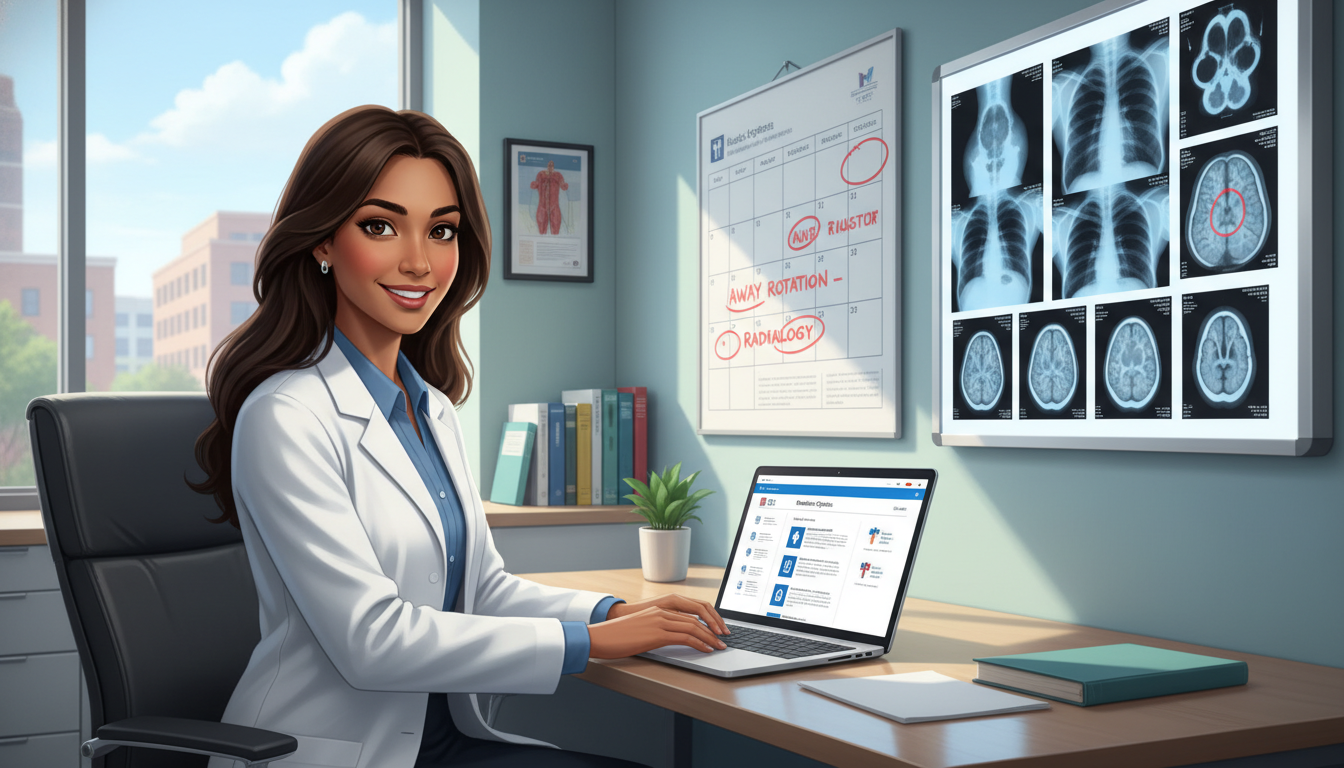
Away rotations can be a powerful leverage point for an MD graduate residency application—especially in Diagnostic Radiology. But they can also be expensive, time‑consuming, and, if chosen poorly, low yield. This guide will walk you through how to build a smart away rotation strategy specifically tailored to an MD graduate targeting an allopathic medical school match in diagnostic radiology.
Understanding the Role of Away Rotations in the Diagnostic Radiology Match
Before deciding how many away rotations to pursue—or where—clarify why you’re doing them and what they can realistically accomplish in the diagnostic radiology match.
What Away Rotations Can Do for You
For an MD graduate seeking a radiology residency, away rotations (often called visiting student rotations or “auditions”) can:
- Provide program‑facing evidence of fit
- Show how you function in a clinical environment
- Demonstrate reliability, work ethic, and collegiality
- Generate strong, targeted letters of recommendation
- Radiology programs value letters from radiologists who know you well
- A successful away rotation can yield a “glowing” letter focused on your work with imaging and clinical reasoning
- Expand your network
- Meet faculty and current residents who can advocate for you
- Gain informal guidance about the program’s culture and expectations
- Strengthen your allopathic medical school match prospects
- Doing well at a particular institution can increase your chance of matching there
- Shows you can integrate into a new academic environment and a different radiology practice style
- Demonstrate geographic interest
- Helpful if you are trying to move to a new region or back to a specific area (e.g., family, partner)
What Away Rotations Cannot Fix
Away rotations are not a magic eraser for every application weakness. They typically cannot fully compensate for:
- Significantly below‑average board scores
- Major professionalism concerns
- Repeated exam failures or severe academic difficulties
However, for an MD graduate with borderline or modestly below average metrics, a strong performance on visiting student rotations—paired with excellent letters and a coherent narrative—can meaningfully improve the diagnostic radiology match outcome.
Is an Away Rotation Necessary for Radiology?
Diagnostic Radiology is a relatively competitive specialty, but not at the level of neurosurgery or derm. You do not need an away rotation to match, especially if:
- You have access to a home radiology department
- You can obtain strong home‑institution radiology letters
- You’re flexible about program prestige and geography
An away rotation becomes more important if:
- You don’t have a home diagnostic radiology program
- You’re applying from a smaller or less well‑known medical school
- You’re targeting highly competitive academic programs
- You have a geographic preference outside your home region
In short: away rotations are optional but strategically useful—particularly when used to support a thoughtful overall application plan.
How Many Away Rotations Should an MD Graduate Do?
For most MD graduates asking “how many away rotations should I do for radiology residency?”, the practical sweet spot is 1–2 away rotations, occasionally 3 in specific circumstances.
General Recommendations
1 Away Rotation (Most Common, High Yield)
Ideal for MD graduates who:
- Have a home radiology program and can obtain 2+ strong letters there
- Want to demonstrate interest in one key geographic area or institution
- Are conscious of cost and scheduling and want to minimize time away
2 Away Rotations (Selective, Strategic Use)
Consider 2 away rotations if:
- You lack a home diagnostic radiology program, or your home letters will be weaker
- You’re aiming for competitive academic centers and want more exposure
- You want to show commitment to two distinct regions (e.g., West Coast and Midwest)
- You are okay with significant travel, housing, and time costs
3 Away Rotations (Upper Limit, Use Cautiously)
Three away rotations might be reasonable if:
- You are an MD graduate without a home program and:
- Need multiple radiology letters
- Are changing regions or coming from a less recognized school
- You have significant red flags and are trying to maximize face‑time and letters
But be careful:
- Too many away rotations can raise questions about why you need that much external validation.
- It can also burn you out and leave little time for research, Step 2/COMLEX Level 2 prep, or personal wellness.
>3 Away Rotations (Rarely Justified)
Usually not recommended:
- Financially and logistically burdensome
- Marginal incremental benefit after your second strong rotation
- Missing diminishing returns: after a few good letters and strong performance, more away time doesn’t add much

Choosing the Right Programs for Away Rotations
Where you rotate is almost as important as how you perform. For a diagnostic radiology match, your away rotation sites should be deliberately chosen, not just wherever has an open slot.
1. Prioritize Programs That Match Your Goals
Clarify your primary goal for each away rotation:
- Goal: Increase chance of matching at a specific program
- Choose that program (or a close regional peer) as an away rotation site
- Aim to rotate in the main diagnostic radiology service, not just subspecialties
- Goal: Strengthen allopathic medical school match prospects generally
- Target a well‑respected academic center in your desired region
- Look for programs with a track record of graduating residents into fellowships/jobs you’d want
- Goal: Compensate for limited home resources
- Seek programs with strong teaching cultures and enthusiastic student involvement
2. Academic vs. Community vs. Hybrid Sites
Academic Medical Centers
- Pros:
- Rich teaching environment, conferences, and structured curricula
- More faculty exposure; helpful for letters
- Strong residency and fellowship pipelines
- Cons:
- Highly competitive slots
- May see a large volume of visiting students; you must stand out
Large Community/Hybrid Programs
- Pros:
- Often more hands‑on opportunities (e.g., preliminary reads, protocol discussions)
- May have fewer rotating students, so more individualized attention
- Can be excellent for demonstrating work ethic and clinical collaboration
- Cons:
- Name recognition may be less prominent outside region
- Academic research exposure may be more limited
For an MD graduate targeting a broad diagnostic radiology match, consider at least one academic center if possible, particularly for a strong letter and broad name recognition.
3. Geographic Strategy
Ask yourself:
- Where do I realistically want (or need) to end up for residency?
- Family, partner, visa, or long‑term practice goals
- Does my current application show clear geographic ties to that area?
- If not, a visiting student rotation there can help
Examples:
- You’re from the Midwest, went to an allopathic medical school in the South, and want to return to the Midwest. A Midwest away rotation highlights your interest and re‑establishes regional ties.
- You trained at a high‑volume Northeast academic center but want West Coast programs. An away rotation there shows serious intent and helps counter any “Will they actually move?” concern.
4. Evaluate Program Culture and Fit
Before you lock in an away rotation, do basic diligence:
- Review resident profiles: Do they resemble your background and goals?
- Look at resident wellness and education initiatives on the website
- Check case mix: trauma level, subspecialty strengths, procedural vs. diagnostic balance
- Talk to current residents or alumni from your school who matched there
An away rotation is both an audition for you and a test-drive for the program. Don’t invest a month in a place where you wouldn’t actually be happy matching.
Designing Your Fourth‑Year Schedule Around Away Rotations
Your away rotation strategy has to fit within a coherent fourth‑year schedule that supports your diagnostic radiology match.
Ideal Timing for Radiology Away Rotations
For allopathic medical school match cycles, the typical application timeline:
- Application opens: June
- Programs begin reviewing: September
- Interviews: October–January
With that in mind:
- Best months for radiology away rotations:
June through September of your final year (for MD graduates on a traditional timeline) - Why?
- Faculty will know you before they finalize interview invites
- You can secure letters early enough to be included in your initial application
- You can mention the rotation and experience in your personal statement and ERAS updates
If your schedule is constrained, July–August are often the highest yield months, but they can also be more competitive, so apply early via VSLO/VSAS.
Pairing Away Rotations With Other Key Clerkships
Think of your schedule in “blocks” with specific purposes:
Home Radiology Experiences
- At least 1 (ideally 2) radiology electives at your home institution
- Goal: learn the basics, secure letters, show interest to your home program
Away Rotations (1–2 blocks)
- Scheduled in June–September
- Goal: targeted relationship‑building, letters, and regional exposure
Sub‑Internships (e.g., Internal Medicine, Surgery, or Transitional Year‑style rotations)
- Strengthen your clinical foundation
- Especially important if you’re applying to preliminary medicine or surgery outside your DR program
Electives That Complement Radiology
- Emergency medicine (understanding ED workflows)
- Oncology, neurology, or surgery (depending on your interests)
- These help you understand the clinical context behind imaging orders
Dedicated Time for Step 2/CK & Application Prep
- Do not overload with back‑to‑back away rotations and sub‑Is around exam deadlines
- Your board scores still matter significantly for radiology
Managing Logistics and Costs
Away rotations are expensive. Common costs include:
- Application fees (VSLO/VSAS and institution fees)
- Temporary housing (short‑term rentals, sublets, or dorms)
- Travel and transportation
- Licensure or onboarding fees at some sites
Strategies to reduce the burden:
- Look for institutional housing or dorms for visiting students
- Share housing with co‑rotators or other visitors when possible
- Apply for travel grants or diversity scholarships some departments offer
- Limit away rotations to high‑yield choices rather than defaulting to many low‑yield ones

How to Maximize Your Performance on a Diagnostic Radiology Away Rotation
Once you’ve secured the rotation, the real work begins. Your goal is to become the kind of visiting student who makes residents say, “We’d love to have them here as a colleague.”
Day‑to‑Day Expectations in Diagnostic Radiology
As a visiting student in radiology, you’re generally not generating final reads, but you can:
- Preview cases and suggest differential diagnoses
- Follow up on imaging results and correlate with clinical notes
- Attend and participate in teaching conferences and tumor boards
- Observe procedures (e.g., biopsies, drain placements) and assist as appropriate
- Show interest in basic physics and imaging protocols when opportunities arise
Programs value students who:
- Arrive early, stay engaged, and don’t disappear
- Interact professionally with technologists, nurses, and other staff
- Ask good questions at an appropriate frequency and depth
Behaviors That Impress Radiology Faculty
Preparation
- Review basic chest/abdomen/pelvis CT anatomy before starting
- Refresh foundational concepts: contrast phases, sensitivity/specificity, common artifacts
- Know your patient’s clinical story when you discuss a case
Curiosity With Humility
- Ask: “How would you approach this case?” or “What’s the key finding that tips you toward X over Y?”
- Avoid overconfident guesses; it’s okay to say, “I’m not sure, but I was thinking about…”
Follow‑Through
- If you’re asked to look up a topic, return the next day with a concise summary
- If you observe a case that intrigues you, follow it clinically in the chart and report back
Conference Participation
- Attend all case conferences and tumor boards, even if optional
- Take notes; ask 1–2 thoughtful questions over the course of the rotation, not every session
- Use conferences to solidify your understanding of integration between imaging and clinical decision‑making
Professionalism and Teamwork
- Treat technologists, nurses, and support staff with respect
- Offer to help with simple tasks (e.g., fetching charts, tracking down relevant labs)
- Be punctual for procedures and readout sessions
Turning Performance into Strong Letters of Recommendation
Letters from your away rotation can strongly impact your diagnostic radiology match prospects. To optimize:
Identify Potential Letter Writers Early
- Aim for attendings who:
- Work with you repeatedly
- Supervise you in both reading room and conference settings
- Are known to be engaged educators
- Aim for attendings who:
Signal Interest Clearly
- About halfway through the rotation, ask:
“I’ve really enjoyed working with you and am applying to diagnostic radiology this cycle. If things continue to go well, would you feel comfortable writing a strong letter of recommendation for me?”
- About halfway through the rotation, ask:
Provide Helpful Materials
- Once they agree, give:
- Your CV and personal statement draft
- A brief bullet list of cases or activities that illustrate your performance (e.g., “followed complex trauma CT series and presented findings”)
- Remind them of your MD graduate residency goals and key strengths
- Once they agree, give:
Follow Up Politely
- If the letter is not uploaded by an expected date, send a gentle reminder
- Once it’s uploaded, send a brief thank‑you email and a later update about your match outcome
Special Situations and Strategy Adjustments
Every applicant’s context is different. Here’s how to adapt your away rotation strategy in common special scenarios.
MD Graduate Without a Home Diagnostic Radiology Program
If your school does not have a diagnostic radiology residency or department:
- Aim for 2 radiology‑focused away rotations at reputable programs
- Use additional electives to:
- Work with radiology‑adjacent clinicians (oncologists, surgeons, neurologists) for extra letters
- Show that you understand radiology’s clinical role
Try to obtain at least:
- 1–2 letters from radiologists (from away rotations)
- 1 strong clinical letter (e.g., Internal Medicine, Surgery, or EM)
MD Graduate With Academic or Step Score Concerns
If you have:
- Slightly lower board scores
- A marginal preclinical record
- A single remediation or repeat course
Then your away rotation focus should be on:
- Reliability and professionalism
- Demonstrating that you function at or above the level expected of a graduating MD
- Building relationships that lead to letters emphasizing your trajectory and growth
Avoid overemphasizing scores in conversation. Instead, highlight:
- How you’ve addressed prior weaknesses
- Consistent, strong performance in clinical settings
Targeting Highly Competitive Academic Radiology Programs
If your goal is to match at a top academic program:
- Do at least 1 away rotation at a strong academic center (preferably one of your top targets)
- Pair it with:
- Solid Step 2 CK performance
- Evidence of scholarly activity (research, case reports, QI projects) in radiology or a related field
- On rotation:
- Identify potential research mentors
- Ask if there are ongoing projects you might contribute to (even modestly) as a student or MD graduate
The combination of academic production + strong away performance + targeted letters is powerful for this tier of programs.
FAQs: Away Rotation Strategy for MD Graduates in Diagnostic Radiology
1. Do I need an away rotation to match into radiology residency as an MD graduate?
Not strictly. Many successful diagnostic radiology match outcomes occur without away rotations—especially for students at schools with strong home radiology departments. However, a well‑chosen away rotation can be very helpful if you lack a home program, want to demonstrate geographic interest, or are aiming for particularly competitive programs.
2. How many away rotations are ideal for a diagnostic radiology match?
For most applicants, 1–2 away rotations are optimal. One away rotation is enough if you already have strong home‑institution support and letters. Two is more appropriate if you lack a home program, are targeting competitive academic centers, or need additional strong letters. More than 2–3 away rotations usually yields diminishing returns and adds unnecessary cost and fatigue.
3. What type of away rotation is best—general diagnostic or subspecialty (e.g., neuroradiology)?
For residency applications, a general diagnostic radiology rotation is typically more valuable than a narrow subspecialty exposure. It allows faculty to see you engage with a broad range of cases and conferences, which better reflects your future residency role. If you have time for a second radiology elective (home or away), a subspecialty rotation can then showcase particular interests.
4. When during fourth year should I schedule my radiology away rotation?
Aim for June through September of your final year. This timing allows attendings to get to know you before interview offers go out and gives you time to secure letters for your ERAS application. July and August are particularly high‑yield but are also very competitive, so apply early.
By thoughtfully deciding whether, where, and how many away rotations to undertake—and then maximizing your performance once there—you can use visiting student rotations as a targeted, high‑yield part of your overall strategy for an MD graduate residency in diagnostic radiology.