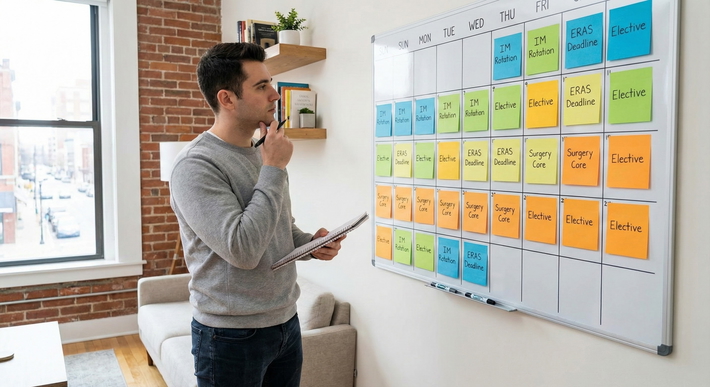
Understanding Away Rotations for Medicine-Psychiatry
Away rotations (also called visiting student rotations or “audition rotations”) can be especially impactful for students interested in a medicine psychiatry combined residency. Because there are relatively few med psych residency programs compared with categorical internal medicine or psychiatry, your strategy for where, when, and how to rotate matters even more.
In Medicine-Psychiatry, away rotations serve multiple purposes:
- They let you experience the culture and workflow of combined programs.
- They help you demonstrate concrete interest in the specialty and in specific programs.
- They provide opportunities for strong letters of recommendation from med-psych faculty.
- They can help you clarify whether you want combined training vs categorical internal medicine or psychiatry.
This guide walks through how to design an effective away rotation strategy in Medicine-Psychiatry—from deciding whether you need an away, to selecting sites, excelling on rotations, and integrating them into your overall residency application plan.
Do You Need an Away Rotation for Medicine-Psychiatry?
The Role of Away Rotations in Med-Psych
Unlike some surgical subspecialties where aways are almost expected, Medicine-Psychiatry is more nuanced. Programs understand that:
- There are limited combined programs nationally.
- Not all medical schools have robust med-psych faculty or dedicated tracks.
- Travel and housing costs can be significant barriers.
Still, away rotations can be particularly valuable in med psych residency applications for a few reasons:
Demonstrating Commitment to Combined Training
Programs want evidence that you understand what combined training entails and that you actively chose it, rather than simply “ranking everything that interviewed you.” A rotation in a med-psych setting shows real exposure and commitment.Getting Specialty-Specific Letters of Recommendation
A strong letter from a Medicine-Psychiatry faculty member or a combined-trained attending signals that:- You function at the level expected in both medicine and psychiatry.
- You have the temperament and curiosity suited to complex, comorbid patients.
Familiarity with Program Culture
Combined programs are small; cultural fit is crucial. An away rotation helps both sides gauge:- Your comfort working in both inpatient medicine and psychiatry environments.
- How you interact with residents, interdisciplinary teams, and complex patients.
When an Away Rotation Is Highly Recommended
You should strongly consider at least one away rotation in Medicine-Psychiatry (or a closely related setting) if:
- Your home institution does not have:
- A Medicine-Psychiatry residency, or
- A combined clinic or consult service where med-psych attendings supervise closely.
- You are uncertain whether combined training is right for you and want deeper exposure.
- You’re targeting a highly competitive or specific geographic region and want to make yourself known.
- You’re a non-traditional candidate (e.g., lower Step scores, gap years, previous career, IMG, DO where local exposure to med-psych is limited) and want to show your ability to excel in a real-world combined setting.
When You Might Not Need an Away
You may be able to succeed without a dedicated away rotation if:
- Your home institution has:
- A Medicine-Psychiatry residency program, and
- You can rotate on their med-psych services (consults, integrated clinics, med-psych inpatient).
- You already have strong relationships and letters from med-psych faculty.
- Financial or family constraints seriously limit travel—and you can build a strong profile through local electives, research, QI, and advocacy focused on patients at the medicine-psychiatry interface.
In those cases, an away is helpful but not absolutely required; you can still effectively show commitment to combined training through your home institution experiences and application narrative.
How Many Away Rotations for Med-Psych—and Where?
One of the most common questions students ask is: “How many away rotations should I do?” The answer is different for med psych than for larger specialties.
How Many Away Rotations?
For Medicine-Psychiatry, a common and reasonable target is:
- 1 dedicated med-psych–focused away rotation for most applicants.
- 0–1 additional related away rotation (e.g., in categorical internal medicine or psychiatry) depending on:
- Your overall application strength
- Financial and scheduling constraints
- Whether you’re also applying to categorical programs as a parallel plan.
Doing more than 2 away rotations is rarely necessary and can be counterproductive:
- Each rotation is exhausting and logistically complicated.
- Time away can limit your ability to complete home sub-internships in medicine or psychiatry, which are also important.
- Spreading yourself too thin can hurt your clinical performance and letters.
A typical strong away rotation plan for a med psych–focused applicant might look like:
- 1 away at a combined Medicine-Psychiatry program where you are strongly considering applying.
- 1 home or nearby sub-internship in internal medicine or psychiatry (maybe both if your schedule allows).
- Additional selective time in integrated care, consult-liaison, or addiction medicine/psychiatry at your home institution.
Choosing Programs Strategically
Because there are relatively few Medicine-Psychiatry programs, choosing where to do away rotations matters. Consider:
Programs You’d Genuinely Be Happy to Match At
Only rotate where you can realistically see yourself living and training. An away is a month-long interview—for both of you.Geographic Priorities
If you have strong geographic preferences (partner’s job, family, visa issues), give those regions priority. A visiting student rotation is an excellent way to:- Build local connections
- Signal geographic commitment
- Learn about regional patient populations and resources
Program Size and Culture
Some med-psych programs:- Are large and deeply integrated into the institution.
- Have strong med-psych identities and dedicated services.
Others are smaller with more individualized mentorship.
Read websites carefully, ask current residents, and consider: - Balance between inpatient medicine and inpatient psychiatry.
- Presence of med-psych consult services or integrated clinics.
- Reputation for supporting residents’ career interests (e.g., CL, primary care, addiction, research).
Clinical Exposure and Role for Students
Review the actual student rotation descriptions:
- Will you work on a combined med-psych service or on separate blocks of medicine and psychiatry?
- Is there direct interaction with med-psych faculty (as opposed to general internists or general psychiatrists only)?
- Are students expected to take ownership of patients, write notes, present on rounds, and attend conferences?
Feasibility and Cost
Factor in:
- Application fees (VSLO/VSAS and institutional)
- Housing (including short-term or sublets)
- Transportation and parking
- Time away from your home support system
If costs are a barrier, look for:
- Visiting student scholarships or diversity/DEI-funded positions.
- Programs that offer housing assistance or travel stipends.
- Rotations at institutions where you have family/friends you can stay with.

Timing and Logistics: Building Your Med-Psych Rotation Calendar
When to Schedule Away Rotations
Most students interested in Medicine-Psychiatry will aim to do aways during early 4th year, often between July and October. Consider:
Earlier (June–August)
- You can obtain letters of recommendation in time for ERAS.
- You can reference these experiences in your personal statement.
- Programs may remember you more vividly during application review.
September–October
- Still reasonable, especially for later-submitted letters.
- Can be ideal if your school’s schedule or Step 2 timing pushes you back.
- Keep in mind that some interview offers may begin going out by late October.
If you anticipate needing a letter from your away rotation for your initial ERAS submission, try to schedule it no later than August so your letter writer has time to submit.
Integrating Aways with Home Sub-Internships
Alongside your away rotations, you’ll want strong sub-internships in at least one, usually both, of the core fields:
Internal Medicine Sub-I
- Shows you can manage complex medical patients, handle cross-cover, and function at an intern level.
- Valuable whether or not you plan to apply to categorical internal medicine as well.
Psychiatry Sub-I (often Inpatient)
- Demonstrates your ability to:
- Build therapeutic alliances
- Manage psychiatric crises
- Work with interdisciplinary teams (social work, nursing, therapy, etc.)
- Demonstrates your ability to:
An ideal schedule for a student focused on Medicine-Psychiatry might look like:
Late 3rd year / Early 4th year:
- Core clerkships completed, including medicine and psychiatry
- One or two focused electives (e.g., CL psychiatry, addiction, integrated primary care)
Early 4th year:
- Internal Medicine Sub-I at home institution
- Psychiatry Sub-I at home institution or affiliated site
- One away rotation at a med-psych residency site
Mid-Late 4th year:
- Additional electives aligned with your career goals (e.g., asylum medicine, neurology, palliative care, SUD treatment, primary care for serious mental illness)
- Dedicated interview season and Step 2 CS/OET if applicable to your grad year
Navigating VSLO and Applications
Most away rotations use the VSLO (Visiting Student Learning Opportunities) system. Plan ahead:
- Check application open dates (many release in February–April for the next academic year).
- Prepare:
- USMLE/COMLEX score reports
- Immunization records
- Background checks and drug screens (if required)
- Transcript and dean’s letter equivalents summarized by your school
- Have a brief personal statement or interest paragraph tailored to Medicine-Psychiatry and the host institution, emphasizing:
- Why you’re drawn to combined training
- What you hope to gain from their specific rotation
- Any prior experiences with complex comorbidity, integrated care, or vulnerable populations
Submit early—many popular visiting student rotations fill quickly.
How to Excel on a Medicine-Psychiatry Away Rotation
Securing an away rotation is only the first step. Your real goal is to leave the program thinking, “we’d be lucky to have this student as a resident.”
Understand the “Dual Lens” of Med-Psych
On a med psych residency service, you’re expected to think simultaneously like a budding internist and a budding psychiatrist. On every patient, ask:
What’s the medical framework?
- Differential diagnosis for physical symptoms
- Medication side effects and interactions
- Workup, labs, imaging
- Risk stratification and disposition
What’s the psychiatric framework?
- Diagnostic formulation (including differential)
- Risk assessment (suicide, violence, grave disability)
- Psychosocial factors, trauma, and social determinants of health
- Treatment planning (meds, therapy, social supports, community services)
On rounds or presentations, explicitly integrate both perspectives. For example:
“Mr. A is a 52-year-old man with schizoaffective disorder and poorly controlled type 2 diabetes, admitted for hyperosmolar hyperglycemic state in the context of medication nonadherence and disorganized thinking. Medically, he’s stabilizing on IV fluids and insulin, but his capacity to manage outpatient insulin remains limited due to psychosis. Psychiatrically, his symptoms are partially controlled but he continues to have persecutory delusions that likely contributed to avoidance of medical care…”
This kind of framing signals that you are thinking like a future med-psych resident, not just a short-term medical student.
Clinical Performance: What Programs Look For
To stand out:
Be Prepared and Reliable
- Show up early, know your patients thoroughly.
- Follow up on labs, consultant recommendations, and collateral information.
- Anticipate on-call needs (orders, notes, sign-out).
Own Your Learning Curve
- If your internal medicine is stronger than your psychiatry (or vice versa), be honest with yourself and proactively seek feedback and teaching in your weaker area.
- Read daily on topics directly related to your patients (e.g., delirium management, neuroleptic malignant syndrome, metabolic syndrome from antipsychotics).
Demonstrate Curiosity About Integrated Care
- Ask questions like:
- “How will this psychiatric regimen affect his diabetes control?”
- “What outpatient resources exist for patients with serious mental illness and high medical needs?”
- Show that you’re interested in systems-based practice, not just individual pathologies.
- Ask questions like:
Be a Strong Teammate
- Med-psych services are small and sometimes stretched thin.
- Offer help with tasks, support interns and residents, and communicate clearly with nurses and other staff.
- Treat every staff member—unit clerks, environmental services, security, social work—with genuine respect.
Building Relationships and Asking for Letters
Strong letters from an away rotation can transform your application. To position yourself well:
- Identify 1–2 key faculty you work closely with (preferably med-psych trained or strongly involved in the combined program).
- Show consistent excellence over the entire rotation (not just the last few days).
- Near the end of the rotation, schedule a brief meeting with your primary attending or site director. In that meeting:
- Express your genuine interest in combined Medicine-Psychiatry.
- Share your career goals (CL, integrated care, underserved populations, etc.).
- Ask for specific feedback on how you’ve done and areas for improvement.
- If the feedback is positive, say something like:
“I’m planning to apply to med-psych residency programs, and I’ve really valued this rotation. Would you feel comfortable writing a strong letter of recommendation on my behalf?”
Provide:
- An updated CV
- A brief personal statement or paragraph about your interest in med psych
- A summary of patients or projects you worked on during the rotation, if helpful

Integrating Away Rotations into Your Overall Med-Psych Application
Crafting Your Narrative
Your experiences on away rotations in Medicine-Psychiatry and related fields should feed directly into your residency application materials:
Personal Statement
- Highlight a few cases from your away or home med-psych experiences that illustrate:
- Complex medical and psychiatric comorbidity
- Systems-level barriers to care
- Your evolving understanding of what it means to be a combined physician
- Reflect briefly—not just descriptively—on what you learned and how it shaped your career trajectory.
- Highlight a few cases from your away or home med-psych experiences that illustrate:
Experiences Section in ERAS
- List your away rotations as clinical experiences with:
- Clear descriptions (e.g., “4th-year visiting student on combined med-psych inpatient service managing patients with serious mental illness and complex medical comorbidities.”)
- Specific responsibilities (notes, presentations, involvement in family meetings, QI projects).
- List your away rotations as clinical experiences with:
Program Signaling (if applicable)
- If your match cycle includes signaling, strongly consider using a signal on:
- The program where you did your away rotation (if you would be happy training there).
- Other med-psych programs where you have strong geographic or professional interest.
- If your match cycle includes signaling, strongly consider using a signal on:
Applying to Combined vs Categorical Programs
Many students interested in a med psych residency also consider applying to:
- Categorical internal medicine
- Categorical psychiatry
Your away rotation strategy can support a dual-application approach:
- One med-psych–focused away rotation, plus:
- A strong home internal medicine sub-I, and/or
- A strong home psychiatry sub-I
If you’re applying to both combined and categorical programs:
- Be ready to articulate clearly:
- Why you’re drawn to combined training.
- Why you would also be satisfied in a categorical path.
- How you plan to maintain your interest in both sides of the interface, regardless of where you match.
Away rotations in categorical medicine or psychiatry at an institution that does not have a med-psych residency can still help by:
- Strengthening core skills and letters.
- Demonstrating that you can excel in demanding environments.
- Building regional ties.
Just be sure your application materials still center your interest in the medicine psychiatry combined approach when applying to med-psych programs.
Common Pitfalls to Avoid
Overloading on Aways at the Expense of Home Performance
- Poor or mediocre evaluations from your core sub-Is will hurt you more than skipping a second away.
Treating an Away Rotation as Purely an “Audition”
- Programs can sense if you’re only there to impress.
- Be genuinely curious, willing to learn, and humble—these traits are highly valued in med-psych.
Failing to Follow Up with Letter Writers
- Politely remind letter writers well before ERAS deadlines.
- Provide all necessary details (ERAS instructions, due dates, your CV, etc.).
Not Accounting for Burnout
- Aways often require relocation, new housing, and additional stress.
- Build some recovery time into your schedule, and avoid stacking multiple demanding rotations back-to-back without any buffer.
FAQs About Away Rotations in Medicine-Psychiatry
1. Do I need to do my away rotation specifically at a med-psych residency program?
It’s ideal, but not absolutely required. Rotating at a program with a Medicine-Psychiatry residency offers:
- Exposure to combined training culture
- Direct contact with med-psych faculty and residents
- Strong letters from physicians who understand the specialty
However, if logistics or capacity make this difficult, you can still build a strong profile by doing away or home rotations in:
- Integrated primary care psychiatry
- Consult-liaison psychiatry
- Addiction psychiatry or addiction medicine
- Medical units that focus on patients with serious mental illness
In that case, be explicit in your application about how those experiences informed your interest in combined training.
2. How many away rotations should I do if I’m applying only to med-psych programs?
For most applicants focusing solely on medicine psychiatry combined training:
- One targeted away rotation in med psych (or closely aligned integrated care setting) is typically enough.
- Consider a second away only if:
- You lack any home med-psych exposure, and
- You can’t obtain med-psych–aligned letters otherwise, and
- You’re confident it won’t compromise your core sub-Is or well-being.
Focus on quality over quantity; one outstanding away rotation is far better than several superficial or exhausting ones.
3. Is it risky to do an away rotation at my top-choice med-psych program?
It can feel risky, but for Medicine-Psychiatry, rotating at a top-choice program is often beneficial:
- You get a realistic view of the program’s culture, workflow, and expectations.
- The program learns your work ethic, reasoning, and interpersonal style more deeply than they could from an interview alone.
- If you perform well, you often become a known and favored applicant.
The main risk is if performance issues, unprofessional behavior, or poor fit emerge. If you:
- Show up prepared and reliable
- Ask for feedback early and apply it
- Are kind and collaborative with everyone
then an away at your top choice is usually an asset, not a liability.
4. What if I can’t afford away rotations or have major logistical barriers?
Programs know that visiting student rotations can be expensive and inequitable. If you cannot do an away:
- Maximize local opportunities:
- Med-psych mentors (even if virtual)
- CL psychiatry, integrated primary care, or addiction rotations
- Research or QI related to patients with comorbid medical and psychiatric illness
- Be explicit in your application narrative about your sustained interest in combined care.
- Look for:
- Visiting student scholarships or DEI funding
- Rotations in locations where you have housing support (family/friends)
- Shorter or more flexible electives if your school allows
Programs will not penalize you for financial or structural barriers beyond your control, especially if your experiences and narrative clearly reflect a strong and thoughtful commitment to Medicine-Psychiatry.
A well-planned away rotation strategy in Medicine-Psychiatry can deepen your understanding of the specialty, strengthen your application, and help you identify the programs where you’ll truly thrive. By choosing sites thoughtfully, integrating aways with strong home rotations, and approaching each experience with curiosity and professionalism, you position yourself as a future physician who is truly prepared to care for patients at the complex interface of mind and body.