Why Away Rotations Matter So Much for a US Citizen IMG in Radiology
For an American studying abroad who wants to match into diagnostic radiology, away rotations (also called visiting student rotations or electives) are not optional “nice-to-haves”—they’re one of your most powerful tools.
As a US citizen IMG, you already have one big advantage: program directors know you are likely to stay in the U.S. long term and you don’t need visa sponsorship. But you still face the usual IMG challenges:
- Limited face time with U.S. faculty
- Fewer U.S. letters of recommendation
- Less familiarity with U.S. hospital systems and expectations
- Bias (explicit or implicit) against non‑US‑MD degrees
A well-planned away rotation strategy directly attacks those problems. In diagnostic radiology especially—where programs care about teamwork, communication, and “fit”—being on-site for four weeks can completely change how your application is perceived.
Your goals for away rotations in diagnostic radiology should be to:
- Prove you can function in a U.S. academic environment
- Earn strong, personalized letters of recommendation from U.S. radiologists
- Show programs you’re serious about radiology and about them specifically
- Expand your list of realistic programs for the diagnostic radiology match
The rest of this guide will walk you step-by-step through crafting a high-yield away rotation plan tailored to a US citizen IMG in diagnostic radiology.
Step 1: Clarify Your Objectives and Constraints
Before asking “how many away rotations?” or where to apply, you need clarity on your goals and limits.
Define What You Need from Away Rotations
For a US citizen IMG applying to radiology, away rotations can serve several different functions. List which ones are most important for you:
Letter-building rotations:
You need 1–2 strong, detailed letters from U.S. radiology faculty who have seen you work.Audition rotations (“try-outs”):
You want to show specific programs that you’re a good culture and performance fit and that you’re serious about them.Exposure and decision-making:
You’re still deciding between academic vs community programs, large vs small, or specific regions.Plan B preparation:
If you might apply to a prelim year in medicine, surgery, or transitional year, you may want at least one non-radiology rotation for backup letters and networking.
Rank these objectives for yourself; this will drive which programs you target and when.
Be Honest About Your Application Strength
Your away rotation strategy should be realistic about your competitiveness:
Stronger US citizen IMG profile may include:
- Solid USMLE scores (e.g., Step 2 CK > 235–240)
- Some U.S. clinical experience already
- Maybe a research abstract or small project in radiology
- Fluent English and confident communication skills
More challenged profile may include:
- Lower Step 2 CK
- Minimal or no prior U.S. hospital experience
- No radiology exposure beyond elective lectures
- Later application timing
If your profile is stronger, away rotations are primarily for “audition” value and letters at your target programs.
If your profile is more challenged, away rotations are partly for skill-building, polishing your communication style, and proving you can thrive in a U.S. setting.
Map Out Your Practical Constraints
As an American studying abroad, logistics matter:
Academic calendar at your school
- When can you leave for 4–8 weeks without jeopardizing graduation?
- Are there minimum “in-country” requirements or mandatory rotations?
Timing vs application cycle
- For the diagnostic radiology match, the most valuable away rotations are usually before ERAS submission (June–September).
- Rotations after ERAS submission (Oct–Jan) can still help with letters and impression but won’t affect initial program interest as strongly.
Financial and visa considerations
- Even as a US citizen IMG, you may have:
- Travel costs (flights back to the U.S.)
- Housing in the rotation city
- Application fees (VSLO and institutional)
- If you study in a country that limits time abroad, confirm your legal ability to leave for rotations.
- Even as a US citizen IMG, you may have:
Know your constraints early—this shapes how many away rotations you can realistically handle and when.
Step 2: Decide How Many Away Rotations and Where to Do Them
The question “how many away rotations?” depends on goals, competitiveness, and budget.
How Many Away Rotations for a US Citizen IMG in Radiology?
General guidance for diagnostic radiology:
- Typical range:
- 2 away rotations in radiology is common and strategic.
- 1 away rotation can be sufficient if supplemented with strong home or affiliate radiology experience.
- 3 away rotations in radiology may be worthwhile if:
- Your application is weaker, or
- You lack any radiology exposure at your home/affiliate institution.
For a US citizen IMG without a home radiology department or with limited U.S. experience, a strong strategy is:
- 2 radiology away rotations (2 different institutions)
- + 1 U.S. clinical rotation in a related field (e.g., internal medicine, emergency medicine, or surgery) to demonstrate broad clinical skills, earn another U.S. letter, and build references beyond radiology.
More than 3 radiology away rotations often adds little extra value compared to the cost and fatigue, unless you have very late radiology exposure and are playing catch-up.
Choosing Target Programs for Away Rotations
Think about programs in three buckets:
Reach programs
- Highly competitive academic centers
- Top-tier or big-name institutions
- High research output; often university-based
- May be harder for IMGs to match, but an impressive performance on away can help you stand out.
Realistic (target) programs
- Mid-range academic or strong community programs
- Historically take some IMGs (look at past resident lists/medical schools)
- Good training, but not ultra-competitive national “brand names”
Safety programs
- Community hospitals or smaller university-affiliated programs
- Clear history of welcoming IMGs, including US citizen IMGs
- May be in less popular geographic locations
For radiology visiting student rotations, a wise distribution for a US citizen IMG is:
- 1 rotation at a realistic-to-reach program you would be excited to match at
- 1 rotation at a realistic-to-safety program that has a strong IMG history
- Optional: 1 additional rotation based on:
- Geography (where you strongly want to end up)
- Program style (high-volume community vs academic research center)
Factors to Consider When Picking Sites
When comparing specific programs for away rotations residency planning, look at:
Program’s history with IMGs
- Do current or recent residents include IMGs?
- Does the website say anything about IMGs?
If the resident page shows only US MDs from top schools, that away may still be valuable for exposure and letter quality—but matching there may be unlikely.
Radiology training style
- Strong case volume?
- Subspecialty divisions (neuro, MSK, body, IR, breast)?
- Morning conferences and case conferences you can attend?
Rotation structure
- Will you read cases with attendings and residents?
- Are there formal teaching sessions for students?
- Do they allow you to attend tumor boards or multidisciplinary conferences?
Geography and lifestyle
- Could you envision living here for 4 years?
- Cost of short-term housing and transportation
Program reputation and fit
- Academic vs community
- Size of residency class
- Culture (teaching-focused, friendly, high-pressure, etc.)
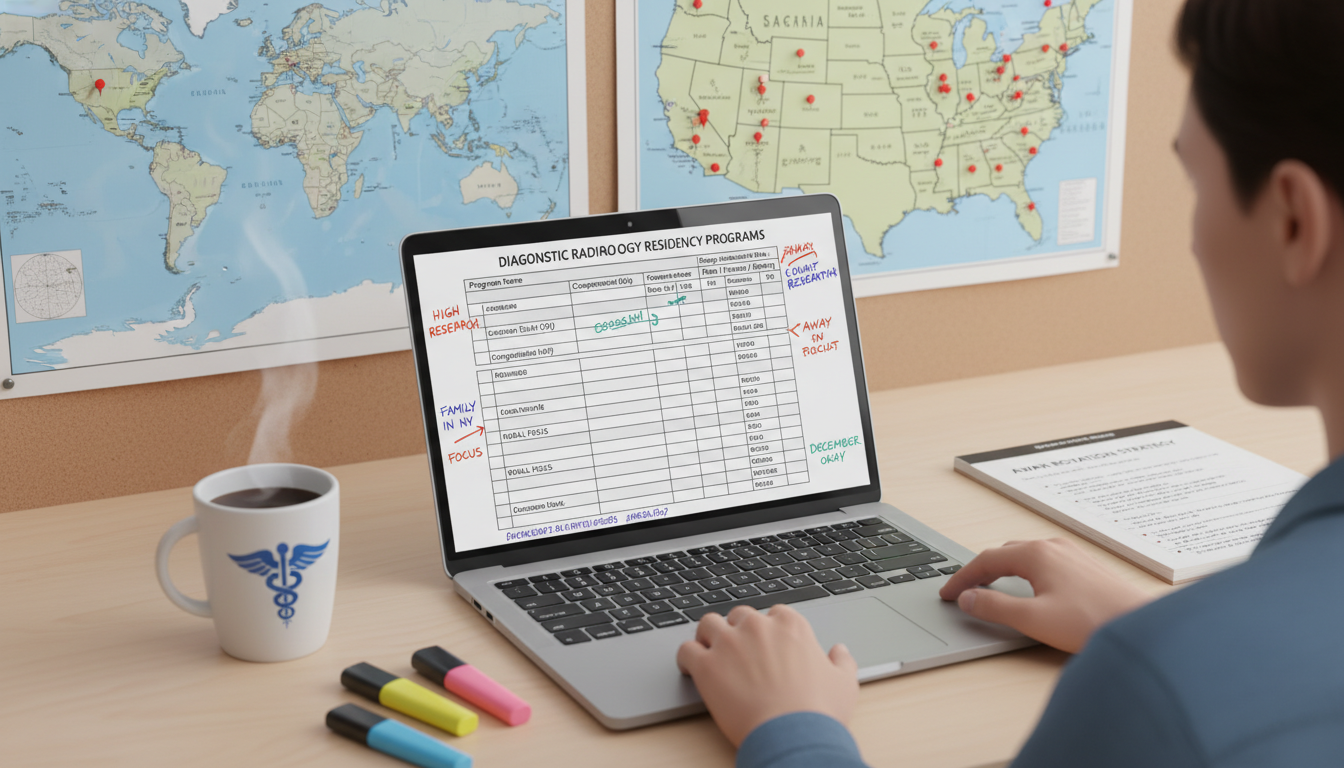
Use all of these to create a prioritized list of 6–10 programs to apply to for visiting student rotations, expecting that you may only secure 1–3 spots.
Step 3: Plan the Timing and Application Strategy
Ideal Timing for Radiology Away Rotations
For the diagnostic radiology match, timing matters almost as much as location:
Best window for primary away rotations:
- Late 3rd year to early 4th year equivalent (often June–September in the year before you apply to the NRMP match).
- This allows letters from away rotations to be ready for ERAS submission or soon thereafter.
Secondary window (still valuable):
- October–December of your application year.
- These rotations can supplement your letters and strengthen your narrative for mid-season program communications and interviews (including, sometimes, post-interview updates).
As a US citizen IMG, align your away rotation dates with:
- Your school’s exam schedules
- Your visa/travel logistics (if you need to re-enter the U.S. from abroad)
- The ERAS and NRMP timeline
Understanding Application Platforms and Deadlines
Most U.S. medical schools use:
- VSLO (Visiting Student Learning Opportunities) — AAMC platform
- Or their own institution-specific application portals
Key action steps:
- Get VSLO access through your school (if available).
- Check each program’s website for:
- Application opening date (often January–March)
- Specific requirements for IMGs and/or US citizens studying abroad
- Deadlines (may be 3–6 months before rotation start)
- Prepare required documents early:
- Transcript
- Dean’s letter or school certification
- Immunization records
- BLS/ACLS certifications (if required)
- USMLE Step 1/2 scores (if taken)
- Health insurance and malpractice coverage confirmation
Because some programs restrict visiting students to LCME schools or to certain affiliations, as a US citizen IMG you’ll often be competing for a smaller pool of open spots. Start applications early and cast a broad net.

Step 4: Maximizing Impact During Your Radiology Away Rotations
Simply showing up is not enough. On an away rotation, you are essentially on a month-long interview. Programs ask themselves: “Would we want this person as a resident in our reading room?”
What Radiology Programs Look for in a Visiting Student
During visiting student rotations, faculty and residents tend to notice:
Work ethic and reliability
- Do you arrive on time (or early)?
- Do you stay engaged throughout the day?
- Do you follow through on tasks?
Curiosity and teachability
- Do you ask thoughtful questions?
- Do you respond well to feedback?
- Do you seem genuinely interested in radiology, not just the match?
Communication skills
- Can you present cases concisely?
- Are your emails professional and clear?
- Do you interact respectfully with technologists, residents, and staff?
Professionalism
- Appropriate dress and demeanor
- Respect for patient privacy and image handling
- Discretion with social media
Team integration
- Do residents enjoy working with you?
- Do you help with small tasks (e.g., printing reports, organizing teaching files) without being asked every time?
Radiology is a “quiet” specialty in many people’s minds, but communication and teamwork are absolutely central—and that’s what they’re testing on your rotation.
Daily Strategies to Stand Out (in a Good Way)
Practical actions you can take:
Arrive early, stay a bit late
- Be in the reading room before the attending. Skim through interesting overnight cases. Stay until the normal end of the workday unless explicitly told otherwise.
Prepare before each rotation block
- If you’re on neuroradiology, review basic neuroanatomy and common pathologies before day 1.
- For chest/abdomen, know basic CT anatomy and typical diagnoses (PE, pneumonia, appendicitis, diverticulitis, etc.).
Shadow actively, not passively
- When viewing cases, silently form your own impressions first:
- “What’s the primary abnormality?”
- “How would I report this in a brief sentence?”
- Then compare with the attending’s read. Ask questions like:
- “I thought that hypodense area might be an infarct—what did I miss?”
- “Is this pattern more suggestive of metastasis vs infection, and why?”
- When viewing cases, silently form your own impressions first:
Volunteer for small responsibilities
- Offer to:
- Draft a brief impression (if allowed) for simple cases
- Present an interesting case in conference
- Help prepare a mini teaching session or case-of-the-day
- Offer to:
Be consistent across rotations
- Program directors talk; your behavior at one institution can indirectly influence how others view you (especially within the same region).
Building Relationships and Earning Strong Letters
As a US citizen IMG, you need U.S. radiology letters that do more than say “hardworking and pleasant.”
To get them:
Target 1–2 faculty per away rotation
- Ideally, an attending who:
- Works closely with students
- Sees you multiple days
- Is respected within the department
- Ideally, an attending who:
Signal your interest early
- Say something like:
- “I’m a US citizen IMG applying in diagnostic radiology and I’m really hoping to get a letter from someone who sees my work. I’d be grateful for any feedback as I go.”
- Say something like:
Ask for feedback mid-rotation
- “Is there anything I can improve on to be more helpful as a visiting student?”
Ask for letters thoughtfully
- Near the end of the rotation:
- “Based on what you’ve seen of my work this month, would you feel comfortable writing a strong, detailed letter of recommendation for my radiology residency applications?”
- If they hesitate, thank them and consider asking someone else. You want letters that are genuinely enthusiastic.
- Near the end of the rotation:
Provide a letter packet
- Updated CV
- Brief personal statement draft
- List of programs you’re targeting (if requested)
- Copy of your medical school transcript (if needed)
Follow up with a polite email reminder later if necessary, especially as ERAS deadlines approach.
Step 5: Integrating Away Rotations into Your Overall Match Strategy
Away rotations are one piece of your diagnostic radiology match puzzle. You should use them to:
Strengthen Your ERAS Application
Your away rotations can directly influence:
Personal statement content
- Incorporate specific experiences:
- “During my visiting student rotation at [Program], I…”
- Describe meaningful cases or insights that confirmed your interest in radiology.
- Incorporate specific experiences:
Letters of recommendation
- Aim for at least two radiology letters from U.S. faculty:
- One from an away rotation
- One from another U.S. radiology experience (home or second away)
- Additional letters can be from:
- Internal medicine or surgery attending who saw your clinical performance
- Research mentor (if relevant)
- Aim for at least two radiology letters from U.S. faculty:
CV and experiences
- List away rotations clearly, highlighting:
- Institution
- Dates
- Key responsibilities (case presentations, conferences, small projects)
- List away rotations clearly, highlighting:
Position Yourself as a US Citizen IMG with Clear Value
In interviews and communication with programs, your away rotations help you:
Demonstrate:
- Familiarity with the U.S. healthcare system
- Comfort with PACS, EMR, and typical workflow
- Ability to adapt to different institutions
Emphasize:
- That as a US citizen IMG, you require no visa
- You’ve invested time in U.S. radiology departments to be sure of your career choice
- You can hit the ground running as a radiology resident
Use Rotations to Build a Network
Don’t treat away rotations as one-and-done experiences. After you leave:
Stay in touch
- Send a brief thank-you email to:
- PD (if you met them)
- Key faculty who taught you
- Residents who helped you
- Share your NRMP match news in March—people often remember students they worked with.
- Send a brief thank-you email to:
Leverage your mentors
- Ask if they’re comfortable with:
- An occasional email question about programs
- Advice about ranking, if they know other institutions
- Advocating for you with colleagues elsewhere if appropriate
- Ask if they’re comfortable with:
Over time, these relationships create a safety net and support system that can span multiple programs and regions.
Common Pitfalls for US Citizen IMGs—and How to Avoid Them
As a US citizen IMG navigating away rotations residency planning, watch for these missteps:
Applying only to “top name” programs
- Very common trap. If all your visiting student rotations are at ultra-competitive, IMG-unfriendly institutions, you may end up with:
- No rotation offers
- Or away experiences that don’t translate into realistic match options
- Solution: Balance your list with realistic and safety programs that historically accept IMGs.
- Very common trap. If all your visiting student rotations are at ultra-competitive, IMG-unfriendly institutions, you may end up with:
Too many radiology away rotations, too few backups
- You might end up with great radiology exposure but no robust letters from non-radiology attendings.
- Solution: Consider at least one general clinical rotation in the U.S. (e.g., medicine) to demonstrate bedside skills and broaden your support.
Being passive on rotation
- Showing up, sitting in the back, not asking questions, leaving early, not engaging with residents—these all hurt your chances.
- Solution: Treat every day as an opportunity to build your professional identity in front of potential colleagues.
Not clearly communicating that you’re a US citizen
- Some programs see “IMG” and automatically think “visa issues.”
- Solution: Make your U.S. citizenship or permanent residency explicit on your CV, ERAS, and in conversation.
Ignoring logistics and burning out
- Back-to-back away rotations in high-cost cities without rest, planning, or budget can exhaust you.
- Solution: Space your rotations enough to recover and reflect, and choose at least one location that’s affordable and manageable.
Frequently Asked Questions (FAQ)
1. As a US citizen IMG, how many away rotations in diagnostic radiology do I really need?
For most US citizen IMGs targeting diagnostic radiology, 2 radiology away rotations is a strong and realistic goal:
- One at a realistic-to-reach academic or hybrid program
- One at a realistic-to-safety program that is clearly IMG friendly
If you have no prior radiology exposure or no U.S. clinical experience at all, adding a third rotation (radiology or general clinical) can help—but beyond three, the benefits usually plateau relative to the cost.
2. Should I do all of my away rotations in radiology, or include other specialties?
If radiology is your clear goal, prioritize:
- 2 away rotations in diagnostic radiology, plus
- 1 U.S. clinical rotation in medicine, surgery, or emergency medicine (especially if you lack any U.S. non-radiology experience).
The non-radiology rotation helps:
- Demonstrate bedside skills and professionalism
- Provide a backup letter writer outside radiology
- Support a potential prelim or transitional year application
3. When is the best time in medical school to complete radiology away rotations?
Aim for radiology away rotations:
- Between late 3rd year and early 4th year (or equivalent timing in your IMG curriculum), ideally:
- June–September before your application year, so letters can be uploaded for ERAS.
- Secondary optional rotations:
- October–December of your application year, which can still strengthen your letters and profile, even if ERAS is already submitted.
Make sure the timing doesn’t conflict with graduation requirements at your international medical school.
4. How do I identify IMG-friendly radiology programs for away rotations and the match?
Look for:
- Resident lists that include IMGs (especially recent classes)
- Program websites or social media showing:
- Diversity of medical schools
- Explicit statements about welcoming IMGs
- NRMP and FREIDA data (when available) showing:
- Percentage of IMGs in the program
- Word-of-mouth:
- Ask faculty or residents at your away sites which programs are known to treat IMGs fairly.
As a US citizen IMG, highlight your lack of visa needs and your U.S. ties, and prioritize programs that are open to applicants from a wide range of schools.
Planning visiting student rotations thoughtfully can transform your chances in the diagnostic radiology match. As an American studying abroad, you bring valuable perspective and commitment; a targeted, well-executed away rotation strategy helps U.S. programs see that clearly and confidently rank you as a future colleague.