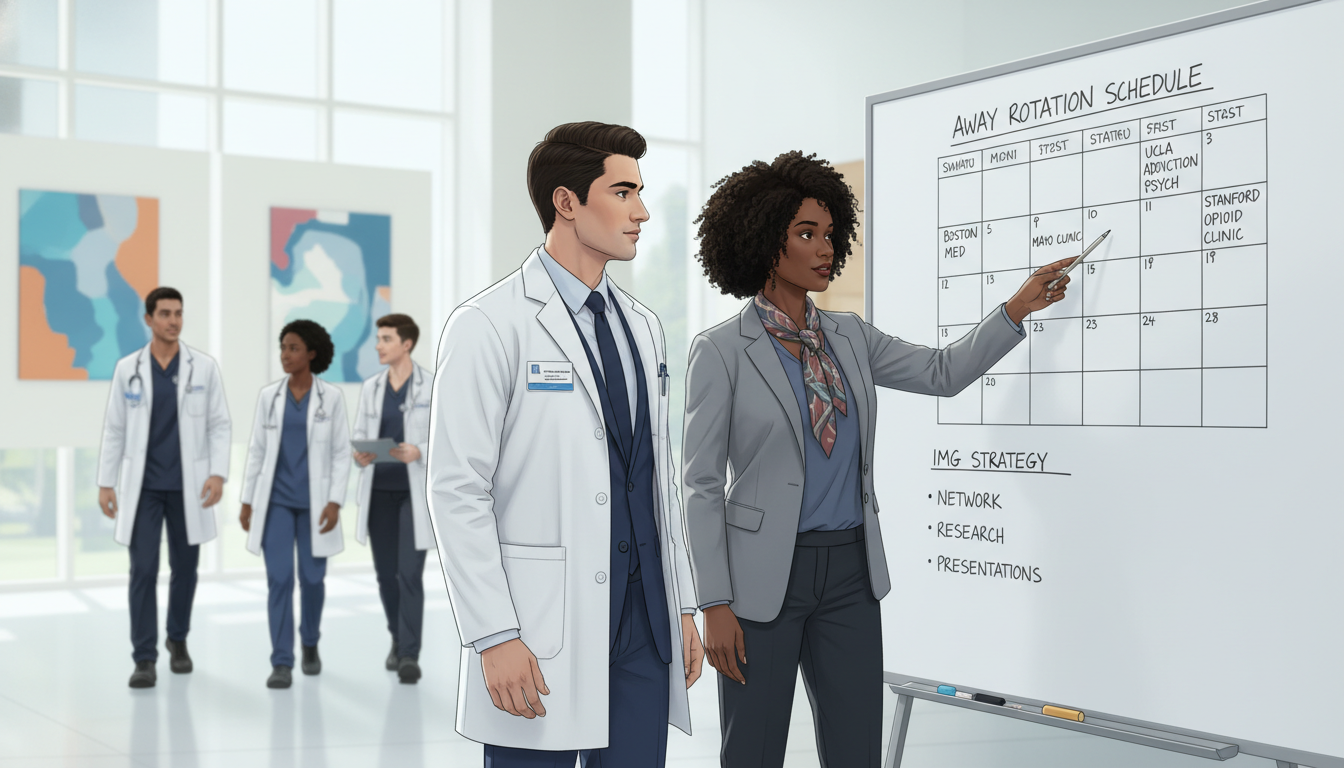
Understanding Away Rotations for IMGs in Addiction Medicine
Away rotations are one of the most powerful tools an international medical graduate (IMG) can use to strengthen a U.S. residency or addiction medicine fellowship application. For IMGs interested in addiction medicine specifically, strategic visiting student rotations can:
- Provide direct exposure to substance use disorder (SUD) care in U.S. healthcare systems
- Generate strong U.S. clinical experience (USCE) and letters of recommendation
- Demonstrate clear, sustained interest in addiction medicine
- Help overcome common IMG barriers such as lack of U.S. mentorship and networking
Because addiction medicine is primarily a fellowship (most applicants first match into psychiatry, internal medicine, family medicine, or emergency medicine), your away rotation strategy must do two things at once:
- Make you a stronger candidate for a core residency (e.g., psychiatry, IM, FM, EM), and
- Clearly communicate your commitment to addiction medicine and substance abuse training.
This IMG residency guide will walk you through how to choose, plan, and execute away rotations that maximize your odds of matching into a strong residency and, later, into an addiction medicine fellowship.
Key questions we’ll cover:
- Which rotations actually help with an addiction medicine career?
- How many away rotations should an IMG do?
- What types of programs are most IMG-friendly?
- How can you stand out on rotation and secure outstanding letters?
1. Clarifying Your Path: Addiction Medicine as an IMG
Before designing your away rotation strategy, you must understand how addiction medicine training is structured in the U.S.
1.1. Addiction Medicine: A Fellowship, Not a First Residency
In the U.S., addiction medicine is an ACGME-accredited subspecialty. Most fellows come from:
- Psychiatry
- Internal Medicine
- Family Medicine
- Emergency Medicine
- Occasionally Pediatrics, OB/GYN, or other fields
So your first match target is a core residency, not an addiction medicine fellowship. Your away rotations should therefore:
- Align with the residency you’re targeting (e.g., psychiatry away rotation if aiming for psychiatry)
- Still offer substantial exposure to substance use disorders (SUDs)
Practical examples:
- Psychiatry rotation with a focus on dual diagnosis or inpatient detox
- Internal medicine inpatient rotation at a hospital with addiction consult services
- Family medicine clinic with integrated MAT (medication-assisted treatment)
- Emergency medicine sub-I at a trauma center with high SUD-related volume
1.2. Why Away Rotations Matter More for IMGs
For an international medical graduate, away rotations and visiting student rotations often carry extra weight because they:
- Provide U.S. clinical experience under ACGME-style supervision
- Let you demonstrate language, communication, and teamwork skills
- Offer a chance to show comfort with electronic medical records and U.S. documentation standards
- Create U.S. mentors who understand the match process and addiction medicine pathways
- Generate U.S. letters of recommendation (LORs) — often critical for IMGs
Programs often ask themselves, “Can I trust this IMG to function safely and effectively in my system?” Away rotations are your chance to prove the answer is “Yes” in a very concrete way.
2. Choosing Rotations That Support an Addiction Medicine Career
Your central strategic question is not only “How many away rotations?” but also “Which away rotations will best tell my story as a future addiction physician?”
2.1. Core Types of Rotations That Help
For IMGs interested in addiction medicine, the following rotation types are particularly useful:
Psychiatry Inpatient / CL (Consult–Liaison) Rotation
- Frequent exposure to patients with substance use disorders, dual diagnoses, and withdrawal syndromes
- Opportunities to observe initiation of medications like buprenorphine, methadone (in some settings), naltrexone
- High yield if you plan a psychiatry residency
Internal Medicine Inpatient Ward or Hospitalist Service
- Many admissions related to alcohol-related disease, infections related to injection drug use, or withdrawal
- Often work closely with addiction consult teams if the hospital has them
- Good fit if you aim for internal medicine residency and later addiction medicine fellowship
Family Medicine Continuity Clinic with Addiction Focus
- Exposure to longitudinal MAT and behavioral interventions
- Chronic disease model of SUD management
- Excellent if you plan a family medicine route to addiction medicine
Emergency Medicine Sub-Internship / Clerkship
- High volume of SUD cases: intoxications, overdoses, withdrawal
- Growing focus on ED-initiated buprenorphine and harm reduction strategies
- Ideal if you’re targeting an EM-to-addiction medicine pathway
Dedicated Addiction Medicine Elective
- Not available everywhere, but extremely valuable if accessible
- Rotations on addiction consult services, methadone clinics, residential rehab, or outpatient SUD programs
- These experiences should be highlighted in your personal statement and CV
An optimal IMG residency guide for addiction medicine would combine one rotation closely aligned to your core specialty (e.g., psychiatry) and another specifically emphasizing substance abuse training (e.g., addiction consult service).

2.2. Where to Find Addiction-Focused Opportunities
To identify programs with strong addiction medicine environments:
Look for hospitals with addiction medicine fellowships.
- These centers almost always have active SUD consult services, outpatient MAT, and teaching faculty.
- Rotating there can position you for future addiction medicine fellowship applications.
Review program websites for:
- Addiction psychiatry or addiction medicine faculty
- Dedicated “Addiction Medicine,” “Substance Use Disorders,” or “Tobacco/Opioid Use Disorder” rotations
- Outpatient clinics advertising MAT services
Use key phrases in your search:
- “Addiction medicine fellowship”
- “Substance use disorder clinic”
- “Buprenorphine clinic”
- “Opioid treatment program”
If your home institution (if you’re in the U.S. or a Caribbean school with U.S. affiliates) has any addiction-related service, prioritize rotating there first. It’s often easier to secure longer rotations and deeper relationships at your home site.
2.3. Academic vs Community Hospitals
Both academic and community sites can be useful, but they offer different advantages:
Academic Centers
- More likely to have addiction medicine fellowships and research opportunities
- Stronger name recognition for letters of recommendation
- Structured teaching, grand rounds, and exposure to cutting-edge SUD care
Community Hospitals / Safety-Net Institutions
- Often serve populations highly affected by addiction and social determinants of health
- May give you more direct responsibility and hands-on experience
- Letters emphasizing your work ethic and real-world patient care can be very compelling
For an IMG with limited U.S. exposure, a balanced mix (e.g., one academic and one community away rotation) can paint a rich, credible picture of your readiness.
3. Planning Your Away Rotations: Timing, Number, and Logistics
3.1. How Many Away Rotations Should an IMG Do?
There is no universal rule for how many away rotations an IMG should do, but you can use this framework:
- Minimum meaningful exposure: 1–2 away rotations
- Aggressive but realistic strategy for IMGs: 2–3 away rotations
Consider the following:
- Financial and visa constraints – housing, travel, application fees add up quickly
- Quality > quantity – two strong rotations with excellent letters and mentor relationships are better than four superficial ones
- Academic calendar – schedule them before or early in the ERAS season whenever possible
For most IMGs targeting addiction medicine via a core residency:
- Aim for 2 well-chosen away rotations:
- One in your target core specialty at an IMG-friendly residency program
- One at a site with strong substance abuse training or addiction medicine fellowship
If you have significant financial or visa limitations, even a single U.S. visiting student rotation done extremely well can be impactful—especially if it results in a strong, detailed LOR from addiction-focused faculty.
3.2. When to Schedule Rotations (Relative to ERAS)
If you are applying to residency in September of Year X:
- Peak time for audition rotations:
- May–September of Year X
- Ideal scheduling strategy:
- Complete at least one away rotation by June–July, so letters are ready for ERAS submission
- You can still rotate in August–September for networking and potential mid-cycle letter updates
For IMGs in earlier phases:
- If you are 1–2 years away from application, consider early observational elective experiences, then plan more formal visiting student rotations closer to your application year.
3.3. Visa and Eligibility Considerations for IMGs
Common hurdles for international medical graduates:
Visa status:
- Some institutions require U.S. citizenship/permanent residency, others accept F-1/J-1 for students
- Check each program’s visiting student page carefully
USMLE requirements:
- Many rotations (especially sub-internships) require Step 1 (and sometimes Step 2 CK) scores
- Some IMG-focused programs may offer observerships even before Steps, but these are less impactful than full clinical rotations
EICS/ECFMG status:
- You may need to have ECFMG certification underway or completed, depending on the program
Action steps:
Create a spreadsheet of target institutions with columns for:
- Addiction medicine fellowship? (Yes/No)
- Accept IMGs for rotations?
- Visa requirements?
- USMLE requirements?
- Application process and deadlines
Prioritize programs that are:
- Known to be IMG-friendly in residency and fellowship
- Located in areas with high SUD burden (Northeast corridor, Rust Belt, West Coast urban centers, etc.)
4. Excelling on Rotation: Standing Out as an IMG Interested in Addiction Medicine
Getting the rotation is only half the battle. Your performance will determine what kind of advocate and letter writer you gain.
4.1. Core Behaviors That Impress Faculty
Regardless of specialty, certain behaviors consistently boost evaluations:
- Arrive early, stay engaged, and be prepared.
- Read about your patients’ conditions, focusing on SUD-related literature when applicable.
- Communicate proactively, especially about follow-up tasks and pending labs or consults.
- Ask for feedback early (end of week 1 and midpoint) and show visible improvement.
For addiction-focused impressions:
- Show curiosity about motivational interviewing, harm reduction, and relapse prevention strategies.
- Learn the basics of MAT (buprenorphine, methadone, naltrexone, acamprosate, disulfiram) and SUD screening tools (e.g., AUDIT, CAGE, DAST).
- Reflect sensitivity to stigma and social determinants of health in your language and documentation.
Example of a strong IMG student behavior:
After seeing a patient with opioid use disorder admitted for endocarditis, you read up on inpatient initiation of buprenorphine and ask your attending, “Could I present a brief summary tomorrow of recent guidelines on starting buprenorphine during hospitalization?” You then share a concise, evidence-based overview with the team.
This positions you as genuinely invested in substance abuse training and as someone who adds educational value.
4.2. Building Relationships for Letters of Recommendation
Great letters for an IMG residency applicant aiming at addiction medicine often come from:
- Addiction medicine or addiction psychiatry faculty
- Core residency program directors or associate PDs
- Attendings who directly supervised you on high-intensity services
To optimize your chances:
Identify potential letter writers early.
- Choose attendings who:
- Have worked with you for several weeks
- Can speak to your clinical reasoning, communication, and professionalism
- Understand your interest in addiction medicine
- Choose attendings who:
State your goals explicitly.
- Mid-rotation: “I’m an international medical graduate hoping to match into psychiatry and ultimately pursue an addiction medicine fellowship. I would really value your feedback on how I’m doing and what I can improve.”
Ask for a strong letter.
- At the end: “Based on our time working together, do you feel you could write a strong letter of recommendation in support of my residency application?”
- This gives them space to decline if not comfortable, which protects you from a lukewarm letter.
Provide a concise “letter packet.”
- Updated CV
- Draft personal statement (or addiction-focused paragraph they can reference)
- Brief summary of key patients or projects you handled on service
Your goal is a letter that not only says you worked hard but also explicitly highlights your potential as a future addiction medicine physician.

4.3. Showing Your Long-Term Addiction Medicine Commitment
Faculty are more likely to support you if they see a coherent story, not a sudden, last-minute interest. During visiting student rotations, you can:
- Mention prior experiences:
- SUD clinic work, research, volunteer work with harm reduction programs, overdose education, or community outreach.
- Ask for introductions:
- “Is there an addiction medicine fellow or faculty member I could meet to learn more about their career path?”
- Attend addiction-related conferences or local events:
- If your rotation overlaps with grand rounds or local trainings on SUD, show up and engage.
These actions make you visible to the addiction medicine ecosystem at that institution — crucial if you later apply for an addiction medicine fellowship there.
5. Integrating Away Rotations Into Your Overall Application Strategy
Away rotations are only one part of your IMG residency guide to addiction medicine. They must fit into a bigger narrative that includes exams, research, and personal branding.
5.1. Linking Rotations to Your Personal Statement and CV
Use your visiting student rotations to generate concrete stories that populate your ERAS application:
Personal Statement
- Describe a key patient (de-identified) from your rotation whose care changed your understanding of addiction as a chronic, treatable illness.
- Highlight specific clinical skills gained—e.g., “I learned to conduct a nonjudgmental substance use history and participate in initiating buprenorphine during hospitalization.”
CV / Experiences Section
- List each away rotation under “Clinical Experience” with clear descriptors:
- “Psychiatry Sub-Internship with Addiction Consult Exposure, [Institution Name]”
- “Internal Medicine Inpatient Rotation with High Prevalence of Alcohol-Related Disorders”
- List each away rotation under “Clinical Experience” with clear descriptors:
Interviews
- Use rotation stories when asked about U.S. clinical experience, health system differences, or interest in addiction medicine.
5.2. Research and Scholarly Activity
If possible, use away rotations to open doors for research or QI (quality improvement) projects related to addiction medicine:
- Ask attendings:
- “Are there any ongoing addiction medicine or SUD-focused projects where I might contribute, even after I return home?”
- Physician mentors may involve you in:
- Chart reviews on MAT outcomes
- Educational projects around screening, brief intervention, and referral to treatment
- Case reports involving complex SUD presentations
Even one or two addiction-related scholarly activities can powerfully reinforce your profile and serve as stepping stones toward an addiction medicine fellowship.
5.3. Targeting Programs with a Clear Addiction Medicine Pathway
When constructing your residency rank list later, prioritize programs that provide:
- In-house addiction medicine expertise (fellowship or dedicated faculty)
- Rotations in:
- Inpatient or outpatient SUD programs
- Dual diagnosis units
- Community partnerships with rehab centers, methadone clinics, or harm reduction organizations
- Protected time or pathways for addiction-related research
Your away rotations serve not just to get you any residency spot, but ideally a residency that gives you the foundation and mentorship needed to secure an addiction medicine fellowship afterward.
6. Sample Away Rotation Plans for Different IMG Scenarios
To make this more actionable, here are example strategies tailored to common IMG situations.
6.1. IMG Targeting Psychiatry → Addiction Medicine
- Rotation 1 (Early):
- Psychiatry inpatient or CL at an academic medical center with addiction psychiatry or addiction medicine fellowship.
- Rotation 2 (Closer to ERAS):
- Addiction consult service or dual diagnosis unit at an IMG-friendly institution.
Focus: Demonstrate strong psychiatric clinical skills plus explicit SUD interest. Seek letters from psychiatry and addiction faculty.
6.2. IMG Targeting Internal Medicine → Addiction Medicine
- Rotation 1:
- Internal medicine inpatient wards at a large teaching hospital with high SUD burden.
- Rotation 2:
- Internal medicine or hospitalist service that works closely with addiction consults, or a dedicated addiction medicine elective.
Focus: Highlight comfort with complex medical comorbidities and interest in integrating SUD treatment into general medicine.
6.3. IMG With Limited Resources (Can Afford Only One Rotation)
- Single High-Yield Rotation:
- Choose a site that is both IMG-friendly and home to an addiction medicine fellowship.
- Aim for a sub-internship level or high-responsibility role in psychiatry, internal medicine, or family medicine.
Maximize impact by:
- Performing at a very high level
- Securing at least one strong, detailed LOR
- Building lasting mentor relationships via email follow-up and ongoing contact
FAQs: Away Rotation Strategy for IMGs in Addiction Medicine
1. As an international medical graduate, do I need addiction-specific away rotations, or are general rotations enough?
You can match into a psychiatry, internal medicine, family medicine, or emergency medicine residency without a formal addiction rotation, but for an IMG, addiction-specific exposure is a strong differentiator. Ideally, pair at least one general core specialty rotation with one that includes structured substance abuse training (e.g., addiction consult service, MAT clinic).
2. How many away rotations should I complete if I’m limited by finances and visa issues?
For most IMGs, 2 away rotations is a realistic and strategic goal. If you can only afford 1 rotation, choose a site that is both IMG-friendly and has strong addiction medicine resources. Focus on maximizing your performance and obtaining an excellent U.S. letter of recommendation.
3. Do addiction medicine fellowships look at my away rotations during residency applications?
Indirectly, yes. Addiction medicine fellowship directors will review:
- Your residency program’s training environment
- Your history of addiction-related rotations during medical school and residency
- Letters of recommendation that mention your interest in addiction medicine
Strong visiting student rotations help you match into residencies that are more likely to support your eventual addiction medicine fellowship goals.
4. I’m still a few years away from residency applications. What can I do now to prepare for addiction medicine?
You can:
- Seek local SUD-related experiences (clinics, NGOs, harm reduction programs) in your home country
- Pursue research or QI projects focused on substance use disorders
- Attend international or virtual conferences on addiction medicine
- Build a reading habit around core SUD guidelines and literature
Later, you can layer visiting student rotations and U.S. clinical experience on top of this foundation, creating a coherent and compelling story as an IMG committed to addiction medicine.
By choosing the right away rotations, performing at a high level, and deliberately showcasing your interest in substance abuse training, you can turn a potential disadvantage as an international medical graduate into a distinctive strength — and build a clear path toward a rewarding career in addiction medicine.