
Understanding Away Rotations for IMGs in Internal Medicine
Away rotations (often called “electives,” “audition rotations,” or “visiting student rotations”) are one of the most powerful tools an international medical graduate can use to strengthen their internal medicine residency application. For an IMG, the right rotation at the right time can:
- Provide US clinical experience (USCE) in an ACGME-accredited setting
- Generate strong U.S. letters of recommendation (LORs) from internal medicine faculty
- Demonstrate that you can function effectively in the U.S. healthcare system
- Put you “on the radar” of specific programs before the IM match
However, away rotations are costly, competitive, and logistically complex—especially for IMGs. This IMG residency guide will walk you through a deliberate, step-by-step away rotation strategy specifically tailored to internal medicine.
1. Strategic Goals: Why Away Rotations Matter for IMGs
Before asking “how many away rotations?” or “which hospitals?”, you need to be clear on your goals. For an international medical graduate aiming for internal medicine residency, away rotations typically serve four core purposes.
1.1 Core Objectives of an IMG Away Rotation Strategy
Obtain strong, specialty-specific U.S. LORs
- LORs from U.S. internists (especially program directors, clerkship directors, or division chiefs) carry significant weight.
- Programs want evidence that you’ve succeeded in their system, on their wards, with their expectations.
Demonstrate performance under U.S. clinical conditions
- Communication skills with patients and teams
- Clinical reasoning and presentation style (“SOAP” notes, concise oral cases)
- Familiarity with EMR, order entry (even if observer-only), and interprofessional teamwork
Increase program familiarity with you as a person and trainee
- Internal medicine residency is team-based and high-contact. Programs look for reliability, maturity, and “fit.”
- An away rotation is essentially a 4-week extended interview.
Clarify your own preferences and realistic target list
- Academic vs. community programs
- Geographic preferences and cost of living
- Program culture, support for IMGs, research opportunities
1.2 When Away Rotations Have the Biggest Impact
For IMGs, away rotations are most impactful when they:
- Occur within 12 months of applying to the IM match
- Are in core internal medicine inpatient services (wards, ICU, consults)
- Are at programs that routinely consider and rank IMGs
- Lead to direct evaluation (and ideally, a letter) from attendings who are known and respected in academic circles
If you cannot check most of these boxes, the rotation may still help, but you must weigh its cost vs. benefit carefully.
2. Planning Your Away Rotations: Timing, Number, and Types
2.1 Ideal Timing for IMGs Applying in Internal Medicine
Your away rotation timing should be aligned with your ERAS and NRMP timeline.
Best windows for IM-focused away rotations:
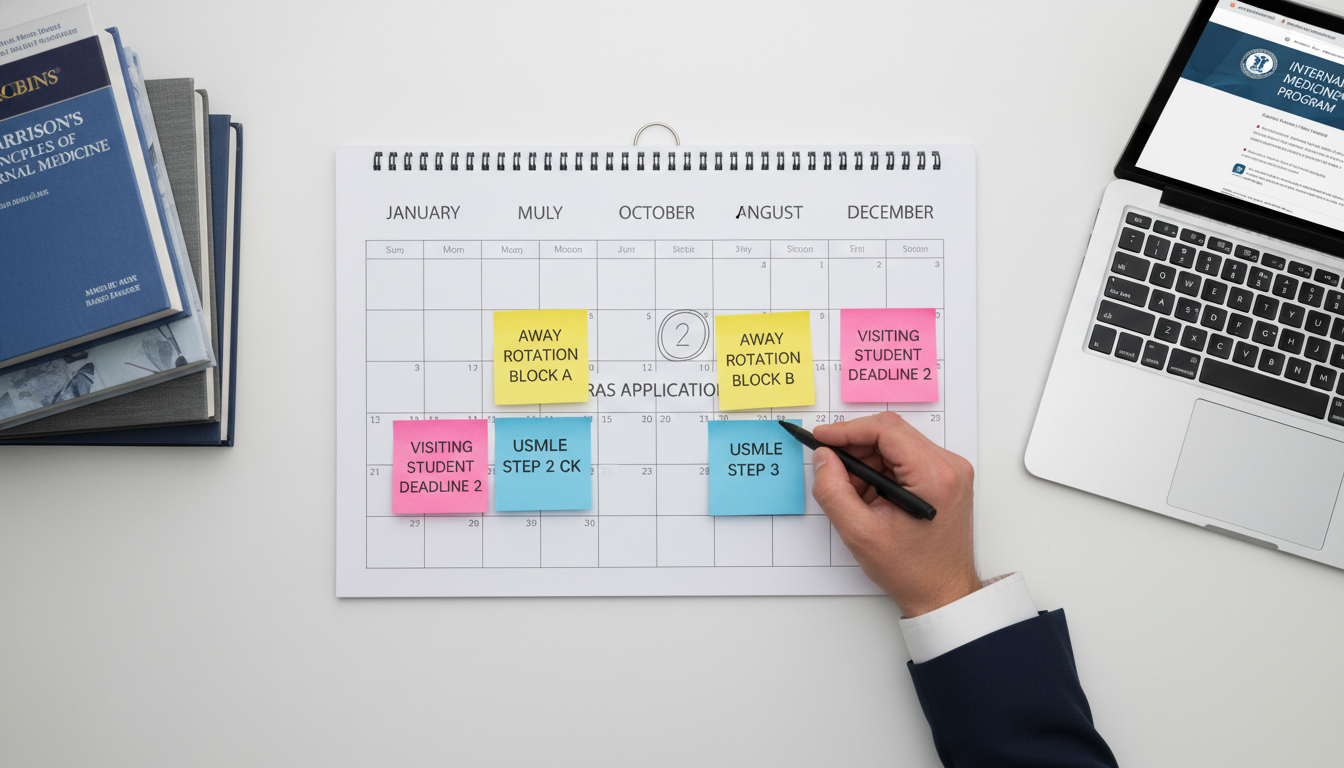
- January–August of the year before the IM match
- Example: For a September 2026 ERAS submission, target rotations from Jan 2025–Aug 2025.
Why this timing works:
- Faculty have time to get to know you and write letters
- You can include rotation performance and LORs in your ERAS application
- Programs you rotate at may remember you during interview season
Risk of too-late rotations:
- Rotations starting after August (e.g., September–November) may still yield experience and letters, but LORs are often late and not fully integrated into early interview decisions.
- For IMGs, early LORs are particularly important because many programs pre-screen aggressively.
2.2 How Many Away Rotations Are Ideal?
There is no one-size-fits-all number, but we can build a reasonable framework.
Minimum meaningful number for IMGs:
- 1–2 quality away rotations in internal medicine at reputable, IMG-friendly teaching hospitals.
Strategic upper limit for most IMGs:
- 3–4 rotations total that truly add value and are feasible financially and logistically.
When more rotations may be justified:
- If you lack any U.S. clinical experience
- If your medical school has low U.S. visibility
- If your USMLE scores are borderline and you need to demonstrate strong clinical performance
However, more is not always better. Four superficial rotations with minimal responsibility and generic letters are less valuable than two intensive, well-chosen rotations leading to excellent LORs.
Rule of thumb for “how many away rotations”:
Aim for 2–3 high-yield internal medicine visiting student rotations, then add only as many additional experiences as your finances, time, and visa status allow without diluting your performance.
2.3 Types of Rotations That Matter for Internal Medicine
Not all rotations are equal from an IM match perspective.
Highest-yield:
Inpatient General Internal Medicine Wards
- Daily rounding, admission H&Ps, progress notes, interdisciplinary meetings
- Best setting to demonstrate work ethic, clinical reasoning, and communication
Internal Medicine Subspecialty Consult Services
- Cardiology, pulmonology, nephrology, infectious disease, GI, etc.
- Useful especially if aligned with your research or career interests
Internal Medicine ICU/CCU (where permitted for students)
- High-intensity, showcases resilience and critical care aptitude
- Some programs prefer senior-level students; IMGs may have limited access
Moderate-yield but still valuable:
Outpatient Internal Medicine Clinics / Primary Care
- Shows continuity-of-care and communication style, but often provides fewer chances to “stand out” compared to inpatient services.
Hospitalist services
- Structurally similar to inpatient wards; check if counted as internal medicine for LOR purposes.
Lower-yield for IM match (but sometimes necessary):
- Observerships without direct patient care
- Useful if you have no other options, but carry less weight than hands-on rotations.
- Better than nothing, but don’t rely on them alone if you can secure U.S. electives.
3. How to Choose Programs and Build a Rotation Portfolio
3.1 Prioritizing IMG-Friendly Internal Medicine Programs
An IMG residency guide must address the key question: where should you rotate?
Look for programs that:
- Regularly match IMGs in internal medicine
- Explicitly state openness to IMGs or list prior IMGs on their website
- Have faculty with international training backgrounds
- Are medium or large teaching hospitals (university-affiliated or large community teaching programs)
Practical steps:
Analyze recent match lists and resident bios
- Check program websites to see where current residents graduated from.
- If you see several international medical graduate backgrounds, that’s encouraging.
Use filters on residency databases (e.g., FREIDA, program websites)
- Some list percentage of IMGs or visa sponsorship (J-1, H-1B).
Email recent alumni from your medical school
- Ask where they rotated and which programs welcomed IMGs.
3.2 Balancing Prestige vs. Probability
It’s tempting to target only big-name academic centers. For IMGs, that can be high risk.
High-prestige academic centers:
- Pros: Strong reputation, potential for standout LOR if you truly excel
- Cons: Very competitive, often limited spots for IMGs, may not rank many IMGs
Mid-tier academic or strong community teaching hospitals:
- Pros: Often more accessible, significant direct clinical responsibility, realistic IM match potential
- Cons: Slightly less name recognition, but often more meaningful interaction with faculty
Recommended mix:
- 1 “reach” rotation at a higher-prestige academic center (if feasible)
- 1–2 solid, IMG-friendly teaching hospitals where your chances of being ranked are higher
- Optional: 1 rotation at a program near your target geographic region (if different from above)
3.3 Selecting Specific Services Within Internal Medicine
When choosing between electives at a given institution:
Prioritize:
- Internal medicine wards (with structured teaching)
- Rotations where students are on teams with residents and attendings
- Services that guarantee regular feedback and formal evaluations
Example prioritization at Hospital X:
- Inpatient General Internal Medicine
- Cardiology Consult Service
- Pulmonary/Critical Care (if allowed for students)
- Outpatient Internal Medicine Clinic
If possible, avoid stacking all sub-specialties without at least one core ward month, as program directors often want to see your performance in a typical resident-like setting.
4. Application Logistics for Visiting Student Rotations
4.1 Common Application Pathways
For IMGs, applying to visiting student rotations usually occurs via:
Institution-specific applications
- Many hospitals have their own international visiting student portals.
- Requirements may include application fee, immunization records, TB testing, proof of English proficiency, malpractice coverage, and dean’s letter.
VSLO (Visiting Student Learning Opportunities)
- Primarily for U.S. medical schools, but some IMGs from partner schools may access VSLO.
- Check if your school participates.
Affiliated/partner programs
- Some international medical schools have formal agreements with specific U.S. hospitals.
- These can be easier to access and often more IMG-friendly.
4.2 Key Requirements and Preparation
Common requirements you should prepare early:
- USMLE Step 1 (and ideally Step 2 CK) scores
- Transcript and proof of being in final years of medical school
- Immunization records (MMR, Hep B, Varicella, Tdap, TB testing, COVID if required)
- Proof of health insurance covering care in the U.S.
- English proficiency (TOEFL/IELTS) for some institutions
- Malpractice/Professional liability insurance (sometimes provided by home school; otherwise, you may need to purchase short-term coverage)
Applying early is critical. Many internal medicine visiting student rotations fill 6–9 months in advance.
Practical timeline example:
- Applying to rotations from May–August 2026
- Start preparing documents by September–October 2025
- Submit rotation applications November 2025–February 2026

4.3 Visa and Legal Considerations for IMGs
If you are not already in the U.S., visa planning is essential.
B-1/B-2 visa:
- Sometimes used for observerships, but less appropriate for hands-on clinical electives.
- Requirements vary by institution and consulate; some may accept B-1 for “unpaid medical clerkships.”
J-1 or F-1 student visas:
- Typically tied to your main place of study. Short-term electives may be possible if your school has agreements.
Always confirm with:
- The host institution’s international office
- Your own medical school administration
- Official consulate or embassy guidance
Do not assume that because one hospital allowed a certain visa type, another will too; policies differ widely.
5. Maximizing the Impact of Each Away Rotation
Once you secure a rotation, how you perform is far more important than where it is.
5.1 Expectations on an Internal Medicine Away Rotation
You will be evaluated on:
Clinical knowledge and reasoning
- Ability to generate differential diagnoses
- Understanding of common IM conditions (CHF, COPD, diabetes, pneumonia, sepsis, etc.)
Work ethic and professionalism
- Being on time (preferably early), staying until work is done
- Respectful communication with all team members
- Accountability for your patients and tasks
Communication skills
- Clear, structured oral presentations
- Legible, concise notes if allowed
- Patient-centered communication, particularly with complex or elderly patients
Teamwork and teachability
- How well you receive feedback and incorporate it
- Willingness to help colleagues and nursing staff
5.2 Concrete Strategies to Stand Out (Positively)
Master the IM presentation format before arrival
- Practice concise, problem-based oral presentations.
- Observe model presentations online and rehearse with peers or mentors.
Pre-read for your patient list daily
- Look up key guidelines and evidence-based management.
- Have 1–2 thoughtful questions per day ready for rounds.
Document your contributions
- Keep a log of interesting cases and your role in them.
- This helps with future interviews and personal statements.
Be proactive but not overbearing
- Volunteer for tasks (“I can call the lab,” “I’ll gather the outside records”).
- Respect the hierarchy and follow your supervising resident/attending’s guidance.
Seek mid-rotation feedback
- After 1–2 weeks, ask:
- “Is there anything I can do to improve my performance?”
- “How can I better meet expectations for a student at this level?”
- After 1–2 weeks, ask:
This demonstrates maturity and allows you to adjust in real time.
5.3 Securing Strong LORs from Internal Medicine Faculty
A major reason for away rotations residency experiences is to secure impactful LORs. Approach this deliberately.
Choosing the right letter writer:
Prioritize:
- Attendings (or chiefs) who:
- Supervised you directly
- Saw you consistently for at least 2 weeks
- Are in internal medicine or a subspecialty related to internal medicine
- Are actively involved in residency teaching or selection (program director, clerkship director, etc.)
When and how to ask:
- Ask during the final week of your rotation, once you’ve received some feedback.
- Use language like:
- “Based on my performance during this rotation, would you feel comfortable writing me a strong letter of recommendation for internal medicine residency?”
If they hesitate or use cautious language, consider asking another attending as well.
Facilitating the letter-writing process:
Provide:
- Your updated CV
- USMLE scores and brief academic summary
- Personal statement (even a draft)
- A brief reminder of key cases and contributions from your rotation
Kindly ask if they can submit the letter by early August (or your ERAS opening date) to ensure it impacts interview offers.
6. Building a Cohesive Application Around Your Rotations
6.1 Integrating Rotations into Your ERAS Application
Use your internal medicine rotations to:
- Highlight specific clinical experiences in your Work/Experiences section
- Emphasize skills gained in the U.S. system: EMR use, multidisciplinary collaboration, EBM practice
- Align your personal statement with themes reflected in your rotation evaluations (e.g., commitment to underserved populations, interest in hospital medicine, academic IM, or subspecialty goals)
6.2 Strengthening Your IM Match Strategy with Rotations
Your away rotation history should inform:
Where you apply:
- If you rotated at Hospital A and had strong feedback, prioritize that program and similar ones.
How you interview:
- Use concrete stories from your away rotations to answer questions like:
- “Tell me about a challenging clinical situation.”
- “How have you adapted to the U.S. healthcare environment?”
- Use concrete stories from your away rotations to answer questions like:
How you rank programs:
- Reflect on team dynamics, supervision, and IM training quality you observed firsthand.
6.3 Common Pitfalls for IMGs to Avoid
- Overloading on low-yield observerships without at least a few hands-on internal medicine rotations.
- Choosing rotations solely by city popularity (e.g., only New York/California) rather than IMG-friendliness.
- Neglecting Step 2 CK or OET/English requirements while chasing multiple away rotations.
- Spreading yourself too thin financially—one failed rotation due to stress/burnout is worse than doing fewer but better.
FAQs: Away Rotation Strategy for IMGs in Internal Medicine
1. As an IMG, how many away rotations do I really need for internal medicine?
Most IMGs aiming for internal medicine residency do well with 2–3 high-quality away rotations that provide:
- Direct patient care experience
- Strong U.S. internal medicine LORs
- Exposure to realistic training environments
If you already have robust U.S. clinical experience and strong letters, you may not need more. If you have none, you might aim for up to 3–4 strategically chosen rotations, as long as finances, visa status, and academic responsibilities allow.
2. Should I prioritize internal medicine wards or subspecialties for away rotations?
If you must choose, start with internal medicine wards. Program directors value seeing your performance in a core IM inpatient environment. After at least one ward month, subspecialty rotations (cardiology, pulmonary, nephrology, etc.) can be helpful, especially if you have interest in that area or research experience to match.
3. Do away rotations guarantee interviews or a spot in that program’s IM match?
No rotation can guarantee an interview or a match, but:
- A strong performance can substantially increase your chances of an interview at that specific program.
- Programs may also share impressions with neighboring institutions.
Conversely, a poor performance may hurt your chances, so treat each rotation as an extended, high-stakes audition.
4. What if I can’t get hands-on electives and only find observerships?
Observerships are still valuable if:
- You have zero prior U.S. clinical exposure
- The observer role allows for structured teaching and close interaction with IM faculty
However, observerships usually carry less weight than hands-on visiting student rotations. If possible, combine 1–2 observerships with at least 1–2 hands-on clinical electives in internal medicine to strengthen your IM residency application.
By approaching your internal medicine away rotations with clear goals, thoughtful program selection, and deliberate performance, you can transform each visiting student rotation into a powerful asset for your IM match strategy as an international medical graduate.