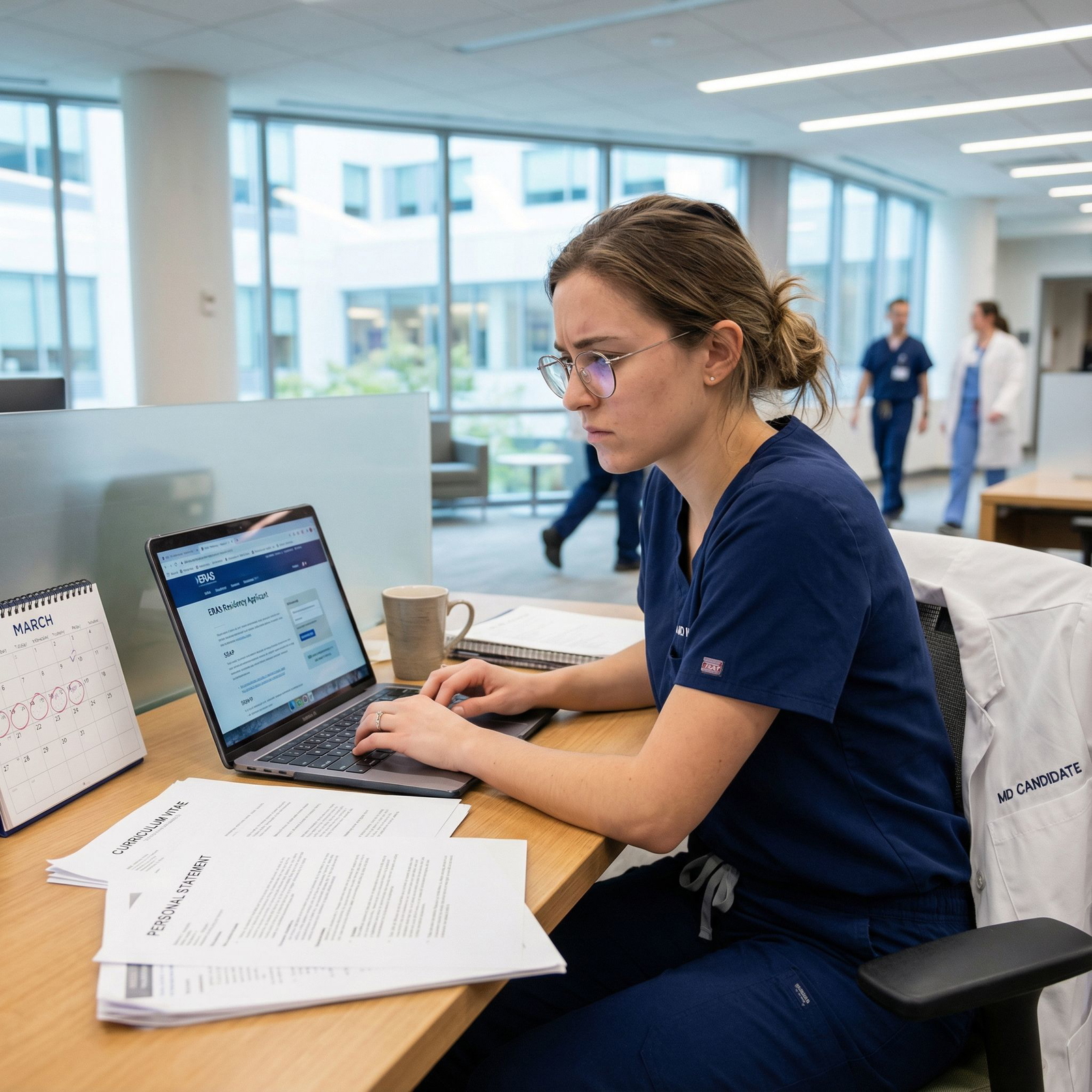
Understanding SOAP: What Every IMG Needs to Know
For many international medical graduates, the Supplemental Offer and Acceptance Program (SOAP) can be the most intense week of the entire residency application cycle. Yet with the right SOAP preparation, it can also be a powerful second chance to secure a residency position.
This IMG residency guide will walk you step-by-step through what is SOAP, how it works, and the exact strategies you need to be ready—before Match Week begins. You’ll learn how to prepare checklists, documents, lists of programs, communication plans, and contingency strategies tailored specifically to the IMG experience.
What Is SOAP?
The Supplemental Offer and Acceptance Program (SOAP) is an NRMP-managed process that allows applicants who go unmatched or partially matched to apply to and accept offers from unfilled residency positions during Match Week.
Key points:
- Eligibility: You must be unmatched or partially matched and ERAS-participating and NRMP-registered to take part.
- Timing: SOAP occurs during Match Week (Monday–Thursday) before the Friday Match Day results.
- Applications: You submit applications via ERAS to programs that have unfilled positions, once the List of Unfilled Programs is released.
- Offers: Programs send offers in four rounds. You can only accept one offer and cannot change once accepted.
For an IMG, SOAP can:
- Be your main path into a preliminary or categorical position if you didn’t receive interviews.
- Offer a second chance if you had interviews but did not match.
- Provide a bridge year (prelim, transitional year) to stay clinical and in the U.S. system.
Understanding this framework early is the first step in effective SOAP preparation.
Pre–Match Week Preparation: Building Your SOAP Readiness Plan
SOAP is high pressure and fast paced. The IMGs who perform best are those who start SOAP preparation months before Match Week, not the weekend before.
1. Know Your Eligibility and Risk Profile Early
By December–January, take a realistic look at your situation:
- Number and type of interviews:
- 0–2 interviews: High risk of being SOAP-eligible → prepare aggressively.
- 3–5 interviews: Moderate risk.
5 interviews: Still prepare; there are no guarantees.
- Type of programs: Categorical vs. preliminary, community vs. university.
- Red flags: Gaps, attempts on exams, visa needs—these factors also affect SOAP competitiveness.
Why this matters: Early recognition allows you to build your SOAP preparation plan without panic.
2. Organize and Optimize Your ERAS Profile
During SOAP, you cannot completely rewrite your application, but you can:
- Update certain sections (within ERAS timeframes)
- Add new experiences
- Tailor your personal statements and program signaling (where applicable)
Focus on:
- USMLE/COMLEX documentation: All final scores uploaded and verified.
- Medical school documents: Diploma, MSPE, transcripts—ensure no missing pages or wrong uploads.
- ECFMG certification:
- If not yet certified, know your timeline.
- Delays can cost you positions in SOAP.
- Experiences: Make sure U.S. clinical experiences, observerships, or research are clearly listed.
- Certifications: BLS, ACLS, language fluency, and any U.S.-based clinical skills—update these.
Think of ERAS as your static foundation during SOAP. If your foundation is weak, no last-minute strategy will fully compensate.
3. Build Your SOAP Document Library in Advance
You should have SOAP-ready versions of key documents saved before Match Week:
Multiple Personal Statements (PS)
- Internal Medicine–focused PS
- Family Medicine–focused PS
- Pediatrics, Psychiatry, Surgery, Preliminary/Transitional year versions if relevant
- Short versions highlighting flexibility, ability to start quickly, and willingness to serve underserved areas
Updated CV (for your own reference and for program communication)
- You won’t upload a separate CV in ERAS, but having a current CV helps you respond quickly to program queries and phone screenings.
Letter of Interest Templates
- Short, adaptable email templates for:
- Preliminary programs
- Categorical programs
- Community programs
- Programs in specific geographic regions where you have ties
- Short, adaptable email templates for:
Reference List
- Contact information (email, phone) for:
- U.S. attendings
- Research mentors
- Program directors or clerkship directors from your rotations
- This allows programs to quickly verify your clinical performance if they contact your references during SOAP.
- Contact information (email, phone) for:

Constructing a Targeted SOAP Program Strategy as an IMG
A common mistake IMGs make is to treat SOAP like a lottery—submitting to as many programs as possible without strategy. The most successful SOAP preparation focuses on fit, feasibility, and flexibility.
1. Understand the Types of Positions in SOAP
In the IMG residency guide context, you may see multiple position types during SOAP:
Categorical positions (PGY-1 with guaranteed completion)
- Highly competitive during SOAP
- Often limited in number, especially in core specialties
Preliminary positions (PGY-1 only, often linked to advanced specialties)
- Internal Medicine Preliminary
- Surgery Preliminary
- Transitional Year
- Often more abundant in SOAP than categorical spots
Advanced positions (PGY-2 start)
- Less common solution for IMGs without a PGY-1
- More relevant if you already have or will secure a PGY-1
As an IMG, especially if you’re visa-dependent, a preliminary or transitional year may be an important stepping-stone to remain in the system, build U.S. experience, and then reapply.
2. Pre-Build a Hypothetical Program List
You won’t know the actual unfilled programs list until Match Week, but you can prepare templates and a ranking framework.
Divide your strategy into tiers:
Tier 1 – High Realistic Fit
- Community programs with a history of taking IMGs
- Programs in states more IMG-friendly (e.g., NY, NJ, MI, OH, PA, IL, FL, TX in some specialties)
- Programs where your profile aligns closely with previous matched residents
Tier 2 – Moderate Fit
- Programs with occasional IMGs
- Slightly higher average scores but still possible with your profile
- Regions without personal or geographic ties but still favorable
Tier 3 – Aggressive/Reach
- University programs or highly competitive regions
- Programs with minimal IMG history but still open to ECFMG-certified applicants
Use this framework when the NRMP releases the List of Unfilled Programs on SOAP Monday:
- Sort programs by specialty, state, and visa policy.
- Cross-check with:
- FREIDA or Residency Explorer data
- Program websites (look at current residents for IMG presence)
- Assign each program to Tier 1, 2, or 3 quickly.
3. Factor in Visa and Licensing Realities
For many international medical graduates, visa considerations can be the single biggest filter during SOAP.
Visa Sponsorship
- Prioritize programs that explicitly state J-1 or H-1B sponsorship on their website or via FREIDA.
- Be cautious with programs that are silent on visa policies; in SOAP, they rarely have time to make exceptions.
State Licensing
- Some states have specific requirements:
- Minimum number of years of medical school
- Maximum time since graduation
- Exam attempt limits
- In your SOAP preparation, keep a shortlist of states where you clearly meet requirements.
- Some states have specific requirements:
Work these factors into your pre-built strategy so you aren’t wasting applications on programs that cannot rank you even if they like you.
4. Specialty Flexibility: How Broadly Should You Apply?
You must be strategically flexible in SOAP, especially as an IMG.
Ask yourself:
- Am I open to:
- Preliminary Internal Medicine or Surgery as a bridge year?
- Family Medicine, Pediatrics, Psychiatry even if I applied originally in IM or another specialty?
- Less “prestigious” but more IMG-friendly community programs?
Example:
- Original applications: Internal Medicine only
- SOAP strategy:
- Primary focus: IM categorical and IM prelim positions
- Secondary: Family Medicine categorical
- Contingency: Transitional Year, Surgery prelim (if you can justify interest)
Your SOAP preparation should include tailored personal statements and a clear narrative that makes this flexibility credible and coherent, not desperate.
Mastering the SOAP Week Workflow
SOAP week is structured and time-constrained. Knowing the timeline and having a playbook reduces stress and errors.
SOAP Timeline Overview (Typical Structure)
While exact times can change slightly year to year, the process is generally:
Monday morning:
- You learn if you are Matched or Unmatched/Partially Matched.
- NRMP sends this via email and your NRMP account.
Monday midday–afternoon:
- SOAP-eligible applicants gain access to the List of Unfilled Programs.
- You can research programs and begin preparing your application list.
- You cannot contact programs directly—this is a strict SOAP rule.
Tuesday morning onward:
- You can submit applications via ERAS to unfilled programs (within the allowed limit).
- Programs begin reviewing applications and may contact you (phone or virtual) through permitted channels.
Offer Rounds (Tuesday–Thursday):
- Typically four rounds where programs extend offers to their preferred SOAP candidates.
- You can:
- Accept one offer (binding)
- Let offers expire
- After accepting, you exit SOAP.
Design your SOAP preparation to match this structure.
1. Monday: Rapid Assessment and Target List Finalization
Once you learn you are SOAP-eligible:
Regulate your emotions first:
- Give yourself 30–60 minutes to process disappointment, talk with a trusted person, then shift into action mode. Emotional control is critical for clarity.
Confirm your eligibility and status:
- Fully unmatched vs. partially matched (e.g., matched to an advanced spot but no prelim year).
- This affects which positions you target (e.g., PGY-1 only vs. categorical).
Work the Unfilled Programs List methodically:
- Filter by:
- Specialty
- State
- Visa acceptance (from pre-research or website)
- Mark programs that:
- Take IMGs
- List J-1/H-1B or are historically IMG friendly
- Filter by:
Apply your Tier system:
- Assign each program to Tier 1, 2, or 3.
- Plan to prioritize higher probability programs while still using some slots for reaches.
2. Tuesday Morning: Application Submission Strategy
SOAP usually imposes a limit on the number of applications (e.g., 45 or so; check the current cycle’s rules).
In your SOAP preparation, plan for:
Core principles:
- Cover enough programs to create volume.
- Maintain quality and fit—do not waste precious slots on impossible long shots.
Allocation example for a typical IMG:
- 50–60% → Tier 1 programs
- 25–35% → Tier 2 programs
- 10–15% → Tier 3 reaches
Within ERAS, attach:
- Appropriate personal statement by specialty
- Correct US LoRs for that specialty
- Ensure no missing exam score reports or transcripts
Double-check everything before final submission; SOAP moves fast, but mistakes are costly.
3. Communication During SOAP (What You Can and Cannot Do)
SOAP has strict communication rules:
- Applicants cannot initiate contact with programs outside of ERAS once SOAP starts.
- Programs can contact you by phone or email for:
- Quick interviews
- Clarification of application details
- Informal assessment of your communication and professionalism
Your SOAP preparation should include:
- A quiet environment and reliable phone/internet for Tuesday–Thursday.
- A professional voicemail greeting:
- Clear name
- Return-call promise
- Brief, courteous tone
- A standardized response structure for phone calls:
- Thank the caller
- Confirm program name and specialty
- Be ready to answer:
- Why this specialty?
- Why this program/state?
- How do you handle stress, call, teamwork?
- How do you explain red flags (gaps, attempts, older YOG)?
You must be reachable and responsive. Missed calls during SOAP can mean missed offers.

Clinical, Personal, and Mental Preparation for SOAP Success
SOAP is not only administrative—it is also a pressure test of your professionalism, communication, and resilience.
1. Prepare Your Story and Talking Points
As an IMG, your narrative often includes:
- Why you chose the U.S. system
- How you adapted to cultural and clinical differences
- Your long-term commitment to primary care, underserved communities, or specific populations
Before SOAP week:
Write out 3–5 key talking points:
- One about your clinical strengths (e.g., managing complex patients, strong documentation)
- One about adaptability and learning quickly in new systems
- One about teamwork and communication with diverse staff
- One about your motivation for your chosen specialty
- One about handling stressful situations on call or in rotations
Prepare clear, concise responses to:
- “Tell me about yourself.”
- “Why did you not match?”
- “Why should we consider you now in SOAP?”
Your ability to answer these confidently can separate you from equally qualified applicants.
2. Plan Your Daily Routine and Support System
Match Week is emotionally heavy. Build structure:
Schedule:
- Fixed wake-up time
- Dedicated blocks for:
- Program research
- Application checking
- Mock phone interview practice
- Time for meals, brief walks, and rest
Support people:
- One or two friends/family who understand that:
- You may need emotional support.
- You may also need quiet and focus during offer rounds.
- One or two friends/family who understand that:
Self-care basics:
- Avoid all-night research sessions once SOAP begins; you must be mentally sharp for sudden phone calls.
- Stay hydrated and eat regularly.
3. Have a Contingency Plan (In Case You Don’t Match Through SOAP)
True SOAP preparation includes thinking beyond SOAP:
If you do not obtain a position by the end of SOAP:
- Consider post-Match strategies:
- Rare post-SOAP unfilled spots (outside NRMP, sometimes for prelim positions)
- Research positions, observerships, or fellowships to strengthen next cycle
- Reflect and analyze:
- Was it exam scores, clinical experience, visa issues, too narrow specialty choice, or late application?
- Build a 12-month improvement plan:
- Additional U.S. clinical experience
- New LoRs
- Extra certifications or QI projects
- Targeted specialty change if indicated
Knowing that you have a plan B reduces panic and allows you to perform better during SOAP itself.
Putting It All Together: A Practical SOAP Checklist for IMGs
Below is a concise, actionable SOAP preparation checklist tailored for international medical graduates:
1–3 Months Before Match Week
- Confirm NRMP registration and ERAS participation.
- Verify ECFMG certification status and timeline.
- Ensure all USMLE/COMLEX scores are uploaded and correct.
- Update ERAS experiences, publications, and certifications.
- Prepare multiple specialty-specific personal statements.
- Create a master CV for your own reference.
- Collect accurate contact information for all references.
- Research visa policies and state licensing rules for IMG-friendly states.
- Create a tier-based program strategy model (Tier 1, 2, 3).
2–4 Weeks Before Match Week
- Run a mock SOAP scenario:
- Assume you are unmatched.
- Practice quickly sorting a hypothetical unfilled list.
- Draft template emails/letters of interest for different program types.
- Prepare talking points and practice phone interviews with friends or mentors.
- Set up a quiet workspace and ensure reliable internet/phone access.
- Update your voicemail greeting to sound professional.
Match Week: Monday–Thursday
Monday
- Process your result; shift to problem-solving mindset.
- Confirm your status (fully vs. partially unmatched).
- Filter the List of Unfilled Programs.
- Assign programs into Tiers using your pre-built framework.
Tuesday
- Submit applications via ERAS strategically across tiers.
- Double-check PS, LoRs, exam reports for each application.
- Keep your phone with you and workspace ready for calls.
Tuesday–Thursday
- Answer all calls/emails promptly and professionally.
- Keep notes on each contact (program name, questions asked, your impression).
- Review and accept offers within the official system and timelines only.
- Once you accept an offer, stop further SOAP activities.
Post-SOAP
- If matched: Celebrate, confirm onboarding requirements, and express gratitude to mentors.
- If unmatched: Meet with advisors, analyze your application, and plan for reapplication and gap-year activities.
Frequently Asked Questions (FAQ)
1. As an IMG, should I focus on categorical or preliminary positions during SOAP?
Aim for categorical positions if they are realistically within reach, but don’t ignore preliminary or transitional year positions. For many international medical graduates, securing a preliminary year:
- Provides U.S. clinical experience
- Keeps your visa status active (if on J-1 or H-1B)
- Strengthens your profile for the next application cycle
Your SOAP preparation should therefore include tailored documents and talking points for both categorical and preliminary options.
2. Can I change my personal statement or LoRs during SOAP?
You cannot fully redesign your application during Match Week, but you can:
- Upload and assign different personal statements for different specialties or program types.
- Reassign existing letters of recommendation to specific program applications (within ERAS limits and timelines).
This is why early SOAP preparation—including multiple specialty-specific PS versions—is so valuable.
3. What is SOAP communication etiquette with programs?
During SOAP:
- You cannot initiate contact with programs to ask for interviews or to lobby for positions; this violates NRMP rules.
- Programs may contact you for:
- Quick phone/virtual interviews
- Clarifications
- You should:
- Answer promptly and professionally
- Be concise but genuine
- Avoid sounding desperate—emphasize fit, readiness, and commitment
Any post-call email should be brief, professional, and only if clearly appropriate.
4. If I don’t get a residency position through SOAP, have I failed permanently?
Not at all. Many IMGs ultimately succeed on second or third attempts. If SOAP does not lead to a position:
- Use the following year strategically:
- Gain U.S. clinical experience
- Improve exam performance (if any retakes are possible/needed)
- Collect stronger LoRs
- Reassess and possibly broaden your specialty focus
- Reapply with a stronger, more targeted application.
SOAP is one critical opportunity, but not the only path to a U.S. residency for an international medical graduate.
By treating SOAP preparation as a deliberate, multi-month process—not a last-minute scramble—you significantly increase your odds of success. As an IMG, you bring resilience, adaptability, and a global perspective. Combined with structured SOAP strategies, these strengths can translate into a residency position, even in the most intense week of the Match cycle.