
Resilience in SOAP: Overcoming Unmatched Hurdles to Secure Your Residency
Navigating the road to a successful Residency Match is one of the most emotionally demanding parts of medical education. When the initial Match results show “unmatched,” it can feel like everything has fallen apart in a single moment. Yet for many applicants, the Supplemental Offer and Acceptance Program (SOAP) is a second chance—and resilience is the key that turns that chance into an actual residency position.
This expanded guide explores how to apply resilience strategies, mindset shifts, and practical planning to the SOAP process so you can move from shock and disappointment to action and opportunity. You’ll learn how to understand the SOAP timeline, manage emotions, refine your application strategy, and use this experience as a powerful step in your long-term career development.
Understanding the SOAP Process and Its Emotional Impact
What Is SOAP in the Residency Match?
The Supplemental Offer and Acceptance Program (SOAP) is a structured process run by the NRMP that helps unmatched or partially matched applicants connect with residency programs that have unfilled positions after the Main Residency Match. It takes place during Match Week and is governed by strict rules and timelines.
In broad terms, SOAP allows eligible applicants to:
- Access a list of unfilled programs through the NRMP and ERAS platforms.
- Apply to a limited number of unfilled residency positions within specific application windows.
- Participate in offer rounds, where programs extend offers and applicants may accept or decline in real time.
- Secure a categorical, preliminary, or transitional position before the public release of the full list of unfilled programs.
Because SOAP is fast-paced and highly structured, you must enter the week prepared—emotionally, logistically, and strategically.
Who Is Eligible to Participate in SOAP?
You are typically eligible for SOAP if you:
- Registered for the NRMP Main Residency Match,
- Are unmatched or partially matched when results are released,
- Are not withdrawn from the Match,
- Have passed necessary USMLE/COMLEX exams required by programs you’re targeting (though some will still consider “pending” scores), and
- Have an active ERAS application.
Your med school dean’s office and the NRMP provide official confirmation of eligibility at the start of SOAP.
The Emotional Reality of Going Unmatched
Learning that you did not match can bring intense emotions:
- Shock, disbelief, or numbness
- Guilt, shame, or fear of judgment from peers and family
- Anxiety about the future and potential career disruption
- Anger or self-criticism about perceived failures
These reactions are normal and understandable. However, SOAP moves quickly—often within hours of receiving Match status—so balancing emotional processing with rapid, clear-headed decision-making becomes critical. This is where resilience strategies transform an overwhelming week into a navigable, structured process.
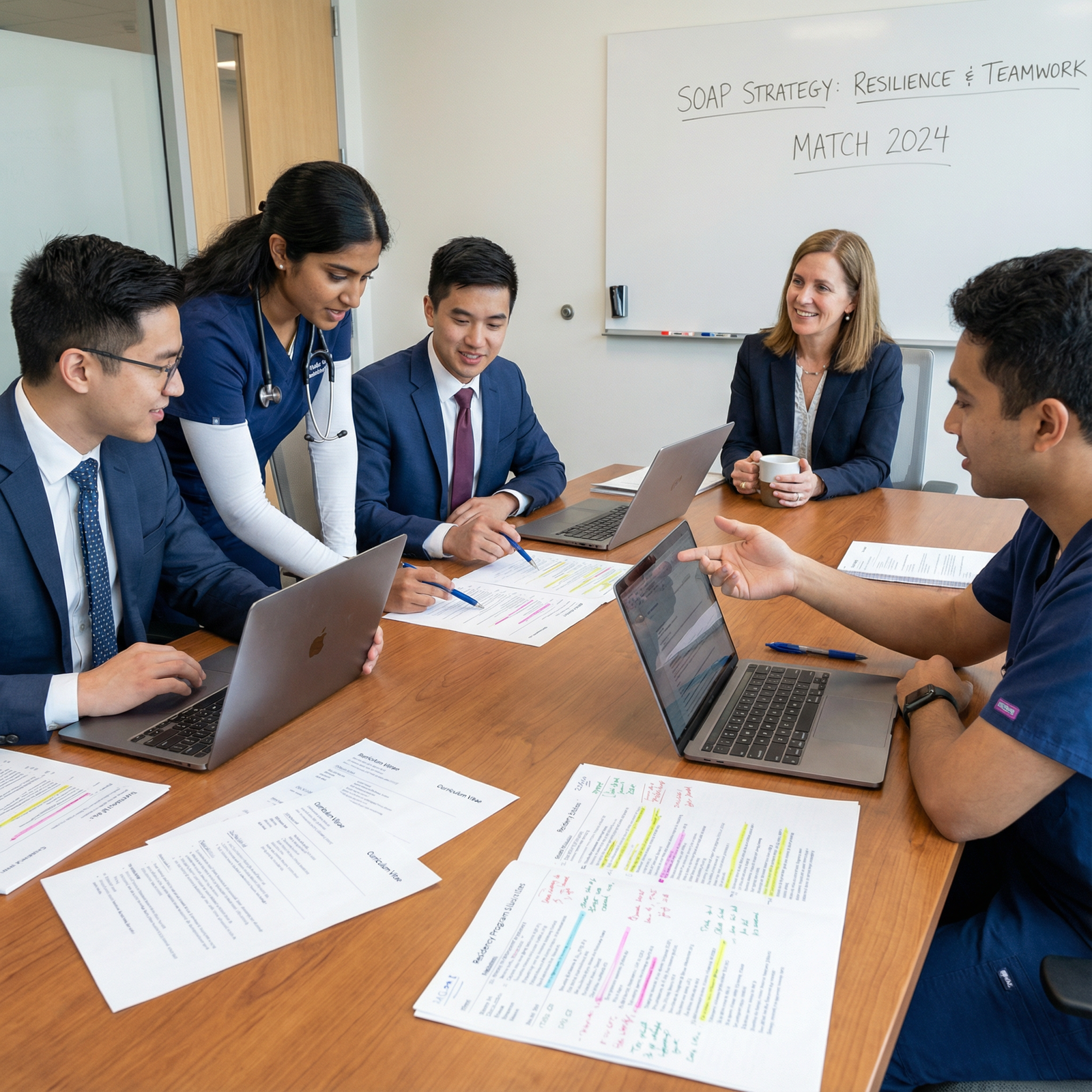
Why Resilience Matters in the SOAP Process
Defining Resilience in the Context of Medical Training
In medical education, resilience is more than “staying positive.” It’s the ability to:
- Absorb a setback (like not matching),
- Process the emotions that come with it,
- Reorient your thinking toward solutions,
- Take purposeful, sustained action under pressure, and
- Grow from the experience instead of being defined by it.
During SOAP, resilience is not a vague personality trait—it’s a set of practical skills and behaviors you can actively develop and apply in real time.
How Resilience Improves Your SOAP Outcomes
Resilience directly influences your odds of success in the SOAP Process:
Emotional Stability Under Time Pressure
The week is compressed and intense. Resilient applicants are better able to:- Make clear decisions about which specialties and programs to target,
- Speak coherently and confidently in last-minute interviews,
- Adjust quickly if an early strategy isn’t working.
Adaptability When Plans Change
You may have to:- Pivot from a highly competitive specialty to a broader one,
- Consider geographical regions you hadn’t prioritized,
- Switch focus from categorical to prelim or transitional positions.
Resilience allows you to adjust without feeling that you’ve “failed”—instead, you’re executing a career development strategy with a longer time horizon.
Persistence and Professionalism
Programs can sense applicants’ energy and mindset, even through brief virtual interviews or phone conversations. Resilience helps you:- Maintain professional composure after rejections or no responses,
- Continue networking and applying strategically,
- Communicate a consistent, forward-looking narrative.
Long-Term Career Growth
The skills you build during SOAP—self-assessment, coping with uncertainty, seeking feedback, and adapting—are the same skills you’ll need as a resident and attending. The way you handle SOAP can become a powerful story of resilience in future interviews and evaluations.
Core Resilience Strategies for SOAP Success
1. Practice Structured Self-Reflection and Emotional Awareness
You may feel there’s “no time” to process feelings during SOAP, but even brief, structured reflection preserves your clarity and stamina.
How to do it in practice:
- Schedule short reflection blocks (10–15 minutes, twice daily) during SOAP week.
- Ask yourself:
- What am I feeling right now (anxiety, anger, fear, hope)?
- What specifically triggered this feeling?
- What is one small, productive action I can take in the next hour?
- Use quick journaling, a notes app, or a voice memo to capture thoughts.
Why this matters:
Recognizing emotions lowers their intensity and prevents them from unconsciously driving your decisions. You’ll be less likely to panic-apply to every available program or freeze when you need to act.
2. Build and Activate a Strong Support Network
A powerful resilience strategy during SOAP is not going through it alone. Your network becomes both a psychological anchor and a strategic resource.
Who Should Be in Your Support Circle?
- Dean’s or student affairs office:
They often have SOAP-specific resources, data on past SOAP outcomes, and direct communication with programs. - Faculty advisors and mentors:
Can help reassess your specialty choices, edit your materials, and make targeted calls or send emails on your behalf. - Recent graduates who went through SOAP:
They understand the process intimately and can share practical tips, reassurance, and real-world outcomes. - Peers and family:
Provide emotional support, encouragement, and help you maintain perspective.
Practical Ways to Use Your Network
- Ask your school to assign you a SOAP advisor if they haven’t already.
- Limit your closest circle to people who are constructive and calm; this isn’t the week to be around chronic pessimists.
- Consider short, daily check-ins with a trusted mentor to recalibrate your strategy based on new information.
3. Set Realistic, SMART Goals for SOAP Week
Vague goals (“I have to match no matter what”) increase stress. Resilient applicants break the week into specific, achievable steps.
Use SMART goals (Specific, Measurable, Achievable, Relevant, Time-bound):
Examples:
- By [Time X]: “I will finalize a priority list of 25 programs in internal medicine and family medicine that I am willing to attend geographically.”
- By [Time Y]: “I will revise my personal statement for primary care–oriented programs and have my advisor review it.”
- Each evening: “I will spend 20 minutes reflecting on what worked today and what I need to adjust for tomorrow.”
This structure not only enhances performance but also provides a sense of progress, which itself builds resilience.
4. Apply Strategic Networking and Communication
Networking during SOAP must be ethical, targeted, and professional. Many programs are inundated with inquiries, so your outreach should be thoughtful and respectful of NRMP rules.
Where and How to Network
- Faculty champions: Ask mentors if they know program directors or faculty in your target specialties or regions and if they’re comfortable reaching out on your behalf.
- Alumni networks:
Your school’s graduates in residency programs can provide insider perspectives on unfilled positions and selection criteria. - Formal events and webinars:
Some institutions and organizations host SOAP preparation sessions or Q&As—these can provide valuable tips and connections.
Effective Communication Examples
When reaching out (where appropriate and allowed):
- Be brief and specific:
- Introduce yourself (name, school, year, specialty interest).
- State your current situation (SOAP-eligible, seeking [X] type of position).
- Highlight 1–2 strengths or unique aspects of your background.
- Ask a clear, reasonable question or request (e.g., “Would you be open to looking over my program list?”).
Remember: networking is about relationships and information, not demanding a spot.
5. Use All Available SOAP Resources and Data
Resilience is not just emotional—it’s also about leveraging tools and information effectively.
Key Resources to Know
- NRMP Website
- SOAP schedule
- Eligibility criteria
- Official rules governing communication and offers
- ERAS Platform
- Application limits and timelines during SOAP
- Ability to tailor personal statements and program signaling (if available)
- Your Med School’s Career Services
- Sample SOAP strategies
- Historical data on SOAP outcomes by specialty and applicant profile
- Workshops on interview prep and specialty pivoting
Actionable Tips
- Review the full SOAP timeline before Match Week so you’re not learning on the fly.
- Create a checklist of:
- Materials to update (CV, personal statement, letters if possible),
- People to contact (advisors, mentors),
- Decisions you must make early (specialty flexibility, geographic limits).
6. Maintain a Deliberate Positive Mindset
“Staying positive” doesn’t mean ignoring reality. It means choosing a constructive interpretation of events and your ability to influence them.
Practical Mindset Techniques
- Cognitive reframing:
Instead of “I failed to match, I’m not good enough,” try:- “I didn’t match this cycle. I now have a clear opportunity to reassess and improve my application.”
- Daily affirmations tailored to SOAP:
- “I can adapt and make wise decisions even under pressure.”
- “This temporary setback does not define my long-term career.”
- Limit comparison:
Temporarily mute social media if seeing Match celebrations triggers distress. Your path is not less valuable because it’s different.
A grounded, hopeful mindset improves how you come across in emails, interviews, and interactions with faculty and programs.
7. Prepare Intensively for Last-Minute SOAP Interviews
Interviews during SOAP may be short-notice, brief, and highly focused. Preparation is one of the most controllable aspects of your success.
Anticipate Common SOAP Interview Topics
Be ready to address:
- Why you did not match and what you learned from it
- Why you are interested in this specific specialty and program
- How you handled stress or setbacks in medical school
- How you will be a resilient, reliable resident in a high-demand environment
Actionable Steps
- Develop a clear, honest, and non-defensive explanation for going unmatched:
- Focus on factors (e.g., limited interviews, late exam score, overreaching specialty list),
- Emphasize what you’ve changed or improved since then.
- Conduct mock interviews with advisors, residents, or peers.
- Prepare program-specific questions that show genuine interest in training and fit:
- “How does your program support interns transitioning from nontraditional or SOAP pathways?”
- “What wellness and mentorship structures are in place for first-year residents?”
Confidence in your responses reduces anxiety and helps you present your resilience story effectively.
8. Reflect on Learning and Plan for Long-Term Career Development
Even if you secure a position through SOAP, it’s worth reflecting on the broader lessons for your career. If you do not secure a spot, this reflection becomes even more important.
If You Match Through SOAP
Ask yourself:
- What aspects of my overall application strategy contributed to going unmatched initially?
- What resilience strategies helped me most during SOAP?
- How can I carry these skills forward into residency training (feedback-seeking, adaptability, stress coping)?
Document this experience. Later, when someone asks in an interview, “Tell me about a time you faced a major setback,” you’ll have a thoughtful, organized narrative.
If You Do Not Match After SOAP
This outcome is painful but not career-ending. Consider:
- Alternative pathways for the coming year:
- Research positions or fellowships
- A clinical research coordinator or teaching role
- Additional clinical experience (preliminary year, externships, observerships)
- Application improvement strategies:
- Strengthening exam scores if possible
- Adding meaningful research or quality improvement projects
- Obtaining new letters of recommendation from U.S. clinical experiences
- Broader specialty and geographic flexibility for the next cycle.
Resilience here means recognizing that medical careers are long; a one-year detour can be transformative rather than purely negative.
Real-World Examples of Resilience in the SOAP Process
Case Study 1: The Adaptive Applicant
Sarah, a U.S. MD senior, applied broadly to competitive specialties with few backup options. On Match Day, she learned she was unmatched.
Her resilience actions:
- Within hours, Sarah met with her dean and a faculty mentor.
- She reflected on her primary interests and realized she equally enjoyed inpatient medicine and longitudinal patient care.
- She pivoted to prioritize internal medicine and some family medicine programs in SOAP.
- She quickly revised her personal statement to emphasize continuity of care, teaching interests, and QI projects.
- She practiced a structured explanation for why she went unmatched and what she had learned.
Outcome:
By the final SOAP offer round, Sarah received and accepted an internal medicine position at a strong university-affiliated program. She later realized that the position aligned more closely with her long-term goal of becoming an academic hospitalist.
Case Study 2: The Strategic Networker
Tom, an international medical graduate (IMG), had good clinical skills but marginal Step scores and limited U.S. clinical experience. He went unmatched in his preferred specialty of pediatrics.
His resilience actions:
- Tom activated his network of attending physicians from U.S. observerships, asking them for honest feedback and any connections in family medicine and internal medicine.
- He joined virtual SOAP preparation sessions hosted by his med school and alumni association.
- He targeted community-based programs that historically welcomed IMGs and emphasized his communication skills and work ethic.
- He kept detailed notes after each interview and adjusted his answers based on feedback.
Outcome:
Tom matched through SOAP into a family medicine program where an alumnus from his school trained. The attending who had supervised his observership later became a key mentor. Today, Tom is a board-certified family physician practicing full-spectrum care.

FAQ: Resilience, SOAP, and Next Steps in Your Residency Journey
Q1: What should I do immediately after learning I am unmatched?
First, allow yourself a brief period to process your emotions—this news is significant, and feeling upset is normal. Next, act quickly but deliberately:
- Contact your dean’s office or student affairs to confirm SOAP eligibility.
- Schedule a rapid advising session to:
- Review your application,
- Identify realistic specialties and geographic options,
- Create an initial SOAP program list.
- Update your ERAS materials (CV, personal statement, experiences) to reflect your most recent achievements and, if needed, a broader specialty focus.
Balancing emotional validation with prompt action is a core resilience strategy at this stage.
Q2: How can I stay resilient if I feel ashamed or embarrassed about not matching?
Feelings of shame and embarrassment are extremely common—but often magnified by assumptions about how others view you. To protect your resilience:
- Limit conversations to people who are truly supportive and constructive.
- Remind yourself that many excellent residents and attendings experienced SOAP or a reapplication cycle.
- Reframe the situation as a complex career development challenge, not a personal failure.
- Consider speaking with a mental health professional, especially if you’re experiencing persistent anxiety or depressive symptoms.
Your worth as a future physician is not determined by a single Match outcome.
Q3: Is it wise to change specialties for SOAP, or should I stick with my original choice?
It depends on your goals and competitiveness profile. A resilience-based approach looks at both short-term feasibility and long-term satisfaction:
- Changing specialties may increase the number of available positions and your chance of securing a residency spot this cycle.
- Stay aligned with what you can realistically see yourself practicing; avoid choosing a specialty solely because “it’s open.”
- Discuss with mentors:
- How your skills and interests translate to alternative specialties,
- How a transitional or preliminary year might help you reapply later to your preferred field.
Flexibility can be a strength if it’s grounded in honest self-assessment and realistic career planning.
Q4: What if I still don’t secure a position after SOAP? Is my medical career over?
No. While incredibly disappointing, not matching after SOAP does not end your medical career. Many physicians took a nontraditional path. Constructive next steps include:
- Seeking research, teaching, or clinical support roles that keep you engaged with medicine.
- Improving your application with:
- New clinical experiences,
- Stronger letters of recommendation,
- Further exam success (if applicable).
- Broadening your specialty and geographic interests for the next cycle.
- Working closely with advisors who have experience guiding reapplicants.
Resilience here means zooming out: your career in medicine spans decades. A one-year delay can lead to a more informed, durable path.
Q5: What specific resources can help me prepare for SOAP and build resilience?
Consider combining process-specific resources with personal support tools:
- SOAP/Match Resources:
- NRMP official website and SOAP guidelines
- ERAS platform resources and tutorials
- Your med school’s career advising office and SOAP workshops
- Specialty-specific organizations (e.g., AAFP, ACP) that may offer guidance
- Resilience and Well-Being Resources:
- Counseling or wellness services at your institution
- Mindfulness or stress-reduction apps (e.g., Headspace, Calm)
- Peer support groups—formal or informal—for unmatched applicants
Using these in combination helps you approach SOAP as both a logistical challenge and a human experience that requires emotional care.
Resilience in SOAP is not about pretending the disappointment of going unmatched doesn’t hurt—it’s about acknowledging that pain while still showing up for the work in front of you. By understanding the SOAP Process, mobilizing support, setting clear goals, adapting strategies, and reflecting on your growth, you position yourself to secure a residency position and build a stronger foundation for your future in medicine.
This chapter in your career may be unexpectedly difficult, but it can also become one of the most defining sources of strength in your journey to becoming a physician.