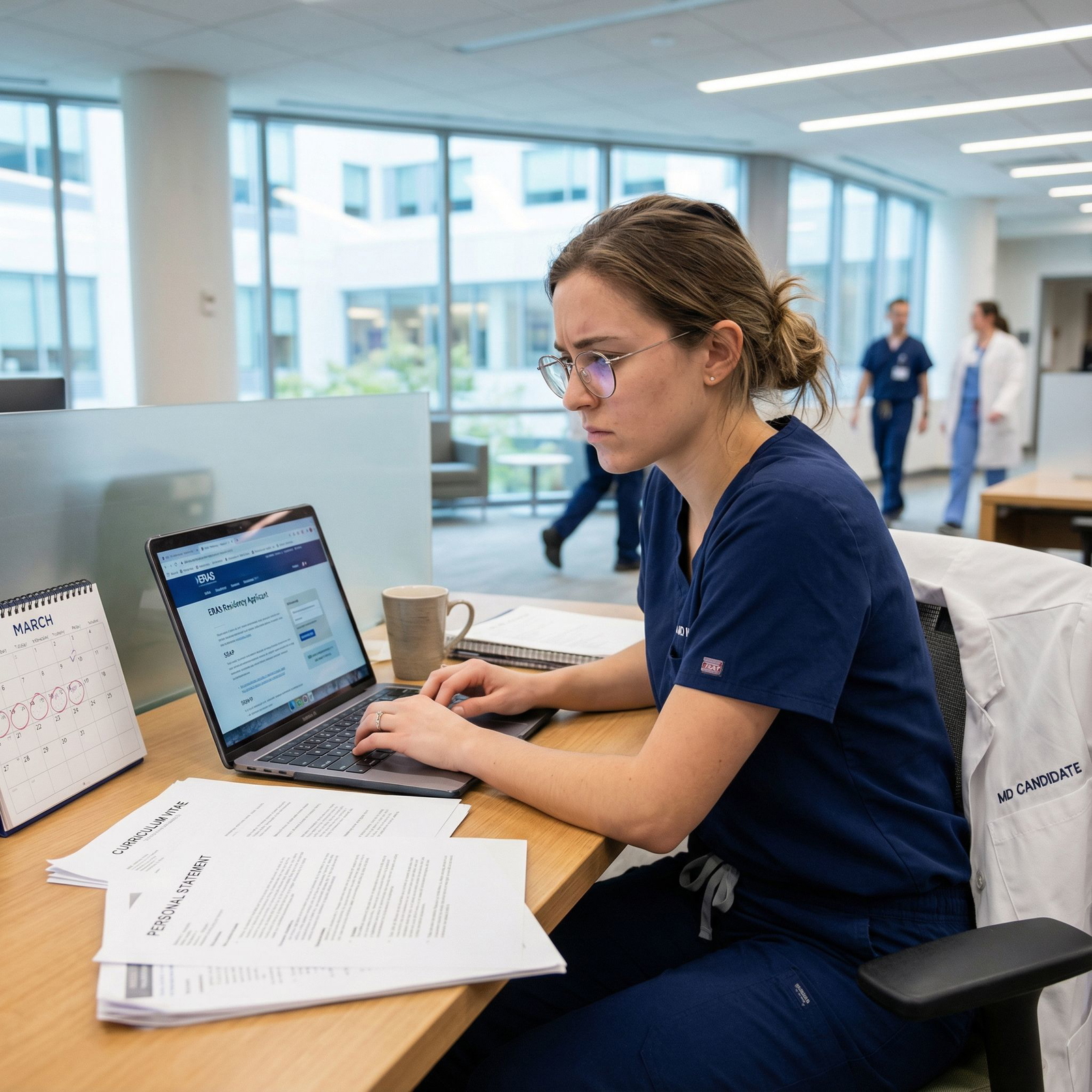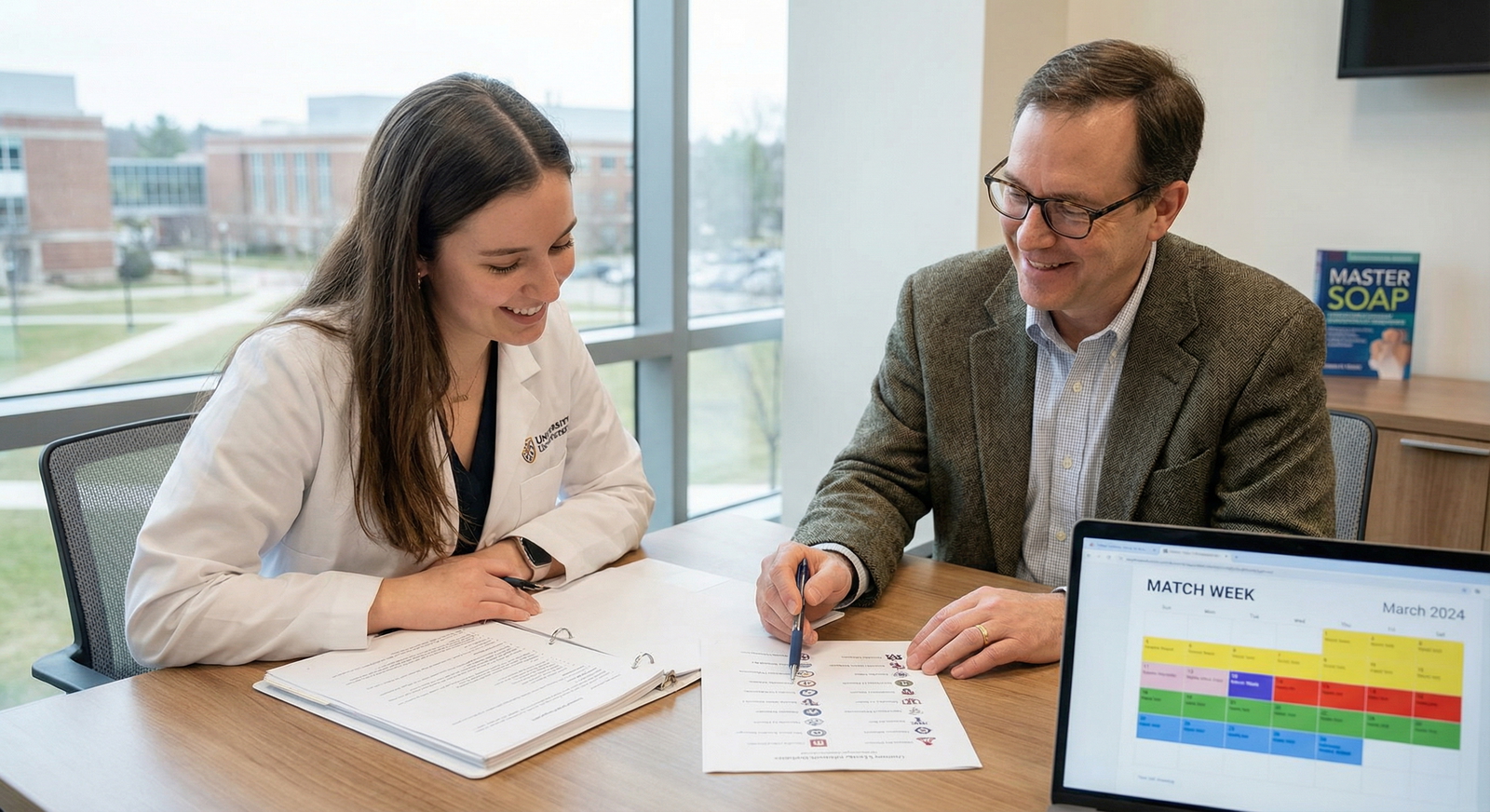
Preparing for the Supplemental Offer and Acceptance Program (SOAP) is one of the most critical safety strategies for a non-US citizen IMG pursuing a family medicine residency. Even a strong applicant can end up unmatched for many reasons—program filters, ECFMG timing, visa issues, or simply bad luck in the algorithm. The SOAP is your structured second chance.
This guide explains SOAP preparation specifically for a non-US citizen IMG aiming for family medicine residency, with a focus on strategy, documents, timelines, and mindset.
Understanding SOAP: What It Is and Why It Matters for Non-US Citizen IMGs
The first step in SOAP preparation is understanding what is SOAP and how it works in practice, especially for a foreign national medical graduate.
What is SOAP?
SOAP (Supplemental Offer and Acceptance Program) is an organized process run by NRMP during Match Week for eligible unmatched or partially matched applicants to apply to and accept positions that go unfilled after the main Match.
Key points:
- SOAP happens during Match Week (Monday–Thursday).
- Applicants can apply only to unfilled, SOAP-participating programs posted by NRMP.
- All applications go through ERAS, with limits on the number of applications.
- Programs review applications, conduct SOAP interviews, and submit offers through NRMP.
- Offers are released in four rounds (Rounds 1–4).
For you as a non-US citizen IMG interested in family medicine residency, SOAP is often the highest-yield backup route, because:
- Family medicine often has more unfilled positions than many other specialties.
- Many FM programs are IMG-friendly and understand visa issues.
- FM programs value diverse background, language skills, and continuity-of-care experience, which many IMGs bring.
SOAP vs Post-Match Scramble
Before SOAP, there was an uncontrolled “scramble.” Now:
- You cannot just call or email programs randomly during SOAP.
- All communication must follow NRMP SOAP rules.
- NRMP rules are strict—violations can lead to being barred from the Match.
You may still reach out to programs before SOAP week (pre-SOAP networking), but once SOAP begins, you must follow the official process.
Why SOAP Planning is Essential for Non-US Citizen IMGs
As a foreign national medical graduate, you face unique challenges:
- Visa sponsorship (J-1 vs H-1B) significantly limits which programs you can consider.
- Some programs may exclude non-US citizen IMGs due to:
- Institutional visa restrictions
- Funding rules
- State licensing limitations
- ECFMG certification timing and Step scores may limit your options in the main FM match.
Because of this, you should treat SOAP as a planned, structured backup, not an emergency reaction. That means:
- Preparing SOAP documents and strategy months in advance.
- Understanding visa-friendly FM programs.
- Being mentally ready to adjust your expectations and broaden your target list quickly.
Pre-SOAP Planning Timeline (6–8 Months Before Match Week)
SOAP preparation is not something to start in March. Begin at least 6–8 months before Match Week, ideally at the same time you plan your primary FM application strategy.

1. Confirm Eligibility-Related Foundations
You can only participate in SOAP if:
- You are registered with NRMP for the current Match.
- You submit a certified rank order list (or at least register for the Match, depending on your path).
- You are unmatched or partially matched when results release on Monday of Match Week.
- You are ERAS-eligible during SOAP.
- For IMGs: you must meet ECFMG requirements by NRMP deadlines (typically before ranking).
Action items:
- Monitor ECFMG status closely; ensure certification is complete early.
- Double-check:
- USMLE Step 1, Step 2 CK passed
- OET (if applicable) completed
- Primary source verification done
Without ECFMG certification by relevant deadlines, your SOAP options may shrink drastically.
2. Build a Realistic FM Profile as a Non-US Citizen IMG
Before Match Week, you should know how competitive you are for family medicine:
Consider:
- USMLE scores and attempts
- Year of graduation and time since graduation
- US clinical experience in family medicine or primary care
- Letters of recommendation from US family physicians
- Research or QI work (helpful, but FM is more clinically focused)
- Visa status (needing J-1 vs H-1B vs green card/other status)
If your profile has weaknesses (e.g., low Step scores, multiple attempts, older YOG, limited USCE), SOAP becomes even more important. You may want to:
- Apply widely during the main FM match, including community and less competitive programs.
- Use observerships or externships in primary care to strengthen your understanding and references.
3. Identify and Track IMG- and Visa-Friendly Family Medicine Programs
Even before SOAP, you can prepare a database of potential FM programs that:
- Have historically taken IMGs, especially non-US citizens.
- Are known to sponsor J-1 and/or H-1B visas.
- Are in regions more open to foreign national medical graduates.
Where to research:
- Program websites (look for: “We sponsor J-1 visas,” “H-1B eligible,” or “We do not sponsor visas”).
- FRIEDA and other residency directories.
- NRMP and program reports on IMG percentages.
- Forums and alumni connections (with caution and verification).
Create a spreadsheet with columns like:
- Program name and ACGME code
- Location and type (community, university-affiliated, rural)
- Visa policy (J-1 only / J-1 + H-1B / no visa)
- History with IMGs
- Program size (larger programs = more spots)
During SOAP, you won’t have time to research from scratch. This pre-built list will allow you to very quickly decide where to send your limited SOAP applications.
Document and Content Preparation for SOAP (Before Match Week)
SOAP uses your existing ERAS platform, but you will likely need different messaging when you pivot into SOAP, especially if you are broadening significantly or re-targeting.

1. Personal Statements: Create SOAP-Specific Versions
In SOAP, you must be able to quickly assign a tailored personal statement for each specialty or scenario. As a non-US citizen IMG focused on family medicine residency:
Prepare at least:
- Primary FM personal statement (for main match)
- SOAP-optimized FM personal statement
The SOAP FM personal statement should:
- Be shorter and more direct (many programs review under time pressure).
- Emphasize:
- Genuine commitment to family medicine and primary care
- Willingness to train in underserved or rural areas if applicable
- Your adaptability as a foreign national medical graduate
- Specific strengths: language skills, cultural competence, continuity of care experience
- Avoid sounding desperate; remain professional, calm, and focused.
Example SOAP-focused FM paragraph:
“As a non-US citizen IMG who has trained and volunteered in resource-limited settings, I am drawn to family medicine’s broad scope and continuity of care. My clinical experience in rural primary care clinics, combined with my fluency in Spanish and English, has prepared me to serve diverse, underserved communities. I am eager to join a program that values teamwork, patient education, and culturally sensitive care, and I am fully committed to contributing to the long-term success of your residency and community.”
2. Letters of Recommendation: Ensure FM-Relevant and Up-to-Date
You cannot usually obtain new letters during SOAP. Prepare strong FM-focused letters in advance:
- At least 3 letters tied to family medicine or primary care:
- US family physician from clinical experience
- Internal medicine or pediatrics in an outpatient primary care setting
- Department chair or faculty familiar with your work ethic and professionalism
For SOAP:
- Verify that all LoRs are in ERAS and correctly assigned to family medicine.
- If you are considering a broader SOAP strategy (e.g., prelim internal medicine as a backup), you may keep a generic IM/Prelim personal statement and suitable letters on file as well.
3. CV and ERAS Application: Update and Optimize for FM
Before Match Week:
- Update all experiences (USCE, volunteering, research, QI projects).
- Ensure that your experiences highlight FM-relevant skills:
- Longitudinal care
- Communication with diverse populations
- Preventive medicine
- Behavioral health integration
For a non-US citizen IMG, also clearly document:
- Any US-based clinical or observership experience (especially in outpatient clinics).
- Language skills (very valuable in FM).
- Any prior visa status, if relevant (e.g., F-1, J-1 research).
SOAP reviewers often skim quickly; organize your experiences chronologically and use clear, concise impact statements.
4. Prepare a “SOAP-Focused” Program Communication Template (For Before SOAP Starts)
Before SOAP week, it is acceptable to contact some IMG-friendly FM programs (not during the formal SOAP period). Prepare an email template that:
- Briefly introduces you as a non-US citizen IMG targeting family medicine.
- Highlights your interest in their program and any geographic or mission fit.
- Politely asks if they are considering IMGs needing J-1 or H-1B visas this cycle.
- Does not mention SOAP directly (pre-SOAP networking is about visibility, not begging for SOAP positions).
Strategic SOAP Preparation: How to Think About Your Options
Once you understand the basics of SOAP and have documents prepared, your focus shifts to strategy—how you will behave if you discover you are unmatched on Monday of Match Week.
1. Decide in Advance: Is Family Medicine Your Priority No Matter What?
Some applicants apply to multiple specialties (e.g., internal medicine, pediatrics, transitional year). As a non-US citizen IMG:
- If family medicine is truly your long-term goal, your SOAP strategy should prioritize FM positions first.
- If you are flexible and mainly want any US residency spot, you might also consider:
- Prelim internal medicine or surgery
- Transitional year (less common in SOAP but possible)
- Other specialties where you have some background
However, note:
- Prelim-only positions do not guarantee a categorical FM spot later.
- Switching from a non-FM prelim year into FM later can be challenging and unpredictable.
For most IMGs who are serious about a family medicine career, it is more strategic to:
- Use the majority (or all) of your SOAP applications on FM programs in Rounds 1–2.
- Only consider non-FM categorical or prelim options later in SOAP if FM opportunities are clearly exhausted and you are sure you want to be in the US system at any cost.
2. Understand SOAP Application Limits and Rounds
NRMP allows a maximum of 45 total SOAP applications (at last update). These are not per round—this is your total over the entire SOAP.
Practical implications:
- You cannot “spam” every unfilled program.
- You must allocate applications strategically, prioritizing:
- FM programs that sponsor your visa type.
- Programs with a known history of accepting foreign national medical graduates.
- Programs aligning with your geographic or mission preferences (to a lesser extent).
Rounds overview:
- Monday: You learn you are unmatched or partially matched.
- Monday–Tuesday: You review the unfilled positions list and submit SOAP applications.
- Wednesday–Thursday: Programs review and conduct interviews (often by phone/Zoom).
- Rounds 1–4: Offers are extended and must be accepted or rejected quickly (usually in 2-hour windows).
3. Visa Strategy for SOAP: J-1 vs H-1B
For non-US citizen IMGs, visa type is often the biggest filter during SOAP.
- J-1:
- More widely sponsored.
- Administered via ECFMG.
- Often the most realistic option in SOAP.
- H-1B:
- Fewer programs sponsor H-1B due to cost and complexity.
- Requires Step 3 (in most states) and earlier planning.
- In SOAP, searching for H-1B only can severely limit your options.
SOAP preparation advice:
- If you do not have Step 3 passed, focus on J-1 accepting programs.
- Even if you prefer H-1B, be practical: in SOAP, you may have to accept a J-1 FM position and later use the waiver pathways (e.g., Conrad 30).
- In your spreadsheet, include a clear visa column so you can quickly filter to “J-1 OK” programs on Monday of Match Week.
Execution During Match Week: Step-by-Step SOAP Preparation Plan
SOAP preparation becomes execution once Match Week begins. Here is how to navigate it as a non-US citizen IMG aiming for family medicine.
Monday Morning: Status and Immediate Actions
On Monday at 11:00 AM ET, you receive one of three emails:
- “You are fully matched.”
- “You are partially matched.”
- “You are unmatched.”
If you are unmatched or partially matched, you may be SOAP-eligible. NRMP and ERAS will provide access accordingly.
Immediate steps:
- Control your emotions first. Take 15–30 minutes to breathe and process.
- Confirm that your ECFMG certification and ERAS are ready.
- Log into NRMP and ERAS to confirm SOAP eligibility status.
Reviewing the Unfilled Programs List
Once the list is available:
- Filter to:
- Specialty: Family Medicine
- State/Region: Open to broad locations to maximize chances.
- Then further filter by your visa needs:
- Use your pre-built spreadsheet to quickly identify:
- Programs that sponsor J-1, possibly H-1B if relevant.
- Programs that are known to accept IMGs.
- Use your pre-built spreadsheet to quickly identify:
If a program on the list is unknown to you:
- Quickly review their website:
- Check if they mention visa sponsorship.
- Look at current residents—do they have IMGs?
- If unclear, you may still apply if they do not explicitly say “No visa sponsorship.”
Assigning Applications Strategically
With 45 total applications:
- Consider spending 30–40 applications on family medicine in Round 1.
- Prioritize:
- J-1 friendly, IMG-friendly FM programs.
- Rural/community-based FM programs (often more open to IMGs).
- States with higher IMG presence (e.g., NY, NJ, MI, TX, IL, etc. – but verify).
You can use the remaining slots:
- For FM programs added later, or
- For non-FM prelim/categorical options if FM becomes impossible (later in SOAP).
Make sure to assign the correct FM-specific personal statement and LoRs in ERAS before submitting.
Handling SOAP Interviews
During SOAP, programs may:
- Email you
- Call you
- Schedule quick virtual interviews
Preparation:
- Have a one-page “SOAP interview sheet” next to you with:
- Your main FM talking points
- Key strengths as a non-US citizen IMG
- Short explanation for anything negative (e.g., low score, gap)
- Visa status and clarity on what you need (J-1 vs H-1B)
Common FM SOAP interview questions:
- “Why family medicine, and why now?”
- “Why our program, given your background?”
- “Are you committed to primary care in the long term?”
- “What is your visa status and timeline?”
Answer concisely and confidently:
- Emphasize long-term commitment to FM and primary care.
- Highlight adaptability, resilience, and cultural competence.
- Be transparent and precise about visa needs:
- “I will require J-1 visa sponsorship through ECFMG.”
Accepting SOAP Offers
When offers are made during each round:
- You will receive them through the NRMP system, not via direct email from programs.
- You typically have a short time window (about 2 hours) to accept or reject.
Strategy:
- Before offers begin, decide your priority order of the programs you applied to.
- If you receive a SOAP offer from:
- A solid, visa-sponsoring FM program that you can see yourself joining → strongly consider accepting immediately.
- A less desirable program, but still FM + visa → weigh the risk of rejecting and getting no further offers.
For non-US citizen IMGs, getting any accredited FM residency position with visa sponsorship is often more valuable than holding out for an ideal location.
Once you accept a SOAP offer, your SOAP participation ends, and you are matched to that program.
Post-SOAP Outcomes and Next Steps
At the end of SOAP, you will be in one of several situations:
- Matched via SOAP to a family medicine residency
- Matched via SOAP to a non-FM or prelim position
- Unmatched after SOAP
If You Match into FM via SOAP
Congratulations—you have achieved your core goal.
Next steps:
- Thank the program politely via email.
- Complete all onboarding and visa steps early (J-1 documentation, DS-2019 process, etc.).
- Reflect on aspects of your application that may have held you back in the main FM match; this can inform your professional development.
If You Match into a Non-FM or Prelim Position
Reflect honestly:
- Is this pathway acceptable long-term?
- Could you re-apply to family medicine later from this position?
If you accept a preliminary or non-FM spot purely as a gateway into the US system:
- Know that switching into FM later is possible but not guaranteed.
- You’ll need to:
- Build strong US-based clinical performance.
- Get new LoRs from US attendings.
- Reapply competitively to FM in future matches.
If You Remain Unmatched After SOAP
This is emotionally tough but not the end of your career.
Immediate actions:
- Take time to process the disappointment.
- Set up a debrief meeting with a mentor, advisor, or paid consultant familiar with IMGs.
- Conduct an honest analysis of:
- Scores and attempts
- Year of graduation
- USCE and LoRs quality
- Visa demands
- Application strategy (too narrow? too late? too competitive?)
Then, consider:
- Improving your profile through:
- Additional US clinical experience (ideally FM/primary care).
- Research or QI in primary care.
- Re-taking OET (if needed) or completing Step 3 (if H-1B oriented).
- Planning a stronger application for the next FM match, with SOAP again as a structured backup.
FAQs: SOAP Preparation for Non-US Citizen IMGs in Family Medicine
1. As a non-US citizen IMG, should I focus only on J-1 programs in SOAP?
If you have not completed Step 3, yes, you should primarily target J-1-sponsoring family medicine programs during SOAP. J-1 is more widely accepted, and SOAP is time-sensitive—you do not have the luxury to chase uncertain H-1B possibilities.
If you already have Step 3 and know specific FM programs that sponsor H-1B and are on the unfilled list, you can include them. However, do not limit your entire SOAP strategy to H-1B only, or you may end up unmatched.
2. How many family medicine programs should I apply to in SOAP?
You are capped at 45 SOAP applications total. For a non-US citizen IMG whose priority is FM:
- Allocate at least 30–40 applications to family medicine early in SOAP.
- Choose programs that:
- Sponsor your visa type (preferably J-1).
- Have a history of taking foreign national medical graduates.
- Are in regions known for higher IMG density (when possible).
Save a few applications for adjustments later in the week or to target additional unfilled FM programs if the list updates.
3. Can I reuse my main match personal statement in SOAP?
You can, but it is better to have a SOAP-optimized FM personal statement:
- Slightly shorter and more focused.
- Clearly emphasizes your commitment to family medicine and your adaptability.
- Highlights how you can quickly integrate and contribute to a new program.
However, if time is extremely limited, using a strong, FM-focused main PS is much better than rushing to create a new, lower-quality one at the last second.
4. Is it okay to accept a non-FM SOAP position if my goal is family medicine?
It depends on your priorities. If your absolute priority is to be in the US system next year, and all reasonable family medicine SOAP options are gone, you may consider a prelim or non-FM categorical spot. But understand:
- You may still have to reapply to FM later, and nothing guarantees a successful switch.
- If family medicine is your long-term passion, and you are willing to wait, reapplying with a stronger FM profile next cycle may be more aligned with your goals.
In all cases, speak with mentors and IMGs who have walked similar paths before making a final decision.
By approaching SOAP as a planned, structured backup strategy—not a last-minute rescue—you significantly increase your chances as a non-US citizen IMG to secure a family medicine residency. Careful early preparation of documents, a realistic assessment of your profile, visa-aware targeting of programs, and calm decision-making during Match Week can turn SOAP from a crisis into an opportunity.