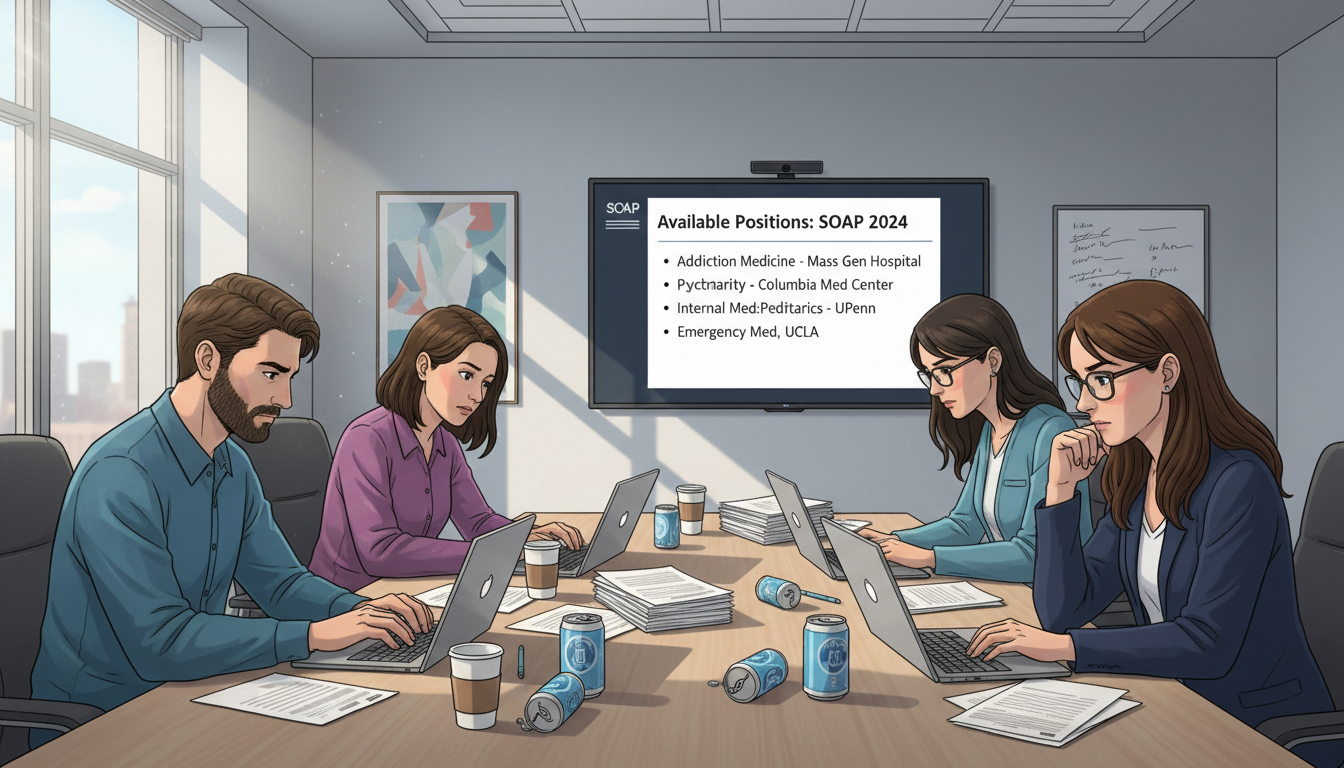
Understanding SOAP in the Context of Addiction Medicine
The Supplemental Offer and Acceptance Program (SOAP) can feel intimidating, but for many applicants—especially those interested in addiction medicine–related training pathways—it becomes a powerful second chance to secure a residency position.
Before you can prepare effectively, you need to understand what is SOAP, how it works, and what it means specifically for applicants whose long-term goal is an addiction medicine fellowship.
What Is SOAP?
SOAP is an NRMP-managed process that takes place during Match Week for eligible applicants who:
- Are unmatched or partially matched (e.g., matched to a preliminary but not an advanced position)
- Registered for the Main Residency Match and submitted a rank order list
- Are not withdrawn or ineligible per NRMP rules
SOAP allows these applicants to apply in a structured, time-limited process to unfilled positions.
Key features:
- Runs from Monday of Match Week (when you learn your match status) through Thursday
- Multiple “Rounds” of offers (usually four) from programs to applicants
- Strict rules on communication—no unsolicited contacting of programs outside ERAS/NRMP guidelines
- Limited number of applications (historically up to 45 programs total during SOAP)
Although there is no categorical “addiction medicine residency,” certain specialties create the strongest foundation for an eventual addiction medicine fellowship, including:
- Psychiatry (and sometimes combined Internal Medicine–Psychiatry)
- Internal Medicine
- Family Medicine
- Pediatrics (especially for adolescent addiction focus)
- Emergency Medicine (for ED–based addiction care and MAT programs)
- Preventive Medicine or Public Health–oriented programs
Understanding this is key to your SOAP preparation: your goal is not just “any spot,” but the best possible training base for a future in addiction medicine.
Strategic Mindset: Linking SOAP Decisions to an Addiction Medicine Career
To prepare well for SOAP in addiction medicine, you must approach Match Week with a strategic, career-long perspective instead of a short-term panic mindset.
The Addiction Medicine Career Pathway
There are two main pathways into an addiction medicine fellowship:
Psychiatry-based path
- Complete a Psychiatry residency (4 years)
- Enter an ACGME-accredited Addiction Psychiatry or Addiction Medicine fellowship
- Career focus often includes dual diagnosis (SUD + other psychiatric disorders), psychotherapy, and psychopharmacology
Non-psychiatry path (Internal Medicine, Family Medicine, etc.)
- Complete a primary specialty residency (usually 3 years)
- Complete an Addiction Medicine fellowship (1 year in most cases)
- Career focus may include inpatient consults, outpatient MAT, integrated primary care–SUD treatment, public health, or systems-level work
Your SOAP plan should therefore prioritize programs that:
- Offer robust substance abuse training within the core curriculum
- Have addiction medicine faculty or established SUD services
- Provide opportunities to work with:
- Medications for opioid use disorder (MOUD/MAT) (e.g., buprenorphine, methadone, naltrexone)
- Alcohol use disorder pharmacotherapy
- Harm reduction programs (needle exchange, naloxone distribution)
- Inpatient or outpatient addiction consult services
Ranking Priorities During SOAP
When evaluating unfilled programs during SOAP, consider the following hierarchy (adapt as needed for your situation):
Psychiatry programs with SUD focus
- Rotations in addiction psychiatry, dual diagnosis units, detox units
- Affiliation with an addiction medicine fellowship or VA with strong SUD services
Internal Medicine / Family Medicine programs with strong behavioral health and SUD exposure
- FQHC partnerships, integrated behavioral health, MAT clinics
Emergency Medicine programs with clear pathways in addiction and harm reduction
- ED-initiated buprenorphine, SUD navigation programs
Programs in communities with high SUD burden
- Even if not formally “addiction-focused,” these settings often have rich clinical exposure and opportunities to lead projects
Preliminary or transitional year positions
- Consider only if you have a defined strategy for securing a categorical spot later that still leads toward addiction medicine
This strategic prioritization should inform your SOAP preparation long before Match Week starts.

Pre–Match Week SOAP Preparation: Building Your Addiction Medicine Narrative
Strong SOAP performance is built months before Match Week. By the time you open the SOAP application interface, you should already know how you will present your interest in addiction medicine and how you will tailor your materials.
1. Clarify Your Narrative in Addiction Medicine
Reflection is crucial:
- Why are you committed to working with individuals with substance use disorders?
- What experiences have shaped your understanding of addiction as a chronic, treatable disease?
- How do you understand stigma, social determinants of health, and trauma in SUD?
- What type of role do you envision for yourself (clinician, educator, researcher, policy advocate, systems leader)?
Document concrete experiences:
- Rotations in:
- Psychiatry (especially consult-liaison or inpatient)
- Primary care with MOUD
- Inpatient services with high SUD prevalence
- Electives:
- Addiction psychiatry/electives at detox or rehab centers
- Public health or community outreach around SUD
- Projects:
- Quality improvement projects related to opioid prescribing or overdose prevention
- Research in SUD, harm reduction, HIV/HCV in PWUD
- Curriculum development or peer education projects about addiction or stigma
These become the raw material for your SOAP personal statement and for interview discussions.
2. Prepare a SOAP-Specific Personal Statement Template
During SOAP, you often have very little time to tailor your materials. The key is to create modular templates in advance that you can quickly adapt to different specialties.
Prepare at least two versions:
- Psychiatry-focused addiction medicine statement
- Primary care–focused addiction medicine statement (Internal Medicine / Family Medicine)
- (Optional) Emergency Medicine–focused addiction medicine statement
Each version should:
- Open with a concise story that demonstrates authentic connection to patients with SUD
- Example: A longitudinal relationship with a patient navigating OUD in clinic
- Demonstrate understanding of addiction as:
- Chronic brain disease
- Deeply linked to trauma, mental illness, and socioeconomic factors
- Highlight evidence-based treatments you’ve seen or participated in (e.g., buprenorphine initiation, contingency management, motivational interviewing)
- Emphasize your core strengths relevant to SUD:
- Nonjudgmental communication
- Team-based care
- Longitudinal follow-up
- Comfort navigating complex psychosocial systems
- Connect clearly how that residency’s core training will prepare you for addiction medicine fellowship
Keep the structure tight:
- 1–2 paragraphs: Personal story + motivation
- 2 paragraphs: Experience and skills, with concrete SUD-related examples
- 1 paragraph: Why this specialty is the right foundation for addiction medicine
- 1 short closing paragraph: Long-term goal in addiction medicine, expressing commitment and gratitude
3. Prepare a SOAP-Ready CV and ERAS Application
Your ERAS application remains central in SOAP. Make sure SUD-related content is easy for programs to see quickly:
- Experience entries:
- Clearly label anything related to addiction:
- “Addiction Medicine Elective at VA Hospital”
- “Quality Improvement: Reducing Opioid Prescribing in Outpatient Clinic”
- “Community Outreach: Naloxone Distribution and Overdose Education”
- Clearly label anything related to addiction:
- Research experiences:
- Titles with “substance use,” “opioid use disorder,” “harm reduction,” etc., stand out
- Add 1–2 bullet points on methods and your role (chart review, data analysis, patient recruitment, etc.)
- Leadership and service:
- Leadership in interest groups such as:
- Psychiatry, addiction medicine, harm reduction, or public health societies
- Peer education roles about SUD, safe prescribing, stigma reduction
- Leadership in interest groups such as:
- Honors and awards:
- Scholarships, grants, or recognition for work with vulnerable populations or mental health
Remember: in SOAP, program directors often skim very quickly. Make your addiction-related experiences immediately visible.
4. LOR Strategy for Addiction Medicine–Oriented SOAP
You typically cannot upload new letters during SOAP, so your pre-SOAP planning matters:
- Aim for at least:
- 1 Psychiatry letter (ideally on a service with strong SUD exposure)
- 1 Medicine or Family Medicine letter (if considering primary care–based paths)
- 1 letter that speaks to your professionalism, empathy, and work with marginalized patients
- Ask letter writers to explicitly mention:
- Your interest in addiction medicine
- Your nonjudgmental, patient-centered approach to individuals with SUD
- Examples where you advocated for evidence-based care (e.g., MOUD instead of punitive discharge)
If you are reading this early in the cycle, build this into your letter requests now.

Match Week: Tactical SOAP Preparation and Execution
Once Match Week begins and you learn you are SOAP-eligible, you need to move quickly, strategically, and calmly. Your specific interest in addiction medicine should direct your decisions—without narrowing your options unnecessarily.
1. Immediate Steps on Monday Morning
When you receive the “Did Not Match” or “Partially Matched” notification:
Pause and regulate
- Take 15–30 minutes to breathe and process
- Avoid impulsive decisions; SOAP is intense, but it is structured
Confirm SOAP eligibility
- Log into NRMP and ERAS
- Ensure you have access to the SOAP interface
Review the List of Unfilled Programs
- Filter by:
- Specialty (Psychiatry, Internal Medicine, Family Medicine, Emergency Medicine, etc.)
- Geographic flexibility
- Identify programs with:
- Known addiction medicine faculty
- Safety-net or public hospitals
- VAs or academic centers with SUD services
- Filter by:
Use this first scan to create tiers:
- Tier 1: Strong alignment with addiction medicine goals + reasonable competitiveness
- Tier 2: Good training quality even if not explicitly addiction-focused
- Tier 3: Backup options or locations less ideal, but still acceptable
2. SMART Application Strategy With Limited Slots
You are usually limited to 45 applications total during SOAP. For an addiction-medicine–oriented applicant, consider this rough allocation (adjust based on your competitiveness and specialty preferences):
- 15–20 Psychiatry programs (if open positions exist and you are a viable candidate)
- 15–20 Internal Medicine / Family Medicine programs
- 5–10 Emergency Medicine / Transitional Year / other viable pathways
Critical points:
- Don’t overconcentrate on the “perfect” SUD-focused programs; those are often competitive even in SOAP.
- Include a mix of:
- Academic and community programs
- Different geographic regions
- Different program sizes
Within each program, review:
- Mission statements highlighting care for vulnerable populations
- Mention of behavioral health integration or SUD clinics
- Existing addiction medicine fellowship at the institution (even in another department)
3. Tailoring Your Materials Rapidly
For each specialty:
- Attach the matching version of your personal statement (Psych VS IM/FM VS EM).
- In ERAS, make sure the experience descriptions fit the specialty:
- For Psychiatry: highlight mental health, dual diagnosis, trauma-informed care
- For IM/FM: emphasize chronic disease management, integrated care, MAT in primary care
- For EM: discuss acute care of overdose, ED-initiated buprenorphine, crisis management
Within each personal statement, if time permits, add one or two short sentences tailored to:
- The program’s:
- Patient population
- Affiliated addiction or behavioral health services
- Mission or institutional values
This level of tailoring is realistic if you are disciplined and use your prepared templates.
4. Communication Rules During SOAP
The NRMP has strict rules during SOAP:
- You cannot initiate unsolicited contact with programs about unfilled positions.
- Programs may contact you via:
- ERAS/phone/email for interviews or interest checks
- If contacted:
- Respond promptly, professionally, and concisely
- Do not attempt to “negotiate” or solicit offers; you must wait for official rounds
When speaking with programs, your addiction medicine interest can be a strength, but it must be framed carefully:
- Emphasize:
- Your interest in caring for patients with complex comorbid SUD
- Desire to build strong skills in core specialty training first
- Flexibility and openness to diverse career trajectories
- Avoid:
- Appearing interested only in SUD and not in the core specialty
- Suggesting residency is just a “stepping stone” you need to get through
Example phone response if a Family Medicine program asks about your interest:
“My long-term goal is to work in primary care with a strong focus on addiction medicine, especially integrating treatment for opioid and alcohol use disorders into routine family practice. I’m very drawn to programs like yours that serve diverse, high-need populations and that emphasize behavioral health integration. I’m also excited about the full breadth of Family Medicine, from chronic disease to preventive care, because those are often the settings where we can have the biggest impact on substance use and overall health.”
5. Interview Preparation With Addiction Medicine in Mind
SOAP interviews are often brief and can be scheduled at short notice. Prepare bullet-point answers for:
- Why this specialty (Psych/IM/FM/EM) and why now
- How your experiences with SUD have shaped you
- A challenging case involving addiction and what you learned
- How you handle burnout, vicarious trauma, and complex psychosocial cases
- Why this program (with one or two specific reasons per program type)
Keep answers:
- Focused on your growth, insight, and professionalism
- Balanced between addiction medicine interests and broad specialty commitment
After Securing a SOAP Position: Maximizing Addiction Medicine Exposure
Once you match via SOAP, your work in addiction medicine is just beginning. View your new position as a platform to build a compelling application for addiction medicine fellowship later.
1. Early Residency: Strategize Your Addiction Medicine Pathway
Within the first 3–6 months:
- Identify faculty mentors interested in:
- Addiction medicine
- Psychiatry, behavioral health, harm reduction, or social determinants of health
- Express your interests clearly:
- Ask for guidance on electives, projects, and QI efforts
- Explore:
- Addiction consult services
- Outpatient SUD treatment programs
- Academic projects in SUD, overdose prevention, or MAT expansion
2. Electives and Rotations
Where possible, prioritize:
- Addiction psychiatry or addiction medicine electives
- VA rotations (often rich in SUD care and MOUD)
- Public or safety-net hospital services with high SUD prevalence
- Community-based clinics with MAT programs
- OB, HIV, or HCV clinics with integrated SUD care
If no formal addiction medicine elective exists:
- Propose a structured elective in collaboration with interested faculty
- Work on clinical projects such as:
- Implementing SBIRT (Screening, Brief Intervention, and Referral to Treatment)
- Increasing buprenorphine waivered prescribers (as regulations allow)
- Tracking and improving SUD screening rates
3. Research, QI, and Scholarship
Fellowship programs in addiction medicine value:
- Evidence of scholarly engagement:
- QI projects
- Case reports on complex SUD cases
- Retrospective chart reviews on OUD treatment outcomes
- Presentations:
- Departmental grand rounds
- Regional or national conferences (e.g., ASAM)
- Publications:
- Even small-scale projects or narrative reviews show initiative
Think longitudinally: one well-designed QI project followed over 2–3 years can provide multiple abstracts and manuscripts, as well as leadership experience.
4. Building a Professional Identity in Addiction Medicine
Throughout residency:
- Join professional organizations:
- American Society of Addiction Medicine (ASAM)
- American Academy of Addiction Psychiatry (AAAP) if in psych
- Seek out:
- Online courses or certificates in addiction care
- Local SUD policy or public health initiatives
- Network:
- With addiction medicine faculty at your home institution or nearby centers
- With peers and mentors at conferences and webinars
Your initial SOAP outcome does not define your ceiling in addiction medicine. Many highly effective addiction medicine physicians started from SOAP-matched positions and leveraged them for rich training experiences.
Common Mistakes and How to Avoid Them in SOAP Preparation
1. Over-fixating on One Specialty
Some applicants set their sights only on Psychiatry, for example, and ignore excellent opportunities in Internal Medicine or Family Medicine that would still be ideal platforms for an addiction medicine fellowship.
Solution:
Develop an ordered but flexible list of acceptable specialties and practice settings. Recognize that addiction medicine is multidisciplinary, and fellowship programs welcome diversity of core backgrounds.
2. Neglecting Core Competence Messaging
Fellowships will care about your addiction medicine interest later, but right now residency programs need reassurance that:
- You are ready for the bread-and-butter work of the specialty
- You want to master the full scope of their curriculum
Solution:
Balance your narrative:
- “I’m passionate about addiction medicine”
and - “I’m committed to being an excellent [psychiatrist/internist/family physician/emergency physician] first.”
3. Rushing Through Application Choices
Under SOAP pressure, applicants sometimes:
- Apply randomly to every unfilled spot
- Neglect to prioritize program quality and career fit
Solution:
Create a write-up or spreadsheet rating programs on:
- Training quality indicators
- Relevance to addiction medicine
- Geographic and personal fit
- Number of positions available
Use this to make deliberate choices even under time pressure.
4. Underutilizing Advisors
Some students avoid discussing SOAP out of shame or disappointment, losing out on valuable guidance.
Solution:
Reach out early in Match Week to:
- Dean’s office or student affairs
- Specialty advisors (Psych, IM, FM, EM)
- Mentors with addiction medicine or behavioral health experience
Be open about your goals so they can help you align SOAP decisions with your long-term plan.
FAQs: SOAP Preparation in Addiction Medicine
1. If I SOAP into Internal Medicine or Family Medicine, can I still do an addiction medicine fellowship?
Yes. Modern addiction medicine fellowship programs accept applicants from multiple primary specialties, including Internal Medicine, Family Medicine, Pediatrics, Emergency Medicine, and others. You will be fully eligible as long as you complete an ACGME-accredited residency and meet that fellowship’s specific criteria.
Your strategy during residency should be to:
- Seek robust substance abuse training opportunities
- Work with addiction-oriented mentors
- Build scholarship or QI projects in SUD care
- Demonstrate strong core clinical competence
2. Is Psychiatry the “best” path to addiction medicine, and should I focus only on Psychiatry in SOAP?
Psychiatry is a classic and excellent path, especially if you are drawn to:
- Dual diagnosis (SUD + mood/anxiety/psychotic disorders)
- Psychotherapy
- Intensive mental health work
However, it is not the only strong path. Internal Medicine, Family Medicine, and Emergency Medicine can lead to impactful careers in:
- Integrated primary care–SUD treatment
- Hospital-based SUD consult services
- ED-based harm reduction and MOUD initiation
During SOAP, prioritize specialties based on your authentic interests, strengths, and the opportunities available. Avoid an “all or nothing” mentality.
3. How can I show programs during SOAP that I’m serious about addiction medicine without seeming too narrow?
Emphasize that:
- You are committed to holistic care of complex patients, especially those with SUD
- Your interest in addiction medicine enhances your value in the specialty:
- Improves management of chronic disease
- Strengthens rapport with vulnerable populations
- Contributes to team-based, trauma-informed care
- You understand the need to first become a strong generalist in your chosen field
In your personal statement and interviews, pair addiction-related anecdotes with examples of excellence in broader clinical work.
4. I’m worried that going through SOAP will hurt my chances for addiction medicine fellowship later. Is that true?
Being SOAP-matched does not automatically disadvantage you for addiction medicine fellowship. Fellowship directors care far more about:
- Your performance and professionalism in residency
- Quality and relevance of your clinical experiences
- Commitment to and understanding of SUD care
- Scholarly work and letters of recommendation
Many fellowship trainees and faculty did not have a linear, “perfect” Match experience. What matters is how you use your residency position—SOAP or otherwise—to build a robust, meaningful, addiction-focused training trajectory.