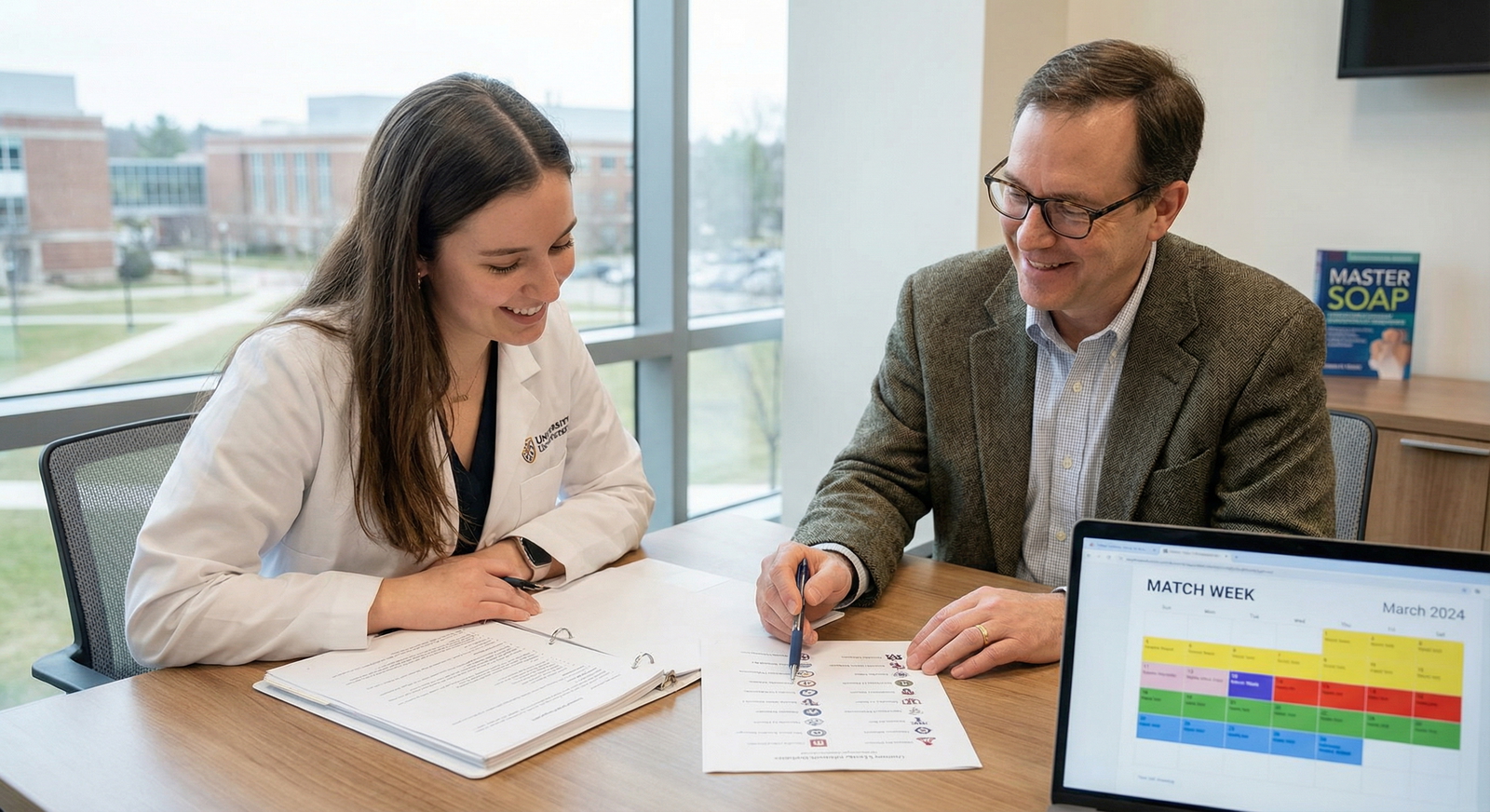
Understanding SOAP for Caribbean IMGs in Internal Medicine
The Supplemental Offer and Acceptance Program (SOAP) can be the difference between moving directly into an internal medicine residency or waiting another year. For a Caribbean IMG—whether from SGU, AUC, Ross, Saba, or another school—SOAP is both an opportunity and a stress test of your preparation.
This guide explains what SOAP is, how it works specifically for internal medicine residency candidates, and exactly how to prepare as a Caribbean IMG, including SGU residency match–style strategies, practical timelines, and checklists.
What Is SOAP?
SOAP (Supplemental Offer and Acceptance Program) is an NRMP-managed process that allows eligible unmatched or partially matched applicants to apply for and accept unfilled residency positions during Match Week.
Key points for context:
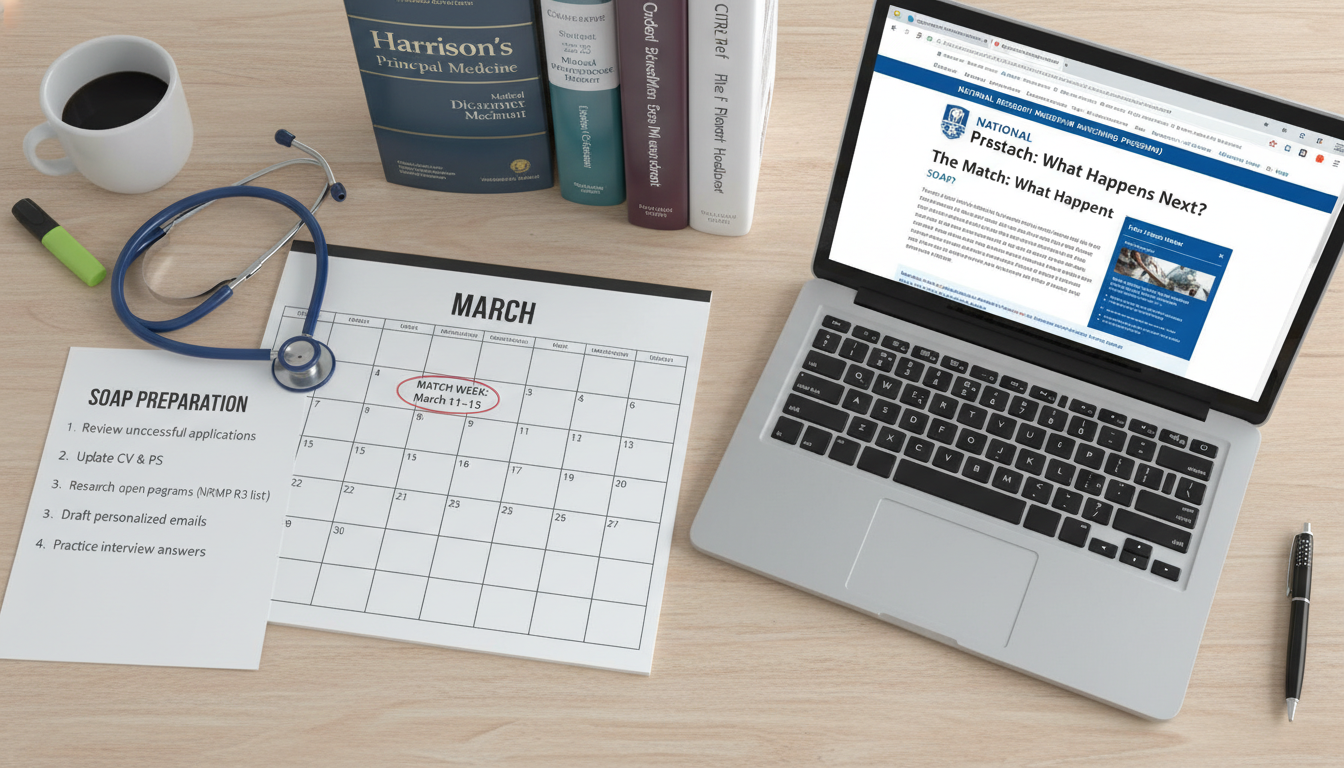
- SOAP happens Monday–Thursday of Match Week
- You use ERAS to apply and NRMP to receive offers
- You can apply to up to 45 programs total during SOAP
- Offers go out in four rounds on Wednesday and Thursday
- You may only accept one position and that acceptance is binding
For internal medicine, SOAP is particularly relevant because:
- IM tends to have the largest number of unfilled positions
- Many community IM programs are IMG-friendly
- Several SOAP positions end up being categorical internal medicine residency spots, not just prelims
Understanding how SOAP interfaces with your Caribbean medical school residency strategy is crucial, especially if you are coming from a place like SGU where the SGU residency match track is strongly structured but still competitive.
Step 1: Know Your Eligibility and Risk Profile
SOAP preparation starts months before Match Week. As a Caribbean IMG, you must be crystal clear on your eligibility and your risk of entering SOAP.
SOAP Eligibility Basics
To participate in SOAP, you must:
- Be registered for the Main Residency Match with NRMP
- Submit a certified rank order list by the NRMP deadline
- Be unmatched or partially matched after the algorithm runs
- Have a valid ECFMG certification status (for IMGs) by SOAP start
- That means: USMLE Step 1 and Step 2 CK passed and verified
- Not have accepted a position outside the Match that starts the same year
If you do not meet these criteria, you cannot participate in SOAP, even if you don’t match.
Caribbean-Specific Risk Factors
As a Caribbean IMG seeking an internal medicine residency, risk factors for going into SOAP include:
- Lower USMLE scores (e.g., Step 2 CK < 230–235 for IM)
- Late ECFMG certification or pending Step 2 CK results
- Limited or no U.S. clinical experience in internal medicine
- Red flags: exam failures, gaps in training, professionalism issues
- Overly competitive rank list (few programs, mostly university or highly competitive locations)
- Applying too broadly across specialties instead of building a strong IM-focused application
If your home institution (e.g., SGU) predicts you are in a “borderline” category, you should assume a real possibility of SOAP and plan accordingly.
Step 2: Build a SOAP-Ready Application (Months Before Match)
If you wait until Match Week to prepare, you will be overwhelmed. The best SOAP preparation is done while you’re building your main application.
Optimize Your ERAS for Internal Medicine
Your SOAP success depends heavily on how IM-focused your ERAS is:
Personal Statement
- Have at least one SOAP-ready general IM personal statement
- Keep it focused on internal medicine, not on a subspecialty or dream location
- Avoid program-specific text (no “I am particularly drawn to XYZ Medical Center”)
- Emphasize:
- Breadth of IM experience (inpatient, outpatient, sub-I)
- Continuity of care and interest in chronic disease management
- Your US clinical experience and how supervisors saw you function in the U.S. system
Letters of Recommendation (LoRs)
- Aim for 3–4 IM-focused LoRs, minimum 2 from U.S. internal medicine attendings
- Have them uploaded into ERAS well before rank list certification
- For SOAP, it’s better to have:
- Fewer strong, specific letters than many generic ones
- Letters that directly address your clinical reasoning, reliability, communication
CV and Experiences
- Highlight:
- Internal medicine sub-internships or acting internships
- U.S. observerships or electives (especially inpatient IM)
- Quality improvement projects, hospital committee work, or case reports
- Make sure entries are specific:
- E.g., “Managed 6–8 patients daily on a busy internal medicine ward, presenting on rounds and adjusting management plans with resident team.”
- Highlight:
Prepare SOAP-Specific Materials in Advance
SOAP moves fast. Before Match Week, have these fully drafted and ready:
SOAP General IM Personal Statement
- Neutral, professional, and applicable to community-based and IMG-heavy IM programs
- Can be quickly tailored (one or two sentences) if needed
Short Email Template to Programs (if they allow contact)
- Some programs explicitly do not want contact during SOAP, others are neutral — always follow instructions.
- Have a short (150–200 words) IM-focused email you can adapt:
- Who you are (Caribbean IMG, school, graduation year)
- Key strengths (USMLE scores, IM clerkships, USCE)
- Specific interest in their kind of program (community-focused, underserved population, etc.)
Updated CV and Score Report PDFs
- Even though ERAS holds your files, some program coordinators may request them directly
- Keep them clean, single file each, ready to send
Step 3: Logistics and Mindset for Match Week
Understanding the Match Week Timeline
For a Caribbean IMG, knowing exactly when things happen reduces panic and improves decision-making.
Typical structure (check NRMP each year for exact times):
Monday – 11:00 a.m. ET
- You learn “Matched” or “Did Not Match” (and if partially matched)
- If unmatched/partially matched and SOAP-eligible, you also learn you ARE SOAP-eligible
Tuesday – Morning
- ERAS opens with the list of unfilled programs (SOAP and non-SOAP)
- You can begin selecting programs and submitting applications (up to 45)
Wednesday – Rounds 1 & 2 of SOAP Offers
- Programs interview rapidly (phone, Zoom, or ERAS messaging)
- You may receive offers in discrete rounds and must decide quickly
Thursday – Rounds 3 & 4 of SOAP Offers
- Remaining offers and final chance to secure a position
Thursday Afternoon/Evening
- SOAP ends; any further unfilled positions become available in the “post-SOAP scramble” (unstructured, not NRMP-controlled)
Mental Preparation: Handling the “Did Not Match” Message
As a Caribbean IMG, you may feel a double pressure: personal expectations plus your school’s culture of high match rates (e.g., SGU residency match outcomes). You must:
- Expect the possibility of SOAP, even if you are confident
- Avoid paralysis on Monday—your time is extremely limited
- Focus on what you can control:
- Rapid program analysis
- Clear, concise communication
- Organized scheduling of any interviews
Many successful internal medicine SOAP matches come from students who stay calm, organized, and responsive during those 3–4 days.

Step 4: Strategic SOAP Targeting for Internal Medicine
Prioritize Internal Medicine Thoughtfully
For a Caribbean medical school residency path focused on internal medicine, your SOAP approach should be:
- Primary focus: Categorical internal medicine residency positions
- Secondary options:
- Preliminary internal medicine (if categorical is scarce)
- Transitional year (rare in SOAP, but helpful if you plan to reapply)
- Cautious with non-IM specialties, unless:
- You are absolutely certain you’d be satisfied with that specialty
- You are prepared to commit; acceptance is binding
Researching Programs Quickly but Effectively
When the unfilled list appears, you must evaluate programs at speed:
Identify IMG-Friendly IM Programs
- Community or community-affiliated hospitals
- Historically have a large proportion of IMGs
- Look up current residents’ medical schools (often visible on program websites)
Location and Visa Considerations
- Programs that sponsor J-1 or H-1B if you require a visa
- States with historically higher IMG intake (e.g., NY, NJ, MI, IL, FL, TX in many years)
Red Flags to Consider (but not automatically avoid)
- High turnover, probation history, or poor reputation
- Sometimes these programs are where IMGs get their chance; weigh:
- Is any ACGME-accredited internal medicine residency experience better than waiting a year for you personally?
- Can you tolerate the location, workload, and culture for 3 years?
How to Use Your 45 Applications
Divide your 45 SOAP applications roughly as follows (adapt for your situation):
- 30–35: Categorical internal medicine positions at IMG-friendly, community-based programs
- 5–10: Preliminary IM positions if you want a foot in the door and plan for future PGY-2 transitions
- 0–5: Other specialties or transitional year, only if consistent with your long-term plan
You cannot withdraw and reassign applications once submitted, so plan deliberately.
Step 5: Communication, Interviews, and Accepting an Offer
How Programs Evaluate You in SOAP
Even in SOAP, programs care about the same major factors:
- USMLE scores and ECFMG status
- Internal medicine clinical performance and LoRs
- Communication skills under pressure
- Perceived fit for a demanding, team-based environment
But they often have very little time, so they rely on quick impressions from:
- ERAS application snapshot
- A 10–20 minute phone or video interview
- Responsiveness and professionalism in email or ERAS messages
SOAP Interview Preparation for IM
Prepare short, focused answers to these common internal medicine SOAP questions:
“Why internal medicine?”
- Emphasize:
- Breadth of pathology, continuity of care, critical thinking
- Experiences on IM where you felt confirmed in your choice
- Emphasize:
“Why are you in SOAP?” or “What do you think happened in the Match?”
- Be honest but not self-sabotaging:
- Example: “I focused on a smaller number of programs in very competitive locations, and my rank list wasn’t broad enough. I’m fully committed to internal medicine and excited by the opportunity to train at a community program like yours.”
- Be honest but not self-sabotaging:
“What strengths would you bring to our residency?”
- Emphasize:
- Work ethic, resilience (especially as a Caribbean IMG)
- Strong clinical skills, good team player, comfort with diverse populations
- Emphasize:
“Tell me about a challenging case on your IM rotation and what you learned.”
- Use a structured 1–2 minute story (Situation, Task, Action, Result, Reflection)
“If you don’t match through SOAP, what is your plan?”
- Show determination and professionalism:
- “I would prioritize clinical work or research in internal medicine, strengthen any weaker areas of my application, and reapply next cycle. However, I believe I can be an asset to your program right now.”
- Show determination and professionalism:
Practice these out loud with a friend, mentor, or your school’s advising office.
Professional Communication During SOAP
- Check email and phone constantly (with voicemail set up and professional greeting)
- Respond to all program contacts within minutes to an hour, if possible
- Address faculty and coordinators respectfully:
- “Dear Dr. [Last Name]”
- “Dear Ms./Mr. [Last Name]”
If a program invites you for an interview:
- Confirm promptly
- Test your video link, microphone, and internet
- Dress exactly as you would for a regular interview (suit or professional equivalent)
- Have notepad and pen for jotting down names and key points
Accepting an Offer: Decision Framework
When an offer appears in NRMP:
- You usually have a short decision window (a few hours or less).
- You can accept, reject, or let it expire (but be careful with expirations).
- Once you accept, you are done with SOAP and locked into that position.
Decision questions to ask yourself:
- Is this an ACGME-accredited internal medicine program (categorical or prelim as you intended)?
- Am I willing to live and work in this location for at least a year (or 3 for categorical)?
- Does the program meet my minimum safety and training standards?
- Given my profile and the market this year, how likely is it that I will get a better offer in later rounds?
For most Caribbean IMGs in SOAP, a solid categorical IM offer in Round 1 or 2 is usually worth accepting rather than gambling.
Step 6: If You Don’t Secure an IM Position in SOAP
Even with meticulous SOAP preparation, not everyone secures a position. As a Caribbean IMG, you must have a Plan B.
Immediate Post-SOAP Actions
Check post-SOAP unfilled list
- Some programs may still be recruiting outside NRMP
- Be tactical; mass-emailing without strategy is rarely effective
Decompress briefly, then analyze your application
- Scores vs. program tiers and locations you targeted
- Timing of exam completions and ECFMG certification
- Quality and quantity of IM USCE and LoRs
- Red flags that may need explicit addressing
Meet with advisors (school or trusted mentors)
- SGU and similar Caribbean programs often have robust unmatched advising
- Create a 12-month remediation plan:
- Additional USCE (observerships, externships) in internal medicine
- US clinical work (e.g., research coordinator, scribe in IM practice)
- Strengthening academic metrics (e.g., Step 3, if appropriate and advised)
Strategic Reapplication for Internal Medicine
For the next cycle, shift strategy based on SOAP experience:
- Apply more broadly and earlier
- Target more IMG-friendly community IM programs
- Align your SOAP preparation with primary application so you aren’t duplicating effort
- Stay clinically active and collect fresh, strong LoRs from U.S. internal medicine physicians
Putting It All Together: A SOAP Preparation Checklist for Caribbean IMGs in IM
Use this high-yield checklist as you plan:
3–6 Months Before Match Week
- Confirm all USMLE exams passed and ECFMG status on track
- Ensure IM-focused ERAS (experiences, LoRs, personal statement)
- Draft a general IM SOAP personal statement
- Prepare CV and score report PDFs
- Meet with your school’s advising office about SOAP scenarios
1–2 Months Before Match Week
- Identify IMG-friendly IM programs you would consider in SOAP
- Practice short-format IM interviews (10–15 minutes)
- Set up a reliable phone, voicemail, and email system
- Prepare a contact template email for programs (if needed and allowed)
Match Week
Monday
- If unmatched/partially matched, confirm SOAP eligibility
- Manage emotional response; transition rapidly to action mode
Tuesday
- Review unfilled list, filter for internal medicine programs
- Prioritize IMG-friendly, visa-sponsoring sites
- Submit up to 45 applications, focusing on categorical IM first
Wednesday–Thursday
- Keep phone and email on, respond rapidly
- Conduct brief interviews professionally and confidently
- Weigh offers carefully; accept a solid IM position when appropriate
After SOAP
- If matched, send professional thank-you notes as appropriate
- If not matched, engage quickly with advisors to plan a structured, purposeful gap year
FAQs: SOAP Preparation for Caribbean IMGs in Internal Medicine
1. How realistic is it for a Caribbean IMG to match internal medicine through SOAP?
Many Caribbean IMGs do successfully enter an internal medicine residency through SOAP each year, especially at community-based, IMG-friendly programs. Your chances improve substantially if you:
- Are ECFMG certified with passing Step 1 and Step 2 CK
- Have strong IM LoRs from U.S. physicians
- Apply strategically to a wide range of IMG-friendly categorical IM programs
- Communicate professionally and respond quickly during SOAP
Your exact probability will depend on your scores, red flags, and how competitive the year is, but SOAP remains one of the most viable recovery paths for Caribbean IMGs who didn’t match.
2. Should I apply to non-internal medicine specialties during SOAP?
Only if you are genuinely willing to train and likely practice in that specialty. SOAP acceptances are binding. For a Caribbean IMG who has invested heavily in internal medicine, scattering applications into unrelated specialties (e.g., pathology, family medicine, prelim surgery) solely out of fear may result in a career path you don’t really want.
A reasonable compromise is to include a small number of:
- Preliminary IM positions
- Possibly a transitional year (if your long-term plan is to reapply to IM)
3. What is SOAP preparation I can do if I am still an MS3 or early MS4 at a Caribbean school?
If you are still early in training, you can begin SOAP preparation in parallel with general match preparation:
- Choose strong internal medicine electives and sub-Is in the U.S.
- Build relationships for high-quality IM letters of recommendation
- Practice concise interview communication and clinical case presentation
- Keep your exam timeline on track so ECFMG certification is not delayed
- Stay informed about Caribbean medical school residency match patterns, including how many SGU residency match or Ross/AUC graduates end up using SOAP for internal medicine
This early preparation makes both your primary application and any potential SOAP experience much stronger.
4. If I accept a SOAP internal medicine position, does it hurt my fellowship chances later?
Generally, no—fellowship programs primarily care about:
- Your performance in residency (evaluations, responsibility, leadership)
- Board exam performance (ABIM)
- Scholarly activity (research, QI, teaching)
- Strong letters from your residency program
SOAP is simply how you obtained the position; it does not label you for fellowship directors. Many physicians in competitive internal medicine fellowships (cardiology, GI, heme/onc) started in community programs, some via SOAP. Your focus should be on excelling once you begin residency.
Preparing effectively for SOAP as a Caribbean IMG in internal medicine means treating it not as a desperate last-minute scramble, but as a structured, strategic extension of your main match plan. If you build a strong IM-focused application, understand the process, and act quickly and professionally during Match Week, SOAP can become your bridge from Caribbean medical school to a successful internal medicine residency in the U.S.