
Understanding SOAP as a Caribbean IMG Aspiring to Cardiothoracic Surgery
For a Caribbean medical school graduate aiming ultimately for cardiothoracic surgery residency, the Supplemental Offer and Acceptance Program (SOAP) can be both a safety net and a strategic opportunity. To use it effectively, you need to understand exactly what SOAP is, how it works, and how cardiothoracic ambitions fit within a realistic SOAP strategy.
What Is SOAP?
SOAP (Supplemental Offer and Acceptance Program) is the structured process that allows unmatched or partially matched applicants to obtain unfilled residency positions during Match Week. Instead of the old “scramble,” SOAP is an organized, time-limited system run through ERAS and the NRMP.
Key points:
Eligibility
You can participate in SOAP if:- You are registering for the Match through NRMP
- You are eligible to start training on July 1 (ECFMG certified or will be by start date)
- You are unmatched or partially matched after the main Match algorithm
- You are not withdrawn or ineligible per NRMP rules
SOAP is not a separate match
It’s a rapid series of application and offer rounds to fill unfilled positions. You cannot apply to any program you want; you can only apply to positions listed as unfilled in the SOAP-eligible list.Timeline basics (typical, subject to NRMP changes)
- Monday of Match Week:
10:00 AM ET – You learn whether you are matched, partially matched, or unmatched.
11:00 AM ET – SOAP-eligible unfilled positions list is released and SOAP applications begin. - Monday–Thursday:
Multiple SOAP offer rounds (usually 4): programs review applications and extend offers; you can accept or reject within a short window. - Friday:
Final Match results posted, SOAP concludes.
- Monday of Match Week:
Why SOAP Matters Specifically for a Caribbean IMG
As a Caribbean IMG, you’re already navigating:
- Higher competition for US residency spots
- Visa considerations
- Perceptions about Caribbean medical school residency outcomes
SOAP is crucial because:
- Safety Net: If your SGU residency match (or other Caribbean school match) in your preferred specialty fails, SOAP is your best structured chance to secure any ACGME-accredited position that keeps you in the training pipeline.
- Continuity of Training: A transitional year, prelim surgery, or internal medicine spot obtained through SOAP can keep you clinically active and strengthen your profile for a future cardiothoracic surgery residency application.
- Limited Cardiothoracic Access at Entry: Integrated cardiothoracic surgery (I-6) positions are extremely competitive for IMGs and rarely appear in SOAP. But SOAP-prelim or categorical surgery positions can keep your dream of heart surgery training alive.
Your mindset for SOAP should be:
“What choice now keeps me in the best possible position to reach cardiothoracic surgery later?”
Realistic Pathways to Cardiothoracic Surgery for a Caribbean IMG
Cardiothoracic surgery residency is among the most competitive fields. For a Caribbean IMG, a direct integrated I-6 spot out of medical school is rare. Understanding realistic routes helps you design a smart SOAP strategy.
Common Pathways to Heart Surgery Training
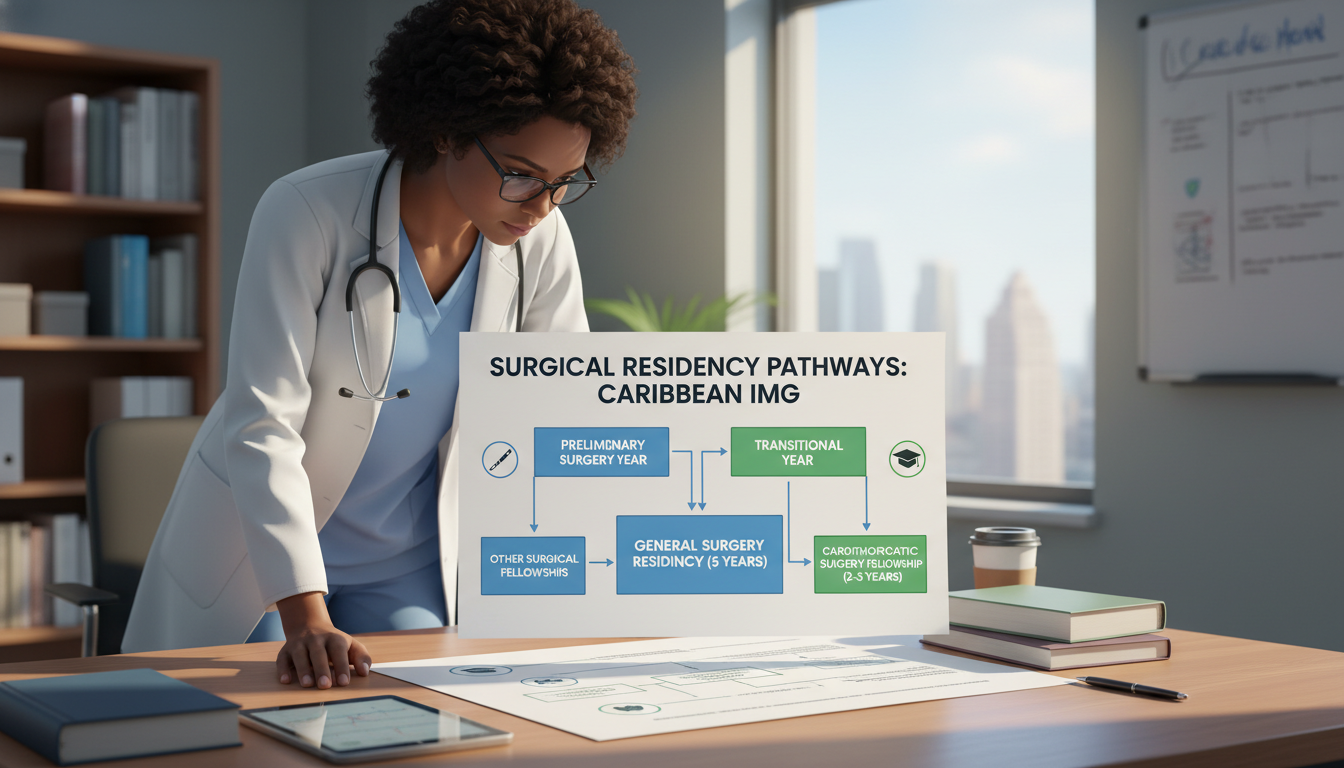
Traditional Pathway: General Surgery → Cardiothoracic Fellowship
- 5 years general surgery residency
- 2–3 years cardiothoracic surgery fellowship
- This is still the most attainable path for IMGs, including those from Caribbean schools.
Integrated I-6 Cardiothoracic Residency
- Single 6-year program starting directly after medical school.
- Immensely competitive, with few IMGs.
- SOAP reality: Essentially never available in SOAP; do not count on this.
Alternate Surgical / Transitional Route
- 1–2 years preliminary surgery or transitional year, then reapply to categorical surgery.
- Parallel research in cardiothoracic surgery or related fields.
- Enter cardiothoracic fellowship after successful general surgery training.
What This Means for SOAP Strategy
For a Caribbean IMG aiming for cardiothoracic surgery, SOAP should focus on:
- Highest priority:
- Categorical General Surgery (if any appear and are realistic for your profile as an IMG)
- Next priority:
- Preliminary Surgery positions (especially at institutions with active cardiothoracic programs)
- Transitional Year positions at hospitals with strong surgery or cardiology/cardiothoracic presence
- Supplemental paths (if above not available):
- Internal Medicine or Anesthesiology at cardiothoracic-heavy institutions
- Provides exposure to cardiac ICU, heart failure, cardiology, or perioperative care, building a profile connected to heart surgery training.
Your SOAP preparation should revolve around maximizing access to surgically oriented training—even if it’s not labelled “cardiothoracic” yet.
Pre–Match Week SOAP Preparation: Building a Ready-to-Deploy Strategy
SOAP moves very fast. The difference between chaos and control is preparation before Match Week. As a Caribbean IMG, you can’t improvise your way through SOAP; you must plan.
1. Clarify Your Tiered Goal Hierarchy
Before Match Week, write down a tiered list of acceptable outcomes:
Tier 1 (Ideal but realistic):
- Match to categorical general surgery in the main Match
- If unmatched, SOAP into categorical general surgery (if positions are available & realistic)
Tier 2 (Good pathway to CT surgery):
- SOAP into:
- Preliminary general surgery at academic centers with cardiothoracic services
- Transitional year at a hospital with a strong surgical program
- SOAP into:
Tier 3 (Still connected to heart/lung care):
- Internal Medicine or Anesthesiology positions at institutions with:
- Cardiothoracic ICU
- Advanced cardiac surgery programs
- Heart failure/transplant or structural heart programs
- Internal Medicine or Anesthesiology positions at institutions with:
Tier 4 (Last-resort but training-preserving):
- Any accredited residency that keeps you clinically active in the US and does not box you into a completely unrelated long-term path (e.g., some IM positions with strong critical care/cardiology exposure).
Having this written out in advance mitigates panic when SOAP starts.
2. Optimize Your ERAS Application for SOAP
Your ERAS remains the core of your SOAP residency profile, but how you present it matters—especially if your original application was heavily tailored to integrated cardiothoracic surgery or ultra-competitive general surgery spots.
Key steps:
Update Personal Statement(s):
- Create at least two versions:
- General Surgery–focused statement: Emphasizing operative interest, technical skills, commitment to surgery, and long-term goal of cardiothoracic fellowship.
- Flexible “surgical/acute-care oriented” statement: Appropriate for transitional year, prelim surgery, or internal medicine with critical care interest; emphasizes your interest in perioperative and cardiopulmonary care and lifelong involvement in complex patient management.
- Keep them concise (about 1 page), focused, and honest. Avoid sounding desperate; instead, project resilience and clarity of purpose.
- Create at least two versions:
Align Experiences with Surgical and Cardiothoracic Themes:
- Reframe your clinical and research experiences to highlight:
- Procedural exposure (sutures, central lines, OR time)
- Cardiac / thoracic / vascular rotations
- ICU experience, particularly cardiac or surgical ICU
- Any quality improvement projects related to OR efficiency, perioperative care, or cardiac outcomes.
- Example: Instead of “Internal Medicine Sub-I,” emphasize:
“Internal Medicine Subinternship with extensive cardiology and heart failure management, regular collaboration with cardiothoracic surgery service.”
- Reframe your clinical and research experiences to highlight:
USMLE/COMLEX Presentation:
- Be prepared to explain any gaps or lower scores in interviews.
- For Caribbean graduates, strong Step scores can counterbalance the Caribbean medical school residency stigma; if scores are moderate, emphasize your clinical evaluations, letters, and work ethic.
3. Letters of Recommendation (LoRs) Strategy
During SOAP, you cannot typically request brand-new letters. You must use what is already in ERAS. However, before rank list certification, you can:
- Ensure you have:
- At least two surgery-related letters if possible (from general surgery or cardiothoracic faculty).
- One strong IM or ICU-related letter for flexibility in applying to broader SOAP specialties.
- If your current letters are too narrow (e.g., only cardiology or basic science), consider:
- Obtaining an additional surgery or ICU attending letter during your last rotations before graduation.
- Ask letter writers to highlight:
- Technical aptitude
- Work ethic and resilience
- Ability to perform under pressure
- Commitment to cardiothoracic or high-acuity care
4. Data-Driven Targeting: Know Your Realistic SOAP Niches
SOAP lists are not available before Match Week, but you can prepare by studying:
Historical SOAP data (from NRMP reports, forums, and your Caribbean school’s advising office):
- Typical specialties with unfilled positions:
- Preliminary surgery
- Transitional year
- Family medicine
- Internal medicine
- Psychiatry, Pediatrics (varies year to year)
- For a Caribbean IMG interested in surgery:
- Preliminary general surgery is often one of the main surgically oriented categories with SOAP positions.
- Typical specialties with unfilled positions:
Your own competitiveness:
- Step 1 (pass/fail) and Step 2 CK scores
- Number and quality of US clinical experiences (sub-I’s, away rotations)
- Research output in cardiothoracic or surgery
- Visa status (US citizen, permanent resident, or requiring J-1/H-1B)
Align your prepared specialty list with a realistic understanding of your profile.
Match Week: Executing SOAP with Precision as a Caribbean IMG
Once Monday of Match Week arrives, SOAP moves quickly. Your goal is to stay organized and unemotional, even when the stakes feel incredibly high.

1. Monday 10:00 AM ET – You Learn You Are Unmatched or Partially Matched
First reaction: Breathe. Then move into structured action:
- If partially matched (e.g., advanced position without a prelim year), your SOAP goal is to fill the missing component (often a transitional year or prelim year).
- If fully unmatched, your goal is to secure any strong, pathway-preserving position.
Avoid impulsive decisions; revert to your pre-written Tier hierarchy.
2. 11:00 AM ET – SOAP-Eligible Unfilled Positions List Appears
Immediately:
- Filter the list by:
- Specialty: Preliminary Surgery, Transitional Year, Categorical General Surgery (if available), Internal Medicine, Anesthesiology
- Visa sponsorship (where applicable)
- Geography (flexible is better, but consider realistic constraints)
- Mark programs that:
- Have cardiothoracic surgery departments or close ties to nearby CT centers
- Are university-affiliated or large teaching hospitals
- Have a reputation for strong ICU/critical care exposure
This is crucial because even a preliminary or transitional year at the right hospital can drastically impact your future heart surgery training prospects.
3. Selecting Programs: Quality Over Panic
You can only apply to a limited number of programs during SOAP (number varies by rules; historically 45 unfilled programs). Use your slots strategically:
First priority:
- Preliminary general surgery at academic centers, especially those with:
- Cardiothoracic services
- Thoracic or vascular surgery fellowships
- Any categorical general surgery programs that:
- Have IMGs in their roster
- Are in less competitive geographic regions
- Preliminary general surgery at academic centers, especially those with:
Second priority:
- Transitional year programs at:
- University hospitals with cardiothoracic, vascular, or high-volume cardiac ICUs
- Internal medicine positions at centers with:
- Cardiothoracic ICU, heart failure/transplant, or structural heart disease programs
- Transitional year programs at:
Third priority:
- Other ACGME-accredited positions that:
- Keep you clinically active
- Do not completely shut down future surgical pathways (mentorship and research can still redirect your trajectory)
- Other ACGME-accredited positions that:
Avoid wasting slots on:
- Programs that never sponsor visas if you need one.
- Strongly “academic-elite” programs that historically take only US grads with top-tier metrics, unless your CV truly matches that level.
4. Tailoring Your Application Package Rapidly
For each group of programs:
- Assign the correct personal statement:
- Surgery-focused for prelim or categorical surgery
- Broader acute-care/cardiopulmonary for transitional year or IM.
- Adjust the program signaling in your ERAS experiences (if time allows):
- Reorder experiences to place surgery and ICU at the top.
- Emphasize any cardiac, thoracic, or critical care rotations in your description fields.
You cannot personalize each application as you would in the main cycle, but you can create clusters (surgical vs. IM vs. transitional) and align statements/experiences accordingly.
5. Communication with Programs During SOAP
SOAP has specific NRMP rules about contact:
- You generally may not cold-call or email programs to solicit interviews or offers during SOAP in a way that violates NRMP communication rules.
- Program-initiated contact (inviting you for an interview or clarifying questions) is allowed.
- Follow your school’s guidelines and NRMP rules carefully; violating them can endanger your eligibility.
When programs reach out:
- Respond promptly and professionally.
- Be prepared with a concise script:
- Why you’re interested in their program
- Evidence of your commitment to surgery or cardiopulmonary care
- How you envision their program fitting into your long-term cardiothoracic career goals (without sounding like you’re using them as a short-term stepping stone).
Post-SOAP: Maximizing the Position You Obtain for a Future in Cardiothoracic Surgery
Whether you match into your first choice or your last-resort option, your next steps determine how you remain viable for future heart surgery training.
1. If You SOAP into Preliminary Surgery
This is often the best-case SOAP outcome for a Caribbean IMG with cardiothoracic aspirations.
Your priorities:
- Excel clinically:
- Show up early, stay late, volunteer for cases.
- Be the resident everyone wants on their team—reliable, technically improving, and teachable.
- Seek cardiothoracic exposure:
- Request rotations with the CT surgery service if possible.
- Ask CT faculty if you can attend their conferences, M&M, or journal clubs.
- Secure high-impact mentorship:
- Identify at least one general surgeon and one CT surgeon who are willing to:
- Guide your career planning
- Write future letters of recommendation
- Potentially sponsor research or QI projects.
- Identify at least one general surgeon and one CT surgeon who are willing to:
- Plan your reapplication early:
- Decide whether to apply to:
- Categorical general surgery only, or
- A mix of general surgery + preliminary/transitional backups.
- Use your prelim year to produce concrete output:
- Strong evaluations
- A surgery- or CT-related project with abstract/poster/paper if possible.
- Decide whether to apply to:
2. If You SOAP into a Transitional Year
Transitional year can be very powerful if you leverage it correctly:
- Optimize your rotations:
- Maximize time on:
- General surgery
- ICU (especially cardiac/surgical)
- Cardiology or cardiac imaging
- Minimize time on low-yield electives unless they support your CT narrative.
- Maximize time on:
- Network:
- Meet general surgery PDs and CT faculty.
- Express your interest in surgery and cardiothoracic training.
- Build your application:
- Ask for letters emphasizing your clinical excellence in high-acuity settings.
- Engage in QI or research related to periprocedural care, ICU outcomes, or heart/lung disease.
3. If You SOAP into Internal Medicine or Another Non-Surgical Field
You still have viable connections to cardiothoracic care:
- In Internal Medicine:
- Seek rotations in:
- Cardiac ICU
- Advanced heart failure
- Pulmonary/CCM (critical care)
- Get involved with:
- Structural heart teams
- Cardiology conferences focusing on heart failure, transplant, or post-operative care.
- Seek rotations in:
- In Anesthesiology:
- Emphasize cardiac anesthesia and perioperative medicine.
- Collaborate closely with CT surgeons and perfusion teams.
While switching to general surgery later is challenging, being extraordinary in any training environment, especially one close to cardiac/lung care, can lead to mentoring and opportunities you may not anticipate.
4. If You Do Not Match Through SOAP
If you end Match Week without a position:
- Do a structured post-mortem analysis:
- Review:
- Scores
- Application strategy
- Specialty choices
- Timing and quality of letters
- Get feedback from:
- Your Caribbean school’s dean/advising office
- Mentors in surgery/CT.
- Review:
- Consider the 12–24 month plan:
- Research fellowships (especially in CT surgery, outcomes, or critical care)
- Additional US clinical experience (observerships, externships)
- Strengthening USMLE portfolio (e.g., Step 3)
- Maintain focus on:
- Demonstrating perseverance
- Deepening your cardiothoracic-related profile
- Reapplying with a clear, improved narrative.
Practical SOAP Preparation Checklist for Caribbean IMGs Targeting Cardiothoracic Surgery
Use this condensed checklist in the months before Match:
6–9 Months Before Match:
- Meet with a mentor and define your tiered goal hierarchy (GS categorical → pre-surg → TY → IM/Anesthesia with cardiac focus).
- Secure at least two surgery-related LoRs and one from ICU/IM/cardiology.
- Complete at least one surgery or CT surgery sub-I if possible.
- Engage in or start a cardiothoracic or surgical research/QI project.
3–4 Months Before Rank List Certification:
- Draft two personal statements (surgery-focused and acute-care/cardiopulmonary-focused).
- Adjust ERAS experiences to highlight surgery, ICU, and cardiopulmonary exposure.
- Study NRMP and school-specific data on historical SOAP outcomes for Caribbean graduates.
1–2 Weeks Before Match Week:
- Finalize your SOAP target specialty list and priority rules.
- Review the SOAP residency rules and communication restrictions.
- Prepare a concise personal “pitch” (60–90 seconds) explaining:
- Who you are
- Why you’re a strong surgical/acute-care trainee
- Your long-term cardiothoracic interest
Match Week (Day-by-Day):
- Monday 10:00 AM: If unmatched, shift into execution mode; re-open your Tier list.
- Monday 11:00 AM: Filter unfilled positions; select programs that fit your pathways.
- Assign correct personal statements to appropriate clusters of programs.
- Respond promptly and professionally to any program outreach.
- Stay aligned with your long-term cardiothoracic goal, but remain flexible about immediate specialty labels.
FAQs: SOAP Preparation for Caribbean IMGs in Cardiothoracic Surgery
1. As a Caribbean IMG, is it realistic to get a cardiothoracic surgery residency directly through SOAP?
No. Integrated cardiothoracic surgery (I-6) positions are extraordinarily competitive and rarely unfilled; they essentially never appear in SOAP. Your realistic goal as a Caribbean IMG is to use SOAP to secure a general surgery–related pathway (categorical or preliminary) or a transitional/IM/Anesthesia position strongly connected to cardiothoracic or critical care. From there, you can work toward a cardiothoracic fellowship.
2. If I SOAP into a preliminary surgery spot, can I still become a cardiothoracic surgeon?
Yes, prelim surgery can be an effective stepping stone, but it’s not guaranteed. You will need to:
- Excel clinically during your prelim year
- Build strong relationships and mentorships in surgery and CT surgery
- Obtain powerful letters of recommendation
- Reapply successfully to categorical general surgery (either at your prelim institution or elsewhere)
- Later, apply competitively to a cardiothoracic fellowship
Many cardiothoracic surgeons took indirect paths; what matters is how you perform and advocate for yourself along the way.
3. What is SOAP preparation I should focus on if my Step 2 CK score is average for an IMG?
With an average Step 2 score, lean heavily into:
- Strong clinical evaluations from surgery and ICU rotations
- Impactful letters from surgeons and CT/ICU faculty
- Demonstrated work ethic, reliability, and technical growth
- A clear narrative linking your experiences to cardiothoracic and high-acuity care
- Smart targeting of programs that:
- Have a track record of taking IMGs
- Are not in the most competitive geographic locations Your ERAS narrative, letters, and program selection become more critical as score strength decreases.
4. How does my Caribbean medical school (e.g., SGU) affect my SOAP chances?
Coming from a well-known Caribbean school like SGU can be a double-edged sword:
- Advantages:
- Programs recognize SGU and similar Caribbean schools and understand the training structure.
- There is often a visible track record of SGU residency match and SOAP outcomes, including surgery-related fields.
- Challenges:
- You will be compared against US MD/DO graduates.
- Some programs have formal or informal preferences against IMGs.
You can partially counterbalance this by:
- Strong USMLE performance
- Robust US clinical experience in surgery and ICU
- Highly supportive LoRs
- Applying smartly during SOAP to programs that historically accept IMGs
By thoughtfully preparing for SOAP, you transform Match Week from a crisis into a strategic pivot point. As a Caribbean IMG targeting cardiothoracic surgery, your path is undeniably steep—but with the right SOAP preparation, a well-chosen prelim or transitional position can become the launchpad toward the heart surgery training you’re ultimately aiming for.