
Understanding SOAP: What It Is and Why It Matters for Caribbean IMGs
The Supplemental Offer and Acceptance Program (SOAP) is your structured second chance during Match Week if you are unmatched or partially matched. For a Caribbean IMG targeting an Emergency Medicine-Internal Medicine (EM IM combined) residency, SOAP can feel intimidating, but with the right preparation, it can also be a powerful opportunity.
What is SOAP?
SOAP is an NRMP-managed process that:
- Occurs during Match Week (Monday–Thursday before Match Day)
- Allows eligible unmatched or partially matched applicants to apply to unfilled residency positions
- Proceeds through multiple offer rounds (usually four) where programs extend offers and applicants accept or decline in real time
- Takes place entirely in ERAS and NRMP R3 systems, not via direct pre-offer communication
For Caribbean IMGs (including SGU, AUC, Ross, etc.), SOAP is particularly important because:
- Many U.S. programs reserve or hold unfilled positions that later become available in SOAP.
- Some community and hybrid academic programs are more open to strong IMGs during SOAP than in the main Match cycle.
- You may uncover Emergency Medicine-Internal Medicine combined or related Emergency Medicine Internal Medicine pathways (e.g., categorical IM with strong ED exposure, EM-prelim, or IM with ED-heavy electives) that you didn’t rank high enough or apply to initially.
If you are coming from a Caribbean medical school and are aiming for EM IM combined training, you must assume from day one of application season that SOAP preparation is part of your strategy, not an afterthought.
Setting Realistic Goals: EM-IM Combined vs Alternative Pathways
Before you plan SOAP preparation, you need clarity on your true range of options as a Caribbean IMG with interest in both Emergency Medicine and Internal Medicine.
1. Understanding EM IM Combined Programs
The EM IM combined programs:
- Are typically 5-year dual-board track (ABEM + ABIM eligible)
- Are few in number and highly competitive
- Frequently prefer:
- Strong USMLE scores
- Robust U.S. clinical experience
- Honors in EM and IM rotations
- U.S. letters of recommendation from both EM and IM faculty
Reality check for SOAP:
Many EM-IM combined programs fill in the main Match. EM and EM-IM are among the specialties with very high fill rates, often leaving few or no unfilled combined spots in SOAP.
This does not mean your EM-IM career trajectory ends. Instead, you can use SOAP strategically to:
- Obtain a categorical Internal Medicine position in a program with:
- Strong ED presence
- Critical care exposure
- EM-friendly electives
- Or find a Preliminary Medicine or Transitional Year with heavy emergency/acute care experience while planning a future EM or EM-IM application.
2. Alternative Training Pathways That Preserve an EM-IM Career
If no EM-IM combined positions appear in SOAP, consider pathways that keep the door open:
Categorical Internal Medicine (3 years)
- Build a strong foundation in acute care, critical care, cardiology, and hospital medicine.
- After IM, consider:
- EM fellowship-style work arrangements in ED settings (depending on state and employer)
- EM fellowship in some systems for IM grads (limited and evolving)
- Hospitalist roles with strong ED consult exposure
Categorical Emergency Medicine (3–4 years)
- Less common in SOAP and highly competitive.
- Requires strong EM-specific letters and SLOEs (if available).
- If any EM positions appear, they will go quickly; you must be application-ready.
Preliminary Medicine or Transitional Year
- One-year training that:
- Provides U.S. residency experience
- Strengthens your CV for a future EM/IM/EM-IM reapplication
- Demonstrates clinical competency and professionalism
- Especially valuable if you have red flags (exam failures, gaps) you need to overcome with strong recent performance.
- One-year training that:
3. Realistic Priority List for SOAP as a Caribbean IMG
When SOAP begins, your priority list might look like:
- EM-IM combined programs (if any unfilled; rare but possible)
- Categorical Internal Medicine programs with:
- Busy ED
- Strong critical care/ICU training
- EM electives or ED-run observation units
- Categorical Emergency Medicine (if any unfilled and your profile is competitive)
- Preliminary Medicine or Transitional Year in hospitals with:
- Reputation for good IMG support
- Strong inpatient and ED exposure
Your SOAP preparation must assume that categorical IM and prelim IM/TY are the most likely attainable and strategically useful outcomes.

Pre-Match Planning: Building a SOAP-Ready Application
SOAP is fast and unforgiving. Everything you can do before Match Week should be done early. Think of SOAP preparation as building a “fire extinguisher” you hope not to need—but will be grateful to have.
1. Academic and Exam Foundation
As a Caribbean IMG, programs will scrutinize your metrics closely. Before SOAP even becomes relevant:
- USMLE Scores:
- Step 1 (Pass/Fail now) – ensure no failures.
- Step 2 CK – aim for competitive scores (often ≥ 230–240+ for EM/IM combined; modestly lower for IM depending on program).
- Attempt history:
- Minimize exam failures. If you have a failure, prepare a concise, honest explanation you can reuse in communications and interviews.
2. Clinical Experiences That Support EM/IM
Your clinical profile should show genuine commitment to both Emergency Medicine and Internal Medicine:
- Core Rotations: Strong evaluations in IM, surgery, and EM-adjacent rotations (e.g., ICU).
- Sub-internships or Acting Internships (AIs):
- At least one strong IM AI in a U.S. hospital
- EM rotation(s) with robust feedback, even if you don’t have formal SLOEs
- Electives:
- Critical care, cardiology, pulmonary, trauma, or urgent care
- Community ED exposure if academic EM-IM wasn’t accessible
During these rotations, behave like a future resident:
- Show punctuality, reliability, and professional communication.
- Ask attendings for specific, detailed letters that highlight:
- Work ethic
- Clinical reasoning
- Ability to manage acutely ill patients
- Teamwork and adaptability
3. Letters of Recommendation Strategy
For an EM-IM oriented SOAP strategy, aim to have:
- 2–3 strong Internal Medicine letters (ideally from:
- U.S. academic or community IM attendings
- An IM program director or associate PD if possible)
- 1–2 Emergency Medicine or acute care letters, such as:
- EM attending or ED medical director
- ICU or hospitalist attendings who directly supervised you in an acute setting
You can reuse the same letters during SOAP. Make sure:
- All letters are uploaded to ERAS well before Match Week.
- At least one letter clearly supports your ability to function in a busy ED or acute care setting.
4. Crafting a SOAP-Ready Personal Statement
You should have at least two personal statements ready before Rank Order List (ROL) certification:
Primary EM-IM/Acute Care PS
- Emphasizes:
- Passion for acute and longitudinal care
- Ability to thrive in high-acuity, time-sensitive settings
- Interest in bridging ED and inpatient medicine
- This can be used for:
- EM-IM combined
- Categorical IM with strong ED/ICU exposure
- EM programs (with minor tweaks if needed)
- Emphasizes:
Backup IM-Focused PS
- Emphasizes:
- Commitment to Internal Medicine
- Interest in complex chronic disease management and inpatient care
- Openness to hospitalist, critical care, or academic paths
- This can be used for:
- Categorical IM positions (especially those less EM-focused)
- Prelim IM or Transitional Year spots
- Emphasizes:
During SOAP, you will not have time to write new personal statements from scratch. You may only have hours between learning your unmatched status and application deadlines.
Technical and Logistical SOAP Preparation
SOAP is highly procedural. Overlooking logistics can cost you real opportunities.
1. Know the Key Systems: ERAS and NRMP R3
- ERAS – handles application submission to programs during SOAP
- NRMP R3 – handles Match participation, SOAP eligibility, and offer acceptance
You must:
- Keep your NRMP account active and updated
- Ensure you are SOAP-eligible:
- Registered for the Match
- Passed required exams for your chosen specialties (e.g., Step 2 CK for most categorical IM and EM programs)
- Not withdrawn or ineligible status
Check NRMP’s criteria carefully and consult with your dean’s office or student affairs if anything is unclear.
2. Documents to Have Completely Ready Before Match Week
By late January / early February, you should confirm:
- ERAS application (CV, experiences, publications) fully updated
- All USMLE transcripts uploaded
- All letters of recommendation uploaded and assigned in ERAS to the right document sets
- Multiple personal statements saved in ERAS, clearly labeled (e.g., “IM-EM Acute Care PS,” “IM Categorical PS,” “Prelim/TY PS”)
- Medical school transcript and MSPE (Dean’s letter) uploaded
Your Caribbean medical school (e.g., SGU) often has specific offices for match advising. Use them early—especially if you’re aiming at EM IM combined or EM/IM-related pathways.
3. Understanding the SOAP Timeline
Know the general structure (exact times vary year-to-year; always confirm on NRMP):
- Monday of Match Week
- Morning: You learn whether you are matched, partially matched, or unmatched.
- If unmatched/partially matched and SOAP-eligible:
- You gain access to the List of Unfilled Programs.
- You can begin preparing and finalizing which programs to apply to.
- Monday–Thursday
- You may submit up to a limited number of applications (usually 45) to unfilled programs through ERAS.
- There are multiple rounds of offers (usually four), where:
- Programs review your application
- They submit offer lists
- You receive offers at prescribed times in NRMP R3
- Thursday
- SOAP concludes.
- Friday (Match Day) – you find out where you matched if you accepted an offer.
Key implication: You need your SOAP strategy and documents ready weeks before Monday of Match Week.
4. Communication Rules During SOAP
SOAP has strict contact rules:
- Programs cannot initiate or engage in unsolicited contact with applicants before making an offer.
- You may not contact programs to solicit interviews or express interest unless:
- They contact you after you have applied to them in SOAP, and even then, communication is often limited and highly structured.
- Violation of these rules can result in NRMP violations with serious consequences.
Thus, your application content alone must be strong enough to earn attention.
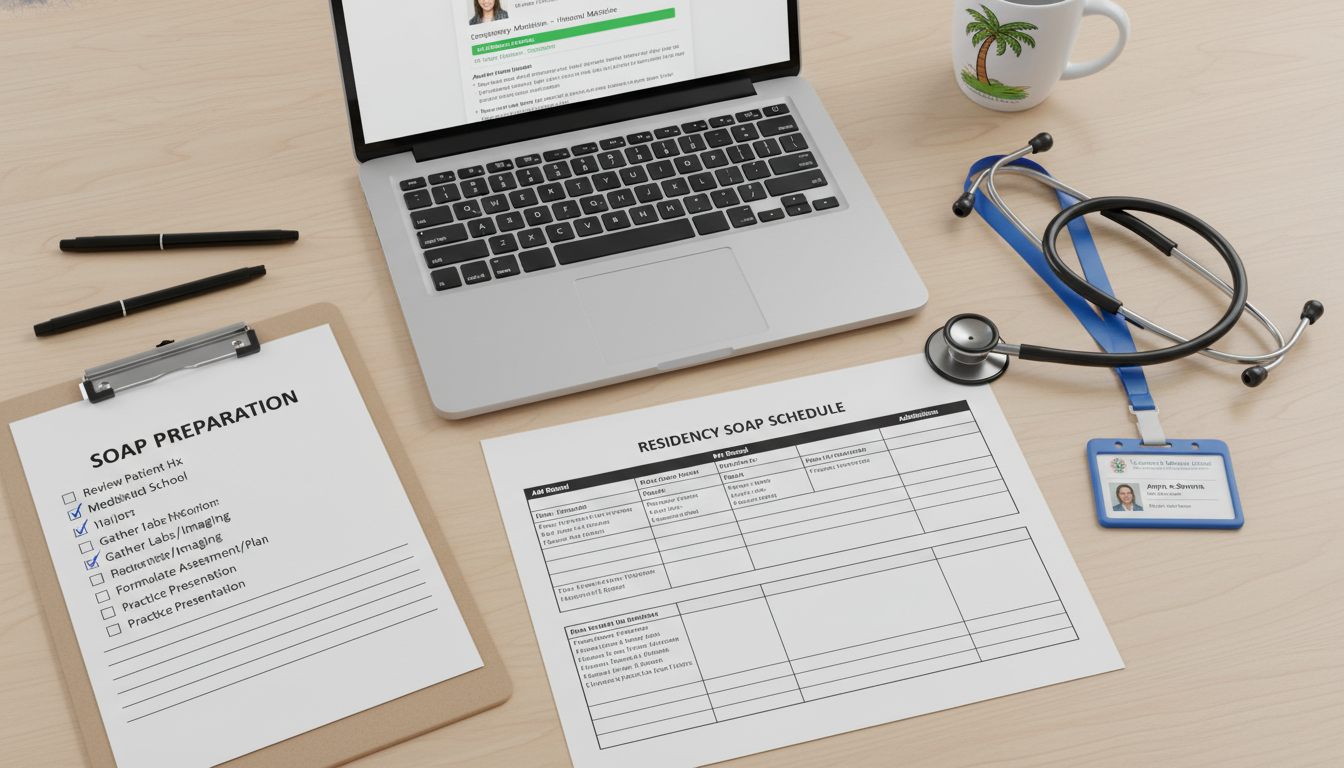
Strategic SOAP Execution for a Caribbean IMG Targeting EM-IM
Once you see the list of unfilled positions, you’ll need to make decisions very quickly. Here’s how to approach this rationally as a Caribbean IMG with EM-IM ambitions.
1. Rapidly Reviewing the Unfilled List
On Monday, when the list opens:
Filter by Specialty:
- Look for:
- Emergency Medicine
- Internal Medicine
- Combined EM-IM (if any)
- Preliminary Medicine
- Transitional Year
- Look for:
Filter by State and Institution Type:
- Prioritize:
- States with historically IMG-friendly environments (e.g., NY, NJ, FL, MI, IL, some southern states)
- Community and community-academic hybrids that list IMGs currently in training
- Prioritize:
Check Program Websites Quickly:
- Confirm:
- Visa policies (for non-U.S. citizens) – J-1 vs H-1B
- IMG acceptance history
- Requirements (USMLE cutoffs, recency of graduation)
- Confirm:
Rank your target programs into:
- Tier A: Most realistic + best fit (IMG-friendly, your metrics >= their norms)
- Tier B: Reach programs (slightly above your metrics but possible)
- Tier C: Backup programs (less ideal geography or prestige but realistic match)
2. Aligning Personal Statements and Letters to Program Type
For each target program type, assign:
EM-IM & EM-focused IM programs:
- Use your EM-IM/Acute Care PS
- Ensure at least one letter with ED or ICU/acute care language is assigned
Categorical IM (general):
- Use your IM Categorical PS
- Assign strongest IM attending letters plus one acute-care letter if allowed
Preliminary IM / Transitional Year:
- You can use:
- IM Categorical PS, or
- A slightly modified IM-IM acute-care PS if it doesn’t overpromise EM-specific goals
- Emphasize your desire for strong clinical exposure, professionalism, and learning attitude
- You can use:
3. Choosing Where to Spend Your Limited SOAP Applications
If you’re limited to 45 applications (or whatever the current cap is), consider:
20–25 applications to categorical Internal Medicine programs that:
- Are IMG-friendly
- Match your exam scores and graduation year
- Offer ED/ICU/CCU exposure
5–10 applications to EM (if any unfilled and you have:
- Strong EM rotation performance
- Adequate USMLE scores for EM
- EM-oriented letters)
10–15 applications to Preliminary Medicine / Transitional Year programs that:
- Have good reputations for teaching
- Are feasible with your metrics
Adjust these ratios based on the actual number of available programs in each category and your competitiveness.
4. Interviewing During SOAP
Some programs will:
- Conduct very brief phone or video interviews during SOAP
- Ask standardized, concise questions:
- “Why this program?”
- “Tell me about a difficult case.”
- “Why were you not matched?”
SOAP interviews are shorter and more business-like than main-season interviews. Prepare:
A 60–90 second pitch:
- Who you are (Caribbean IMG, school, year)
- Your interest in EM/IM and acute care
- Key strengths (work ethic, resilience, team player, strong US clinical rotations)
- Why their program fits your goals (ED/ICU exposure, patient volume, IMG support)
A concise explanation for being unmatched:
- Avoid blaming others.
- Focus on:
- High competitiveness of EM-IM or EM
- Maybe limited number of interviews
- Pivoting to IM or prelim as a strategic decision
- Emphasize your continued commitment to learning and improvement.
Example answer:
“I primarily targeted highly competitive EM-IM combined and Emergency Medicine programs this year. While I was fortunate to receive several interviews, I recognize that with my profile as an IMG, the competition was intense. I believe I have a strong foundation in Internal Medicine and acute care, and I’m eager to commit fully to a program where I can contribute immediately and continue to grow. That’s why I’m very interested in your Internal Medicine program with its strong ED and ICU exposure.”
Post-SOAP Outcomes: Planning Your Next Moves
No matter what happens during SOAP, you need a forward-looking plan.
1. If You Match Through SOAP
If you secure a position—categorical IM, EM, prelim, or TY:
Commit fully to being the best resident you can be.
If in categorical IM:
- Seek rotations in:
- ED
- ICU
- Cardiology/CCU
- Continue exploring career paths:
- EM practice options after IM (institution- and state-dependent)
- Critical care or hospitalist roles with ED interfaces
- Seek rotations in:
If in preliminary or TY:
- Treat it like a one-year audition:
- Excel clinically
- Secure powerful new letters
- Reapply more competitively to EM, IM, or possibly EM-IM (depending on openings and track record)
- Treat it like a one-year audition:
2. If You Do Not Match Even after SOAP
Not matching—even after SOAP—is emotionally hard, but far from the end of your career.
Your next steps:
Emotional reset and support
- Connect with peers, mentors, wellness services.
- Give yourself time—days to weeks—to process before making big decisions.
Comprehensive gap analysis
- Review:
- USMLE scores and attempts
- Number and quality of interviews
- LOR strength
- MSPE comments
- Any professionalism issues or gaps
- Get a frank appraisal from:
- Your Caribbean school’s match advising office
- Trusted attendings or program leaders
- Review:
Strengthening Year Plan
- Consider:
- U.S. clinical experience (paid positions like research assistant, clinical observer, scribe in ED/IM)
- Research in EM or IM (if possible)
- Teaching roles (tutor, TA) showing commitment to academics
- Aim to add at least one new strong letter and meaningful recent clinical work.
- Consider:
Reapplying with a flexible specialty strategy
- You may need to:
- De-emphasize EM/EM-IM and focus more heavily on categorical IM.
- Expand geographic and program-type preferences.
- Consider family medicine or other specialties depending on your long-term goals.
- You may need to:
FAQs: SOAP Preparation for Caribbean IMGs in EM-IM
1. How realistic is it for a Caribbean IMG to get an EM IM combined spot through SOAP?
It is uncommon. Most EM-IM combined programs fill in the main Match due to their popularity and small size. A Caribbean IMG’s best SOAP strategy is usually:
- Try for any available EM-IM positions (if they exist),
- But primarily target categorical IM, EM (if available), and prelim/TY spots that keep open doors to an acute-care career.
2. I’m an SGU graduate. Does my school reputation help me in SOAP?
Being from a well-known Caribbean medical school such as SGU can help, especially in terms of:
- Established track record of SGU residency placements (including SGU residency match successes in IM and EM)
- Familiarity of PDs with your school’s curriculum and grading
However, in SOAP, individual performance matters more than school name. Strong US clinical experiences, letters, exam scores, and a professional presentation are the true differentiators.
3. Should I rewrite my personal statement during SOAP?
Usually no. SOAP is too fast for complete rewrites. Instead:
- Prepare multiple tailored personal statements before Match Week.
- During SOAP, you may make minor edits (1–2 sentences) for specific programs, but do not rely on having hours for deep revisions.
Your time during SOAP is better spent on program selection, document assignment, and short interview preparation.
4. If I’m applying to both EM and IM programs in SOAP, won’t that confuse programs?
Not necessarily—if you handle it correctly:
- Use specialty-appropriate personal statements:
- EM-focused or acute-care PS for EM/EM-IM–like programs.
- IM-focused PS for categorical IM.
- Make sure your narrative is coherent:
- You love acute care, critical thinking, continuity of care, and complex internal medicine.
- Different programs represent different but related ways to practice the medicine you enjoy.
- You don’t need to advertise your cross-application strategy; instead, present a strong, consistent story tailored to each specialty.
By integrating early SOAP preparation, realistic specialty planning, strong clinical performance, and disciplined execution during Match Week, a Caribbean IMG interested in Emergency Medicine-Internal Medicine can significantly improve their odds of securing a meaningful, career-building residency position—even if the main Match doesn’t go as planned.