
Preparing for the Supplemental Offer and Acceptance Program (SOAP) is an essential strategic step for any Caribbean IMG aiming for a nuclear medicine residency in the United States. Even if you are confident about your initial Match prospects, SOAP readiness protects you from worst-case scenarios and positions you to act decisively if you go unmatched or partially matched.
This guide is written specifically for Caribbean IMGs—especially those from schools like SGU, AUC, Ross, Saba, and others—who are interested in nuclear medicine or related imaging fields. We’ll walk through what SOAP is, how it intersects with nuclear medicine residency opportunities, and how to build a concrete SOAP preparation plan tailored to your background.
Understanding SOAP: What It Is and Why It Matters for Caribbean IMGs
Before building a SOAP strategy, you must clearly understand what is SOAP and how it functions in the residency match ecosystem.
What Is SOAP?
SOAP (Supplemental Offer and Acceptance Program) is a structured, time-limited process run by the NRMP for eligible unmatched or partially matched applicants during Match Week. It allows applicants to:
- View a list of unfilled residency positions
- Apply to up to 45 programs through ERAS
- Participate in multiple offer rounds over several days
- Accept only one position (offers are legally binding once accepted)
SOAP is not the same as the pre-SOAP “scramble” era. It’s controlled, timed, and regulated. You cannot cold-call program directors during SOAP to solicit offers; all contact must follow NRMP rules.
Why SOAP Matters Especially for Caribbean IMGs
As a Caribbean IMG, you already know the competition is steep—particularly for specialized fields like nuclear medicine. Reasons SOAP matters for you:
- Higher risk of going unmatched compared to US MD seniors
- Visa limitations can reduce your program options
- Many Caribbean graduates initially aim for internal medicine, radiology, or another specialty and later discover open niches like nuclear medicine residency positions through SOAP
- Some community or smaller academic institutions that struggle to fill spots will use SOAP aggressively to fill their programs
SOAP might be your main entry to US GME or a plan B that keeps you on track while still keeping nuclear medicine in your long-term vision.
Nuclear Medicine Residency and the Match Landscape for Caribbean IMGs
Nuclear medicine is a relatively small field, but that can work both for and against you as a Caribbean IMG.
Structure of Nuclear Medicine Training
Historically, nuclear medicine has had:
- Dedicated nuclear medicine residency programs (often 3 years)
- Nuclear radiology fellowships (for those who completed diagnostic radiology)
- Transition to combined or pre-requisite pathways (e.g., 1 year of clinical training + nuclear medicine)
Depending on the year and evolving ACGME policies, there may be:
- Categorical nuclear medicine residency positions
- Advanced positions (starting after a preliminary or transitional year)
- Fellowship-level training after internal medicine, radiology, or another core specialty
Always review the most current ACGME and program-specific requirements during your application cycle.
Nuclear Medicine Match and SOAP: Realities for Caribbean IMGs
When we talk about nuclear medicine match and nuclear medicine residency, there are a few key realities:
Limited Number of Programs and Spots
Nuclear medicine is smaller than internal medicine or family medicine. Fewer programs mean:- Fewer total spots
- Variability in whether programs participate in the main Match vs. filling through off-cycle or institutional processes
SOAP and Nuclear Medicine
Each year, a small number of nuclear medicine positions may appear in the SOAP vacancy list, but:- Many years, there may be very few or no nuclear medicine residency positions in SOAP
- Some nuclear medicine programs may fill outside the NRMP, especially fellowships or non-standard pathways
Strategic Implication
If your sole plan is to SOAP directly into nuclear medicine, you may be setting yourself up for disappointment. A more realistic strategy is:- Use SOAP to secure a preliminary year (prelim medicine, prelim surgery), transitional year (TY), or categorical internal medicine/family medicine position that keeps you eligible for future nuclear medicine training.
- Keep nuclear medicine in your long-term strategy by:
- Targeting institutions with nuclear medicine or radiology departments
- Building imaging-related research and clinical exposure
- Networking with nuclear medicine faculty once you are in the system
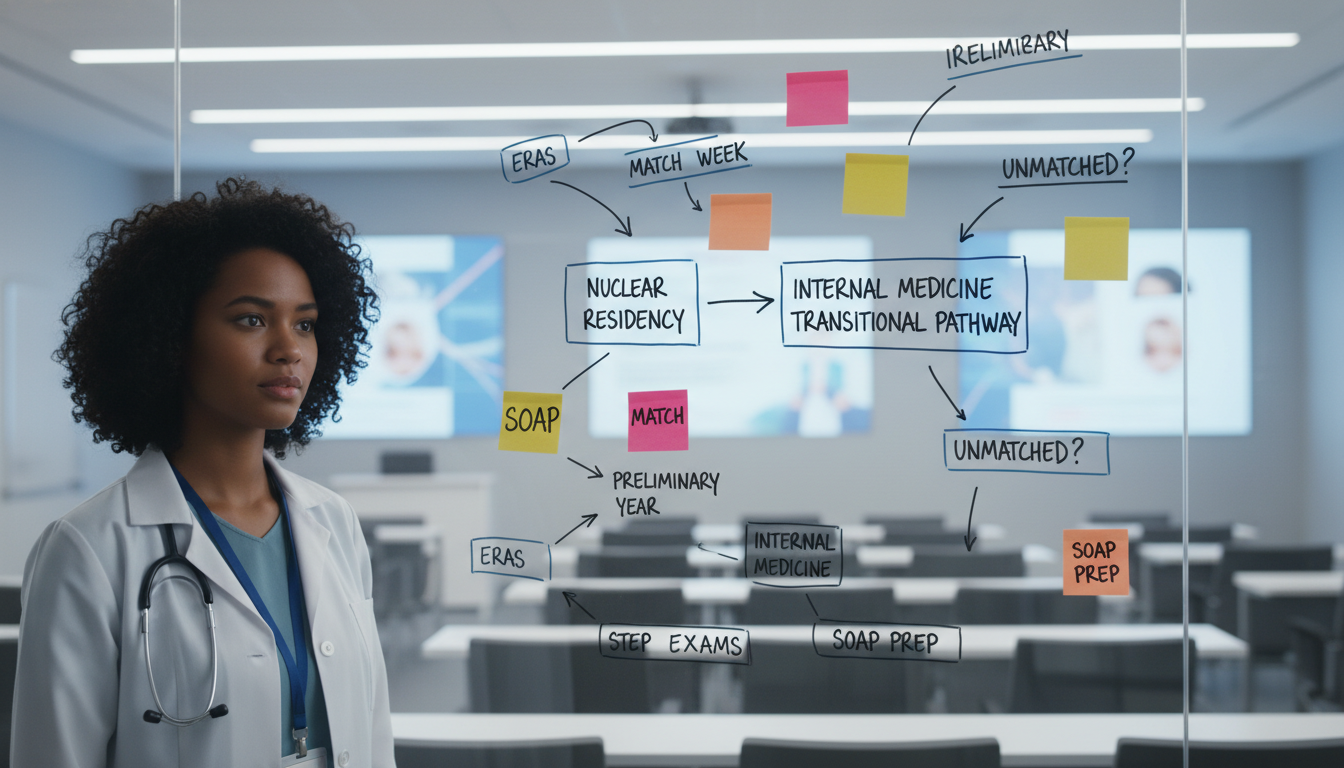
Building a SOAP Preparation Plan Months Before Match Week
SOAP success depends far more on what you do before Match Week than what you do during it. For Caribbean IMGs, this is even more crucial.
1. Accept That You Might Need SOAP
Many applicants treat SOAP as an unthinkable “failure scenario” and avoid planning for it. That is dangerous. Instead:
- Normalize the idea of SOAP as a standard part of your strategy
- Recognize that Caribbean IMGs often have lower first-pass Match rates
- Give yourself emotional permission to consider alternate tracks while still aiming high
This mindset shift makes you more prepared, calm, and strategic if you learn you are unmatched.
2. Clarify Your Tiered Specialty Strategy (Including Nuclear Medicine)
Create a tiered preference system:
- Tier 1 (Primary Goal):
- Diagnostic radiology, nuclear medicine residency, or a combined imaging path (if you applied there).
- Tier 2 (Imaging-Compatible Fields):
- Internal medicine, transitional year, preliminary internal medicine or surgery in institutions that have strong imaging departments.
- Tier 3 (Broader SOAP Opportunities):
- Family medicine, psychiatry, pediatrics, neurology, or other fields you are genuinely willing to train in if higher tiers don’t work.
As a Caribbean IMG targeting nuclear medicine in the long run, Tier 2 is your most important safety layer. A categorical internal medicine or TY year in a hospital with a nuclear medicine department can keep your nuclear medicine match aspirations alive.
3. Strengthen Your Application Before Rank List Submission
Your SGU residency match or other Caribbean medical school match success will depend heavily on your pre-SOAP profile. Before ROL certification:
- Update ERAS completely
- Clinical experiences, research, volunteering
- Any late exam scores (USMLE Step 2 CK especially)
- Recent publications or case reports, particularly imaging-related
- Refine your personal statement(s)
- Create variants:
- One for diagnostic radiology/nuclear medicine focus
- One for internal medicine
- One general version applicable to primary care or prelim/TY
- Highlight any exposure to nuclear medicine, radiology, or imaging research—even if your SOAP target is IM. It signals focused interest.
- Create variants:
- Ensure strong letters of recommendation
- Ideally at least:
- 1–2 internal medicine (or core clinical rotation) letters
- Any available radiology/nuclear medicine letters (if you had exposure)
- For SOAP, generalized strong clinical letters often carry more weight than hyper-specialized ones, unless you are directly applying to imaging programs.
- Ideally at least:
4. Prepare SOAP-Specific Documents in Advance
Before Match Week, have these ready:
SOAP-Ready Personal Statement(s)
- A SOAP IM/TY/Prelim-focused statement that:
- Emphasizes your work ethic, teachability, and resilience
- Mentions your interest in imaging/nuclear medicine briefly but does not make you look uninterested in general clinical work
- A SOAP family medicine/other specialty statement if you’re open to those options
- A SOAP IM/TY/Prelim-focused statement that:
Updated CV or ERAS-Style Resume for Quick Reference
- While programs see your ERAS application, having a personal reference copy helps:
- Interview prep
- Phone/Zoom conversations during SOAP
- While programs see your ERAS application, having a personal reference copy helps:
Talking Points for Quick Interviews
- A 30–60 second “elevator pitch” including:
- Who you are (Caribbean IMG, school, graduation year)
- Brief clinical strengths
- Connection to imaging/nuclear medicine
- Why you’re enthusiastic about that specific specialty or program type
- A 30–60 second “elevator pitch” including:
Document Checklists
- ECFMG certification or timeline for certification
- Visa status clarity (J-1 vs H-1B potential)
- Any institutional forms your school requires during Match Week
Step-by-Step SOAP Strategy for Caribbean IMGs with Nuclear Medicine Interests
When Monday of Match Week arrives and you see “You are not matched to any position,” the clock starts ticking. Your SOAP preparation becomes action.
Step 1: Process the News Quickly and Stabilize
You’ll have a short window before the SOAP residency process formally opens:
- Allow yourself 30–60 minutes to react emotionally; don’t suppress but don’t spiral.
- Contact your dean’s office or your school’s residency advising team.
- Schools like SGU, Ross, AUC, etc., often have dedicated SGU residency match or “post-Match support” teams familiar with Caribbean IMG challenges.
- Confirm your SOAP eligibility in NRMP and ERAS.
Step 2: Analyze the Unfilled Positions List Strategically
When the unfilled positions list is released:
Filter by Specialty
- Check for:
- Nuclear medicine residency positions (if any)
- Diagnostic radiology positions (usually rare in SOAP)
- Internal medicine categorical and prelim
- Transitional year positions
- Family medicine, psychiatry, neurology, or others you’re willing to pursue
- Check for:
Use a Nuclear Medicine–Informed Lens
Even if you don’t see nuclear medicine positions, look for:- Hospitals with robust radiology or nuclear medicine departments
- Academic centers that may have future fellowships or rotations in imaging
- Institutions known to train IM residents who later pursue imaging specialties
Apply in Waves (Prioritized Lists)
You have up to 45 applications during SOAP. Create three priority tiers:- Priority A (15–20 programs):
- Internal medicine or TY/prelim programs at institutions with nuclear medicine/radiology departments.
- Any nuclear medicine residency spots, if available.
- Priority B (15–20 programs):
- Strong community IM or FM programs open to IMGs and visas, even if not imaging-focused.
- Priority C (Remaining spots up to 45):
- Additional specialties or locations you find acceptable if higher tiers don’t pan out.
- Priority A (15–20 programs):
As a Caribbean IMG with a nuclear medicine interest, don’t waste your 45 on ultra-unlikely options that have a history of not taking IMGs or visas.
Step 3: Tailor Your Messaging Quickly
During SOAP you typically cannot send mass unsolicited emails, but if programs invite you to interview or speak:
- Use your nuclear medicine interest as an asset, not a problem:
- Frame it as a sign of intellectual curiosity, comfort with technology, and quantitative reasoning.
- Emphasize that you are fully committed to excelling in their program’s specialty first, regardless of your imaging interests.
Example answer if asked about long-term goals:
“Long term, I see myself in a role that incorporates diagnostic imaging, possibly nuclear medicine, given my interest in physiology and quantitative analysis. However, my immediate goal is to become an outstanding internal medicine resident who can deliver excellent patient care. I believe strong clinical training here will give me the foundation I need, wherever my career develops.”
This reassures programs that you won’t be “checking out” after PGY-1 while still honestly reflecting your nuclear medicine interests.
Step 4: Prepare for Rapid-Fire Interviews
SOAP interviews are often:
- Short (10–20 minutes)
- Virtual (phone, Zoom, or institutional platforms)
- Scheduled with little notice
Prepare:
- Core stories:
- A clinical challenge you handled well
- An example of resilience (e.g., handling setbacks as a Caribbean IMG, USMLE struggles, or personal challenges)
- Any experience with imaging, nuclear medicine, radiology, or research
- Program-specific notes:
- Quick bullet points on why you want each program type:
- IM: breadth of pathology, continuity of care, stepping stone to imaging or academic medicine
- TY/Prelim: exposure to multiple disciplines, strong foundation for future specialty
- Quick bullet points on why you want each program type:
- Questions to ask them:
- “How do you support residents interested in subspecialties like cardiology, oncology, or imaging fields?”
- “What mentorship resources are available for residents exploring fellowships?”
Step 5: Navigating SOAP Offer Rounds
Throughout the nuclear medicine match–relevant period of SOAP (if such positions exist) and other specialties:
- If you receive an offer:
- You have a short time window (often 2 hours) to accept or reject.
- Once you accept a SOAP offer, you are done. You are contractually bound and removed from further offer rounds.
- Decision strategy:
- If it’s a solid IM or TY program in a hospital with imaging departments, this can be an excellent bridge to your nuclear medicine goals.
- If it’s a completely unrelated specialty in a setting that doesn’t fit your long-term vision at all, think carefully but realistically about:
- Your debt and financial situation
- The probability of repeating the Match successfully
- Your resilience to trying another cycle vs. progressing in a different field
For most Caribbean IMGs, a SOAP IM/TY spot is usually preferable to going unmatched, especially if there’s a plausible path toward imaging-related training later.

Long-Term Nuclear Medicine Strategy If You SOAP into Another Specialty
Many doctors in nuclear medicine arrive there via indirect paths. If SOAP leads you into internal medicine, family medicine, or a transitional/prelim year, you still maintain options.
1. Use Residency to Strengthen Your Imaging Portfolio
During your residency:
- Seek elective rotations in:
- Nuclear medicine
- Diagnostic radiology
- Cardiology or oncology services that use nuclear imaging heavily (e.g., PET-CT, SPECT)
- Get involved in research:
- Quality improvement projects involving imaging utilization
- Case reports featuring nuclear medicine findings
- Collaboration with radiologists or nuclear medicine physicians
This builds a convincing narrative when you later apply for nuclear medicine residency or nuclear radiology fellowships.
2. Maintain Contact with Imaging Mentors
If you had any imaging or nuclear medicine mentors from med school or observerships:
- Update them once you secure a SOAP position
- Ask if they can:
- Introduce you to colleagues at your new institution
- Provide guidance on timing for applications to nuclear medicine programs
3. Track Evolving Pathways into Nuclear Medicine
The landscape of nuclear medicine training is evolving:
- Some pathways may require:
- One or more years of clinical training (e.g., IM, surgery)
- Completion of radiology residency
- Stay updated via:
- SNMMI (Society of Nuclear Medicine and Molecular Imaging)
- ACGME program requirements and individual program websites
- Plan accordingly:
- If you’re in IM, consider fellowships that align closely with imaging:
- Cardiology (nuclear cardiology)
- Oncology (PET imaging)
- Endocrinology (thyroid imaging)
- These can further enhance your candidacy for imaging-related opportunities.
- If you’re in IM, consider fellowships that align closely with imaging:
4. Reapplying After a SOAP Year (If Needed)
If you SOAP into a prelim year or TY and still want a dedicated nuclear medicine match:
- Start planning early in your PGY-1:
- Update ERAS with residency experiences and attending letters
- Reach out to nuclear medicine programs about requirements and timing
- Be open to:
- Applying broadly, including less competitive geographic regions
- Considering research or non-standard pathways if they exist within institutional frameworks
Practical Tips Specific to Caribbean IMGs Targeting Nuclear Medicine
To bring all of this together, here are actionable, Caribbean-IMG-focused tips:
Leverage Your Caribbean School’s Match Office
- SGU residency match and similar offices often have historical data on which programs:
- Have taken Caribbean grads
- Participate regularly in SOAP
- Are friendly to IMGs with J-1 visas
- Use this to prioritize your SOAP residency list.
- SGU residency match and similar offices often have historical data on which programs:
Be Honest but Strategic About Nuclear Medicine in Interviews
- Never claim nuclear medicine is the “only” thing you care about when interviewing for IM/TY roles.
- Do say you value rigorous clinical training and see imaging as part of comprehensive patient care.
Address IMG Bias Confidently
- Have talking points ready if your Caribbean background is subtly questioned:
- Emphasize your adaptability (moving countries, navigating different systems)
- Highlight your US clinical experience quality
- Show concrete examples of performance (honors, strong evaluations, leadership roles)
- Have talking points ready if your Caribbean background is subtly questioned:
Prepare Financially for SOAP and Potential Repeat Cycles
- SOAP itself doesn’t charge per application (beyond your initial ERAS fees), but you may:
- Need to travel later for pre-employment screenings or orientation
- Consider the cost of possibly reapplying if you go unmatched
- Budgeting early reduces panic-driven decisions.
- SOAP itself doesn’t charge per application (beyond your initial ERAS fees), but you may:
Take Care of Mental Health
- Match Week is enormously stressful, especially as a Caribbean IMG with loans and visa concerns.
- Arrange support in advance:
- Friends or family who understand your goals
- Counseling resources at your school
- A clear head will make your SOAP choices better—and protect your long-term trajectory toward nuclear medicine.
FAQs: SOAP Preparation for Caribbean IMG in Nuclear Medicine
1. Is it realistic to SOAP directly into a nuclear medicine residency as a Caribbean IMG?
It is possible but uncommon. Nuclear medicine residency programs are limited in number, and not every cycle has unfilled nuclear medicine slots in SOAP. As a Caribbean IMG, you should absolutely check the SOAP vacancy list for nuclear medicine, but your main realistic SOAP goal should be to secure a strong IM, TY, or prelim position that keeps you eligible for nuclear medicine later.
2. How should I mention nuclear medicine interest when applying to internal medicine programs during SOAP?
Mention it in a way that enhances your internal medicine candidacy:
- Emphasize that your interest in nuclear medicine stems from a desire to better understand and manage complex medical conditions.
- Make clear that you are fully committed to being an excellent internist first.
- Example: “I’m especially interested in how nuclear imaging can refine diagnosis and management of cardiovascular and oncologic diseases, and I hope to bring that knowledge back to daily internal medicine practice.”
3. What if I don’t Match or SOAP into any position? Can I still aim for nuclear medicine in the future?
Yes, but the path becomes longer and more complex. If you remain unmatched:
- Strengthen your application:
- Additional US clinical experience
- Research (preferably imaging-related)
- USMLE score improvements if possible (Step 3, if appropriate)
- Reapply in the next Match cycle with a broader specialty target list.
- Nuclear medicine will likely require you to first secure a residency position in another specialty (often IM or radiology), so prioritize gaining any GME foothold you can realistically get in a field you’d accept long term.
4. How does my Caribbean school reputation (e.g., SGU) affect my SOAP chances?
Larger Caribbean schools (SGU, AUC, Ross, etc.) often:
- Have more established relationships with US programs
- Provide better SOAP guidance and data on program history
- May have slightly better recognition among program directors
That said, your individual application—USMLE scores, clinical evaluations, interview performance, and professionalism—will matter more than school name alone. Use your school’s match office aggressively: they understand Caribbean IMG patterns and can guide you toward programs with a history of taking graduates like you.
Being SOAP-ready is not pessimism; it’s professionalism and strategy. For a Caribbean IMG interested in nuclear medicine, SOAP can be the bridge that gets you into the US system—often via internal medicine or a transitional year—so you can build the experiences and relationships that eventually lead to a nuclear medicine match. Prepare early, act decisively, and keep your long-term imaging goals in focus while taking each realistic step forward.