Understanding SOAP for a DO Graduate in General Surgery
The Supplemental Offer and Acceptance Program (SOAP) can feel overwhelming, especially for a DO graduate focused on matching into general surgery. Yet, with the right SOAP preparation, it can be an effective route into a strong training program—even if it’s not your original target.
As a DO graduate, you face unique variables: integration of osteopathic and allopathic positions, differences in program attitudes toward DOs, and the intense competitiveness of the surgery residency match. This guide will walk you through what SOAP is, why DO graduates in general surgery need a specific strategy, and how to prepare before, during, and after SOAP to maximize your chances of securing a categorical or preliminary surgery spot—or a strategically chosen alternative.
We will also integrate key concepts like SOAP residency strategy, what is SOAP, and osteopathic residency match considerations, all tailored to the general surgery residency applicant.
1. What Is SOAP and Why It Matters for DO General Surgery Applicants
The SOAP (Supplemental Offer and Acceptance Program) is the structured process NRMP uses to fill unfilled residency positions after the main Match. It takes place during Match Week and is not the old “scramble.” It has rules, strict timelines, and a defined offer system.
1.1 What Is SOAP? (Core Concepts)
In practical terms, SOAP is:
- A four-day process during Match Week
- For eligible unmatched or partially matched applicants
- That allows you to apply to unfilled programs through ERAS
- And receive up to four rounds of offers from programs
Key points:
- You can apply to a maximum of 45 programs during SOAP.
- Communication rules are strict: you cannot initiate contact with programs; programs contact you.
- Offers are made in waves; you accept or reject in a short time window.
- Once you accept a SOAP offer, it is binding, just like a normal Match.
1.2 Why SOAP Is Critical for a DO Graduate in General Surgery
For a DO graduate targeting general surgery residency, SOAP is especially important because:
- General surgery is competitive, especially for categorical positions.
- Some DO graduates may go unmatched despite strong applications due to:
- Overly narrow rank lists (few programs, mostly highly competitive programs)
- Limited away rotations
- Late USMLE completion or lower Step/Level scores
- Limited research or surgical exposure
- The SOAP provides:
- A second chance to obtain a general surgery categorical or preliminary position
- A route into transitional year (TY) or preliminary medicine positions that keep you clinically active and competitive for a reapplication in the next cycle
- Access to programs that may be particularly interested in DOs, especially in historically DO-friendly regions
1.3 How SOAP Fits into the Osteopathic Residency Match Landscape
Though the AOA and ACGME merged into a single accreditation system, DO graduates still navigate unique challenges:
- Some programs still show preferences in their historical match data (MD vs. DO ratios).
- DO graduates may rely more heavily on Step 2 CK and strong clinical evaluations to demonstrate equivalence.
- The osteopathic residency match era may be ending formally, but many DO-friendly programs, particularly in community general surgery, maintain an ethos of osteopathic inclusion.
In this environment, strategic SOAP preparation can significantly increase the chances that a DO graduate residency path in surgery—or a surgery-adjacent field—remains viable, even if the main surgery residency match outcome is disappointing.
2. Pre-Match SOAP Preparation: What to Do Before Match Week
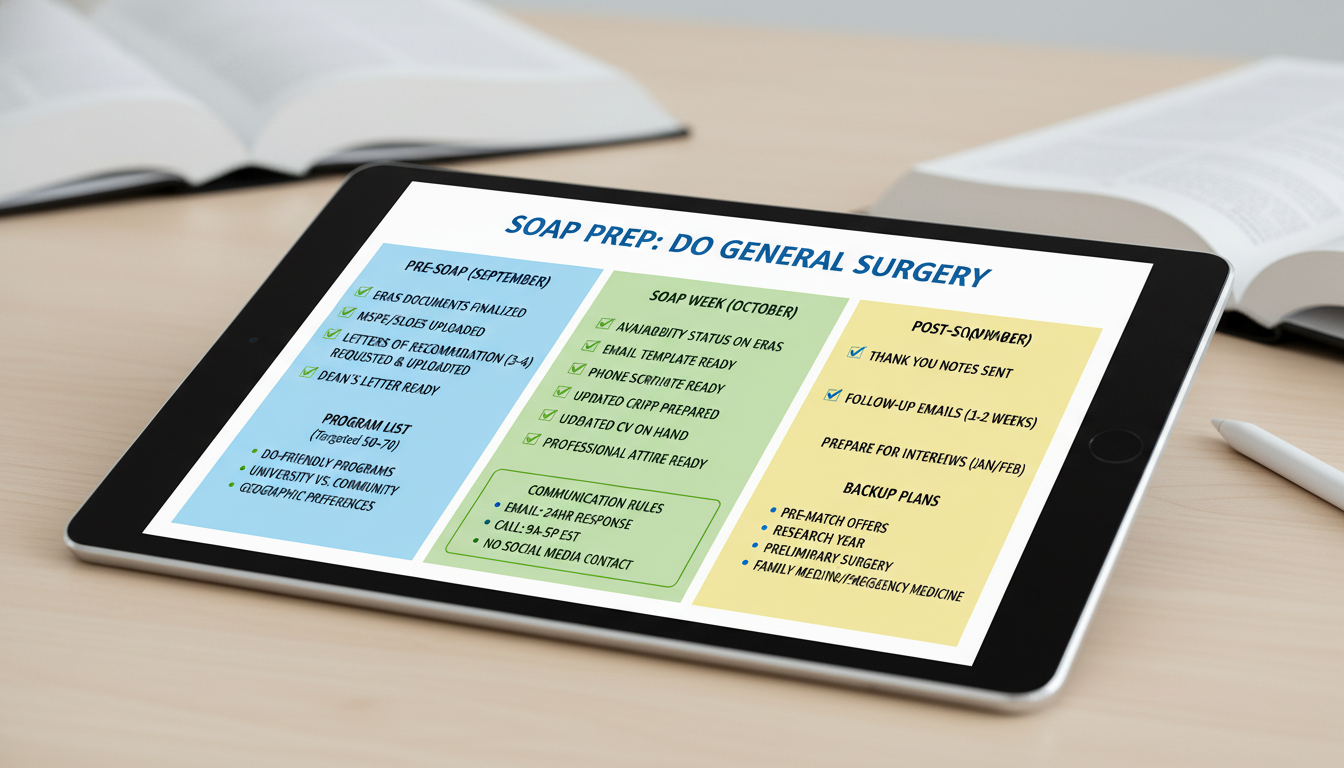
Effective SOAP preparation starts months before Match Week. Many applicants wait until the Monday of Match Week (when they learn they’re unmatched) to think about SOAP; by then, you are already behind.
2.1 Decide Early: Will You Use SOAP If Needed?
Before rank lists are due, have an honest conversation with yourself and your advisors:
- Is any residency position this year better than reapplying next year?
- Are you open to:
- Preliminary general surgery positions?
- Transitional year (TY) or preliminary medicine as a bridge year?
- Moving geographically far from home?
- Are there financial or visa/timing constraints that make delaying training risky?
For most DO graduates aiming at general surgery, the answer is:
Yes, using SOAP is preferred to going unmatched and sitting out a year, unless there are strong personal or visa-related reasons otherwise.
2.2 Update and SOAP-Optimize Your Application Materials
Ensure that your ERAS file is SOAP-ready:
Personal Statement
- Prepare at least two versions:
- General surgery–focused personal statement (for categorical and prelim surgery)
- A flexible “clinical year / prelim / TY” statement that emphasizes:
- Desire for strong clinical training
- Interest in future surgery or other acute care specialties
- Professionalism and adaptability
- For DO graduates, briefly but clearly highlight:
- Strengths of your osteopathic training (holistic care, MSK skills, patient communication)
- How these strengths support your success in surgery (resilience, hands-on skills)
- Prepare at least two versions:
CV and Experiences
- Ensure all recent rotations, research, and leadership are up to date.
- Highlight:
- General surgery sub-internships / acting internships
- Surgical case logs (if your school tracks them)
- Any trauma, ICU, or emergency medicine experiences supporting surgical interest
Letters of Recommendation (LoRs)
- Secure at least 2–3 strong general surgery letters by the time of applications.
- Consider an additional letter from:
- A program director or core clinical faculty emphasizing reliability and teamwork
- Be sure letters are already uploaded to ERAS and designated to general surgery and prelim programs.
USMLE/COMLEX Scores
- If possible, have Step 2 CK and Level 2 CE scores reported before SOAP.
- For DO graduates without USMLE:
- Emphasize strong COMLEX performance and clinical evaluations.
- Be ready to explain (if asked) why you did not take USMLE.
2.3 Build a SOAP Program Strategy Framework (Before You See the List)
You won’t know which programs are unfilled until Match Week, but you can:
- Create a spreadsheet template with columns for:
- Program name, ACGME ID, location, type (academic vs. community)
- Categorical vs preliminary general surgery
- DO-friendliness (historical DO match data if you can find it)
- Visa policies (if relevant)
- Your priority score (1–5)
- Define selection criteria in advance:
- Strong interest: community or academic programs with good operative volume and DO-friendly culture
- Acceptable alternatives: preliminary general surgery at hospitals with proven pipeline into PGY-2 positions
- Safety options: TY or prelim medicine in locations you can live in for a year while reapplying
This “framework” allows you to rapidly populate and prioritize once the official SOAP list is released.
3. Strategy for DO Graduates: Targeting General Surgery Through SOAP
On Monday of Match Week, you’ll learn if you’re:
- Unmatched
- Partially matched (e.g., matched to an advanced position but no PGY-1, or vice versa)
- Fully matched
If you are unmatched or partially matched and eligible for SOAP, your goal as a DO graduate pursuing general surgery is to use your 45 applications strategically.
3.1 Understanding General Surgery Opportunities in SOAP
In most years:
- There are relatively few categorical general surgery spots in SOAP.
- There are more preliminary general surgery spots.
- Many prelim spots are at:
- Large academic centers
- Community teaching hospitals with heavy clinical volume
For a DO graduate, this means:
- Categorical general surgery via SOAP is possible but limited.
- Preliminary general surgery can be:
- A powerful stepping stone into PGY-2 or categorical positions
- A way to demonstrate surgical capabilities and secure internal or external advancement
3.2 How to Allocate Your 45 Applications
Your exact distribution depends on your competitiveness, but a typical DO surgery applicant might consider:
- High-priority category (e.g., 15–20 programs):
- Categorical general surgery positions in SOAP (if available)
- DO-friendly programs (based on past DO match data, location, or school relationships)
- Medium-priority category (e.g., 15–20 programs):
- Preliminary general surgery positions with:
- Strong educational structure
- History of promoting prelims to categorical elsewhere or internally
- Good mentorship
- Preliminary general surgery positions with:
- Safety/bridge category (e.g., 5–15 programs):
- Transitional year or prelim medicine at reputable institutions
- Especially where:
- There is a surgery department receptive to prelims/TY transitioning
- You can do strong surgical electives during that year
Adjust your ratios based on:
- Academic metrics (Step/Level scores, clerkship grades)
- Number and strength of LoRs in surgery
- Whether you already have an advanced position in another specialty
3.3 Categorical vs Preliminary General Surgery: Pros and Cons
Categorical General Surgery (ideal):
- Direct 5-year (or more) track to full general surgery training.
- Stability and identity as a surgery resident.
- Harder to obtain in SOAP due to limited spots.
Preliminary General Surgery (realistic stepping stone):
- 1-year PGY-1 (occasionally PGY-2) position without guaranteed continuation.
- Pros:
- You gain surgery-specific training and operative experience.
- You can build strong relationships with faculty who can advocate for your advancement.
- Easier to transition into PGY-2 or categorical positions that open mid-year or in next year’s match.
- Cons:
- No guarantee of continuation.
- Intense workload with ongoing need to apply and interview again.
For a DO graduate serious about surgery, a good preliminary general surgery spot often beats:
- Sitting out the year
- Doing a TY with minimal surgical exposure (unless extremely strong academically with guaranteed surgical electives)

4. Execution During SOAP Week: Step-by-Step for DO General Surgery Applicants
Once Match Week and SOAP begin, time is your scarcest resource. Here is how to move efficiently and professionally.
4.1 Monday: Confirm Status and Begin Active Planning
On Monday:
Check your NRMP status:
- Confirm you are eligible for SOAP.
Immediate actions:
- Contact your dean’s office and advisors/mentors in surgery.
- Request:
- A quick review of your targeted SOAP strategy
- Help identifying DO-friendly programs
- Any insider knowledge on specific programs likely to appear on the SOAP list
Emotional management:
- Allow yourself to feel disappointed.
- But quickly pivot to: “This is my second chance; I will approach it systematically.”
4.2 Tuesday Morning: Reviewing the Unfilled List and Rapid Targeting
When the list of unfilled programs is released:
Filter by specialty and position type:
- Start with general surgery (categorical and preliminary).
- Then review transitional year and prelim medicine options that could function as bridges to surgery.
Prioritize DO-friendliness and feasibility:
- Consider:
- Programs in regions known for osteopathic training (Midwest, Appalachia, some Southern states).
- Programs that previously listed DO-friendly policies or have DO faculty.
- Consider:
Fill your spreadsheet:
- Add each unfilled general surgery program.
- Score them quickly (1–5) based on:
- Fit with your career goals
- Geographic acceptability
- Perceived DO receptivity
- Reputation for prelims advancing to categorical
Assign your 45 applications:
- Lock in your top 15–20 categorical/prelim surgery choices.
- Add bridge-year programs (TY/prelim medicine) as needed to reach 45.
4.3 Tailoring Application Materials During SOAP
Within ERAS, you can:
Assign specific personal statements to programs:
- Use your surgery-focused statement for all general surgery positions.
- Use your clinical year / TY statement for non-surgical but clinically intense positions.
Double-check:
- All necessary LoRs are assigned.
- Your CV is accurate and complete.
- Contact information is up to date and reliable for rapid communication.
4.4 Navigating SOAP Interviews as a DO Surgery Applicant
During SOAP, programs may:
- Reach out via phone or email.
- Invite you to brief virtual interviews.
- Conduct rapid-fire Q&A sessions.
Key points for DO graduates:
Prepare a 30–60 second “elevator pitch”:
- Who you are (DO graduate, your medical school)
- Why surgery
- What you bring (resilience, strong work ethic, hands-on skills from osteopathic training)
- Why their program specifically
Be ready for common SOAP-specific questions:
- “Why do you think you went unmatched in the main surgery residency match?”
- Own your story briefly; avoid blaming. Emphasize growth and readiness.
- “What did you learn from your application process?”
- Highlight reflection, improved self-awareness, and commitment to improvement.
- “Will you be content with a preliminary spot?”
- If you apply to prelim, frame it as a deliberate path, not a consolation prize:
- “I understand prelim doesn’t guarantee continuation, but I see it as a high-value opportunity to prove myself as a surgical intern and be competitive for advancement.”
- If you apply to prelim, frame it as a deliberate path, not a consolation prize:
- “Why do you think you went unmatched in the main surgery residency match?”
Address DO-specific concerns confidently:
- If asked about being a DO:
- Emphasize comprehensive training, early hands-on exposure, and holistic patient care.
- If you completed USMLE: note that you intentionally did so to compare on equal footing.
- If you did not: emphasize COMLEX performance and strong clinical performance.
- If asked about being a DO:
Professionalism and responsiveness:
- Answer calls promptly, check email obsessively (politely).
- Keep a notebook or digital log of:
- Who called, from which program
- Interview times
- Name of interviewer(s)
- Key points discussed
4.5 Accepting or Declining SOAP Offers
Offers go out in rounds. Core rules:
- You can hold only one offer at a time.
- You must accept or reject within a specified window.
- Once accepted, you are done with SOAP.
For a DO general surgery applicant:
Categorical general surgery offer:
- Almost always accept, unless there is a truly critical personal or visa conflict.
- This is your primary goal.
Prelim general surgery offer:
- Strongly consider accepting if:
- The institution has a solid reputation and operative volume.
- You can envision working there for a year.
- Decline only if:
- You are highly confident in a better categorical or prelim offer coming in a later round (risky).
- Or if personal/financial issues make it unsustainable.
- Strongly consider accepting if:
TY or prelim medicine offer:
- Accept if:
- You have not received any surgery-related offer and time is running out.
- The program has good educational structure and you can do surgical electives.
- Always weigh this against the risk of ending SOAP with no position at all.
- Accept if:
5. Post-SOAP Planning: Maximizing Your Surgery Career Trajectory
Once SOAP ends and you have accepted a position, the work of long-term career planning begins.
5.1 If You Matched into Categorical General Surgery via SOAP
Congratulations—you navigated one of the toughest paths.
Next steps:
- Connect early with:
- Program leadership
- Future co-residents
- Ask how you can best prepare:
- Recommended reading (e.g., ABSITE-level resources)
- Skills courses (suturing, knot tying, basic laparoscopy)
- As a DO graduate:
- Be confident in your training.
- Seek early mentorship—especially from faculty who trained in community or osteopathic environments, if available.
5.2 If You Matched into Preliminary General Surgery
Your goals this year:
- Perform at your absolute best:
- Be punctual, prepared, and reliable.
- Volunteer for cases and call responsibilities reasonably.
- Build relationships:
- Identify champions among attending surgeons and chief residents.
- Request feedback early and often.
- Plan for next steps:
- Monitor for PGY-2 categorical spots that open internally or at other institutions.
- Consider applying to the next cycle if a clear categorical path doesn’t emerge by mid-year.
Your prelim year is your audition for a stable surgery residency position. Many DO graduates have successfully converted prelim positions into categorical spots by excelling clinically and maintaining professionalism.
5.3 If You Matched into TY or Prelim Medicine with Surgery Aspirations
Use this year strategically:
- Seek rotations in:
- General surgery
- Surgical ICU
- Trauma and acute care surgery
- Maintain close contact with:
- Your original surgery mentors
- New surgical faculty at your TY/prelim institution
- Prepare a strong reapplication:
- Improve Step 2 CK (if still possible), pursue research, present at conferences.
- Update your CV with robust clinical evaluations and surgical experiences.
- Focus on programs historically willing to transition DO prelims/TY residents into categorical surgery roles or that respect diverse pathways.
6. Practical Tips and Common Pitfalls for DO Graduates in SOAP
6.1 Practical Tips
- Have a SOAP rehearsal:
- Sit down with a mentor and run through:
- How you’ll prioritize programs
- How you’ll present your story in interviews
- Sit down with a mentor and run through:
- Use your DO network:
- Ask older DO graduates/residents in general surgery how they navigated:
- SOAP
- Prelim-to-categorical transitions
- Ask older DO graduates/residents in general surgery how they navigated:
- Stay organized:
- Keep all your personal statements, CV, and program notes in one accessible folder.
- Use your spreadsheet as your “mission control” during SOAP week.
6.2 Common Pitfalls to Avoid
- Waiting until Monday of Match Week to plan:
- You lose critical time. Begin planning months earlier.
- Using all 45 applications on only categorical general surgery:
- Very risky. Include prelim surgery and possible bridge-year options.
- Applying to programs without realistic self-assessment:
- Balance aspiration with feasibility; avoid only top-tier academic programs if your metrics are average.
- Declining a good prelim or TY offer in hopes of a dream categorical:
- Unless you have a very strong reason, this can leave you unmatched at the end of SOAP.
FAQs About SOAP Preparation for DO Graduates in General Surgery
1. As a DO graduate, are my chances worse in SOAP compared to MD applicants?
Your DO degree does not automatically disadvantage you in SOAP, but program biases and historical trends can matter. Some programs may prefer MDs; others are DO-friendly or neutral. Your competitiveness depends more on your full profile—scores, clinical grades, letters, and interview performance—than the letters after your name. Use your osteopathic background as a strength (holistic care, hands-on skills) and focus on programs with a track record of taking DOs.
2. Should I take a preliminary general surgery position or a transitional year if I want a career in surgery?
For most surgery-focused DO graduates, a preliminary general surgery position at a strong program is the better direct path—especially if the program has a history of helping prelims find PGY-2 seats. A transitional year can also be valuable if it allows substantial surgical rotations and you don’t secure a prelim surgery spot. Avoid non-clinical gap years unless there is a compelling academic or personal reason.
3. How can I explain going unmatched in the main surgery residency match during SOAP interviews?
Be honest and brief, focusing on reflection and growth. For example:
- “I targeted a narrow set of highly competitive programs and didn’t cast a broad enough net.”
- “I took my licensing exam later than ideal, which limited my interview opportunities.” Then pivot to what you’ve done to improve—better performance on recent rotations, stronger letters, or updated exams. Avoid blaming others or sounding bitter.
4. What is SOAP preparation, practically speaking, and when should I start?
SOAP preparation means having a clear, actionable plan if you do not match in the main surgery residency match. Practically, that includes:
- Updated ERAS materials (multiple personal statements, current CV, LoRs)
- A pre-built program prioritization framework
- Clear decisions about categorical vs prelim vs TY options
- Discussed strategies with mentors and your dean’s office
You should start no later than a few weeks before rank list certification, ideally even earlier, so that if you need SOAP, you can execute smoothly rather than scrambling.
Thoughtful, early SOAP preparation transforms a stressful, uncertain week into a structured second chance. As a DO graduate aiming for a general surgery residency, approaching SOAP with clarity, realism, and confidence can keep your surgical ambitions firmly on track—even if your path isn’t the traditional one through the initial surgery residency match.