
Understanding SOAP and Its Role in Your Osteopathic Career
The Supplemental Offer and Acceptance Program (SOAP) can feel intimidating, especially if you’re a DO graduate aiming for a career in Addiction Medicine. Yet, with thoughtful SOAP preparation, it can become a strategic second chance rather than a desperate scramble.
As a DO graduate, you bring unique strengths—holistic training, strong patient communication, and frequent exposure to behavioral health—that align directly with Addiction Medicine and substance abuse training. The key is to translate these strengths into a targeted, efficient SOAP strategy.
This article will walk you through:
- What SOAP is and how it works
- SOAP preparation tailored for a DO graduate
- How to target programs that align with an Addiction Medicine career
- How to communicate your interest in substance use disorder care
- Practical scripts, timelines, and tools
- Post‑SOAP planning toward an Addiction Medicine fellowship
Throughout, we’ll weave in actionable steps so you can move from anxiety to execution, even under SOAP’s tight timeline.
What Is SOAP? Core Concepts for DO Graduates
Before you can prepare well, you must fully understand: What is SOAP, and how does it impact your path to Addiction Medicine?
Basic SOAP Overview
SOAP is the structured process NRMP uses during Match Week to help eligible unmatched or partially matched applicants obtain unfilled residency positions.
Key points:
- Eligibility:
- You must be registered for the Main Residency Match and either:
- Fully unmatched, or
- Partially matched (e.g., matched to a preliminary year only or one track of a dual-application strategy).
- You must be registered for the Main Residency Match and either:
- Communication Rules:
- During SOAP, programs may only contact you if you have applied to them.
- You cannot contact programs directly (no cold calls/emails) during SOAP; this is a frequent violation to avoid.
- Offer Rounds:
- There are multiple “offer rounds” (e.g., four) over several days where programs send offers through ERAS, and you can accept or reject them in real time.
- Once you accept a SOAP offer, it is binding and you are removed from further SOAP participation.
Timeline at a Glance (Typical NRMP Structure)
Exact dates vary by year, but the typical sequence:
Monday of Match Week, 11:00 AM ET – You learn if you’re:
- Matched
- Partially matched
- Unmatched
Monday, 3:00 PM ET – The List of Unfilled Programs is released to SOAP-eligible applicants via NRMP.
Monday–Thursday – SOAP application and multiple offer rounds:
- You use ERAS to apply to a limited number of programs (often up to 45 total for SOAP).
- Programs review your file, may interview you (often virtually or by phone), and submit their preference lists.
- You may receive offers in several rounds; each round has short time windows to accept.
Thursday – SOAP concludes. After that, remaining unfilled positions are available for open (post-SOAP) recruitment, where normal contact rules resume.
Why SOAP Matters Specifically for a DO Graduate Interested in Addiction Medicine
For a DO graduate:
- Primary residency is your gateway to an Addiction Medicine fellowship.
- There are very few PGY‑1 Addiction Medicine residency positions; Addiction Medicine is typically a subspecialty requiring completion of residency in fields like:
- Internal Medicine
- Family Medicine
- Psychiatry
- Emergency Medicine
- Pediatrics (with some pathways)
- A successful SOAP outcome into a primary specialty that strongly intersects with substance use disorders—particularly Psychiatry, Internal Medicine, or Family Medicine—can place you on a direct path to a future addiction medicine fellowship and advanced substance abuse training.
So, SOAP isn’t just “salvaging” a year. It’s a strategic redirection that can still fully support your plan to practice Addiction Medicine.
Pre‑SOAP Preparation: Building a DO‑Focused Strategy
Effective SOAP preparation begins well before Match Week. Think of it as pre‑loading the work so that once SOAP opens, you can act quickly rather than react frantically.
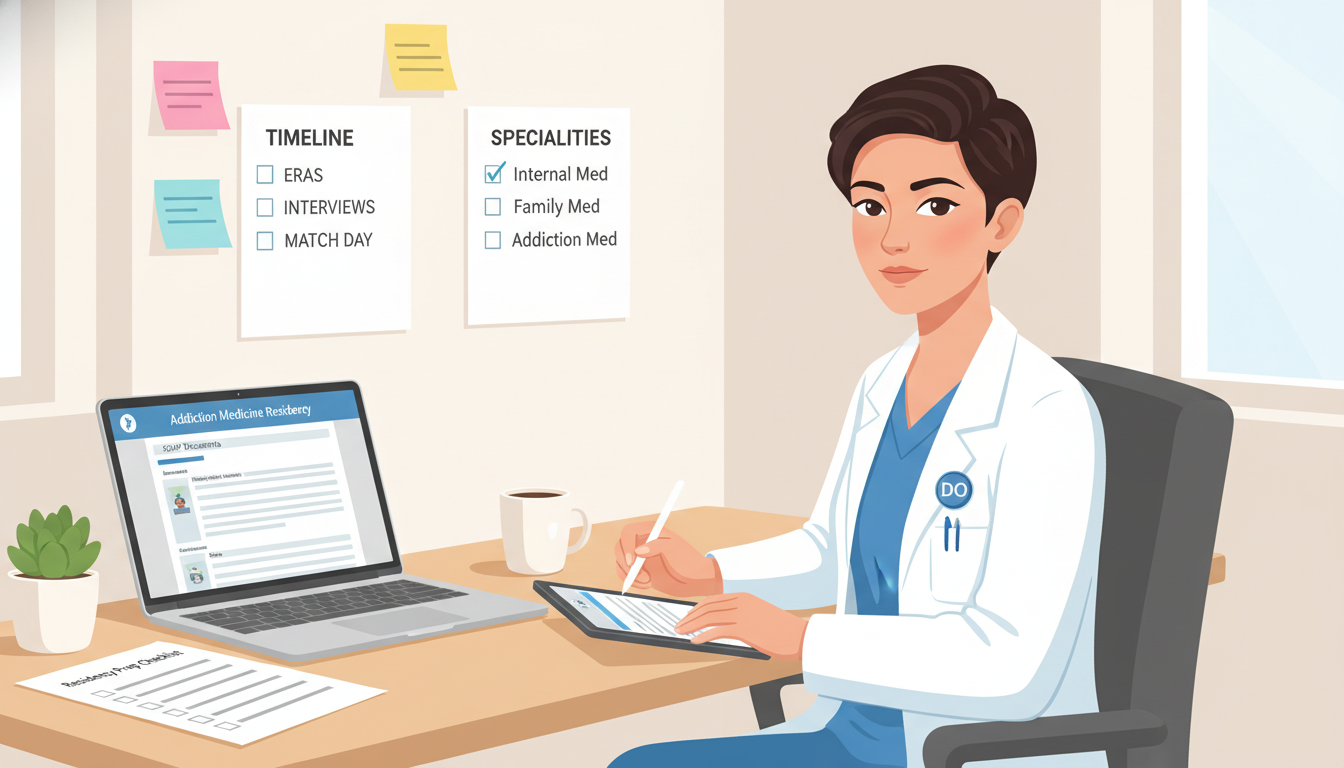
Step 1: Clarify Your Addiction Medicine–Aligned Career Path
You don’t need to abandon your Addiction Medicine goal just because you’re in SOAP. Instead, define which core specialties best align with that future:
Strong pathways to Addiction Medicine fellowship:
- Psychiatry
- Excellent if you want deep training in co-occurring psychiatric and substance use disorders.
- Internal Medicine
- Ideal if you foresee working in hospital settings, integrated primary care, or consult services.
- Family Medicine
- Ideal if you want to focus on lifespan, community, and outpatient management of addiction.
- Emergency Medicine
- Key for acute intoxication, withdrawal, and ED‑based buprenorphine induction programs.
When you see unfilled programs during SOAP, prioritize these specialties as they are recognized feeder paths to an Addiction Medicine fellowship.
Step 2: Assess Your DO-Specific Strengths and Gaps
Conduct a self‑audit:
- COMLEX / USMLE scores:
- Identify score patterns that may limit certain programs (e.g., highly competitive academic centers) and push you to emphasize community or osteopath‑friendly programs during SOAP.
- Clinical experiences:
- Rotations in psychiatry, internal medicine, family medicine, emergency medicine, or addiction/substance use disorder clinics.
- Any sub‑internships, addiction consult services, or exposure in OMT clinics dealing with chronic pain and opioids.
- Research or scholarly work:
- Quality improvement (QI) projects on opioid stewardship, MAT (medication-assisted treatment), or screening (SBIRT).
- Personal attributes:
- Osteopathic principles (mind-body-spirit) fit naturally with Addiction Medicine’s holistic model.
- Communication skills, motivational interviewing exposure, empathy, and nonjudgmental attitude.
Write out a one-page “profile summary” that you will draw from for:
- Personal statement revisions
- Quick email updates to your dean’s office
- Interview responses during SOAP
Step 3: Prepare Updated Application Materials in Advance
You will not have time to write from scratch once SOAP starts. Before Match Week:
Personal Statement Variants
- Create 2–3 specialty-specific versions (e.g., Psychiatry, Family Medicine, Internal Medicine).
- Each should:
- Highlight your long-term interest in Addiction Medicine and substance use disorder care.
- Show how that specific specialty is a logical gateway to your Addiction Medicine fellowship goal.
- Include at least one clinical vignette involving:
- A patient with opioid use disorder
- Alcohol withdrawal
- Co-occurring anxiety/depression and substance use
Updated CV
- Emphasize:
- Addiction-related electives
- Workshops (e.g., buprenorphine waiver training if available during your school years)
- Community outreach (needle exchange, sober living, recovery programs)
- OMT experience, especially if you helped manage chronic pain non-pharmacologically.
- Emphasize:
Letters of Recommendation (LoRs)
- Ideally, have at least one letter that speaks to:
- Your interest in behavioral health or Addiction Medicine.
- Your professionalism and teachability.
- If your primary letters lean toward one specialty (e.g., Psychiatry), you can still use them strategically when applying to adjacent fields (e.g., Family Medicine) during SOAP, but prioritize alignment where possible.
- Ideally, have at least one letter that speaks to:
SOAP-Specific Document Organization Create a folder structure:
/SOAP/Personal_Statements/Psychiatry.docx/SOAP/Personal_Statements/FM.docx/SOAP/Personal_Statements/IM.docx/SOAP/CV/Updated_CV.pdf/SOAP/Notes/Program_Research.xlsx
Having this organized will let you pivot quickly as soon as the List of Unfilled Programs is released.
Step 4: Understand SOAP Residency Rules and SOAP Residency Limits
SOAP has strict rules around:
- Application limits: Often up to 45 total programs you can apply to during SOAP.
- Communication: You must never contact programs unsolicited during SOAP; only respond if they reach out to you.
- Offer acceptance: You cannot hold multiple offers; once you accept one, you’re done.
Study NRMP’s official guidance before Match Week so you are not learning “what is SOAP” in the middle of the process.
Building a Targeted SOAP List for an Addiction Medicine Future
When SOAP opens and the List of Unfilled Programs appears, it can be overwhelming. Your instinct may be to apply everywhere. That’s rarely a good strategy. Instead, aim for a balanced, targeted list.

Step 1: Categorize Programs by Specialty and Addiction Alignment
As you review unfilled positions, create categories:
High Alignment with Addiction Medicine
- Psychiatry (especially with addiction clinics or consult services)
- Family Medicine programs with:
- Integrated behavioral health
- Known MAT programs
- Community-based addiction services
- Internal Medicine programs with:
- Strong inpatient consults for alcohol/opiates
- Pain management or palliative experiences
Moderate Alignment
- Emergency Medicine programs focusing on:
- ED-based addiction pathways (e.g., buprenorphine in ED)
- Combined Medicine-Psychiatry (rare in SOAP but ideal)
- Emergency Medicine programs focusing on:
Fallback Options
- Transitional Year (TY)
- Preliminary Medicine or Surgery
- These can act as bridges, but you will likely need to re-enter the match or seek categorical spots later.
For each program, ask:
“Can this program reasonably prepare me for an Addiction Medicine fellowship or a career focusing heavily on substance use disorders?”
If yes, prioritize it over a less aligned specialty.
Step 2: Evaluate DO Friendliness and Location
As a DO graduate, you should also screen for:
- Previous DO residents:
- Program websites often list alumni; look for DO graduates.
- ACGME-accredited community programs in states known to be DO-friendly (e.g., Michigan, Ohio, Pennsylvania, New Jersey, parts of the South and Midwest).
- Geographic flexibility:
- During SOAP, widen your geographic preferences—it’s more important to secure a position in a specialty that aligns with Addiction Medicine than to stay in a single city.
Step 3: Use Quick‑Research Techniques
Time is limited. For each program you seriously consider, spend 5–10 minutes on:
- Program website:
- Look for:
- Addiction rotation descriptions
- Substance use disorder clinics
- Behavioral health or MAT availability
- Look for:
- Fellowship output:
- Do any graduates go into Addiction Medicine, Psychiatry subspecialties, or related fellowships?
- Vibe and size:
- Community programs may be more flexible and supportive, especially for DO residents.
Capture this in a simple spreadsheet with columns:
- Program name
- Specialty
- Location
- DO-friendly? (Y/N)
- Addiction-relevant training? (Y/N; notes)
- Priority level (High/Med/Low)
This list becomes your SOAP residency game plan within hours of the unfilled list release.
Executing During SOAP Week: Applications, Interviews, and Communication
Once SOAP officially begins, you will be under intense time pressure. Having a clear, stepwise method reduces chaos.
Step 1: Rapidly Tailor Your Application
As soon as you decide which programs to target:
- Assign the appropriate personal statement (Psych, FM, IM, EM, etc.) to each program.
- If you have a generic statement that emphasizes Addiction Medicine and holistic care, use it for less specific programs where you lack a specialty-tailored version, but prioritize the customized ones first.
In each statement, include:
- A clear, concise paragraph that connects:
- Your DO training
- Your interest in addiction and substance abuse training
- Why their specialty is an ideal platform for your goals
Example (Psychiatry-focused):
“As an osteopathic graduate, I have been consistently drawn to the intersection of mind, body, and environment. My clinical experiences caring for patients with opioid use disorder, alcohol withdrawal, and co-occurring anxiety have confirmed that Psychiatry is the field where I can most effectively practice holistic, patient-centered care. I plan to pursue an Addiction Medicine fellowship, and I am seeking a residency that will help me develop the skills necessary to provide comprehensive, evidence-based treatment to individuals with substance use disorders.”
Step 2: Prepare for Fast, Focused SOAP Interviews
Programs may schedule brief virtual or phone interviews with little notice. Prepare SOAP‑specific talking points:
Why this specialty now?
- Keep a concise story that:
- Acknowledges your initial Match plan without sounding bitter.
- Centers on your sustained interest in Addiction Medicine and how this specialty fits.
- Keep a concise story that:
Why our program?
- Reference any addiction-relevant elements you found in your research:
- “I saw that your Family Medicine program partners with a local methadone clinic and has a dedicated MAT curriculum, which aligns directly with my goal to pursue Addiction Medicine fellowship training.”
- Reference any addiction-relevant elements you found in your research:
How will you handle the rigor?
- Emphasize your resilience and adaptability, giving a brief specific example from clinical rotations or your DO training.
Addressing the SOAP situation professionally
- If asked about being in SOAP:
“While I didn’t match initially, SOAP has given me an opportunity to reassess and refine my goals. I’m focused on finding a program where I can grow, contribute from day one, and continue to build toward a career in Addiction Medicine.”
- If asked about being in SOAP:
Step 3: Manage Stress and Decision-Making in Offer Rounds
During SOAP offer rounds:
- Have criteria written out beforehand:
- Specialty relevance to Addiction Medicine (top priority)
- Program type (categorical > TY/prelim, unless you have a clear re-entry plan)
- Geographic factors (secondary)
- Overall program stability and DO-friendliness
If you receive multiple offers:
- Ask:
- “Which of these gets me closest to my long-term goal of practicing Addiction Medicine?”
- Consider:
- A categorical Psychiatry or Family Medicine position is usually preferable over a transitional year, even at a slightly less “prestigious” institution, if your priority is long-term SUD care.
Remember: once you accept, that decision is binding. It is better to accept a solid, Addiction‑aligned categorical offer in the second round than to reject it hoping for something “perfect” that might never come.
After SOAP: Positioning Yourself for Addiction Medicine Fellowship
Whether or not you secure a residency through SOAP, you still need a plan to move toward your Addiction Medicine goals.
If You Match Through SOAP
You’ve secured a position. Now maximize it.
- Early Communication with Program Leadership
- Let your program director or advisor know:
“I have a strong interest in Addiction Medicine and hope to pursue an addiction medicine fellowship after residency. Are there rotations or elective opportunities that focus on substance use disorders or integrated behavioral health that I should plan for early?”
- Let your program director or advisor know:
- Seek Substance Abuse Training Opportunities
- Volunteer for:
- Rotations with addiction consult services
- Outpatient SUD clinics
- MAT programs
- Attend:
- Grand rounds or local conferences on Addiction Medicine.
- Volunteer for:
- Document Your Exposure
- Keep a log of:
- Addiction-related cases
- Quality improvement projects around opioid prescribing, withdrawal protocols, or alcohol detox protocols.
- Keep a log of:
- Pursue Formal Training
- Many residents pursue:
- Buprenorphine training (X‑waiver–style education; note that legal requirements have changed, but training remains valuable).
- CME courses in motivational interviewing and substance use disorder treatment.
- Many residents pursue:
Over three or four years, these experiences will build a solid application for an addiction medicine fellowship.
If You Do Not Secure a SOAP Position
It’s discouraging, but not the end of your path.
Immediate Debrief
- Meet with:
- Your Dean’s office
- A trusted mentor in Psychiatry, FM, IM, or EM
- Ask for honest feedback on:
- Exam scores
- Application alignment
- Geographic limits
- Perceived red flags
- Meet with:
Consider a Gap Year Strategy
- Look for opportunities such as:
- Research assistant or coordinator in Addiction Medicine or SUD-related projects
- Clinical jobs in treatment facilities (e.g., case manager, counselor assistant, or MOUD clinic staff)
- Public health roles in overdose prevention or harm reduction
- During this time:
- Strengthen your application with tangible Addiction Medicine exposure.
- Optionally, retake exams (if eligible) or complete additional clinical experiences.
- Look for opportunities such as:
Prepare for Next Cycle Early
- Rework your personal statement to clearly define:
- Why you are committed to a particular core specialty.
- How that specialty plus your gap-year experiences position you for Addiction Medicine fellowship.
- Apply more broadly:
- Wider geography
- More community/osteopathic-friendly programs.
- Rework your personal statement to clearly define:
Even if your path is delayed by a year, a focused plan can still lead to a solid residency in a field aligned with Addiction Medicine.
Practical Tips and Common Pitfalls for DO Graduates in SOAP
To close the loop on SOAP preparation, here are targeted, practical tips:
High-Yield Tips
- Start SOAP preparation 1–2 months before Match Week.
Don’t wait until you know your match status. - Know your story cold.
Be able to explain:- Why you went into medicine
- Why Addiction Medicine interests you
- Why this core specialty is the right route for you now
- Leverage your osteopathic identity.
- Highlight the alignment between osteopathic philosophy and holistic SUD treatment.
- Coordinate with your school.
- Many DO schools have SOAP support teams that can help you:
- Identify DO-friendly programs
- Review your personal statement in real time
- Practice rapid-fire interview questions
- Many DO schools have SOAP support teams that can help you:
Common Pitfalls to Avoid
- Over‑focusing on prestige over specialty fit.
- For an Addiction Medicine career, the field of residency is usually more critical than the brand name.
- Ignoring program culture.
- Look for programs that emphasize wellness and supportive mentorship—important in addiction work.
- Violating communication rules.
- Do not email or call programs during SOAP unless they contact you first. This can jeopardize your eligibility.
- Applying too narrowly.
- While you should maintain a strategy, do broaden your scope across multiple Addiction‑aligned specialties and geographies.
FAQs: SOAP Preparation for DO Graduates Interested in Addiction Medicine
1. As a DO graduate, do I have a realistic chance to match into a SOAP residency that leads to Addiction Medicine?
Yes. Many DO graduates successfully enter Psychiatry, Family Medicine, Internal Medicine, and Emergency Medicine through SOAP, then pursue Addiction Medicine fellowship training. Your chances improve if you:
- Apply broadly to DO-friendly programs
- Prioritize Addiction‑aligned specialties over prestige
- Present a coherent, consistent story about your interest in substance use disorders
2. Which specialties should I prioritize in SOAP if I want an addiction medicine fellowship later?
The most common and direct feeder specialties are:
- Psychiatry
- Internal Medicine
- Family Medicine
- Emergency Medicine
Psychiatry and Family Medicine are often seen as especially well aligned with outpatient addiction care and integrated behavioral health, while Internal Medicine and Emergency Medicine can lead to strong inpatient and acute care roles in Addiction Medicine.
3. How can I highlight my interest in substance abuse training during SOAP without sounding too narrow?
Frame Addiction Medicine as a core component of your broader interest in the specialty:
- For Psychiatry: Emphasize co-occurring disorders and behavioral health.
- For Family or Internal Medicine: Stress chronic disease management, integrated care, and preventive medicine.
- Express openness to all aspects of residency while clearly stating that you hope to build depth in caring for patients with substance use disorders.
4. If I end up in a Transitional Year or preliminary position through SOAP, can I still reach Addiction Medicine?
It is possible, but the path is more complex:
- A Transitional Year or preliminary Medicine position gives you clinical experience, but you’ll usually need to:
- Re-apply for a categorical position in Psychiatry, Family Medicine, Internal Medicine, or EM in a later cycle.
- Maintain strong performance and secure updated Letters of Recommendation.
- During that time, continue to pursue addiction-related rotations, quality improvement, and scholarly work to demonstrate your commitment to an Addiction Medicine pathway.
With deliberate SOAP preparation, a DO graduate can still chart a strong, realistic course toward a fulfilling career in Addiction Medicine—whether through a successful SOAP residency placement or via a strategic regrouping for the next cycle.