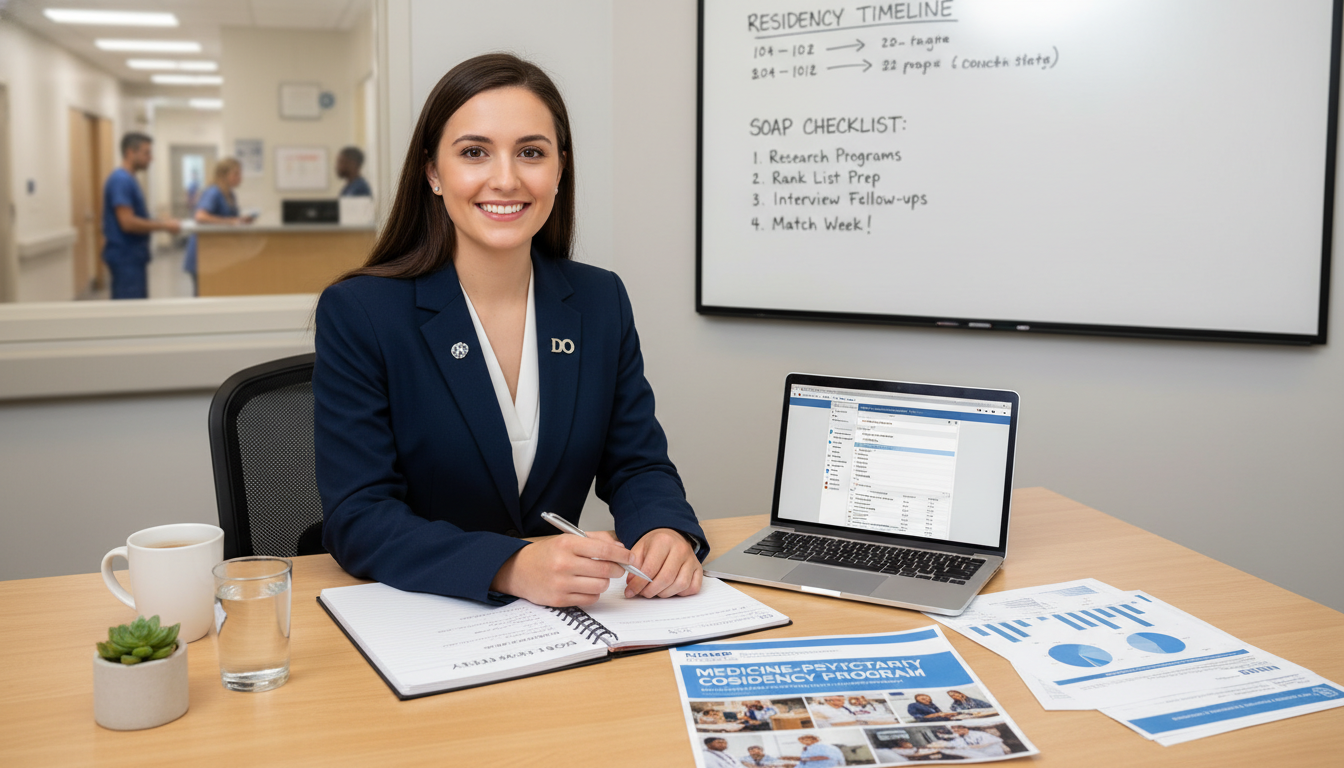
Understanding SOAP as a DO Graduate Targeting Medicine-Psychiatry
The Supplemental Offer and Acceptance Program (SOAP) can feel intimidating, especially if you’re a DO graduate aiming for a competitive combined specialty like Medicine-Psychiatry. Yet, with systematic SOAP preparation, you can turn a stressful week into a structured, opportunity-focused process.
As a DO graduate, you bring a holistic, biopsychosocial foundation that fits naturally with medicine psychiatry combined programs. Your task is to translate that strength into a sharp SOAP strategy—whether for med psych residency directly, categorical internal medicine or psychiatry, or other pathways that keep you aligned with your long-term goal.
This guide walks you through:
- What is SOAP and how it impacts DO graduate residency pathways
- How to prepare for SOAP before Match Week
- Strategy specific to Medicine-Psychiatry and related programs
- How to present your DO training and psych/IM interests convincingly
- Actionable timelines, scripts, and checklists
- Commonly asked questions for DO graduates in SOAP
What Is SOAP and Why It Matters for DO Graduates in Medicine-Psychiatry
The Supplemental Offer and Acceptance Program is the structured process the NRMP uses to fill unfilled positions after the main Match. Only applicants who are eligible and unmatched or partially matched can participate.
Core Elements of SOAP
Eligibility:
- You registered for and are eligible for the Main Residency Match
- You are unmatched or partially matched at the start of Match Week
- You have passed at least one licensing exam (e.g., COMLEX-USA Level 1; many programs also prefer/require Level 2 or USMLE equivalents)
Timeline (high-level):
- Monday of Match Week: You learn if you are matched, unmatched, or partially matched; list of unfilled programs released to eligible applicants.
- Monday–Thursday: You can submit applications to a capped number of programs via ERAS and participate in multiple SOAP offer rounds.
- Thursday: SOAP concludes; unmatched applicants may then contact programs independently.
For a DO graduate residency applicant in Medicine-Psychiatry, SOAP has specific advantages and constraints:
Advantages for DO Graduates
Osteopathic-friendly programs may appear in SOAP
Internal Medicine and Psychiatry both include programs historically open to DO applicants. Some medicine psychiatry combined programs, or their parent IM/psych programs, may have occasional unfilled spots.Your skill set is versatile
The combination of somatic and psychosocial training in DO curricula aligns well with:- Categorical Internal Medicine
- Categorical Psychiatry
- Transitional year or preliminary medicine positions
These can be stepping stones toward med psych residency or a career focused on integrated care.
You can leverage dual interest
A strong narrative of interest in both medicine and psychiatry helps you appeal to:- IM programs with strong psychosocial focus or consult-liaison services
- Psychiatry programs with heavy medical-psychiatry exposure
- Programs interested in integrated behavioral health models
Constraints You Must Plan Around
Application cap during SOAP:
The NRMP limits the number of programs you can apply to during SOAP (check the exact cap for the current year; historically 45). Every program choice matters.Limited time:
You have hours—not weeks—to finalize documents, tailor personal statements, and send applications.Communication rules:
During SOAP, you may not initiate contact with programs; they must contact you. Violating these rules can jeopardize your candidacy.
Because of these limitations, SOAP preparation is critical: your planning happens before Match Week so that execution during SOAP is swift and organized.
Pre-SOAP Foundations: Assessing Your Profile and Setting Realistic Goals
Before thinking about specific SOAP moves, you need a clear-eyed assessment of your strengths, limitations, and realistic target programs.
Step 1: Review Your Application Metrics
Key aspects for a DO graduate aiming at medicine psychiatry combined or related paths:
- Board scores and attempts
- COMLEX Levels 1–3, and/or USMLE Step exams
- Any failures must be addressed briefly and professionally in your narrative.
- Clinical performance
- Core clerkship grades in Internal Medicine and Psychiatry
- Sub-I or audition rotation evaluations in IM, Psych, or med psych
- Research and scholarly work
- Case reports, QI projects, poster presentations, especially in IM, Psychiatry, or integrated care.
- Letters of recommendation
- At least one IM and one Psychiatry letter are ideal for med psych; for SOAP, you may pivot to what best matches the positions you’re targeting.
Step 2: Clarify Your Priority Hierarchy
If the ideal is a Medicine-Psychiatry combined residency, you must predefine your tiered fallback strategy:
Tier 1 – Med Psych Residency
- Unfilled medicine psychiatry combined programs (if any)
- Rare but important to identify quickly
Tier 2 – Categorical Internal Medicine or Psychiatry
- DO-friendly programs with strong:
- CL (consult-liaison) psychiatry
- Primary care with integrated behavioral health
- Addiction medicine or psychosomatic medicine exposure
- DO-friendly programs with strong:
Tier 3 – Transitional Year or Preliminary Positions
- Transitional year (TY) with strong IM or psych rotations
- Preliminary internal medicine positions in academic centers with robust psychiatry departments
Tier 4 – Other Acceptable Programs
- Family medicine with integrated behavioral health
- Community-based programs with high psych comorbidity in patient panels
Knowing your tiers before Match Week allows you to allocate limited SOAP applications strategically, avoiding last-minute indecision.
Step 3: Understand How Programs View DO Graduates in SOAP
Programs may view DO applicants positively, particularly those with:
- Solid COMLEX scores and/or USMLE equivalents
- Strong clinical evaluations, especially in IM and psych
- Evidence of professionalism and resilience
- Clear motivation for medicine psychiatry combined or integrated care
Your task is to make your DO identity an asset:
- Emphasize holistic, biopsychosocial training
- Highlight OMT exposure where relevant (e.g., chronic pain, somatic symptoms)
- Demonstrate comfort in both inpatient medicine and behavioral health discussions

Building a SOAP-Ready Application Packet Before Match Week
Because SOAP moves fast, SOAP preparation means having all modifiable ERAS components ready to tailor at a moment’s notice.
1. Personal Statements: Create a Modular Set
Create at least three personal statement templates in advance:
Medicine-Psychiatry Focused Statement
- Emphasize:
- Sustained interest in both medicine and psychiatry
- Rotations where you managed complex comorbidities (e.g., CHF + depression, COPD + anxiety, cirrhosis + substance use)
- Desire to become a bridge between medical and psychiatric care
- Use this when there are med psych residency spots or IM/psych programs clearly aligned with integrated care.
- Emphasize:
Internal Medicine–Focused Statement with Psych Emphasis
- Emphasize:
- Interest in chronic disease management and complex medical cases
- Comfort managing psychiatric comorbidities on the medical service
- Examples: delirium, somatic symptom disorder, medically unexplained symptoms, chronic pain with mood disorders
- Subtly mention long-term interest in integrated behavioral health without implying you’re only using IM as a stepping stone.
- Emphasize:
Psychiatry-Focused Statement with Medical Emphasis
- Emphasize:
- Work with medically complex psychiatric patients
- Consultation-liaison exposure or interest
- Comfort reading EKGs, managing metabolic side effects, and collaborating with internists
- Show that your medical background enhances your psych practice, not that you’re unsure of your direction.
- Emphasize:
Optional: a Transitional Year/Preliminary Medicine Statement highlighting flexibility and desire for broad clinical exposure while maintaining interest in psychosomatic and integrated care.
Pro tip:
Use a core narrative paragraph about your DO background and holistic approach that remains consistent across statements, then adjust about 40–50% of the content toward IM, psych, or med psych emphasis depending on target.
2. Letters of Recommendation (LoRs)
Before Rank List certification:
- Secure at least:
- 1–2 IM letters
- 1–2 Psychiatry letters
- If possible, a letter from someone who has directly supervised you in a med psych–type setting (e.g., CL psych, integrated primary care, addiction med).
During SOAP:
- You cannot easily obtain new letters, but you can select which letters to assign per application.
- For:
- Med Psych programs: Prefer mix of IM and psych letters.
- IM programs: Lead with IM letters; add psychiatry letter to demonstrate psych insight without overshadowing your IM commitment.
- Psych programs: Lead with psych letters; one IM letter can support your medical competence.
3. CV and ERAS Experiences: Highlight Integrated Care
Review your ERAS entries and ensure they showcase:
- Relevant clinical experiences:
- Rotations in:
- Internal Medicine wards
- ICU, step-down units
- Psychiatry (inpatient, outpatient, CL, ED psych)
- Rotations in:
- Leadership and advocacy:
- Mental health advocacy roles
- Quality improvement projects targeting readmissions related to mental health
- Work in student-run clinics serving populations with high psychiatric comorbidity
- Research and scholarly work:
- Topics that blend medicine and psychiatry:
- Depression in diabetes, adherence in heart failure, substance use in cirrhosis, delirium prevention, etc.
- Topics that blend medicine and psychiatry:
Your goal is to create a cohesive picture: you are a DO graduate whose training naturally supports medicine psychiatry combined work, even if you match into IM or psychiatry alone through SOAP.
4. Licensing Exams and Documentation
Make sure:
- COMLEX (and any USMLE) results are correctly uploaded and verified
- ECFMG status (if applicable) is clear
- Any gaps or leaves are briefly but honestly explained in your ERAS application
Strategic SOAP Execution for Medicine-Psychiatry–Oriented DO Graduates
Once Monday of Match Week hits and you learn you are eligible for SOAP, you’ll pivot from preparation to rapid execution.
Step 1: Interpreting the Unfilled List
When the list of unfilled programs is released:
Identify any Medicine-Psychiatry combined programs
- This is your Tier 1.
- They may be labeled explicitly as combined medicine psychiatry or Med-Psych; check both IM and Psych lists and also filter by “combined” in search tools if available.
Identify DO-friendly Internal Medicine and Psychiatry programs
- Look for:
- Historically DO-inclusive programs (use past data, advisor guidance, or online forums cautiously).
- Community-based IM or Psych programs with strong service needs.
- Academic centers with multiple Med-Psych or CL psychiatrists, even if no combined program.
- Look for:
Identify Transitional Year and Preliminary Internal Medicine programs
- Prioritize those at institutions with:
- Strong psychiatry departments
- Existing Med-Psych faculty or services
- Opportunities for electives in psych or psychosomatic medicine
- Prioritize those at institutions with:
Create a quick spreadsheet or list categorizing programs by:
- Specialty (Med-Psych, IM, Psych, TY/Prelim IM)
- Location and visa policies (if relevant)
- DO-friendliness (based on known data)
- Specific features aligned with your interest in integrated care
Step 2: Allocating Your Limited SOAP Applications
Because you can only apply to a capped number of programs, plan an approximate allocation (adjust based on what’s actually unfilled):
Example distribution for a DO graduate strongly focused on med psych residency:
- 5–10 applications: Medicine-Psychiatry combined (if available)
- 15–20 applications: Categorical Internal Medicine (DO-friendly, with strong psych/CL)
- 15–20 applications: Categorical Psychiatry (DO-friendly, medically-oriented)
- Remaining applications: TY / Preliminary IM at institutions with strong psychiatry
If no med psych programs are available via SOAP:
- Split your applications more evenly between IM and Psychiatry based on your long-term career vision and relative strength of your experiences.
Step 3: Tailoring Personal Statements Rapidly
For each program type:
- Assign the appropriate pre-written personal statement:
- Med-Psych statement for combined programs or clearly integrated-care–focused programs
- IM-focused statement for internal medicine programs
- Psych-focused statement for psychiatry programs
- TY/Prelim statement for transitional/prelim positions
Optional micro-customization (if time permits):
- Reference the program’s:
- Emphasis on integrated care or CL services
- Population served (e.g., high SUD or SMI prevalence)
- Mission statement mentioning holistic/biopsychosocial care
But do not slow down excessively for customization; timely submission to a robust set of realistic targets is more important than perfect individual tailoring.
Step 4: Preparing for SOAP Interviews
During SOAP, programs contact you to schedule short, often virtual, interviews. Prepare in advance:
Core Story: Your “Medicine-Psych DO” Narrative
Have a 60–90 second, clear response ready for:
“Tell me about yourself and your interest in our specialty.”
Structure:
- Background: “I’m a DO graduate from [School], where I gravitated toward complex patients at the interface of medicine and psychiatry…”
- Clinical proof: Highlight specific rotations or patients illustrating integrated care.
- Why this specialty right now: Connect your med psych interest to the specific specialty (IM, Psych, or combined).
- Future goals: Explain how you envision practicing at the intersection of medicine and psychiatry—whether within IM, Psychiatry, or a med psych residency.
Anticipate SOAP-Specific Questions
Common questions:
“Why were you unsuccessful in the Match?”
- Answer briefly and non-defensively:
- Increased competitiveness, late exam score release, narrow focus on combined programs, etc.
- Emphasize what you learned and how you’ve reflected and prepared.
- Answer briefly and non-defensively:
“Why our program, and why now?”
- Have 2–3 concrete features per program type (e.g., strong CL service, integrated care clinics, faculty interests in psychosomatic medicine).
“If you match here in IM/Psych, what are your long-term goals?”
- Show commitment to the specialty; if still interested in integrated care, frame it as focus within the specialty, not as a short-term pit stop.
Maintaining a Med-Psych Career Trajectory If You SOAP into IM or Psychiatry
Many DO graduates with a med psych residency goal ultimately SOAP into categorical IM or Psychiatry and still build integrated careers. Your SOAP outcome doesn’t end your med psych journey.

Pathways from IM or Psychiatry into Integrated Practice
If you SOAP into:
Internal Medicine
- Seek:
- Rotations on CL psychiatry
- Primary care with embedded behavioral health
- Addiction medicine experiences
- Consider future:
- Psychosomatic medicine/CL fellowship (via psychiatry collaboration)
- Addiction medicine fellowship
- Roles in collaborative care models
- Seek:
Psychiatry
- Seek:
- Rotations on medically complex inpatient units
- Strong training in metabolic monitoring and medical comorbidity management
- Joint clinics with internal medicine or family medicine
- Consider future:
- CL psychiatry fellowship
- Integrated primary care psychiatry roles
- Hospital-based psychiatry with heavy medical interface
- Seek:
Transitional Year or Preliminary Internal Medicine
- Use electives strategically:
- CL psychiatry
- Addiction medicine
- Pain management with psychological components
- Network with both IM and Psychiatry faculty to keep doors open for categorical spots or combined opportunities later.
- Use electives strategically:
Your SOAP preparation should acknowledge that multiple acceptable outcomes exist. The key is to protect your long-term med psych identity while committing fully to whichever specialty you join through SOAP.
Practical SOAP Preparation Checklist for DO Graduates in Medicine-Psychiatry
Use this as a timeline-style guide before and during Match Week.
4–8 Weeks Before Rank List Deadline
- Meet with advisors or mentors to review competitiveness for:
- Med-Psych
- IM
- Psychiatry
- Clarify a realistic tiered plan if you go unmatched.
- Request any additional letters that might strengthen IM or Psych applications.
- Draft 3–4 tailored personal statements (Med-Psych, IM, Psych, TY/Prelim).
1–2 Weeks Before Rank List Deadline
- Finalize all personal statement versions in ERAS.
- Ensure LoRs are uploaded and correctly categorized.
- Confirm all exam scores are reported and verified.
- Build a simple spreadsheet template for SOAP target programs (columns for specialty, DO-friendly, integrated care features, website notes).
1–2 Weeks Before Match Week
- Practice concise interview responses explaining:
- Your DO background and holistic training
- Your med psych interest
- Why IM or Psychiatry (or both) are genuinely appealing
- A brief, non-defensive explanation for potential non-match scenarios
- Review NRMP SOAP rules (especially communication restrictions).
- Test your webcam, internet connection, and interview environment.
During Match Week (If SOAP-Eligible)
Monday Morning
- Confirm SOAP eligibility status.
- Access the unfilled program list.
- Immediately filter for:
- Med-Psych programs
- DO-friendly IM and Psychiatry
- TY/Prelim IM positions with strong psych exposure
- Fill spreadsheet with program details.
Monday–Tuesday
- Assign appropriate personal statements to each program type.
- Double-check LoR assignments.
- Submit applications promptly within cap limits.
Tuesday–Thursday
- Respond promptly to any interview invitations.
- Conduct interviews in a quiet, professional environment.
- After each interview, quickly record notes about:
- Program strengths
- Your interest level
- Any concerns
After SOAP Concludes
- If unmatched, meet with advisors to discuss post-SOAP strategy.
- If matched, send brief thank-you notes where appropriate (following NRMP rules).
FAQs: SOAP Preparation for DO Graduates in Medicine-Psychiatry
1. As a DO graduate, should I still apply to med psych residency programs in SOAP, or focus only on IM/Psych?
Apply to any available medicine psychiatry combined programs that are realistic based on your profile—these are your best fit if they appear on the unfilled list. However, med psych spots in SOAP are rare, so you should also apply broadly to categorical IM and Psychiatry programs that align with your integrated-care interests. Building a combined career from IM or Psych is entirely possible, especially for DO graduates with a holistic ethos.
2. How do I explain my interest in medicine psychiatry combined training when I’m interviewing for IM or Psychiatry only?
Frame your interest as a value-add, not a sign of indecision. For IM interviews, emphasize your comfort with psychiatric comorbidities and desire to be an internist who addresses whole-person care, including mental health. For Psychiatry, highlight your ability to manage medical complexity and collaborate with internists. Make it clear that you see yourself building an integrated practice within their specialty, not only as a stepping stone to something else.
3. What is SOAP communication etiquette? Can I email programs to express interest?
NRMP rules strictly limit communication during SOAP. Applicants may not initiate contact with programs during the SOAP window. Programs must reach out to you first. You can, however, communicate with your own advisors, deans, and mentors, who may at times reach out on your behalf if permitted, but they must also follow NRMP policies. Always verify current-year rules on the NRMP website and with your institution before any outreach.
4. If I SOAP into a transitional year or preliminary internal medicine spot, how can I keep my med psych goals alive?
Use that year strategically:
- Choose electives in CL psychiatry, addiction medicine, or pain management.
- Develop relationships with both IM and Psychiatry faculty, especially those involved in integrated care.
- Undertake a small QI or scholarly project at the interface of medicine and mental health.
- Reapply to categorical IM, Psychiatry, or even med psych residency with stronger, more targeted experiences and letters.
Your SOAP outcome is one step in a longer professional path. With deliberate planning and a clear narrative, a DO graduate interested in medicine psychiatry combined training can thrive—whether through SOAP into a med psych residency itself or via IM, Psychiatry, or transitional pathways that still lead to an integrated career.