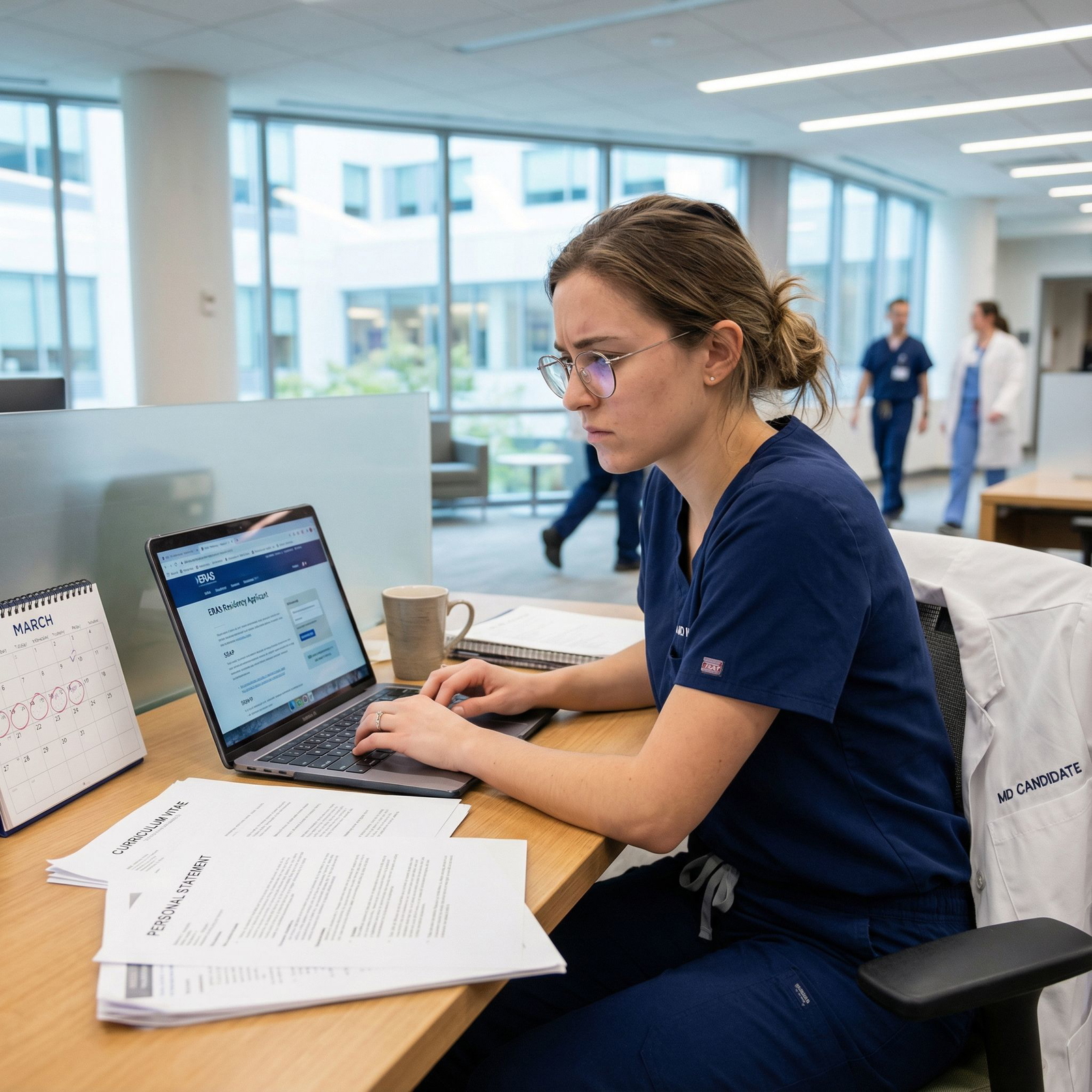
Understanding SOAP for the Caribbean IMG in Emergency Medicine
For a Caribbean IMG who dreams of practicing Emergency Medicine (EM) in the United States, the Supplemental Offer and Acceptance Program (SOAP) can be a critical second chance during Match Week. To use it effectively, you need to understand what SOAP is, how it works, and how it specifically affects your chances of an emergency medicine residency.
What Is SOAP?
SOAP (Supplemental Offer and Acceptance Program) is an NRMP-managed process that helps unmatched or partially matched applicants obtain unfilled residency positions during Match Week. It runs before the Main Residency Match results are fully finalized, and all communication and offers are handled through ERAS and NRMP systems.
Key points:
- You must be ERAS-registered and NRMP-registered.
- You must be SOAP-eligible (unmatched or partially matched after the initial algorithm run).
- You can apply only to unfilled programs listed on the NRMP SOAP list, not to any program you choose.
- All contact with programs must follow strict NRMP rules—no cold-calling, no backdoor emails, no outside offers.
For Caribbean IMGs, particularly those from schools like SGU, AUC, or Ross, SOAP can be an important pathway to both categorical EM positions (rare) and EM-adjacent options such as preliminary medicine or surgery, transitional year, or off-cycle EM-prep positions that strengthen a future EM application.
Why SOAP Matters for Caribbean EM Applicants
Caribbean graduates are often highly motivated and clinically experienced, but they face:
- Visa barriers (if non-US citizen)
- USMLE score filters
- Bias toward US MD/DO applicants in competitive specialties like EM
Even strong candidates may not match initially. However, data from schools like SGU residency match outcomes show that many Caribbean IMGs successfully secure positions via SOAP or strategic reapplication.
For EM:
- Pure EM categorical SOAP spots are usually very limited.
- There may be Emergency Medicine Preliminary or EM-combined spots occasionally.
- Most EM-focused Caribbean IMGs who SOAP end up prioritizing:
- Transitional Year (TY)
- Preliminary Medicine
- Preliminary Surgery (less ideal but sometimes chosen)
- Family Medicine or Internal Medicine with strong ED exposure
Understanding this reality before Match Week is crucial so your SOAP preparation is grounded, flexible, and strategic.
Building a SOAP-Ready Application Before Match Week
SOAP is fast and stressful. The applicants who survive it best are those who have prepared months in advance—even if they are confident they will match. As a Caribbean IMG, you should think of SOAP preparation as an insurance policy.
1. Strengthen Your Core EM Application Early
Even though SOAP is technically a separate process, your baseline application strength still determines whether programs will consider you.
Focus on:
- USMLE Scores
- Step 1 (pass/fail): ensure a clean pass with no attempts.
- Step 2 CK: aim for a competitive score (often 230+), especially crucial as an IMG.
- EM Clinical Experience
- At least one US-based EM rotation with a strong letter.
- Additional rotations in urgent care, internal medicine, or critical care can help.
- Letters of Recommendation
- Aim for 2 EM letters if possible (SLOEs from US EM rotations preferred).
- At least 1 non-EM clinical LOR that emphasizes reliability, communication, and adaptability.
- Personal Statement
- EM-focused, with clear narrative about:
- Why EM
- Evidence you understand EM lifestyle and challenges
- Experiences in high-acuity, diverse patient settings
- EM-focused, with clear narrative about:
Even if you later have to pivot to TY or preliminary medicine in SOAP, a strong baseline EM application signals motivation, resilience, and clinical readiness.
2. Create SOAP-Specific Personal Statement Variants
Do not wait for Match Week to write or adapt new personal statements. Caribbean IMGs often need flexibility to pivot quickly.
Create three versions of your personal statement:
EM-Focused PS (Primary)
- For any rare EM or EM-adjacent SOAP positions.
- Emphasize your commitment to EM, team leadership, rapid decision-making, and ED experiences.
Transitional Year / Preliminary Medicine PS
- Explain that you are EM-oriented but seek a solid broad clinical foundation.
- Highlight:
- Interest in acute care
- Commitment to mastering inpatient medicine and cross-cover
- Desire to build skills that align with emergency care (resuscitation, admissions, cross-discipline management)
Family/Internal Medicine PS (EM-Pathway-Oriented)
- In case you pivot to FM or IM with strong ED exposure or EM tracks:
- Show sincerity about the specialty while referencing your interest in acute care and continuity.
Save all versions in ERAS so during SOAP you can quickly assign appropriate PSs to each program type.
3. Tailor Your CV and ERAS Content for Flexibility
Review your ERAS experiences with SOAP in mind:
- Highlight activities that show:
- Adaptability and resilience (volunteering, relocation, working through adversity)
- Team-based care (interdisciplinary teams, ED teams, trauma codes)
- High-acuity or resource-limited experiences (common in Caribbean and international rotations)
- Make sure your descriptions:
- Emphasize systems thinking and workflow—important in EM and hospital-based specialties.
- Are concise and easy to skim under time pressure (programs review many applications very quickly during SOAP).
You cannot rewrite ERAS entries during SOAP, so pre-season editing is critical.
4. Prepare Your Program List Strategy in Advance
Before Rank Order List certification, create:
- A Plan A: Match directly into EM.
- A Plan B: SOAP into EM-compatible positions (TY, prelim programs).
- A Plan C: If SOAP fails, structured plan to reapply next cycle stronger.
Start a spreadsheet with:
- Transitional year programs where your school historically places graduates.
- Preliminary medicine and surgery programs with prior Caribbean IMG presence.
- Family medicine programs in community hospitals with strong ED exposure.
- Any EM programs that have historically had unfilled spots (rare, but research them).
Even though you won’t know which ones will be unfilled until SOAP begins, this pre-research helps you act fast, understand institutional cultures, and draft targeted outreach plans for post-SOAP networking if needed.
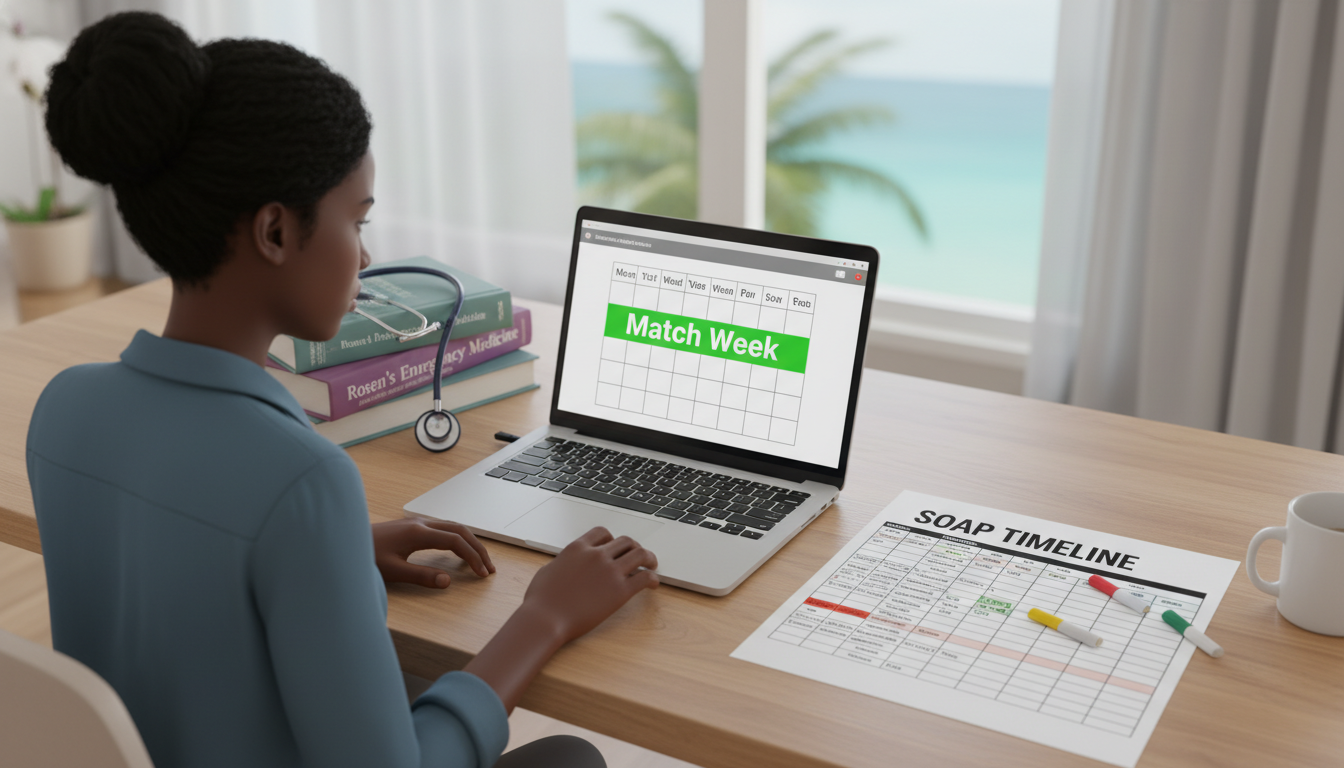
The Timeline: What Happens During Match Week and SOAP
Knowing the exact sequence of events helps you avoid panic and use each hour wisely.
Monday: Unmatched Status and SOAP Eligibility
On Match Week Monday, you receive one of three outcomes:
- Fully Matched
- You are not eligible for SOAP.
- Partially Matched
- Example: Matched to an advanced position (e.g., PGY-2) but not a preliminary year.
- You may be SOAP-eligible for a PGY-1 year.
- Unmatched
- You are SOAP-eligible if you meet NRMP criteria.
If you are unmatched or partially matched:
- You gain access to the List of Unfilled Programs in the NRMP R3 system.
- This list is your main target for Caribbean medical school residency options through SOAP.
Monday–Tuesday: Application Phase
You have a limited time (often from Monday afternoon to Tuesday) to:
- Review unfilled positions list
- Decide on your priority programs
- Assign:
- Personal statements
- LORs
- USMLE transcript
- Other ERAS components
- Submit up to the allowed maximum of SOAP applications (traditionally 45).
For an EM-focused Caribbean IMG, your priorities may be:
- Any EM categorical or EM-combined program (if present).
- Transitional Year programs at academic or busy community hospitals with ED exposure.
- Preliminary Medicine programs at institutions with strong ED and ICU experiences.
- Preliminary Surgery programs that provide procedural skills and work ethic training (but be mindful if surgery is not your long-term plan).
- Family/Internal Medicine with clear ED exposure or EM tracks.
Wednesday–Thursday: Interview and Offer Rounds
During SOAP, programs contact you, not the other way around.
- Programs may:
- Request quick virtual interviews (often short and focused).
- Ask targeted questions via message or brief call (still strictly controlled by SOAP rules).
- There are several offer rounds:
- You may receive offers in a specific round.
- You must accept or reject in a short time frame.
- Once you accept a SOAP position, you are bound to it (similar to the Main Match).
You must be reachable and responsive:
- Keep phone and email monitored at all times.
- Avoid scheduling conflicts; this week is fully dedicated to SOAP.
Strategic SOAP Preparation for EM-Focused Caribbean IMGs
Emergency Medicine is competitive, and the EM match (EM match) has shown increasing preference for US MD/DO graduates. Caribbean IMGs need a realistic but optimistic strategy.
1. Prioritizing EM-Adjacent Positions
While you may desire only categorical EM, in SOAP you must consider stepping-stone positions that can lead to EM in the future:
- Transitional Year (TY)
- Broad exposure to multiple specialties.
- Often lighter call schedules compared to prelim surgery; good for studying and networking.
- Helpful if you plan to reapply to EM stronger next cycle.
- Preliminary Internal Medicine
- Strong inpatient foundation.
- High exposure to acute care, critical care, and cross-disciplinary cases.
- Common route for EM reapplicants.
- Preliminary Surgery
- Intense work, high procedural volume.
- Demonstrates stamina, resilience, and technical skills valuable in EM.
- Best if you truly can handle surgical workload and still plan to reapply.
- Family Medicine with Strong ED Exposure
- Some community FM programs allow extensive ED moonlighting or rotations.
- For those open to dual interests: FM plus urgent care or community EM later.
Have clearly ranked personal priorities before SOAP starts, so you can react quickly when offers appear.
2. Tailoring Your SOAP Narrative for Non-EM Programs
If you are EM-driven but applying to non-EM programs in SOAP, you must still sound genuinely interested in what they offer.
In your SOAP communications and interviews:
- Acknowledge your EM interest honestly but respectfully:
- “My long-term goal is to practice in high-acuity, front-line care. I see a strong Preliminary Medicine year here as the best way to build the core inpatient and critical care skills necessary to be excellent in that environment.”
- Emphasize:
- Willingness to integrate fully as a team member.
- Respect for the specialty (IM, FM, surgery, TY) as essential to patient care.
- Commitment to completing the year with professionalism, not treating it as a placeholder.
Programs are wary of applicants who appear to be using them only as a temporary “parking spot.” Show that you will add value during your time there.
3. Leveraging Your Caribbean Background as a Strength
Many Caribbean medical school residency candidates have unique experiences:
- Exposure to resource-limited settings
- Diverse patient populations
- Adaptation to new countries and healthcare systems
Use this to your advantage during SOAP:
- Highlight how these experiences prepare you for:
- Unpredictable ED environments
- High cultural and linguistic diversity
- Problem-solving when resources are limited
- Talk specifically about:
- Cases you saw in the Caribbean that sharpened your diagnostic skills.
- Times you led or contributed meaningfully to acute care situations.
Programs often appreciate resilience and adaptability—the hallmarks of Caribbean IMGs who succeed.

Practical SOAP Interview and Communication Tips
Even in SOAP, you may be interviewed by multiple programs on short notice. Preparation matters.
1. Master the Core Questions
Prepare polished, concise answers to:
- “Tell me about yourself.”
- 1–2 minutes max.
- Focus on medical path, EM interest, and key strengths.
- “Why this program/this specialty?”
- Show you’ve done prior research.
- Link program strengths to your goals (e.g., high ED volume, strong IM training, robust simulation).
- “Why did you go unmatched?”
- Be honest, reflective, and non-defensive.
- Examples:
- Scores that were slightly below EM cutoffs.
- Late EM decision limiting number of EM rotations.
- Overly narrow program list.
- Always pair this with what you have learned and how you have improved.
- “How will you handle a heavy workload?”
- Use examples from difficult rotations, night shifts, or multiple responsibilities in med school.
2. Addressing the Unmatched Status as a Caribbean IMG
As a Caribbean graduate, you may face direct or indirect questions about your path and why you did not match initially.
Key principles:
- Take ownership, not blame.
- “In retrospect, I applied very EM-heavy and did not diversify enough into preliminary or other specialties. I now see the importance of strategic breadth, and I’m committed to making the most of this opportunity to grow as a clinician.”
- Show trajectory:
- Mention recent exam scores, improved clinical evaluations, or new research.
- Show that you are on an upward trend.
- Avoid sounding bitter or defeated:
- Programs want learners who are resilient in setbacks.
3. SOAP Communication Etiquette
Remember the rules:
- You cannot initiate contact with programs for SOAP positions unless they reach out first.
- Be professional and punctual:
- Reply to any program message within minutes to an hour if possible.
- Confirm interview times clearly.
- For interviews:
- Dress professionally (business formal).
- Check your tech (internet, sound, camera) ahead of time.
- Find a neutral, quiet background.
Post-SOAP: Planning Next Steps Regardless of Outcome
Whether you secure a position through SOAP or not, planning your next steps with intention is essential.
If You Match Through SOAP
Congratulations—you will begin residency, perhaps not in EM directly but on a path that can still lead there.
To keep EM in your future:
- Seek rotations with strong acute care exposure:
- ICU
- ED electives
- Night float teams
- Network with EM faculty and residents at your institution.
- Develop a plan with mentors to:
- Reapply to EM during or after PGY-1 (if that is your goal).
- Build an EM-focused CV (conferences, case reports, quality improvement projects in acute care).
If You Do Not Obtain a SOAP Position
This is emotionally difficult, but many Caribbean IMGs recover and succeed the following cycle.
Immediately after SOAP:
- Request feedback from trusted mentors, advisors, or deans (especially at Caribbean schools with formal advising structures).
- Analyze your:
- USMLE performance
- Portfolio of clinical experiences
- EM vs. non-EM program choice strategies
- Create a gap-year improvement plan, which may include:
- US-based clinical experience (observerships, research fellowships, paid clinical roles where allowed)
- Retaking Step 2 or taking Step 3 (where strategic and advisable)
- Building a more diverse application portfolio (EM + IM/FM/TY)
Use data from your school’s historical match outcomes (e.g., prior SGU residency match patterns if you’re from SGU) to understand realistic targets and improve your approach.
FAQ: SOAP Preparation for Caribbean IMG in Emergency Medicine
1. As a Caribbean IMG who wants EM, should I only apply to EM programs in SOAP?
No. Pure emergency medicine residency spots are rare in SOAP, and competition is high. While you should absolutely apply to any EM or EM-adjacent positions that appear, you should also:
- Prioritize Transitional Year and Preliminary Medicine programs.
- Consider Family or Internal Medicine programs at institutions with strong ED exposure.
- Have a clear ranking of acceptable alternatives before SOAP starts.
This preserves your long-term EM aspirations while maximizing your chance of starting residency.
2. What is SOAP, and how is it different from scrambling?
SOAP is a structured, rules-based system created by NRMP to replace the old “scramble,” which used to be a chaotic rush for unfilled positions. During SOAP:
- Applicants can only apply through ERAS to programs listed as participating in SOAP.
- Programs and applicants follow strict contact rules.
- Offers occur in multiple timed rounds within NRMP software.
Understanding what is SOAP and its rules helps you avoid violations that could jeopardize your chances.
3. How can I best prepare for SOAP interviews as a Caribbean IMG?
Focus on:
- Practicing clear, concise answers to:
- Why EM?
- Why this specialty/program (TY, prelim, IM/FM, etc.)?
- Why did you go unmatched, and what have you learned?
- Framing your Caribbean training as a strength:
- Resilience, adaptability, broad exposure.
- Demonstrating professionalism and gratitude:
- Programs want to know you will be a reliable, hardworking resident who will fully commit to their team.
Doing mock SOAP interviews with advisors or recent graduates is especially helpful.
4. If I’m an SGU or other Caribbean graduate, does my school’s match history help me in SOAP?
Indirectly, yes. Reviewing your school’s Caribbean medical school residency statistics (e.g., SGU residency match lists) helps you:
- Identify which programs are historically open to Caribbean IMGs.
- See which specialties and program types (TY, prelim, FM, IM) frequently accept graduates from your school.
- Guide your SOAP target list to institutions where your school’s name is already familiar and trusted.
However, during SOAP, each program still evaluates you individually, so your personal performance and preparation remain crucial.
Thoughtful, early SOAP preparation can transform Match Week from a crisis into an opportunity. As a Caribbean IMG focused on Emergency Medicine, your path might be more complex, but with a realistic plan, flexible strategy, and strong execution, you can still move steadily toward the front lines of acute care.