Understanding SOAP for the Neurology-Interested IMG
The Supplemental Offer and Acceptance Program (SOAP) can feel like a blur: tight timelines, rapid decisions, and high stakes. For an international medical graduate (IMG) pursuing neurology residency, it can be both a second chance and a unique pathway to a neuro match—if you prepare strategically.
This IMG residency guide will walk you through SOAP preparation step by step, with a neurology-specific focus. You’ll learn what SOAP is, how it works, what neurology-relevant options you might realistically have, and how to maximize your chances before, during, and immediately after SOAP week.
What Is SOAP? A Clear, Practical Definition
SOAP is a structured, time-limited process run by NRMP during Match Week to help unmatched or partially matched applicants obtain unfilled residency positions. It is not a separate match; it is an organized, rules-based recruitment phase before the public release of the List of Unfilled Programs.
In simple terms:
- Who: Eligible unmatched or partially matched applicants (including IMGs).
- When: Match Week (usually Monday–Thursday before Match Day).
- Why: To fill unfilled positions and give applicants another opportunity.
- How: Via ERAS applications to a limited number of programs, followed by brief interviews and several “offer rounds.”
For IMGs targeting neurology residency, SOAP often means:
- Neurology categorical or advanced positions are rare in SOAP.
- Preliminary medicine, transitional year (TY), or categorical internal medicine positions are more common.
- These can still keep you aligned with a neurology path—if you plan smartly.
Pre-SOAP Foundations: Maximizing Your Neurology Profile Before Match Week
Your SOAP preparation starts months before Match Week. The stronger your application and the more neurology-focused your story, the more competitive you’ll be—whether for a neurology spot (if available) or neurology-relevant alternatives.
1. Build a Neurology-Centered Narrative
SOAP goes fast. Programs will glance at your ERAS and ask, “Does this applicant make sense here?” You want the answer to be a clear “yes,” especially for neuro, medicine, or TY programs.
Key components of your neurology narrative:
Personal statement (PS):
- Have two versions ready before Match Week:
- A neurology-focused PS.
- A broader internal medicine / TY PS that still highlights your neurology interest but fits non-neuro programs.
- Emphasize:
- Specific neurology clinical experiences (stroke, epilepsy, neuro ICU, outpatient clinics).
- Neurology mentors or role models.
- Any neurology research, quality improvement, or case reports.
- Have two versions ready before Match Week:
CV and ERAS experiences:
- Highlight:
- Neurology electives, observerships, or sub-internships in the US.
- Neurology research (even small projects, posters, or local presentations).
- Stroke teams, EEG reading exposure, neuroimaging experiences.
- Organize neurology-related experiences near the top of your CV and ERAS “Experiences” section.
- Highlight:
Letters of Recommendation (LoRs):
- Aim for at least:
- 2 neurology letters, ideally from US-based neurologists.
- 1 medicine or TY letter that emphasizes your inpatient performance.
- If you lack neurology letters, prioritize getting at least one strong letter from a neurologist before the match.
- Aim for at least:
2. Strengthen Your Academic and Exam Profile
Programs screening during SOAP will still look at your metrics quickly.
USMLE / COMLEX scores:
- Step 1 is now pass/fail, but Step 2 CK is heavily weighted, especially for IMGs.
- If your Step 2 CK is weaker:
- Emphasize clinical strengths, strong US mentor comments, and consistent improvement.
- Avoid drawing attention to the score in your PS; let your performance story speak through experiences and letters.
Gaps and red flags:
- Prepare a concise explanation for:
- Gaps in training.
- Failed attempts.
- Extended graduation time.
- Use a positive, forward-looking frame: what you learned, how you improved, and why it won’t recur in residency.
- Prepare a concise explanation for:
3. Understand Your Realistic Neurology-Related Options in SOAP
While some years have a handful of unfilled neurology residency positions, many do not. As an IMG, you must be ready for several realistic neurology-adjacent pathways:
- Neurology categorical / advanced positions (ideal but rare)
- Transitional Year (TY) programs
- Preliminary Medicine positions
- Categorical Internal Medicine programs with strong neurology exposure or affiliations with neurology departments.
In SOAP, emphasize programs that:
- Are in hospitals with neurology residencies or strong neurology departments.
- Offer robust neurology rotations (stroke, neuro ICU, general neurology).
- Have a track record of graduates matching into neurology.
Your mindset: “I am building a bridge to neurology, even if the first year is not labeled neurology.”
Strategic SOAP Preparation: Systems, Documents, and Lists
When Match Week arrives, there is no time to “start” preparing. You need ready-to-deploy documents, lists, and systems.
1. Document Preparation: SOAP-Ready Versions
Have these elements finalized and uploaded to ERAS before Monday of Match Week:
a. Multiple Personal Statements
Create at least three PS variants:
Neurology-specific PS
- Use for any neurology or neuro-preliminary positions.
- Highlight:
- Your long-term goal to become a neurologist.
- Concrete neurology experiences.
- Your fit for clinical neurology: attention to detail, patience, curiosity, communication with cognitively impaired patients.
Internal Medicine–focused PS with neurology angle
- Use for categorical medicine or preliminary medicine positions.
- Emphasize:
- Strong interest in complex inpatient medicine, stroke, and neuro-vascular care.
- Team-based care, cross-disciplinary communication.
- Desire to build a strong medicine foundation for future neurology subspecialty training.
Transitional Year (TY) PS
- Use for TY programs, where flexibility and broad training are valued.
- Emphasize:
- Adaptability to different specialties.
- Interest in building general clinical and procedural skills.
- Clear goal: use the TY year to prepare for eventual neurology residency.
b. Tailored CV Emphasis (Within ERAS Limits)
While you can’t upload different CVs, you can:
- Arrange experiences to highlight:
- Inpatient rotations and acute care.
- Neurology and internal medicine connections.
- Ensure accurate, concise descriptions that are easy to skim.
c. Letters of Recommendation
You cannot upload new LoRs during SOAP, but you can decide which ones to assign:
- For neurology programs:
- Prioritize neurology LoRs first.
- For medicine or TY:
- Combine a strong medicine LoR with a neurology LoR to underscore both competence and direction.
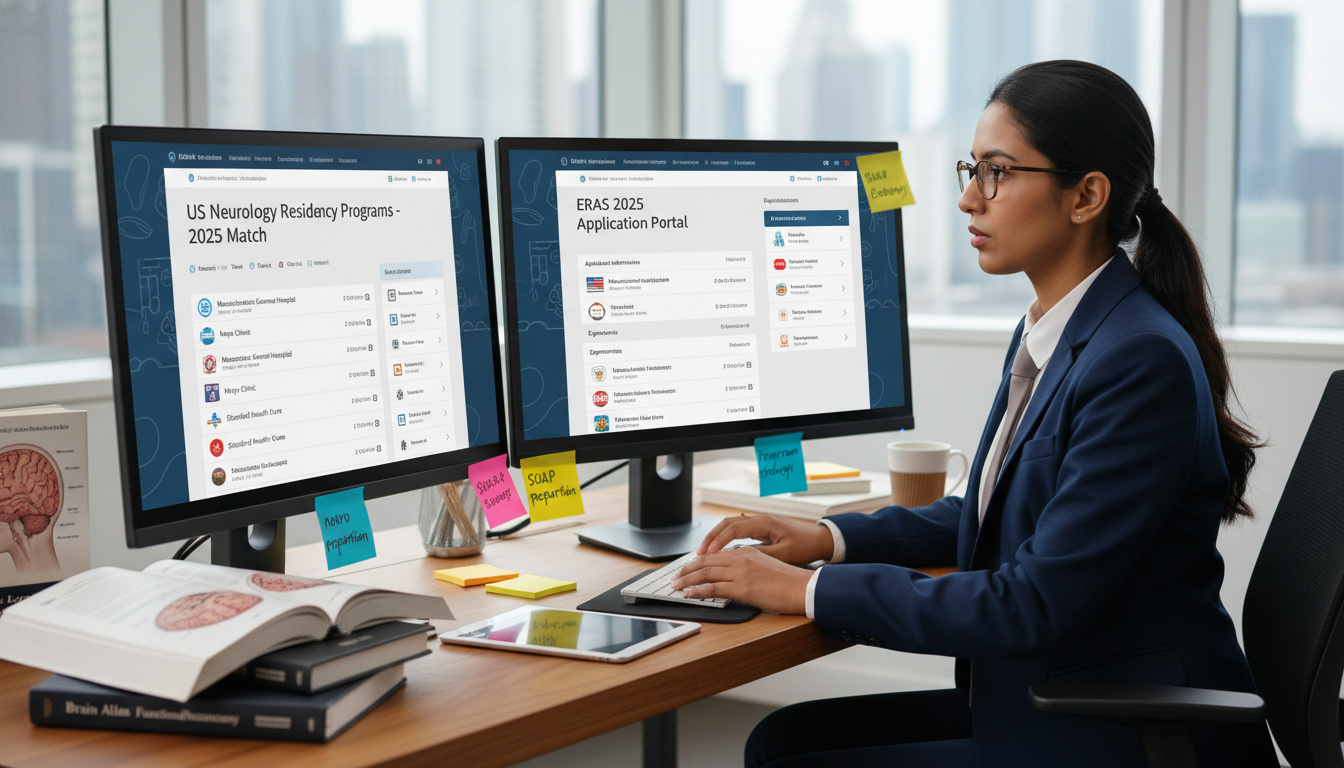
2. Research and Build a Targeted Program List
You only get a limited number of ERAS applications during SOAP (commonly 45 total; verify the current NRMP rules each season). Your program list must be strategic, realistic, and neurology-conscious.
a. Use Historical Data
Before Match Week:
- Review prior years’ NRMP data:
- Which specialties commonly have unfilled positions?
- Historically, neurology has relatively few unfilled spots, while preliminary medicine, TY, and family medicine tend to have more.
- Look at neurology programs that:
- Have newer or expanding classes.
- Are in less competitive geographical locations.
- Have previously taken IMGs.
b. Categorize Prospective Programs
Create a spreadsheet with:
- Column A: Program name and ACGME ID
- Column B: Specialty (Neuro / IM / Prelim / TY)
- Column C: IMG-friendliness (previous IMG residents, visa support)
- Column D: Neurology exposure (neuro ICU, stroke center, outpatient neuro)
- Column E: Your interest level (High/Medium/Low)
- Column F: Notes (faculty research, alumni, location factors, etc.)
During SOAP, this list will help you rapidly identify good fits and avoid wasting applications on unrealistic targets.
3. Plan Communication and Technology
SOAP is highly time-sensitive. Ensure:
Updated contact information in ERAS:
- US phone number that you can reliably answer.
- Professional voicemail greeting.
- Stable email address you check frequently.
Technology check:
- Laptop with a functional camera and microphone.
- Stable internet for video interviews.
- Headphones for clear audio and privacy.
Quiet interview space:
- Neutral background.
- Good lighting.
- Minimize interruptions.
Inside SOAP Week: Step-by-Step Execution for IMGs in Neurology
During Match Week, your SOAP preparation is tested. Here is how to navigate each phase with a neurology-focused strategy.
1. Monday Morning: Unmatched Status and Eligibility
On Monday, you learn if you are:
- Fully matched
- Partially matched (e.g., advanced but no prelim, or vice versa)
- Unmatched
If you are unmatched or partially matched and meet SOAP eligibility criteria, you gain access to:
- The List of Unfilled Programs
- The ERAS SOAP application functionality
2. Reviewing the List of Unfilled Programs
Once you see the unfilled list:
Filter by Specialty:
- Look for Neurology first.
- Then Internal Medicine, Transitional Year, and Preliminary Medicine.
Identify Neurology-Linked Programs:
- Hospitals that host a neurology residency.
- Institutions recognized for stroke centers or neuro services.
- Programs mentioning neurology rotations or neurology faculty within their description.
Check Program Details Quickly:
- Visa sponsorship (critical for IMGs).
- IMG friendliness if discernible.
- Geographic location (be flexible if you truly want a neuro match in the long term).
3. Allocating Your Applications: A Balanced, Realistic Strategy
You must decide how to split your limited number of SOAP applications in a way that gives you both a chance at neurology and a safety net.
A sample strategy for an IMG strongly committed to neurology might look like:
- 10–15 applications to any unfilled neurology programs (categorical or advanced), even if they seem competitive.
- 20–25 applications to preliminary medicine and TY programs in hospitals with neurology services.
- 5–10 applications to categorical internal medicine programs with strong neurology presence or known IMGs.
Adjust numbers based on the actual availability that year. The principle: maximize opportunities in neurology-linked environments while not over-concentrating on highly unlikely options.
4. Tailoring Applications Within ERAS
For each program group:
Neurology programs:
- Assign neurology PS.
- Assign neurology LoRs + strongest other LoR.
Preliminary Medicine / Internal Medicine:
- Assign medicine or hybrid PS emphasizing neurology interest.
- Include at least one neurology LoR to signal your long-term direction.
Transitional Year:
- Assign TY-specific PS.
- Choose LoRs that show versatility and good team functioning, ideally including one neurology or inpatient-heavy letter.

SOAP Interviews and Offers: Performing Under Pressure
Programs may begin contacting you as soon as they review your application. In SOAP, interviews are often short and focused.
1. Common Neurology- and Medicine-Relevant Interview Themes
Be ready with structured answers for:
“Tell me about yourself.”
- 60–90 seconds.
- Brief background, medical education, key neurology or inpatient experiences, and your goal to become a neurologist.
“Why neurology?” / “Why internal medicine as a path to neurology?”
- Highlight:
- Fascination with brain–behavior relationships.
- Rewarding experiences caring for stroke, epilepsy, or dementia patients.
- Dedication to long-term neurological care and interdisciplinary teamwork.
- Highlight:
“Why our program?”
- Reference:
- Neurology services, stroke center designation, neuro-ICU, or neurology faculty.
- Curriculum aspects (ward structure, night float, continuity clinics).
- Your readiness to serve their specific patient population.
- Reference:
“What are your strengths and weaknesses?”
- Tie strengths to neurology-relevant competencies: patience with complex histories, pattern recognition, clear explanations to families.
- Weakness framed with improvement: e.g., initial difficulty with documentation speed and how you improved via structured templates.
Red-flag explanations:
- Failed exams, gaps, or career changes.
- Use concise, honest accounts with emphasis on growth and current readiness.
2. Expressing Realistic Commitment
Especially for non-neurology specialties (TY or IM):
- Make it respectful and clear:
- “My long-term goal is neurology, but I fully understand and value the work in internal medicine / transitional year. If I train with you, I will commit 100% to your program, your patients, and your team. I see this as essential preparation to become the best possible neurologist.”
Programs want to know:
- You will not check out after a few months.
- You understand and respect their core specialty.
- You will be a reliable, teachable resident.
3. Handling Multiple Programs and Offers
NRMP SOAP has several offer rounds, each with a short time window (often 2 hours) to accept or reject offers.
Key principles:
Rank your preferences beforehand:
- On your spreadsheet, add a clear priority ranking.
- Consider: specialty, neurology alignment, location, visa support, program reputation, and your gut feeling.
If you receive an offer:
- Compare to your pre-made ranking.
- If it is from your top tier, it is typically wise to accept.
- Remember: accepting an offer in SOAP is binding and removes you from further participation.
If you decline:
- Understand you may not receive another offer.
- Only decline if you’re confident that you have better, realistic chances with remaining programs.
After SOAP: Long-Term Neurology Strategy for IMGs
Whether you match in SOAP or remain unmatched afterward, your neurology journey continues.
1. If You Match into Neurology (Categorical or Advanced)
- Start preparing early:
- Review fundamental neurology textbooks (e.g., Adams and Victor’s, Bradley’s Neurology in Clinical Practice).
- Focus on stroke protocols, seizure management, neurological exam, and localization.
- Connect with:
- Future co-residents.
- Program leadership.
- Research mentors in neuro subfields of interest.
2. If You Match into Preliminary Medicine or TY
This is still a powerful bridge to a neuro match:
During your prelim / TY year:
- Seek neurology electives and inpatient neurology consult months.
- Get fresh neurology LoRs from US neurologists.
- Participate in neurology or stroke-related quality improvement or research.
Re-apply to neurology:
- Use your US clinical performance to strengthen your application.
- Update your PS with concrete examples from your prelim/TY year that show readiness for neurology.
- Use program directors or chiefs as advocates when appropriate.
3. If You Do Not Match After SOAP
This is difficult, but far from the end of the road for an international medical graduate.
Action steps:
Debrief your application:
- Seek feedback from:
- Mentors.
- Neurology faculty who know you.
- Residency advisors familiar with IMG challenges.
- Seek feedback from:
Enhance your neurology profile:
- Additional US clinical experience (observerships, externships).
- Neurology research positions or clinical research coordinator roles.
- Publications or presentations (even case reports).
Re-strategize for next cycle:
- More targeted neuro match strategy:
- Apply broadly to neurology.
- Apply to neurology-linked medicine programs willing to consider future neuro applicants.
- Improve exam scores if eligible (e.g., retaking Step 2 for a higher score if permitted, or adding Step 3 where strategically beneficial for visas and program comfort).
- More targeted neuro match strategy:
Your overarching goal: move each year closer to being an obvious, low-risk, high-value candidate for a neurology residency.
FAQs: SOAP Preparation for IMGs in Neurology
1. As an IMG, how realistic is it to get a neurology residency through SOAP?
It is possible but uncommon, because neurology often fills most positions in the Main Match. Some cycles have a few unfilled neurology spots, sometimes more in less competitive regions or newer programs. The most realistic outcomes for IMGs in SOAP are:
- A rare neurology position (if available and if your profile is strong).
- A preliminary medicine, transitional year, or categorical IM spot in a hospital with robust neurology services.
Use SOAP to maximize your foothold in a neurology-rich environment, even if your first year isn’t labeled “neurology residency.”
2. What is SOAP, and how is it different from the regular match?
SOAP (Supplemental Offer and Acceptance Program) is a post–Rank Order List, pre–Match Day mechanism used to fill unfilled positions:
- You do not submit a rank list in SOAP.
- You send a limited number of ERAS applications to unfilled programs.
- Programs then contact candidates, conduct brief interviews, and submit preference lists.
- Offers are extended in several rounds during Match Week, and accepting an offer is binding.
In contrast, the Main Match uses rank lists from both applicants and programs, with a single algorithmic matching outcome.
3. How should I prioritize programs during SOAP if my goal is neurology?
Prioritize in this approximate order:
- Unfilled neurology positions (categorical or advanced), especially with IMG-friendliness and visa support.
- Preliminary medicine or TY programs in hospitals with neurology residencies or strong neuro departments.
- Categorical internal medicine programs that:
- Have close integration with neurology services.
- Show a history of graduates moving into neurology fellowships or advanced training.
Within each tier, factor in visa sponsorship, geography, and your personal circumstances. Use your spreadsheet to assign a clear rank to each target program before offers start.
4. What can I do now, months before Match Week, to improve my SOAP readiness for neurology?
Key steps:
- Secure and upload strong neurology and medicine LoRs.
- Prepare at least three targeted personal statements (neuro, IM, TY).
- Arrange your ERAS experiences to highlight neurology and inpatient strengths.
- Build a program target list with neurology, prelim IM, and TY options in neurology-rich institutions.
- Ensure you have a reliable communication setup (phone, email, technology) and a quiet interview space.
- Discuss strategy early with mentors who understand IMGs and the neurology residency landscape.
By preparing early and thinking of SOAP as part of a long-term neuro match strategy, you increase your chances of turning Match Week into a step forward—even if it’s not the exact path you initially imagined.