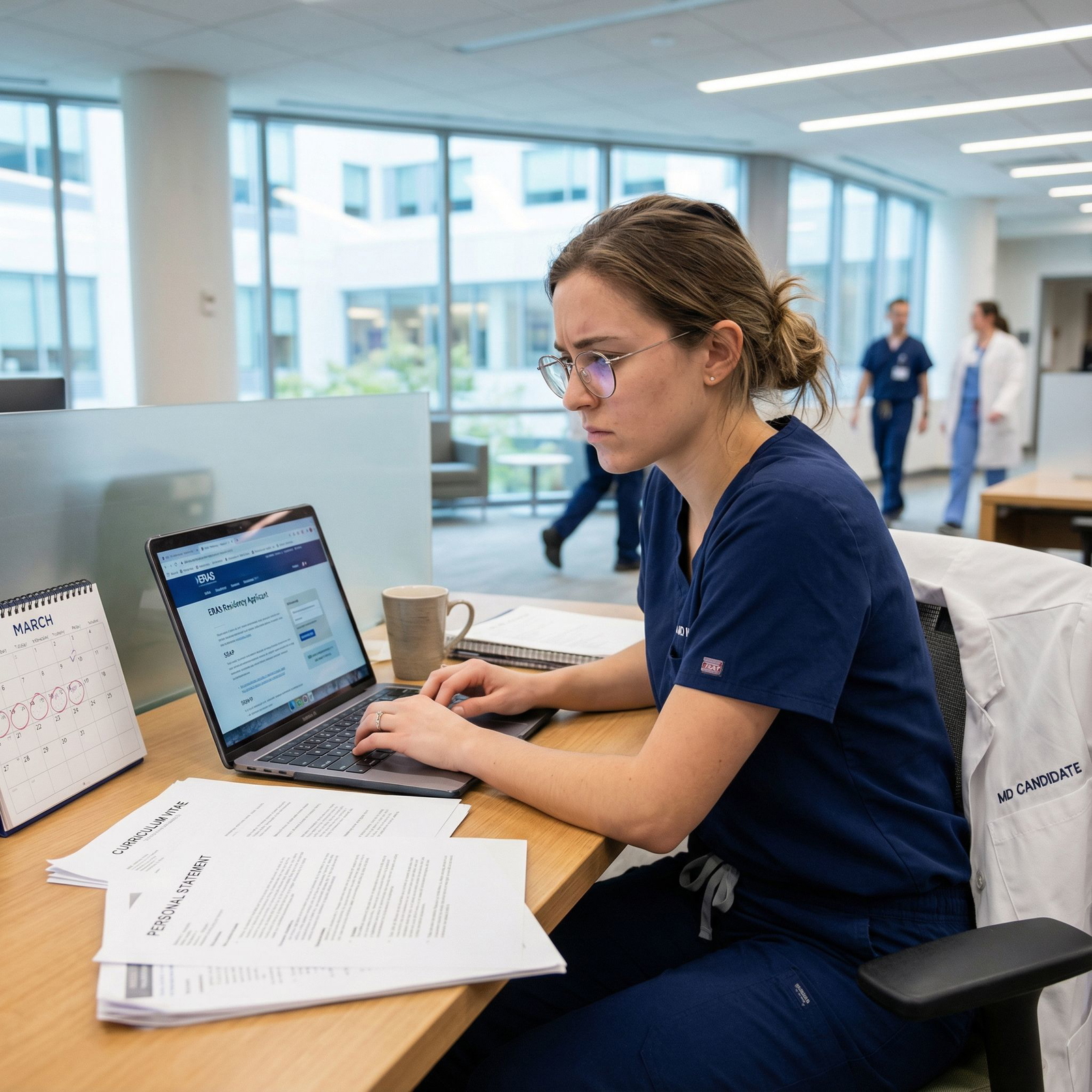
Understanding SOAP and Its Role in the Anesthesiology Match for IMGs
The Supplemental Offer and Acceptance Program (SOAP) can be a second chance—or a final safety net—in the residency match process. For an international medical graduate (IMG) applying to anesthesiology, SOAP preparation is not optional; it is a strategic requirement.
In this IMG residency guide, we will walk step-by-step through what SOAP is, how it works, and how you, as an international medical graduate targeting anesthesiology, can prepare in advance—well before Match Week—to maximize your chances of securing a position, whether in anesthesia or a related field.
What Is SOAP?
SOAP (Supplemental Offer and Acceptance Program) is the structured process the NRMP uses during Match Week to fill unfilled residency positions with unmatched or partially matched applicants.
Key points:
- Who participates?
- Applicants who are eligible for SOAP (unmatched or partially matched and registered for the Main Match).
- Programs with unfilled positions after the main match algorithm runs.
- Where does it happen?
- Entirely through ERAS and NRMP—no direct cold-calling or emailing programs about open positions is allowed once SOAP begins.
- Timing:
- SOAP occurs during Match Week, typically Monday–Thursday.
- Rounds of offers:
- Offers go out in multiple rounds; you may receive, accept, or reject offers in short time windows.
For anesthesiology, open PGY-1 and PGY-2 anesthesia positions in SOAP are limited and highly competitive, especially for IMGs. You must therefore treat SOAP preparation for anesthesiology like a dedicated project long before March.
Step 1: Pre–Match Week Readiness – Build a SOAP-Ready Application
To succeed in SOAP, you need more than luck. You need an application that is polished, targeted, and ready to send immediately once unfilled positions are released.
1.1 Know Your Risk Profile as an IMG in Anesthesiology
Anesthesiology is a moderately competitive specialty, and for an international medical graduate, several factors affect your likelihood of going into SOAP:
- USMLE performance
- Step 1 (Pass/Fail) and Step 2 CK scores significantly shape your competitiveness.
- Lower Step 2 CK or failures increase your SOAP risk.
- Visa status
- Needing a J-1 or H-1B visa may limit the number of programs willing to rank/interview you.
- US Clinical Experience (USCE)
- Limited or no US clinical experience in anesthesiology or perioperative medicine can weaken your profile.
- Graduation year
- Being many years out of medical school often places IMGs at a disadvantage.
If 2–3 of these risk factors apply, assume you have a significant chance of needing SOAP and plan accordingly.
1.2 Update Core Application Documents Before Rank List Deadline
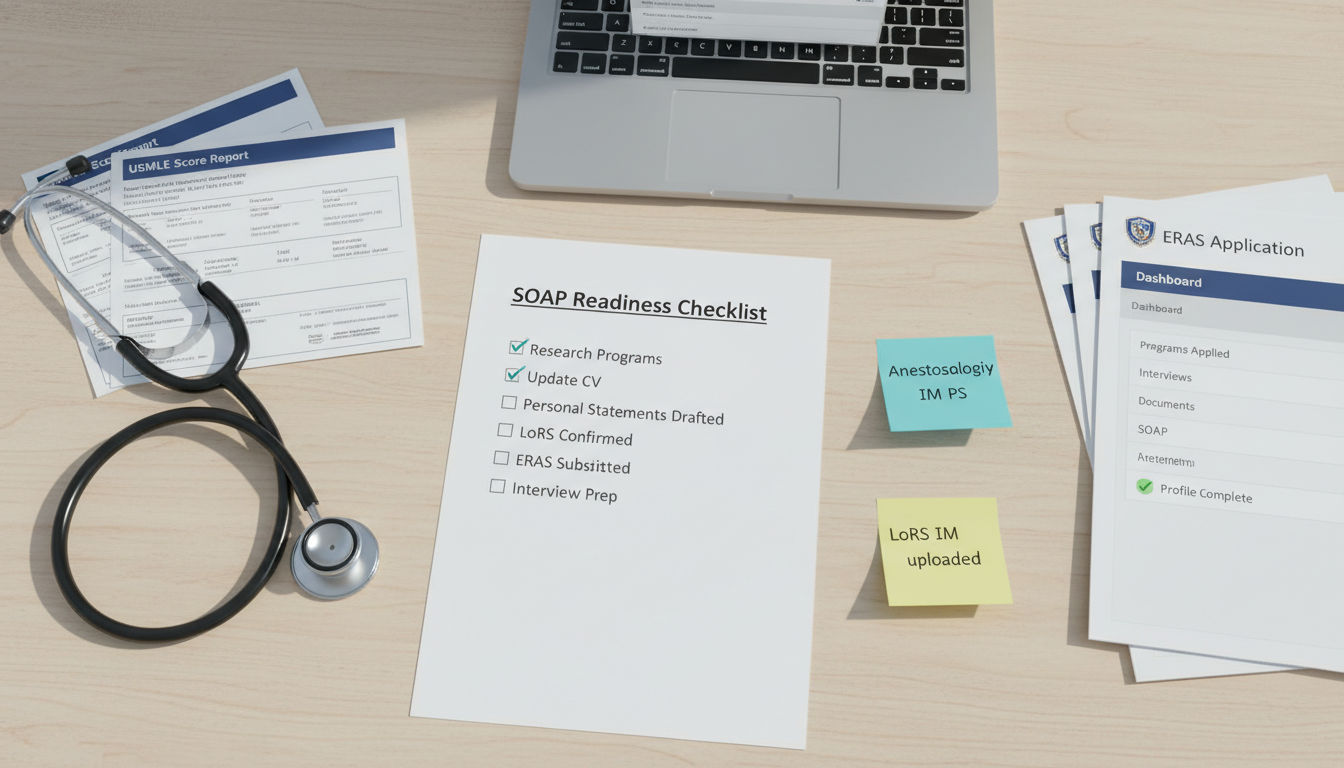
SOAP moves fast. You won’t have time during Match Week to write new documents from scratch. By February, have a SOAP-ready version of:
Curriculum Vitae (CV)
- Highlight perioperative/critical care experiences, ICU rotations, ER, and internal medicine.
- Include anesthesia-related research, quality improvement, and patient safety projects.
- Emphasize procedural skills: IV placement, arterial lines (if you have them), central lines, airway management exposure, ultrasound exposure, etc.
Personal Statement(s)
Prepare at least two versions:- Anesthesiology-focused statement
- Clarify your motivations for anesthesia, strengths in crisis management, teamwork, attention to detail, and patient communication.
- Emphasize experiences in OR, PACU, ICU, and pain clinics.
- Preliminary/Transitional/IM/FM backup statement
- Explain your broader interest in hospital-based care, critical care, and multidisciplinary teams.
- Show flexibility: you’re committed to being an excellent resident in any program that accepts you.
- Anesthesiology-focused statement
Letters of Recommendation (LoRs)
- Aim for 3–4 strong letters, including:
- At least one from an anesthesiologist (preferably from USCE if possible).
- One from ICU or critical care.
- One from internal medicine, surgery, or emergency medicine.
- Confirm that letters are uploaded to ERAS and not specialty-labeled so you can reuse them freely in SOAP (or clearly labeled in a way acceptable to other fields, e.g., “clinical performance” rather than “anesthesia-only”).
- Aim for 3–4 strong letters, including:
Medical School Performance Evaluation (MSPE) and transcripts
- Ensure they are uploaded, accurate, and legible.
- Clarify any interruptions or leaves of absence in your ERAS explanation statements in advance.
1.3 Optimize Your ERAS for Possible SOAP Paths
For IMG anesthesiology applicants, a realistic SOAP plan often includes multiple specialty pathways, such as:
- Categorical anesthesiology (PGY-1)
- Advanced anesthesiology (PGY-2) + preliminary year in medicine/surgery
- Preliminary internal medicine or surgery
- Transitional year
- Family medicine or internal medicine categorical (as a broader backup for those open to non-anesthesia careers or later transfer)
Prepare ERAS in a way that allows quick tailoring:
- Create saved personal statements matched to each path.
- Have LoR combinations thought out:
- For anesthesia: 2+ anesthesia/ICU/surgery; 1 internal medicine or allied specialty.
- For IM/FM: mostly internal medicine/family medicine letters; possibly 1 anesthesia letter if it emphasizes general clinical skills.
Step 2: Strategic Planning – Designing Your SOAP Playbook
Once Match Week begins, you will have only a few hours to decide which programs to apply to during SOAP. Thoughtful advance planning is essential.
2.1 Understand the SOAP Application Limits
NRMP typically allows up to 45 program applications during SOAP (this number can change; always verify current rules).
Important details:
- These are programs, not specialties.
- Anesthesiology positions in SOAP are usually far fewer than in the main match.
- You must decide how many of your 45 to dedicate to:
- Anesthesiology (categorical and/or advanced)
- Preliminary medicine/surgery
- Transitional year
- Other categorical programs (e.g., IM/FM) if you’re open to alternate careers.
2.2 Use Historical Data to Set Realistic Targets
Use NRMP and FREIDA data, plus old SOAP results (if accessible) to answer:
- How many anesthesiology positions typically remain unfilled?
- Which programs have historically taken IMGs into anesthesia?
- Which preliminary or transitional programs have a track record of:
- Accepting IMGs
- Hosting anesthesiology residents
- Offering strong ICU/OR exposure
This research helps you build a target list ahead of time instead of starting from zero on Monday of Match Week.
2.3 Build a Tiered SOAP List
Create a spreadsheet with columns for:
- Program name and ACGME code
- Specialty and track (anesthesia categorical, anesthesia advanced, prelim IM, etc.)
- IMG-friendliness (using FREIDA filters, program websites, alumni lists)
- Visa policy (J-1, H-1B, or none)
- Geographic preference (or restrictions)
- Personal notes (e.g., strong ICU, academic vs community, previous email interactions if before SOAP)
Then tier them:
Tier 1 – Optimal Fit
- Programs historically taking IMGs in anesthesia or at least in medicine/surgery.
- Willing to sponsor visas.
- Align with your Step 2 CK score and graduation year.
Tier 2 – Moderate Fit
- Programs occasionally taking IMGs.
- Somewhat higher score expectations but still realistic.
Tier 3 – Safety Net
- Community-based, broad-acceptance programs.
- Mostly preliminary or transitional positions where you can prove yourself clinically.
Once unfilled positions are released, you map them to your tiers, then choose which 45 to apply to accordingly.
Step 3: What to Do During Match Week – SOAP Execution
3.1 Monday Morning: Unmatched and SOAP-Eligible – Now What?
On Monday of Match Week:
You receive an email from NRMP/ERAS indicating:
- Matched
- Partially matched
- Unmatched
If you are partially matched (e.g., matched to an advanced anesthesiology position but not a prelim year, or vice versa), or unmatched, and you meet NRMP criteria, you can participate in SOAP.
The List of Unfilled Programs is released (initially without program names in some years, then with details).
Your tasks:
- Stay calm and organized.
- Log into ERAS and NRMP; confirm SOAP eligibility.
- Open your prepared target list spreadsheet and start matching unfilled positions to your tiers.
3.2 Rapid Application Strategy
Once the electronic SOAP application window opens, you can send up to your allowed number of applications (e.g., 45).
Key principles for an IMG in anesthesiology:
Prioritize anesthesia if it’s still realistic
- Apply to all unfilled anesthesiology positions that:
- Accept IMGs.
- Accept your visa type.
- Do not have score cutoffs above your profile (or if data is not clear, still consider applying).
- Apply to all unfilled anesthesiology positions that:
Secure a strong prelim or transitional year as backup
- If anesthesia slots are few or your profile is mid-range/low, devote most applications to prelim IM/Surg or transitional year programs that are:
- Known to accept IMGs
- Connected to anesthesia departments (ICU, OR exposure)
- If anesthesia slots are few or your profile is mid-range/low, devote most applications to prelim IM/Surg or transitional year programs that are:
If open to an alternate specialty long-term
- Use some applications for categorical IM or FM programs to ensure you have a path into US training.
Tailor documents quickly but intelligently
- For anesthesia programs:
- Select your anesthesiology personal statement.
- Emphasize ICU/anesthesia/OR letters.
- For prelim/transitional:
- Use a general hospital-based care personal statement.
- Use internal medicine/surgery/ICU LoRs plus one anesthesia letter if it highlights general strengths.
- For anesthesia programs:
3.3 Communication Rules – What You Can and Cannot Do
During SOAP:
- You cannot cold-contact programs to solicit positions (no calling/emailing unless they contact you first).
- Programs may initiate contact via phone or video to briefly interview you.
- All official offers must come through NRMP SOAP rounds, not via direct agreements.
Know the rules clearly; violating them risks being removed from SOAP.
3.4 Preparing for SOAP Interviews (Often Same-Day)
Some programs will call or set up quick video interviews the same day they receive your application.
For an IMG anesthesiology candidate, typical rapid-fire questions may include:
- “Tell me briefly about yourself and your path to anesthesiology.”
- “Why are you interested in our program specifically?”
- “How have you dealt with stress or crisis situations in the OR/ICU?”
- “What is your plan if you do not match into anesthesiology this cycle?”
- “Can you start on time, and do you have any visa issues?”
Preparation tips:
Have a 2–3 sentence summary of your background ready:
- Origin country and medical school
- Key US experiences (especially in anesthesia/ICU)
- One or two strengths relevant to anesthesia (calm under pressure, teamwork, communication)
Prepare a 5–6 line explanation of:
- Why anesthesiology is the right specialty for you
- What you bring as an IMG (diversity, resilience, broad clinical exposure)
For prelim/transitional programs:
- Emphasize how you will be a reliable, hardworking team member, open to long hours, night shifts, procedural work, and ICU coverage.
Have your visa situation explained clearly in one sentence:
- “I will require J-1 visa sponsorship; my documents are ready and I can start by July 1.”

Step 4: Maximizing Acceptance Chances in SOAP for Anesthesiology
Even with strong SOAP preparation, anesthesia seats are limited. Success depends on a combination of realistic expectations, flexibility, and clear priorities.
4.1 Understand the Offer Rounds
SOAP includes multiple offer rounds over two days:
- Between rounds, programs rank the applicants they interviewed or reviewed.
- You may receive:
- No offers
- One offer
- Multiple offers (rare but possible)
When you receive an offer:
- You must accept or decline within a specified time window.
- If you accept, you are legally bound to that position and removed from SOAP.
- If you decline, you will not receive that same offer again from that program in another round.
Plan beforehand:
- Under what conditions will you accept a prelim IM position even if you don’t get anesthesia?
- Are you willing to accept FM or IM categorical in SOAP, or do you prefer to reapply to anesthesia next cycle?
- What geographic or visa constraints are non-negotiable for you?
4.2 Strategy Scenarios for IMGs Targeting Anesthesia
Scenario A: You receive an offer for categorical anesthesiology
- This is the ideal outcome.
- If the program is accredited and fits your minimum criteria (visa, start date, professionalism), accept immediately.
Scenario B: You receive an advanced PGY-2 anesthesia offer but no prelim year yet
- If you believe you have a reasonable chance to secure a prelim medicine or surgery position in the remaining SOAP rounds (or potentially off-cycle post-match), strongly consider accepting the advanced spot.
- However, be realistic: securing a solid prelim year is mandatory; no prelim = no way to start.
Scenario C: Only prelim or transitional year offers
- Carefully weigh:
- Taking a prelim IM/Surg or TY where you can gain strong US experience, possibly reapply to anesthesia later with an improved profile.
- Versus declining and risking no US training this year and reapplying from outside the system.
For many IMGs, accepting a prelim/TY year in a solid institution is a strategically smart move: it boosts your US experience, provides new LoRs, and gives you closer proximity to anesthesia faculty.
Scenario D: Non-anesthesia categorical (e.g., IM/FM) offers
- Decide based on your long-term goals:
- If your passion is strictly anesthesiology, you may prefer to reapply rather than committing to a long-term non-anesthesia path.
- If you are open to an internal medicine or family medicine career—and the offer is from a reputable, IMG-friendly program—accepting may offer long-term stability.
4.3 Emotional Resilience and Professionalism
SOAP is emotionally intense:
- Results of years of effort condensed into days.
- Pressure from family, finances, visa timelines.
Maintain:
- Professional communication in every interaction (email, phone, video).
- Consistent, calm demeanor—programs want residents who can stay composed under stress, especially in anesthesiology.
- Flexible mindset: success may look different than your original plan, but still be a meaningful step into US training.
Step 5: Post-SOAP – Next Steps if You Match, Partially Match, or Remain Unmatched
5.1 If You Match Through SOAP
If you secure a position (in anesthesia or related):
- Confirm details in writing (start date, visa type, orientation).
- Begin onboarding paperwork promptly: immunizations, background checks, ECFMG certification finalization if pending.
- Use the months before residency to:
- Strengthen anesthesia fundamentals (pharmacology, physiology, airway management basics).
- Improve spoken and medical English, particularly OR communication phrases.
- Prepare for life in your program’s city (housing, transportation, finances).
If your position is prelim or transitional, design a clear plan to reapply to anesthesiology if you still desire it:
- Seek rotations with anesthesia or ICU.
- Request LoRs from US attendings who know your work.
- Update ERAS early for the next cycle with robust US experience.
5.2 If You Partially Match (e.g., advanced anesthesia but no prelim)
- Network within your future institution if possible to secure a prelim/TY there or nearby.
- Look for off-cycle prelim positions even after SOAP (allowed by NRMP once SOAP concludes).
- Keep your ECFMG status, visa planning, and licensing documents in perfect order to be ready if an opportunity appears.
5.3 If You Do Not Match at All After SOAP
This is difficult, but it is not the end:
Analyze your application honestly
- Scores, attempts, graduation year, visa type, LoRs, USCE.
- Seek feedback from mentors, faculty, or IMG advisors.
Identify specific improvements for the next cycle
- Obtain US clinical or research experience in anesthesiology, ICU, or internal medicine.
- Consider Step 3 if appropriate, especially for IMGs needing visas—passing Step 3 can make you more competitive for some anesthesia and IM programs.
- Strengthen your English communication and interview skills.
Consider alternative but strategic stepping stones
- Research fellowships or observerships associated with anesthesia departments.
- Non-residency clinical roles may be limited by visa status, but research or academic positions can be helpful.
Protect your mental health
- Seek support from peers, family, mentors, or counseling services.
- Remember that many successful anesthesiologists, especially IMGs, did not match on their first attempt.
Frequently Asked Questions (FAQ)
1. Is it realistic for an international medical graduate to get anesthesiology in SOAP?
It is possible but challenging. Anesthesiology has become more competitive, and relatively few anesthesia positions go unfilled compared to some other specialties. As an IMG, your best SOAP strategy is usually:
- Apply to all feasible anesthesia openings, and
- Simultaneously apply broadly to preliminary/TY positions with strong ICU/OR exposure, so you can reapply to anesthesia from a stronger position next year if necessary.
2. How should I prioritize my 45 SOAP applications as an IMG anesthesia applicant?
A common strategy:
- First, apply to every unfilled anesthesia position that is IMG-friendly and visa-compatible.
- Next, fill the remaining application slots with:
- Prelim internal medicine/surgery positions at programs that train anesthesiologists or have strong critical care.
- Transitional year positions if available.
- Categorical IM/FM if you are truly open to an alternative long-term path.
The exact distribution depends on how many open anesthesia positions exist and your risk tolerance.
3. What is SOAP preparation I can start before Match Week to save time?
Key steps you should complete no later than February:
- Finalize two personal statements (anesthesiology-focused and general hospital-based).
- Ensure 3–4 strong LoRs are uploaded, including at least one from an anesthesiologist or ICU physician.
- Create a spreadsheet of potential programs with notes on IMG-friendliness and visa policies.
- Practice short, focused interview responses (1–2 minutes) about your background, interest in anesthesia, and work ethic.
- Clarify your visa and start-date situation so you can answer questions clearly.
4. What is SOAP vs post-match “scramble,” and can I still contact programs directly?
SOAP replaced the old “scramble” and is now the only official mechanism to fill unfilled positions during Match Week. During SOAP:
- You cannot cold-contact programs to request positions.
- Programs must initiate contact if they want to interview you.
- Official offers are extended only through NRMP SOAP rounds.
After SOAP concludes, some positions may still be available “post-match.” At that point, direct contact and off-cycle hiring may occur, depending on NRMP and program policies. Always verify the current year’s NRMP rules.
A thoughtful, well-timed SOAP preparation strategy can transform a stressful, uncertain week into a structured opportunity. As an international medical graduate aiming for anesthesiology, your best advantage lies in early planning, realistic targeting, and professional composure—before, during, and after SOAP.