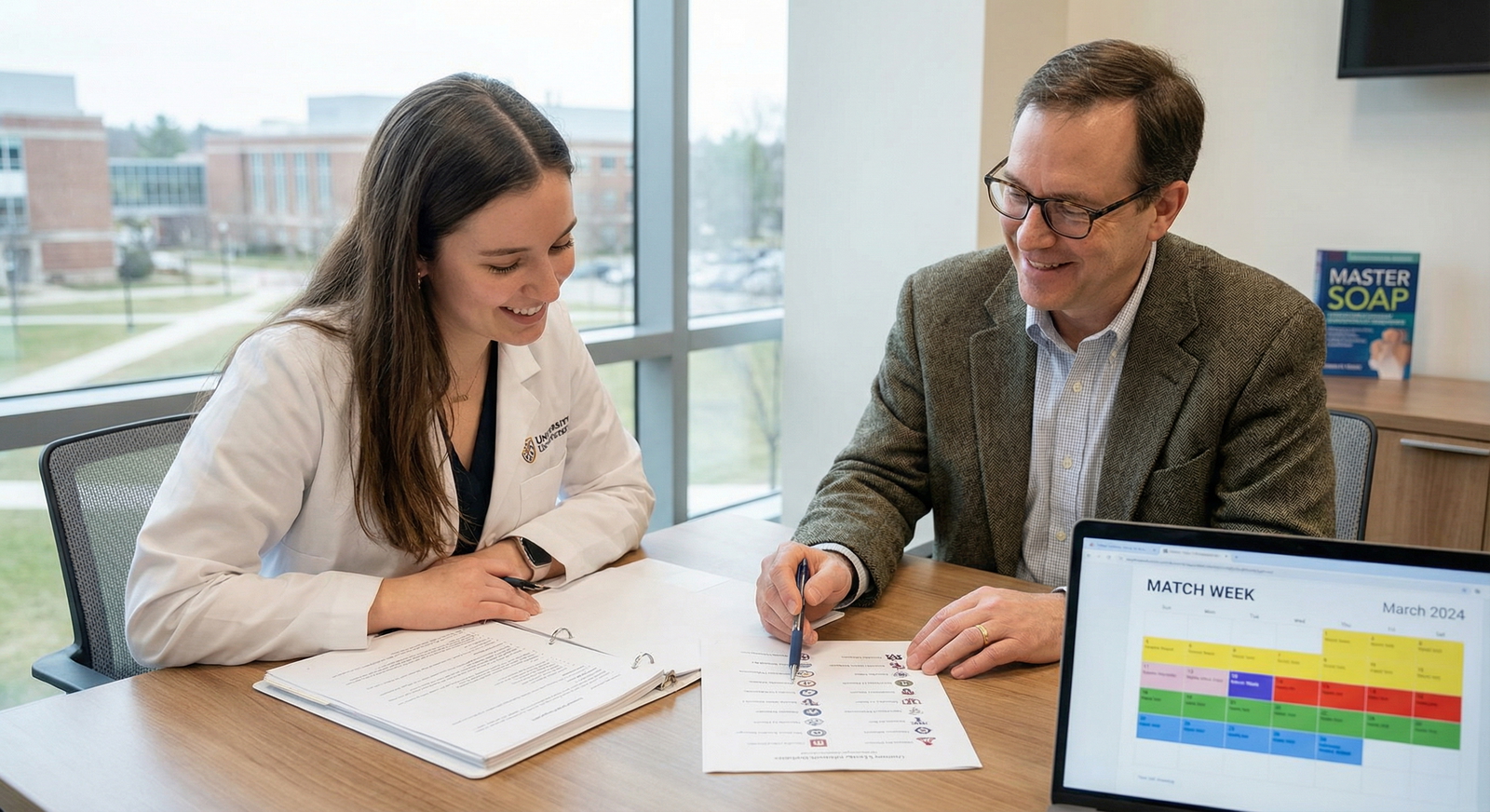
Understanding SOAP for Interventional Radiology–Bound IMGs
For an international medical graduate aiming at interventional radiology (IR), the Supplemental Offer and Acceptance Program (SOAP) is a critical safety net—and, in some cases, a strategic pathway—within the NRMP Match.
This IMG residency guide will focus on SOAP preparation specifically for those ultimately targeting an interventional radiology residency, with practical steps you can take before and during SOAP to maximize your options and keep IR as a long‑term goal.
What Is SOAP?
SOAP is a structured, time‑limited process run by the NRMP during Match Week that allows eligible unmatched or partially matched applicants to obtain unfilled residency positions. It replaces the old “scramble” with a more orderly system.
You are SOAP-eligible if you:
- Registered for the Main Residency Match and certified a rank order list
- Are partially matched or unmatched after the main Match algorithm
- Are not withdrawn by NRMP for policy violations
- Have passed required exams and met all institution/ECFMG requirements by the NRMP deadlines
For IMGs, an added layer is ECFMG certification (or meeting all ECFMG prerequisites) by the required date. If you are uncertain, confirm your SOAP eligibility through your NRMP and ECFMG accounts well before Match Week.
Why SOAP Matters for IR‑Bound IMGs
Directly matching into integrated Interventional Radiology (IR/DR) as an IMG is highly competitive. Many IMGs ultimately reach IR by:
- Matching into diagnostic radiology (DR) first, then IR fellowship
- Matching into an independent IR program after a diagnostic pathway
- Entering more prelim or transitional year programs that support future radiology/IR applications
SOAP can:
- Provide a backup PGY-1 or categorical spot (e.g., Internal Medicine, Surgery prelim, Transitional Year)
- Keep you in the U.S. system with active clinical training, letters, and networking opportunities that help you in a later IR match
- Prevent gaps in training that can hurt future applications and visa chances
Your core SOAP question isn’t “Can I SOAP into IR?” (because IR rarely, if ever, has SOAP positions), but rather:
“How can I use SOAP strategically so I am in the best possible position to apply or re‑apply for interventional radiology in 1–3 years?”
The remainder of this article is structured to help you do exactly that.
Pre‑SOAP Preparation: Set Up Months Before Match Week
Preparation for SOAP should begin well before Match Week—even if you are optimistic about matching. As an international medical graduate, planning a contingency is not pessimism; it is strategy.
1. Clarify Your Long‑Term IR Pathway
Before you can plan for SOAP, you must clearly understand how you intend to reach IR. Realistically, IMGs most commonly follow one of these routes:
- Integrated IR/DR residency (PGY‑2 entry, with PGY‑1 separately or included)
- Diagnostic Radiology (DR) residency → IR fellowship
- Prelim/Transitional Year → Re‑apply for DR or IR
- General or Vascular Surgery track → later subspecialize or collaborative IR roles
Your SOAP strategy should prioritize programs that:
- Are in institutions with strong radiology or IR departments
- Offer access to procedural experience, research, and U.S. mentors
- Have a track record of supporting residents who later pivot to radiology or IR
2. Know the Timeline and Technical Requirements
In the weeks to months before Match Week:
- Review NRMP SOAP timelines on the NRMP website
- Double‑check your ECFMG certification status and USMLE/COMLEX score reports
- Ensure your ERAS account is fully updated, even if you think you will match
- Confirm your contact information (phone, email) is accurate and professional
Even a minor technical problem (locked NRMP account, outdated email, incomplete documents) can cost you valuable hours during SOAP.

3. Optimize Your Application Materials for SOAP
Your ERAS application is the shell you will use during SOAP. You cannot rewrite everything from scratch in March, but you can pre‑optimize for rapid adaptation.
Key steps:
Personal statement templates
- Create at least 3 versions in advance:
- IR/DR‑focused statement
- Internal Medicine / Transitional Year oriented statement
- General Surgery / Prelim Surgery oriented statement
- Focus on:
- Your procedural interest
- Imaging and anatomy strengths
- Teamwork in acute care settings
- Commitment to patient safety and continuity of care
- During SOAP, you may need to rapidly swap in the most appropriate statement for different specialties.
- Create at least 3 versions in advance:
Letters of Recommendation (LoRs)
- Collect:
- At least one radiology or IR‑related letter (if available)
- One core clinical letter (IM, surgery, EM, or similar)
- One letter emphasizing professionalism and communication, especially from U.S. faculty
- Ensure letters are uploaded to ERAS well before Match Week; in SOAP you cannot wait for new letters to arrive.
- Collect:
ERAS CV / experiences section
- Emphasize:
- Radiology/IR electives, observerships, or research
- Any procedural exposure (central lines, lumbar punctures, biopsies, angiography shadowing)
- Quality improvement or patient safety projects
- Experiences that show adaptability as an IMG (new health system, language, culture)
- For SOAP, your experiences should still support your eventual IR path but also appear logical to non‑IR programs.
- Emphasize:
4. Prepare for SOAP Residency Communication
You cannot predict exactly which programs will have unfilled positions, but you can prepare your communication skills:
Elevator pitch tailored to SOAP (30–60 seconds):
- Who you are (IMG, school, graduation year, visa status)
- Core interests (procedural care, imaging, acute care, longitudinal patient relationships)
- Why you are a strong resident and why that specific specialty and program fit
- How your long‑term interest in interventions (e.g., IR) will still benefit their department (procedural enthusiasm, QI, research)
Mock SOAP phone/video interviews:
- Practice short, structured answers:
- “Why are you interested in our program?”
- “Why did you not match?”
- “What have you done since graduation?”
- “What is your visa status and plan?”
- Use peers, mentors, or institutional career offices to run mock calls in strict time limits—SOAP calls are often brief.
- Practice short, structured answers:
Strategic Specialty Choices During SOAP for IR‑Bound IMGs
Because interventional radiology residency positions rarely remain unfilled, an IMG cannot reasonably plan to get an integrated IR spot through SOAP. Instead, think of SOAP as choosing the best stepping‑stone on the way to IR.
1. Realistic Targets: Where Should You Apply?
During the IR match (both main match and later cycles), programs look favorably on candidates who come from strong clinical and imaging-focused backgrounds.
When you open the SOAP list of unfilled positions, consider:
Higher‑value choices for an IMG ultimately targeting IR:
Preliminary Surgery (especially in large academic centers with radiology departments)
- Pros: Procedural exposure, anatomy, acute care, ICU, patient management
- Cons: High workload, less imaging teaching, no guarantee of radiology later
Transitional Year (TY) in academic or community programs with radiology
- Pros: Broader exposure, elective months, ability to do radiology/IR electives
- Cons: Only 1 year; must re‑apply for categorical DR/IR
Preliminary Internal Medicine with good radiology access
- Pros: Strong foundation in patient management, chronic disease, consults
- Cons: Limited procedures, but good for IR that values internal medicine knowledge
Categorical Internal Medicine or General Surgery
- Pros: Stable long‑term path; IR can still be pursued via DR/IR/fellowship or hybrid careers (e.g., vascular, endovascular)
- Cons: You may need to pivot your long‑term vision if radiology is no longer feasible
Less strategic but sometimes necessary choices might include Family Medicine, Pediatrics, or Psychiatry if your priority is purely securing any U.S. GME position and visa sponsorship. However, these have a less direct connection to IR, so consider them carefully.
2. How to Prioritize Programs
When comparing unfilled SOAP programs, consider factors that support future IR/DR applications:
- Presence of a radiology or IR department at the same institution
- Availability of electives in radiology/IR for prelims and interns
- Institutional history of:
- Accepting IMGs
- Supporting residents for fellowship and residency re‑applications
- Producing graduates who go into DR, IR, or procedural subspecialties
If you have time, quickly scan the residency website to check:
- Faculty biographies—any IR/DR faculty listed?
- Resident success stories—are there grads in radiology or IR fellowships?
- Size of the program—larger programs often have more flexibility for electives and research.

3. Visa and IMG‑Specific Considerations
As an international medical graduate, visa sponsorship must be part of your SOAP strategy:
- Filter programs by:
- Programs that explicitly accept J‑1 and/or H‑1B visas
- State or institutional history with IMGs
- During SOAP calls:
- Be transparent and concise about your visa needs
- Have your ECFMG and visa-related documents (if applicable) ready to email or upload immediately if requested
A strong but non‑visa‑sponsoring program does you no practical good; check viability before ranking it highly on your internal priority list.
Executing During SOAP Week: Step‑by‑Step for IR‑Focused IMGs
When Match Week arrives and you discover you’re in SOAP, emotions can run high. The important thing is to shift quickly from disappointment to execution.
1. Monday Morning: Assess and Re‑Anchor
Once you receive your “Unmatched” or “Partially Matched” notification:
- Confirm your SOAP eligibility in NRMP.
- Take 30–60 minutes to process your emotions—but set a firm time limit.
- Re‑clarify your primary objective:
- “Get a position that keeps me clinically active in the U.S. system and aligned, as much as possible, with my future IR match goals.”
2. Review the Unfilled Positions List with an IR Lens
When NRMP releases the list of unfilled positions:
- Quickly filter by specialties of interest:
- Transitional Year
- Preliminary Surgery
- Preliminary Internal Medicine
- Categorical Internal Medicine / General Surgery (if needed)
- Prioritize academic or large community programs with:
- On‑site radiology/IR departments
- Existing IMGs and visa sponsorship history
Create a tiered list:
- Tier 1 – Best alignment with IR (prelim/TY in centers with radiology, clear IMG support, visa‑friendly).
- Tier 2 – Good programs that are less directly connected to IR but still strong clinically (categorical IM/GS with academic resources).
- Tier 3 – Safe‑net positions chosen to avoid a gap year or loss of visa status, even if not ideal for IR.
3. SOAP Application Strategy: Limited Applications, Maximum Fit
NRMP SOAP limits how many programs you can apply to during each round. Use each slot intentionally:
- Use your most relevant personal statement for each specialty
- If allowed, tailor your application slightly (e.g., name the program’s strengths in your statement, update your experiences section if feasible)
- Avoid sending the IR/DR heavy statement to programs that want a committed Internal Medicine or Surgery applicant; instead:
- Emphasize:
- Love of patient care
- Interest in long‑term management or peri‑operative care
- Teamwork and learning goals
- You can still mention your procedural and imaging interests in a way that benefits that specialty.
- Emphasize:
4. Handling SOAP Calls and Mini‑Interviews
Programs may reach out quickly once they see your application. During SOAP, time is compressed and faculty are triaging many candidates rapidly.
Prepare to:
- Answer unknown numbers professionally
- Have a 1‑page “cheat sheet” next to you:
- Your ERAS AAMC ID
- Core talking points about your background
- Key strengths and examples (teamwork story, resilience story, procedural story)
- A short list of questions for programs (when appropriate)
In calls, focus on:
- Fit and reliability
- Show you understand their program’s structure and are ready for the workload.
- Professional maturity
- Briefly and calmly address not matching:
- “The match is highly competitive, especially for interventional radiology and diagnostic radiology. I understand that, and I’m committed to training hard in [IM/GS/TY]. I’m excited about the opportunity to contribute to your program.”
- Briefly and calmly address not matching:
- Future goals (with nuance)
- You don’t have to hide your long‑term IR interest, but frame it as:
- “I’m drawn to procedural and imaging‑guided care, which is why I initially applied to IR/DR. However, I see tremendous value in a strong foundation in [IM/GS], and I would be fully committed to contributing to your department and patients.”
- You don’t have to hide your long‑term IR interest, but frame it as:
Programs want residents who are reliable and likely to stay, not those who treat them as a stopgap. Be honest but emphasize genuine appreciation for the specialty and program.
After SOAP: Positioning Yourself for a Future IR Match
Whether or not you secure a SOAP residency position, your longer‑term IR journey continues. Your actions in the 12–24 months after SOAP are critical.
1. If You Match Through SOAP
If you secure a prelim, TY, or categorical position:
Early in PGY‑1: establish yourself as an excellent resident
- Show reliability, strong work ethic, good communication, and teachability.
- Avoid any professionalism concerns—they can be fatal to future IR match attempts.
Build relationships with radiology and IR faculty
- Request elective rotations in diagnostic radiology or IR when possible.
- Ask for involvement in case conferences, morbidity & mortality meetings, journal clubs.
Engage in IR‑related research or QI
- Projects on central line complications, anticoagulation for procedures, imaging in sepsis, etc., are often feasible from IM/GS vantage points.
- Aim for abstracts, poster presentations, or publications that strengthen your IR/DR profile.
Plan for your next IR/DR or independent IR application cycle
- Collect new letters of recommendation from U.S. faculty who see your clinical performance.
- Update your personal statement to reflect growth during residency.
- Use your residency program director as an advisor in crafting a realistic target list of IR/DR and DR programs.
2. If You Do Not Match in SOAP
If you remain unmatched after SOAP:
Avoid paralysis. Within 1–2 weeks:
- Meet with mentors (including radiologists, IMGs who matched after a gap, program advisors).
- Analyze your application objectively:
- USMLE scores and attempts
- Year of graduation and gaps
- Clinical experience in the U.S.
- Strength of LoRs and personal statement
Constructive options during a gap year:
- U.S. clinical observerships or externships (if permitted) in radiology/IR or high‑yield fields (IM/GS/EM)
- Research positions in IR, DR, or related fields (oncology, vascular surgery, cardiology)
- Structured testimony of improvement: better language proficiency, publications, teaching roles, or QI projects
Document your growth
- Keep a log of roles, responsibilities, skills, and achievements during the gap.
- Future program directors want to see increasing trajectory, not stagnation.
3. Strengthening Your Narrative as an IMG
Throughout this process, you should continually refine a narrative that makes sense to IR/DR selection committees:
- You faced one or more cycles without matching but responded with:
- Resilience – you continued to improve academically and clinically.
- Adaptability – you integrated into diverse clinical teams and systems.
- Commitment – you sustained your interest in patient‑centered, procedural, and imaging‑guided care.
When written and spoken clearly, this narrative turns what initially seems like a setback into evidence of your determination and suitability for a demanding specialty like interventional radiology.
FAQ: SOAP, IMGs, and the IR Match
1. Can an international medical graduate get an interventional radiology residency through SOAP?
Practically speaking, it is very rare. Integrated interventional radiology residency positions are highly competitive and usually fill in the main match. The IR match rarely leaves spots available for SOAP.
For IMGs, the best way to use SOAP is to obtain a strong prelim/TY or categorical position that keeps you active in the U.S. system and aligned with your long‑term IR goals.
2. What is SOAP, and how is it different from the old “scramble”?
SOAP (Supplemental Offer and Acceptance Program) is a structured NRMP process that:
- Limits how many applications each candidate can send in each round
- Organizes program offers and acceptance windows digitally through NRMP
- Prohibits random mass calling/faxing of programs outside of defined rules
Unlike the older “scramble,” SOAP is more controlled and equitable, but this also means IMGs must be strategic and prepared, as you cannot simply bombard dozens of programs spontaneously. Understanding what is SOAP and its rules in detail is crucial for effective SOAP preparation.
3. As an IMG, which SOAP specialties should I prioritize if I ultimately want to do IR?
Focus on specialties and programs that:
- Provide strong clinical training (Internal Medicine, General Surgery)
- Offer procedural exposure (preliminary surgery, ICU, ED)
- Have radiology/IR departments and allow electives in those areas
A Transitional Year or Preliminary Surgery/IM at an academic center with IR/DR is often ideal. However, a solid categorical position in IM or GS can also be leveraged later toward IR or related procedural careers.
4. How should I adjust my personal statement and application for SOAP while still signaling interest in IR?
Create SOAP‑specific personal statements for each specialty:
- Emphasize:
- Commitment to that specialty’s core mission (e.g., longitudinal care in IM, operative care in surgery)
- Your strengths in teamwork, communication, and patient safety
- Your procedural and imaging interests in a way that adds value to that specialty (e.g., imaging‑guided decision making, comfort with procedures, QI in catheter‑related issues)
Avoid presenting IR as your only real interest when applying to non‑IR programs during SOAP. Instead, show that your IR‑related skills and passions will make you an excellent resident in their specialty while still leaving the door open for future IR/DR pathways.
By approaching SOAP with a clear strategy, realistic expectations, and a structured plan, an international medical graduate interested in interventional radiology can transform Match Week from a moment of crisis into a pivotal step toward a long‑term IR career.