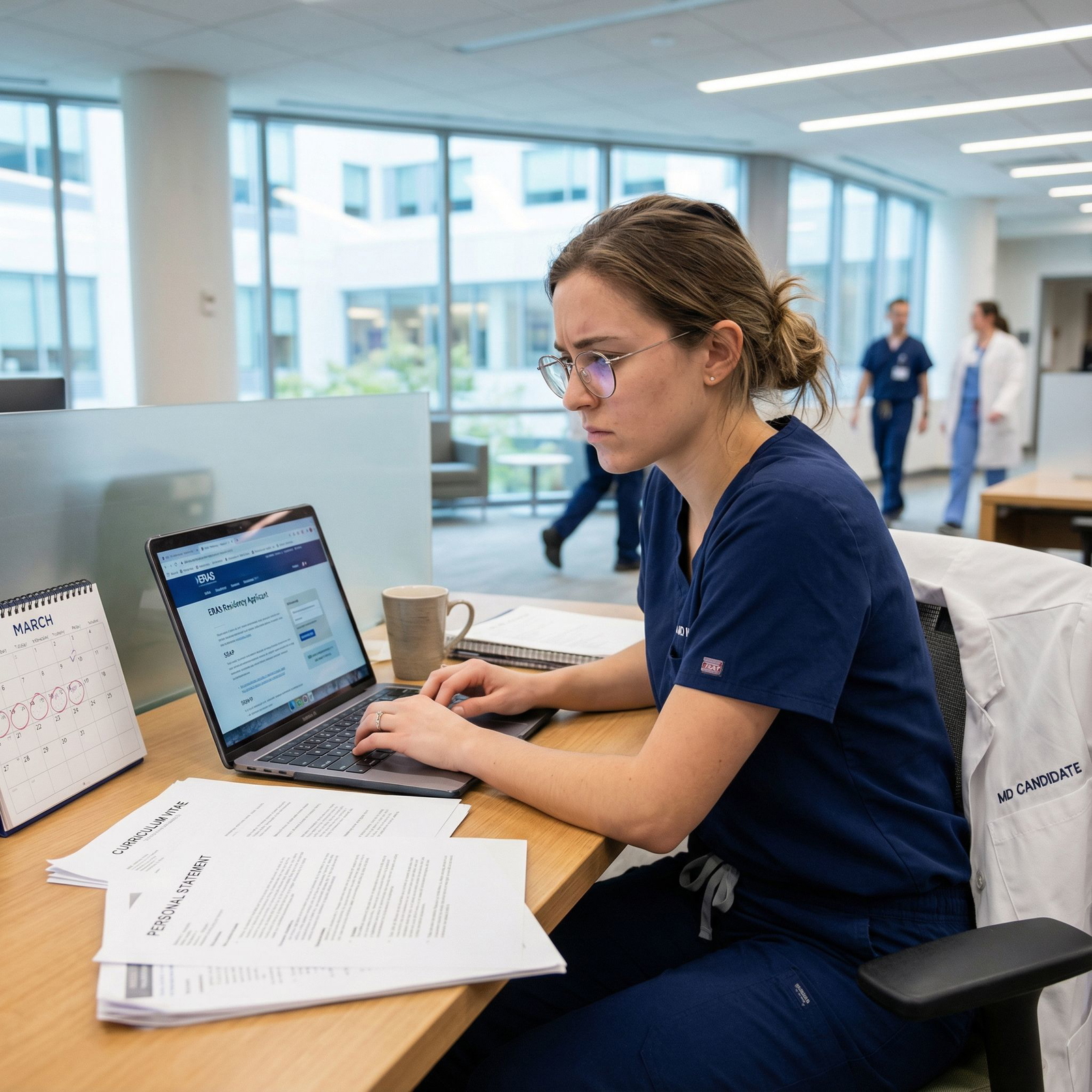
Understanding SOAP for MD Graduates in OB GYN
For MD graduates pursuing an OB GYN residency, the Supplemental Offer and Acceptance Program (SOAP) can feel intimidating—but it is also a powerful second chance at securing a training position. Thoughtful SOAP preparation can transform an emotionally stressful week into a focused, strategic opportunity.
As an MD graduate from an allopathic medical school, you hold an advantage in the allopathic medical school match and SOAP compared to many non–US-MD applicants—but only if you plan ahead. This guide walks you through what SOAP is, how it works specifically for obstetrics & gynecology applicants, and how to prepare—from months before Match Week through the final offer.
We will focus on:
- What is SOAP and how it applies to OB GYN
- Pre-Match Week SOAP preparation
- Building a SOAP-focused OB GYN and alternative specialty strategy
- Executing a strong SOAP application and interview performance
- Emotional resilience and professional conduct during SOAP
- Common FAQs about SOAP for OB GYN–bound MD graduates
What Is SOAP and How Does It Work for OB GYN Applicants?
Defining SOAP in the Match Process
SOAP—the Supplemental Offer and Acceptance Program—is a structured, time-limited process run by the NRMP during Match Week. It allows eligible unmatched or partially matched candidates to apply to and receive offers from unfilled residency positions before the general list of unfilled programs is released to everyone.
In simple terms, what is SOAP?
- A four-day process during Match Week
- For eligible unmatched or partially matched applicants
- Allows application to unfilled positions via ERAS
- Offers made in multiple rounds, with short windows to accept or reject
- Designed to be more orderly and equitable than the pre-2012 “Scramble”
As an MD graduate, you must:
- Be registered for the NRMP Match
- Be eligible to start residency on July 1 (or program start date)
- Be fully unmatched, or
- Partially matched (e.g., matched to a preliminary year only) and seeking a categorical position
If you match into an OB GYN residency in the main match, you are not eligible for SOAP. If you go unmatched or match only into a preliminary spot, SOAP becomes your next critical opportunity.
OB GYN Residency Context in SOAP
OB GYN residency is a moderately competitive specialty. In most years:
- Most OB GYN positions fill in the main Match.
- A small number of categorical OB GYN slots may appear in SOAP.
- Some programs may have unexpected vacancies due to last-minute changes.
For an MD graduate:
- You are generally more competitive in SOAP than non–US-MD applicants, especially for prelim medicine/surgery or transitional year spots.
- For categorical OB GYN positions, competition remains high—with many applicants focusing specifically on obstetrics & gynecology.
Your SOAP preparation strategy must therefore be two-pronged:
- Primary goal: Pursue any available OB GYN residency positions (categorical or preliminary if relevant to program pathways).
- Parallel strategy: Pursue strong alternative options (prelim year or another specialty) that keep you competitive for a future obstetrics match if needed.
Pre–Match Week SOAP Preparation: Start Early, Plan Deliberately
Effective SOAP preparation begins months before Match Week—ideally in the fall and winter of your application year. This is especially important if:
- Your scores or application profile are borderline for OB GYN.
- You received fewer OB GYN interviews than expected.
- You have significant red flags (attempts, leaves of absence, professionalism concerns).
Step 1: Honestly Assess Your Risk of Not Matching
Before SOAP week, work with:
- Your OB GYN department advisor
- Your Dean’s Office or Student Affairs
- A faculty mentor who knows your file
Questions to consider:
- How many OB GYN interviews did you receive?
12 interviews: lower SOAP risk (but never zero)
- 6–11: moderate risk—prepare seriously for SOAP
- <6: high risk—SOAP planning is essential
- Any exam red flags?
- USMLE Step 1 failure or marginal pass
- Step 2 CK below national mean or failure
- Any gaps or professionalism issues?
- Did you apply broadly enough (geography, program types)?
Use this assessment to decide how aggressively you should prepare for SOAP and for backup specialties.
Step 2: Clarify Your Priorities and Boundaries
Before SOAP starts, decide:
- Are you willing to:
- Accept any OB GYN residency position regardless of location?
- Accept a preliminary or transitional year with the intent to reapply to OB GYN?
- Consider a different specialty if no OB GYN spot is available?
- What are your absolute deal-breakers?
- Programs with known severe violations or unsafe environments
- Locations where you genuinely cannot live due to major personal constraints
Be honest and realistic—but understand that during SOAP, flexibility is often crucial.
Step 3: Prepare Your Application Materials for SOAP
Your SOAP preparation should include having SOAP-ready versions of key documents before Match Week:
Updated ERAS CV and experiences
- Ensure all OB GYN rotations, research, leadership, and volunteer work are clearly documented.
- Highlight women’s health, reproductive justice, advocacy, quality improvement, and surgical experience.
Personal Statements Prepare at least three tailored statements:
- Primary OB GYN personal statement (refined and concise)
- Alternative specialty personal statement (e.g., internal medicine, family medicine, surgery, prelim, transitional year)
- Flexible/general statement for prelim/transitional or undecided programs
Letters of Recommendation (LoRs)
- Ensure you have at least 3 strong OB GYN letters from attending physicians who know you clinically.
- Ask your Dean’s Office whether additional specialty-neutral letters might be needed for SOAP (e.g., medicine or surgery attendings).
- Confirm all letters are uploaded and assigned appropriately in ERAS.
MSPE and Transcripts
- These are typically already uploaded but review for accuracy.
- Know if there are any comments that might trigger questions and prepare answers.
SOAP-Specific Document Preparation
- Draft short, adaptable email templates you can use to express interest to programs during SOAP (where permissible).
- Prepare a brief, 60–90 second SOAP introduction script for phone or video interviews.

Building a SMART SOAP Strategy for OB GYN and Alternatives
Once you understand the SOAP process and have your materials ready, the next step is to design a strategic plan tailored to OB GYN as your primary goal.
Step 1: Know the SOAP Rules and Structure
During SOAP:
- You will learn on Monday of Match Week whether you are matched, partially matched, or fully unmatched.
- If you are SOAP-eligible and unmatched/partially matched:
- You gain access to the list of unfilled programs.
- You can submit applications through ERAS only (no direct applications).
- You have a limited number of applications:
- Historically: up to 45 programs total during SOAP (check the current year’s NRMP guidelines).
- Programs review applications and may contact you for:
- Short virtual interviews
- Phone calls
- Brief written follow-up questions
- Offers are made in rounds:
- You have a brief window (often 2 hours) to accept/reject.
- Once you accept an offer, you are no longer eligible for further SOAP offers.
Step 2: Prioritize OB GYN vs Alternative Pathways
As an MD graduate committed to OB GYN, consider three possible goal hierarchies:
Category A – OB GYN Above All
- Priority 1: Any categorical OB GYN residency spot
- Priority 2: A prelim year (medicine, surgery, or transitional year) in a strong training environment to reapply to OB GYN
- Priority 3: Other specialties only if above options fail
Category B – OB GYN Strongly Preferred, But Open
- Priority 1: Categorical OB GYN
- Priority 2: Categorical primary care or women’s health–oriented specialties (family medicine, internal medicine) that still align with women’s health
- Priority 3: Prelim/transitional with plan to reassess after PGY1
Category C – Geographic/Personal Constraints High
- Priority 1: OB GYN or prelim in specific regions only
- Priority 2: Alternative specialties with geographic priority
- This is less flexible and riskier but may be necessary for some applicants.
Discuss your category with mentors before Match Week so decisions under pressure are aligned with your long-term goals.
Step 3: Mapping Potential Alternative Specialties
If no obstetrics match option appears in SOAP, many MD graduates successfully pivot to:
- Preliminary Internal Medicine or Surgery:
- Gives robust inpatient experience
- Keeps the door open for future OB GYN applications
- Transitional Year (TY):
- Broad, mixed clinical exposure
- Excellent for applicants still deciding or planning to reapply
- Family Medicine:
- Strong alignment with women’s health, prenatal care, contraception
- Some programs offer high-volume OB experiences and deliveries
- Internal Medicine:
- Pathway to women’s health fellowships, reproductive endocrinology research, or hospital medicine with a women’s health focus
In your SOAP preparation, research ahead of time:
- Transitional year programs with strong OB exposure or women’s health clinics
- Family medicine programs with full-scope OB (including deliveries)
- Internal medicine programs with dedicated women’s health tracks
Document these in a SOAP “short list” spreadsheet with columns for:
- Program name and specialty
- Location
- Strengths related to women’s health or OB exposure
- Your level of interest (1–3 ranking)
- Notes from websites or mentors
This lets you move quickly once the SOAP list is released.
Executing During SOAP Week: Applications, Interviews, and Offers
Step 1: Reacting to the “Did I Match?” Email
On Monday of Match Week at noon Eastern, you receive your NRMP email:
- If matched: You are done—no SOAP eligibility.
- If partially matched (e.g., prelim only): You may SOAP for a categorical position.
- If unmatched: You are SOAP-eligible if you meet NRMP’s criteria.
If unmatched or partially matched:
- Meet immediately with your Dean’s Office or advising team.
- Maintain professional composure—programs may begin to reach out the same day or next morning.
- Review your pre-built SOAP strategy and documents.
Step 2: Reviewing the Unfilled List and Choosing Programs
Once the unfilled list is released:
- Filter for OB GYN programs first.
- Identify categorical OB GYN positions.
- Look for any prelim OB GYN or combined tracks if applicable.
- Apply strategic criteria:
- Realistic reach for your application profile
- Willingness to train in the location
- Program’s reputation and case volume
Given your limited number of applications (e.g., 45):
- Allocate a meaningful portion (e.g., 10–20) to OB GYN and closely related opportunities if available.
- Use remaining applications for:
- Prelim year positions
- Transitional year programs
- Alternative categorical specialties aligned with your values and interests
Step 3: Tailoring Materials Rapidly but Thoughtfully
When assigning personal statements and LoRs in ERAS:
- For OB GYN programs:
- Use your strongest, focused OB GYN personal statement.
- Assign OB GYN–specific letters (3–4 if allowed).
- For Family Medicine/Internal Medicine programs:
- Use a statement that:
- States your interest in the specialty
- Connects your passion for women’s health and continuity of care
- Assign at least one non-OB GYN letter if available, plus strong OB GYN letters as appropriate.
- Use a statement that:
- For Prelim/Transitional programs:
- Use a more general but sincere statement:
- Emphasize your desire for broad clinical training
- Briefly mention your intent to grow as a physician and keep OB GYN or women’s health as long-term interests (only if appropriate; avoid implying you are “using” them solely as a stepping stone).
- Use a more general but sincere statement:
Step 4: Preparing for SOAP Interviews
SOAP interviews are typically:
- Short (10–20 minutes)
- Focused on:
- “Why our program?”
- “Why are you in SOAP/unmatched?”
- “How will you handle the intensity of residency?”
- “Why this specialty, especially if different from your original application?”
As an MD graduate targeting OB GYN:
Key messages to prepare:
Authentic interest in OB GYN
- Highlight specific clinical experiences: deliveries, surgeries, continuity clinics, advocacy.
- Emphasize skills: teamwork, communication, managing emergencies, procedural comfort.
Insight into why you may not have matched
- Brief, non-defensive explanation:
- “I applied somewhat narrowly geographically.”
- “My Step 1/2 score was below average, which I believe limited my interview offers.”
- Focus on growth:
- “Since then, I have strengthened my application through X, Y, Z.”
- Brief, non-defensive explanation:
Fit with that specific program
- Reference their:
- Patient population (e.g., underserved, high-risk OB)
- Educational priorities (simulation, research, global health)
- Values (equity, advocacy, surgical training)
- Reference their:
If interviewing for a non-OB GYN position
- Show genuine respect for the specialty.
- Do not frame it as a purely “backup” move.
- Connect how your OB GYN interest deepens your commitment to women’s health, primary care, or inpatient medicine.
Practice answers with a mentor or peer before Match Week as part of your SOAP preparation.

Professionalism, Emotional Resilience, and Long-Term Perspective
SOAP is not just a logistical challenge—it is an emotional stress test. As an MD graduate who invested heavily in obstetrics & gynecology, learning that you are unmatched can be heartbreaking. Your behavior under this stress, however, can powerfully influence how advisors support you and how programs perceive you.
Managing the Emotional Impact
During SOAP week:
- Allow yourself time to feel disappointed, but set a clear time limit (e.g., a few hours) before turning to action.
- Lean on:
- Trusted friends and family
- Mentors and faculty who understand the process
- Mental health services if your institution provides them
- Avoid:
- Social media comparisons
- Public venting about programs, exams, or the Match process
Remind yourself:
- Many excellent physicians did not match into their first-choice specialty on their first try.
- Some have used prelim years or alternative specialties to build meaningful careers still centered on women’s health and obstetrics, even without a traditional OB GYN residency.
Maintaining Professionalism Throughout SOAP
Programs pay close attention to how applicants conduct themselves during SOAP:
- Communication
- Respond promptly, courteously, and clearly.
- Use professional language in emails and calls.
- Honesty
- Do not misrepresent your interest level in a program.
- If you apply to a program, be ready to consider it seriously.
- Reliability
- Show up on time to virtual or phone interviews.
- Test technology in advance.
- Decision-making
- Use the offer windows wisely; avoid last-second indecision.
- Once you accept an offer, fully commit and stop second-guessing.
If You Do Not Secure an OB GYN Position in SOAP
If SOAP ends without an OB GYN residency:
- Fully commit to the position you do accept (prelim, transitional, or another specialty).
- Arrive as the hardest-working, most teachable intern.
- Build strong relationships with faculty and program leadership.
- Continue to develop your OB GYN–relevant profile:
- Seek women’s health clinic experiences.
- Get involved in OB-adjacent research or QI (e.g., maternal morbidity, contraception access).
- Reassess after PGY1 with your mentors:
- Is reapplying to OB GYN realistic?
- Are there fellowships or career paths within your new specialty that still align with your goals (e.g., women’s health in internal medicine, full-scope family medicine with OB)?
Your future in women’s health is not defined by a single Match cycle. Strong SOAP preparation improves your odds now and builds resilience and clarity for whatever comes next.
FAQs: SOAP Preparation for MD Graduates in Obstetrics & Gynecology
1. As an MD graduate from an allopathic medical school, do I have an advantage in SOAP for OB GYN?
Yes, generally. In the allopathic medical school match and SOAP, US MD graduates are often preferred by many programs due to familiarity with training standards and documentation. However:
- OB GYN remains competitive, even in SOAP.
- Your relative advantage is greater for:
- Preliminary medicine or surgery positions
- Transitional year programs
- Some alternative categorical specialties (e.g., family medicine)
- For any available OB GYN slots, you still compete with other strong MD and DO candidates, and possibly well-qualified IMGs.
Your best use of this advantage is:
- Strong SOAP preparation
- Rapid, organized application strategy
- Polished interviews that clearly articulate your commitment and readiness
2. How should I balance applying to OB GYN vs other specialties during SOAP?
Think of your application pool as a portfolio:
- Start by identifying all OB GYN positions in SOAP.
- Apply to all reasonable OB GYN programs where:
- You would truly attend if offered.
- Your profile is at least plausibly competitive.
- Use remaining application slots for:
- Prelim internal medicine, surgery, and transitional year positions in solid teaching environments.
- Possibly categorical family medicine or internal medicine programs that strongly emphasize women’s health.
For many MD graduates focused on an obstetrics match, a realistic distribution might look like:
- 10–20 OB GYN programs (if available)
- 10–20 prelim or transitional programs
- 5–10 categorical primary care programs, depending on your openness to an alternative long-term path
Discuss numbers with mentors based on the actual unfilled position list that year.
3. Should I mention that I want to reapply to OB GYN if I interview for prelim or transitional programs during SOAP?
This depends on the program’s culture and openness:
- For many prelim medicine/surgery or transitional year programs, it is acceptable—and sometimes expected—that applicants may be planning to reapply to another specialty such as OB GYN, anesthesia, or radiology.
- Frame it positively:
- “My long-term goal is to work in women’s health and ideally complete OB GYN residency. I’m excited about the breadth and rigor of your prelim year, which I believe will make me a stronger physician and future applicant.”
- Avoid sounding like you will be disengaged or view them as just a stepping stone.
- Emphasize commitment:
“Regardless of my long-term path, I will give 100% to your patients and your program.”
- Emphasize commitment:
For categorical non-OB specialties (e.g., family medicine, internal medicine), be more cautious. Many categorical programs want residents who are committed to their specialty, not planning an immediate transfer.
4. How can I make my application more appealing specifically for OB GYN programs during SOAP?
Even in SOAP, OB GYN programs look for:
Demonstrated interest and exposure
- Core OB GYN clerkship with strong comments
- Sub-internships or acting internships in OB GYN
- Involvement in OB GYN or women’s health research, advocacy, or organizations (e.g., ACOG, medical student OB GYN interest groups)
Clinical strengths
- Solid teamwork on busy inpatient rotations
- Comfort with acute care and emergencies
- Strong communication skills with patients during vulnerable moments
Professionalism and resilience
- Clean professionalism record
- Thoughtful reflection on any setbacks (e.g., marginal scores, leaves of absence)
Practical steps before SOAP:
- Ask OB GYN attendings to explicitly comment on your readiness for residency in their letters.
- Update your ERAS experiences to highlight OB GYN–related accomplishments:
- Quality improvement in L&D
- Projects on maternal mortality, contraception access, or equity in reproductive care
- Refine your personal statement to clearly articulate:
- Why OB GYN
- How your experiences have prepared you
- What strengths you bring to an OB GYN team
Thoughtful SOAP preparation—starting months before Match Week—gives you the best chance of securing an OB GYN residency or, if necessary, an alternative path that keeps you meaningfully engaged in women’s health. As an MD graduate, you have a strong foundation. Combine that with strategic planning, clear priorities, and professionalism under pressure, and you will navigate SOAP with purpose and resilience.