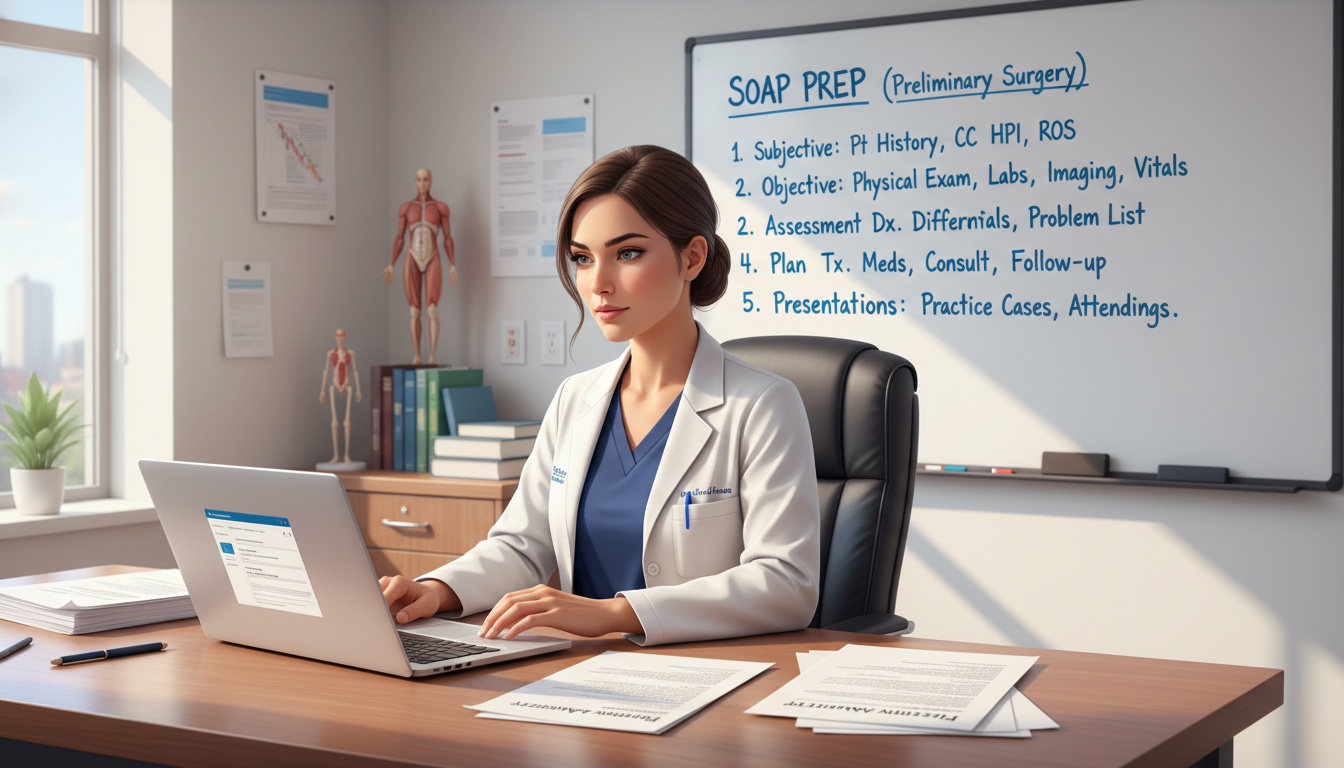
Preparing for the Supplemental Offer and Acceptance Program (SOAP) as a non-US citizen IMG applying to psychiatry residency is one of the highest-stakes weeks of your career. You have very little time, high competition, and extra visa and eligibility hurdles that US graduates do not face. Thoughtful SOAP preparation before Match Week can be the difference between scrambling in panic and executing a clear, realistic plan that maximizes your chances in psychiatry—and, if needed, in alternative specialties.
This guide walks you step-by-step through SOAP preparation specifically tailored to foreign national medical graduates targeting psychiatry residency in the US.
Understanding SOAP for Non-US Citizen IMGs in Psychiatry
Before you can prepare effectively, you must understand what SOAP is and how it affects a non-US citizen IMG interested in the psych match.
What is SOAP?
The Supplemental Offer and Acceptance Program (SOAP) is the formal, structured process NRMP uses during Match Week to fill unfilled residency positions with eligible unmatched or partially matched applicants. It replaces the old, chaotic “scramble.”
Key features:
- Occurs during Match Week (Monday–Thursday)
- You can apply only to programs listed as unfilled in the NRMP’s List of Unfilled Programs
- All communication and offers go through ERAS and NRMP, not via phone calls or cold emails
- There are several offer rounds; you can accept only one position and that acceptance is binding
If you’re aiming for psychiatry residency, SOAP may be your second chance at a psych position—or a strategic pivot into another specialty or a transitional year.
SOAP Eligibility: Special Considerations for a Foreign National Medical Graduate
To participate in SOAP, you must:
- Register for NRMP and remain unmatched or partially matched after the algorithm runs.
- Be ERAS-registered and have a certified ERAS application.
- For non-US citizen IMGs:
- You must be ECFMG certified or eligible according to the year’s specific rules:
- Usually: Passed required USMLE/ECFMG exams and had your credentials verified.
- Meet any state-specific requirements (some states require certain exams or documentation before rank lists or SOAP).
- You must be ECFMG certified or eligible according to the year’s specific rules:
For you as a non-US citizen IMG in psychiatry, there are two big twists:
- Visa: Not every program in SOAP can or will sponsor visas (J-1 or H-1B).
- Timing: Any missing documents (e.g., delayed ECFMG certification) can make you ineligible or less competitive, just when every hour counts.
Action item now (months before the Match):
Confirm your eligibility on ECFMG OASIS and ensure all documents and exam scores are processed well before Rank Order List deadlines.
Pre–Match Week SOAP Preparation: Laying the Groundwork
The worst time to learn about SOAP is Monday of Match Week. Your goal is to have a complete SOAP playbook ready before you find out if you matched.
1. Clarify Your Risk Profile and Goals in Psychiatry
As a non-US citizen IMG, your probability of matching into psychiatry varies based on:
- USMLE scores and number of attempts
- Year of graduation (YOG) and gap years
- US clinical experience (USCE) in psychiatry
- Quality of letters of recommendation
- Visa status (requires sponsorship vs. already on a suitable visa/green card)
Create a realistic ranking of goals:
- Ideal: Categorical Psychiatry position through main Match.
- High Priority in SOAP:
- Unfilled categorical Psychiatry positions.
- Unfilled preliminary or transitional year spots in psych-friendly hospitals (as a bridge for next year’s psych match).
- Acceptable Back-ups (if you want to be in the US system this year):
- Internal medicine prelim, family medicine, or other fields that keep you clinically active, if directed by your long-term plan.
Write this down now—when you are calm. It will guide your SOAP decisions later, when you’re under pressure.
2. Optimize Your Application Before SOAP
Your ERAS application is the same for the Match and SOAP. Once SOAP opens, you will have highly limited time to edit anything substantive.
Focus on:
a. Personal Statement Strategy
Create two versions now:
Psychiatry-focused personal statement
- Emphasize your sustained interest in psychiatry, mental health advocacy, and any psych-related research or experiences.
- Highlight strengths valued in psych:
- Empathy, communication, reflective capacity
- Interest in psychotherapy, neurobiology, social determinants of health
- Include brief, specific examples (e.g., work with underserved populations, psychiatric rotations, tele-psychiatry projects).
Generic back-up personal statement (if you might apply to another specialty in SOAP)
- Can be adapted quickly for internal medicine, transitional year, family medicine.
- Focus on adaptability, work ethic, and foundational clinical skills.
Store these documents clearly labeled so you can swap them in SOAP without rewriting from scratch under time pressure.
b. Psychiatry-Focused CV and Experiences
Ensure your ERAS experiences:
- Clearly label psychiatry electives, observerships, clerkships, and research.
- Include mental health–related volunteer work (e.g., crisis hotlines, community mental health clinics).
- Emphasize roles that show:
- Longitudinal patient relationships
- Cultural and language skills (particularly valuable in psych)
- Comfort with complex social and psychosocial factors
Avoid last-minute additions unless they’re significant and fully verifiable.
c. Letters of Recommendation (LoRs)
Prior to Rank List certification:
- Aim for at least 2 psychiatry LoRs, ideally from:
- US-based psychiatrists
- Faculty who directly supervised you in a psych setting
- At least one letter should strongly address:
- Your interpersonal skills
- Teamwork and professionalism
- Fit for psychiatry as a career
If you have multiple strong LoRs:
- Designate one primary psychiatry letter for all psych applications.
- Keep at least one more general clinical letter you can also use if you switch specialties during SOAP.

3. Visa Strategy and Documentation
For a non-US citizen IMG, visa readiness is essential SOAP preparation—not an afterthought.
Common scenarios:
- J-1 visa (ECFMG-sponsored):
- Most common pathway for foreign national medical graduates.
- Many psychiatry programs accept J-1; some only accept J-1, not H-1B.
- H-1B visa:
- Less common for psychiatry residency; requires:
- USMLE Step 3 passed (in most states)
- Program willing and institutionally able to sponsor H-1B.
- Less common for psychiatry residency; requires:
- Other status (e.g., F-1 OPT, dependent visa, green card):
- Clarify whether you need sponsorship or can work independently.
Action steps:
- Prepare a concise visa summary you can communicate in your application or correspondence:
- “Non-US citizen IMG, currently residing in [country], requires J-1 visa sponsorship.”
- Or: “Step 3 passed, eligible for H-1B if program sponsors; J-1 also acceptable.”
- Keep passport, ECFMG certificate (or verification letter), and USMLE transcripts quickly accessible.
In SOAP, you will need to quickly filter unfilled programs by visa sponsorship; being clear on your needs prevents wasted applications.
Week-by-Week Timeline: From Pre-SOAP to Match Week
4–8 Weeks Before Match Week: Build Your SOAP Toolkit
Develop a digital “SOAP Folder” on your computer or cloud drive:
- Final ERAS PDF copy (for reference)
- Psychiatry personal statement
- Back-up specialty personal statement(s)
- Visa summary document
- List of programs that historically are IMG- and visa-friendly in psychiatry and related fields (from past NRMP data, forums, and program websites)
- Template email phrases (professional, concise) for any allowed communication outside the formal SOAP offer process (e.g., pre-SOAP networking)
Even though direct solicitation is restricted during SOAP, having accurate program information ahead of time gives you an edge when choosing where to apply.
2–3 Weeks Before Match Week: Refine Your SOAP Strategy
Define your SOAP tiers (on paper):
Tier 1: Psychiatry programs (categorical, prelim, or combined) that:
- Accept J-1 (and/or H-1B if applicable)
- Have track record of taking IMGs
- Fit your score profile
Tier 2: Transitional year / prelim IM or other programs that:
- Are visa-friendly
- Provide strong clinical training and time for a future psych application
Tier 3: Absolute back-up options (only if you decide being in some US residency this year is more important than specialty choice).
Plan your application priorities in case you are:
- Unmatched with few or no interviews: You may need to cast a wider net beyond psychiatry.
- Unmatched but with multiple psych interviews: Reasonable to be more psych-focused in SOAP.
- Partially matched (e.g., advanced position but no prelim, or vice versa): Strategy will differ (more on this below).
Navigating Match Week: Step-by-Step SOAP Execution
Match Week is emotionally intense. Having a clear plan by Friday before Match Week makes your actions more rational and focused.
Monday Morning: “Did I Match?” – Interpreting Your Status
NRMP will tell you one of the following:
- Matched: Congratulations—SOAP does not apply.
- Partially Matched: (e.g., matched to advanced position, no prelim or TY, or the reverse)
- You may use SOAP to find the missing part (prelim/TY).
- Unmatched: Eligible for SOAP if you meet criteria.
Do not panic. Take a few hours to process emotionally, then move to structured action.
Accessing the List of Unfilled Programs
By Monday midday, NRMP releases the List of Unfilled Programs to eligible SOAP participants.
For a non-US citizen IMG interested in psychiatry:
Filter for Psychiatry first:
- Note all psych programs, their type (categorical, prelim, combined), and state licensure requirements.
- Immediately research visa sponsorship via:
- Program website
- FREIDA
- Past applicant reports (while remembering these may not be fully up to date)
Mark each program:
- Visa: J-1 only, H-1B, both, or none.
- IMG-friendliness: Based on known IMG residents, prior interview patterns, and mission statements.
If the psychiatry options are very limited or mostly not visa-friendly, decide how far you are willing to pivot:
- Add Internal Medicine, Family Medicine, Transitional Year, or other specialties to your target list if that aligns with your long-term plan and life circumstances.

Crafting Your SOAP Application List
SOAP has a capped number of applications you can send (commonly 45; confirm for your specific year).
Prioritization strategy for a non-US citizen IMG in psychiatry:
Top priority (first 15–20 slots):
- Visa-friendly psychiatry positions where your profile is reasonably competitive.
Next 10–15 slots:
- Other psychiatry programs with some unknowns about visa or IMG-friendliness but not clearly excluding IMGs.
Remaining slots (if needed and if you decide to broaden):
- Transitional Year or prelim Internal Medicine programs that:
- Sponsor your required visa
- Have a good reputation and potential psych rotations
- Alternative specialties only if you have enough genuine interest and can credibly adapt your application.
- Transitional Year or prelim Internal Medicine programs that:
Do not waste applications on:
- Programs clearly stating “no visa sponsorship” when you need one.
- Programs that specify “US graduates only” or “US MD/DO only.”
Tailoring Your Application During SOAP
You will not have time to write new personal statements for each program during SOAP. Instead:
- Use your psychiatry personal statement for all psych applications.
- Use your generic or alternative specialty personal statement for non-psych programs, quickly customizing the first paragraph if possible (e.g., mention internal medicine interests).
Update your ERAS program signaling and document assignments carefully:
- Ensure psychiatry LoRs are assigned to psych programs.
- More generic or internal medicine LoRs go to non-psych programs.
Double-check everything. In SOAP, simply avoiding errors (wrong specialty PS, wrong letters) can set you apart.
Strategic Considerations Specific to Psychiatry and Non-US Citizen IMGs
Unique Aspects of Psychiatry SOAP for IMGs
Psychiatry has become increasingly competitive, particularly in urban academic centers. In SOAP:
- Unfilled psych positions may be:
- In geographically less popular areas
- At newer or smaller programs
- Occasionally at programs open to IMGs but with specific preferences (e.g., strong Step scores, certain experiences)
As a foreign national medical graduate:
- Highlight your cultural and linguistic skills; psychiatry values ability to work with diverse populations.
- Emphasize any experience in cross-cultural psychiatry or mental health in resource-limited settings.
- If applicable, mention research or QI projects focused on mental health outcomes.
If You’re Partially Matched
If you matched into:
Advanced psychiatry position (PGY-2+) but lack a prelim/TY year:
- Target transitional year and prelim Internal Medicine or Surgery programs in SOAP.
- Clearly state in your PS or experiences that you already have an advanced psychiatry spot; reassure them you are committed to completing their year successfully.
- Focus on programs that sponsor your needed visa type.
Prelim year but no advanced position:
- Use SOAP to seek a categorical psychiatry position, but clarify:
- How your prelim year will complement psychiatry.
- Why you remain deeply committed to psych.
- Use SOAP to seek a categorical psychiatry position, but clarify:
If You Re-Enter Next Year’s Psych Match
If SOAP does not lead to a psychiatry position (or to any position you are willing to accept), your SOAP preparation is not wasted. You have:
- A refined psychiatry personal statement
- Defined program tiers
- Better understanding of visa and state nuances
If you enter a SOAP residency in another specialty, plan your path carefully:
- Maintain some involvement or interest in mental health (consults, research, electives).
- Avoid burning bridges; professionalism and strong evaluations help if you apply for psych again later.
Common Mistakes Non-US Citizen IMGs Make During SOAP—and How to Avoid Them
Waiting until Monday of Match Week to learn what SOAP is
- Instead: Prepare months in advance with the strategies above.
Ignoring visa issues until after submitting applications
- Instead: Filter and prioritize using visa policies from the start.
Over-focusing only on big city academic psychiatry programs
- Instead: Be open to community programs, smaller cities, and newer programs that may provide excellent training.
Using a generic personal statement for all specialties
- Instead: Have at least a distinct, psychiatry-focused statement and a flexible general statement.
Panic-applying to every unfilled spot regardless of fit
- Instead: Use your limited applications on realistic, visa-compatible, and strategically chosen programs.
Poor communication or unprofessional emails
- Any permitted communication (usually limited) must be concise, respectful, and error-free.
Mental Health and Professionalism During SOAP
Ironically, as someone pursuing psychiatry, you are at high risk of emotional distress during Match Week yourself.
Protect yourself by:
- Setting a daily structure: sleep schedule, designated work blocks, short breaks.
- Identifying at least one support person (friend, family, mentor) you can check in with.
- Avoiding endless social media scrolling and comparison with other applicants.
Remember that not matching in psychiatry on your first attempt does not define your capability as a future psychiatrist. Many psych residents and attendings matched on a second attempt or entered via non-linear paths.
FAQs: SOAP Preparation for Non-US Citizen IMG in Psychiatry
1. As a non-US citizen IMG, is it realistic to get a psychiatry residency through SOAP?
It is possible but more challenging than matching in the main psych match. Unfilled psychiatry positions may be limited and often in less competitive locations. Your chances improve if:
- Your scores and application are at least moderately competitive.
- You are flexible about geography and type of program.
- You have your visa strategy ready and are targeting visa-friendly programs.
Think of SOAP as one more opportunity, not a guaranteed second psych match.
2. Should I apply only to psychiatry programs in SOAP, or also to other specialties?
It depends on:
- How many psychiatry positions are available.
- How competitive you are compared with typical psych applicants.
- Your long-term goals and financial/life situation.
Many non-US citizen IMGs combine:
- A primary focus on psychiatry positions
- Some applications to transitional year or prelim internal medicine as a bridge.
Decide in advance whether you would accept a non-psych spot this year or prefer to reapply to psych next cycle.
3. What can I do now to improve my SOAP chances as a foreign national medical graduate?
Prioritize:
- Completing ECFMG certification requirements.
- Strengthening your psychiatry experiences and letters.
- Preparing two personal statements (psych-focused and general).
- Researching IMG- and visa-friendly programs.
- Clarifying and documenting your visa status and needs.
These steps not only help with SOAP preparation but also improve your main psych match prospects.
4. If I accept a non-psychiatry SOAP residency, can I still become a psychiatrist later?
Yes, but it requires careful planning and honesty:
- Many residents switch to psychiatry from internal medicine, family medicine, or transitional years.
- You must:
- Maintain an excellent record in your current program.
- Communicate professionally, without misleading anyone.
- Build or maintain mental health-related experiences as feasible.
However, switching specialties is not guaranteed and can be complex, especially with visa sponsorship considerations. Consider these factors before accepting a SOAP offer outside psychiatry.
Thoughtful, early SOAP preparation gives you control during one of the most stressful phases of residency applications. As a non-US citizen IMG aiming for psychiatry, understanding what SOAP is, planning your SOAP strategy, and aligning it with your visa reality and long-term career goals will put you in the strongest possible position—whether you secure a psych residency this year or build toward a successful psych match in the next cycle.