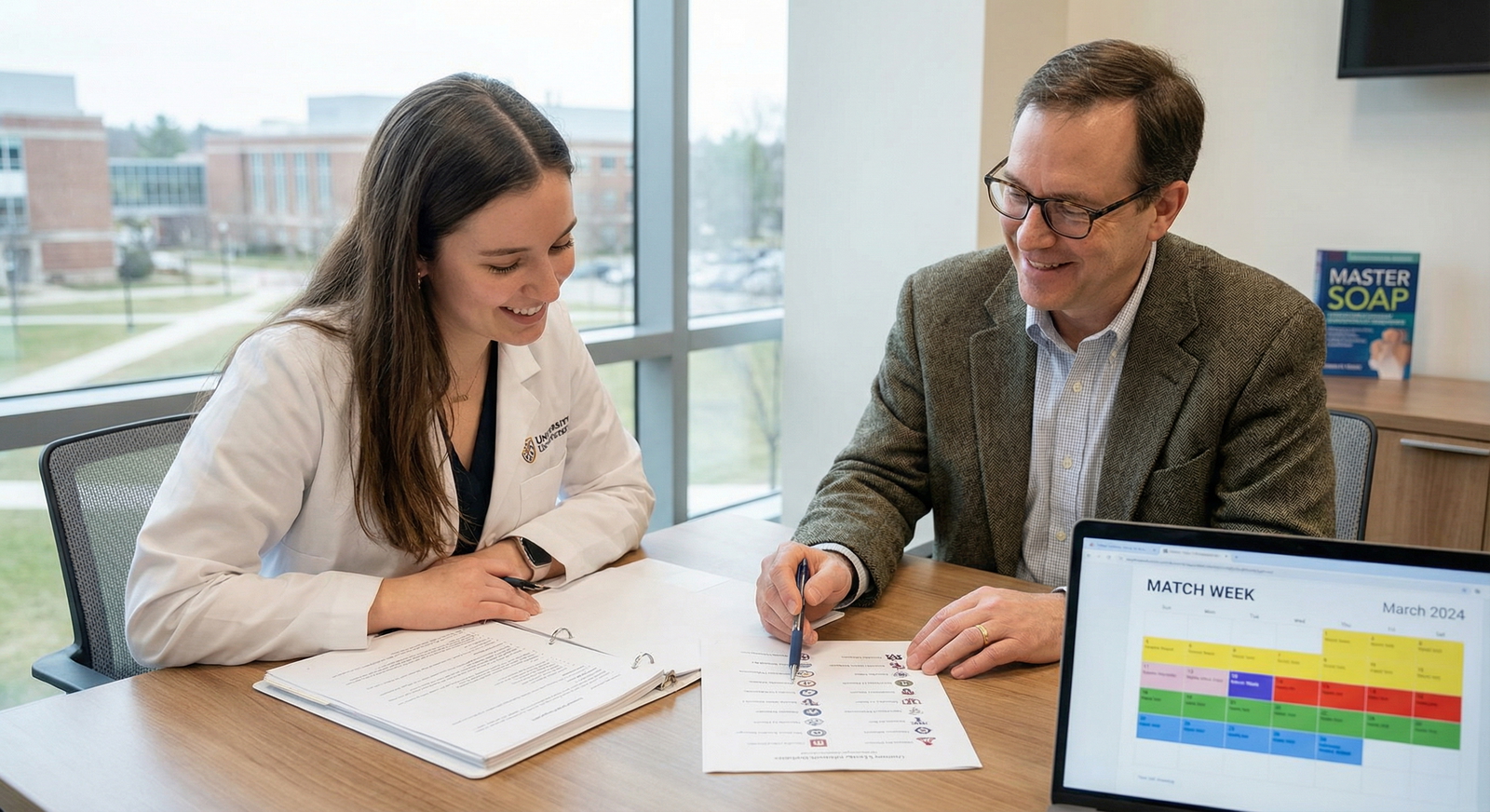
Preparing for the Supplemental Offer and Acceptance Program (SOAP) can feel overwhelming—especially as a US citizen IMG and even more so if you’re targeting a niche combined specialty like Medicine-Psychiatry (med psych residency). Yet with structured SOAP preparation, you can dramatically improve your chances of securing a solid position, even if it’s not in the exact program you initially envisioned.
This guide is written specifically for the US citizen IMG and American studying abroad who is interested in medicine psychiatry combined training or Psychiatry/IM-related pathways, and who wants a concrete, step-by-step plan to navigate SOAP calmly and strategically.
Understanding SOAP: What It Really Is (and Isn’t)
Before you can prepare well, you need to understand what is SOAP and how it works in practice.
What Is SOAP?
SOAP (Supplemental Offer and Acceptance Program) is an NRMP-managed process that allows unmatched or partially matched applicants to obtain unfilled residency positions in the week of Match. It replaces the old “scramble” with a more structured, time-limited, and rules-based system.
In short:
- Timeline: SOAP takes place during Match Week, typically Monday–Thursday.
- Who participates: Only applicants who are SOAP-eligible (verified as unmatched or partially matched by NRMP).
- Where it happens: All through ERAS and NRMP; no chaotic phone calls or mass faxing allowed.
- What you do: Apply in multiple waves to unfilled programs that participate in SOAP, then wait for and respond to offers.
SOAP doesn’t guarantee a residency position, but strong SOAP preparation can maximize your options and reduce panic.
SOAP Eligibility Basics for US Citizen IMGs
As a US citizen IMG (or American studying abroad), you are in a favorable category for many programs that consider IMGs. For SOAP, you must:
- Be registered for the Main Match with NRMP.
- Have your USMLE scores and ECFMG certification actions in order (or at least ECFMG certification expected if allowed for your grad year).
- Be unmatched or partially matched (e.g., matched to an advanced position but without a prelim year).
Programs often prioritize:
- US citizenship/green card over needing a visa.
- Passing Step scores (ideally first attempt).
- Some US clinical experience, especially in internal medicine and/or psychiatry.
- Clear, concise communication during SOAP.
If you suspect you may not match (borderline scores, limited interviews, mostly reach programs), your SOAP preparation should start months before Match Week, not after you see the “Did Not Match” message.
Strategic Mindset for a US Citizen IMG Targeting Medicine-Psychiatry
Combined medicine psychiatry programs are few and highly competitive, with relatively small class sizes. That makes it unlikely they will offer many SOAP positions in a given year. The key, therefore, is to:
- Understand your priority hierarchy (combined vs categorical).
- Prepare a flexible specialty strategy for SOAP.
- Align your documents and messaging to support that strategy.
Realistic Expectations About Med Psych in SOAP
Combined med psych residency programs:
- Have small intake (2–4 residents/year).
- Often fill through the Main Match.
- May or may not appear with unfilled positions during SOAP in any given year.
As a US citizen IMG, even with excellent preparation, relying solely on a combined program opening in SOAP is high-risk. You need a Plan A, B, and C:
- Plan A: Target any Medicine-Psychiatry combined openings (if they exist).
- Plan B: Strong applications to Internal Medicine or Psychiatry categorical programs that align with your interest in integrated care (e.g., strong CL psychiatry, primary care-mental health, or complex chronic disease).
- Plan C: Broader set of programs where your profile is competitive (e.g., prelim IM, transitional year, or categorical in another field you can live with).
SOAP success is not just “did I find a med psych spot?” but “did I secure a position that moves me toward my long-term goal of working at the intersection of medicine and psychiatry?”
How Programs View US Citizen IMGs in SOAP
During SOAP, program directors look for:
- Reliability: No professionalism red flags.
- Evidence you can pass boards: Passing USMLE scores; if Step 1 is pass/fail, Step 2 CK performance matters more.
- Fit and flexibility: Will you adapt quickly to their program environment under time pressure?
- Genuine interest in the specialty and program type.
Being a US citizen IMG is often an advantage because:
- They do not need to sponsor a visa.
- They may view you similarly to a US graduate from a less well-known school, especially if you have US clinical experience.
Your mission is to make it very easy for a busy PD in SOAP week to say, “This applicant can start here in July and succeed.”
SOAP Preparation Timeline: From Early Planning to Match Week
SOAP is a compressed process. The more work you do before results are released, the less you scramble emotionally and logistically.

3–6 Months Before Match: Build SOAP-Ready Foundations
Even while applying to and interviewing with your primary list of programs, quietly prepare for SOAP as a safety net.
Clarify Your SOAP Specialty Strategy
- Decide how broadly you’d be willing to go:
- Priority: Medicine-Psychiatry combined
- Very interested: Psychiatry categorical, Internal Medicine categorical
- Acceptable if needed: Prelim year in IM or transitional year
- Reflect this in:
- Personal statement drafts (more on that below)
- CV emphasis
- Referee selection (letters)
- Decide how broadly you’d be willing to go:
Draft Multiple Personal Statement Variants For SOAP, you’ll have limited time to tailor. Prepare 3 core versions now:
Medicine-Psychiatry Combined Focus
- Emphasize:
- Passion for integrated care
- Cases involving both chronic medical illness and psychiatric conditions
- Interest in CL psychiatry, psychosomatic medicine, or integrated primary care.
- Emphasize:
Psychiatry Categorical Focus
- Highlight:
- Longitudinal patient relationships
- Psychotherapy interest
- Rotations in psychiatry, addiction, consult-liaison.
- Any research or QI related to mental health.
- Highlight:
Internal Medicine Categorical Focus
- Focus on:
- Breadth of disease exposure
- Comfort managing complex medical problems
- Teamwork and inpatient/outpatient experiences.
- Focus on:
Keep each statement concise, specific, and honest. During SOAP, you can update or trim these, but having well-structured drafts gives you a huge head start.
Secure At Least 3–4 Strong Letters of Recommendation Ideally:
- 1–2 letters from Internal Medicine attendings (ward or clinic).
- 1–2 letters from Psychiatry attendings.
- If possible, one from a rotation or role that showcases integrated care (e.g., CL psych, psychosomatic medicine, primary care-mental health).
For SOAP, you can selectively assign letters to programs (e.g., more psych-heavy letters to psychiatry programs, more IM-heavy to IM programs).
Clean Up Your ERAS Application
- Revise your experiences to:
- Emphasize internal medicine and psychiatry-related activities.
- Clearly describe your role, not just duties.
- Double-check:
- Dates, locations, and descriptions for accuracy and clarity.
- No unexplained gaps (brief explanation in Experience or Education where needed).
- Prepare a short explanation for any setbacks (e.g., Step failures, extended time in medical school); you might be asked during SOAP interviews.
- Revise your experiences to:
1–2 Months Before Match: Contingency Planning and Research
Identify SOAP-Friendly Program Types While you won’t know which specific programs will be unfilled, you can identify:
- Regions willing to consider IMGs (Midwest, South, some community programs).
- Programs that historically have IM or Psych positions in SOAP.
- Programs that previously listed “US citizen or permanent resident preferred” vs. those heavily favoring H1B/J1.
Use:
- Prior year unfilled lists (from NRMP data summaries).
- Reddit/Student Doctor Network threads (with caution).
- Word of mouth from recent grads.
Clarify Your Non-Negotiables As a US citizen IMG, you often have more geographic flexibility than non-citizen IMGs. Still, decide now:
- Are there any absolutely unacceptable locations (e.g., due to family obligations)?
- Are you open to:
- Rural or less urban areas?
- Community-based vs university programs?
- Would you accept:
- Prelim-only if no categorical is available?
Having these decisions made in advance helps you respond quickly to SOAP offers without agonizing.
Mock SOAP Interviews Practice short, focused interviews that mirror SOAP reality:
- Format: 10–15 minutes, often by phone or video.
- Common questions:
- “Tell me about yourself.”
- “Why [Internal Medicine/Psychiatry/Med-Psych]?”
- “Why are you interested in a program like ours?”
- “What happened in this Match cycle?”
- “If we offered you a position, would you be willing to accept?”
Practice with:
- A faculty mentor.
- Advisor familiar with SOAP.
- Another US citizen IMG who has gone through SOAP.
1–2 Weeks Before Match: Final SOAP Preparation
Organize Your Documents Create a folder (digital) with:
- Updated CV.
- PDF of ERAS application.
- All personal statement versions.
- A short one-page “program priority list” based on your anticipated strategies.
Understand the SOAP Rules and Timeline Know:
- When you’ll find out if you matched (Monday of Match Week).
- When the List of Unfilled Programs becomes available.
- How many applications per SOAP round you can send (usually up to 45 total across all rounds, but confirm in the current NRMP guidelines).
- When you can receive and respond to offers.
Bookmark:
- NRMP SOAP guide.
- ERAS applicant instructions page.
Plan Your Support System SOAP is intense. Line up:
- At least one mentor/advisor you can text or email quickly.
- A family member or friend who understands that week will be stressful.
- A quiet workspace with reliable internet for the whole week.
Match Week: Executing a Focused SOAP Strategy
During SOAP week, time and emotional energy are limited. You need a clear decision framework, particularly as a US citizen IMG with potential flexibility around geography and program type.

Monday Morning: Learning You Didn’t Match
If you see “Did Not Match” or “Partially Matched”:
Take 30–60 minutes to process.
- Step away from the computer.
- Breathe, hydrate, and center yourself.
- This is a difficult moment, but it does not define your career.
Confirm Your Eligibility and Status
- Make sure NRMP shows you as SOAP-eligible.
- If partially matched (e.g., you matched an advanced Psych but not prelim year, or vice versa), your SOAP strategy may differ.
Initial Meeting With an Advisor (If Possible)
- Share:
- Your specialty interests.
- Any major red flags in your application.
- Realistic goals (combined vs categorical vs prelim).
- Share:
Reviewing the Unfilled List: Targeting Med Psych and Related Programs
Once the List of Unfilled Programs is released:
First pass:
- Highlight any Medicine-Psychiatry combined positions.
- Then highlight Psychiatry and Internal Medicine positions that:
- Consider IMGs.
- Do not require visa sponsorship (as a US citizen IMG, this is a plus).
- Are within geographical zones you can accept.
Second pass:
- Loosen restrictions:
- More community-based.
- Rural or smaller cities.
- Programs that may not be your dream but are acceptable.
- Loosen restrictions:
Triage Programs Into Tiers
- Tier 1: Strong fit, would accept immediately if offered (includes any med psych, psych, or IM programs aligned with your goals).
- Tier 2: Acceptable, but not ideal (location hardship, less academic, but solid training).
- Tier 3: Only if necessary (prelim spots, or less desirable due to significant tradeoffs).
This tiering guides your application distribution across rounds.
Crafting SOAP Applications Under Time Pressure
For each program type:
Medicine-Psychiatry Combined:
- Use your med psych–focused personal statement.
- Emphasize:
- Your dual interests.
- Integrated care experiences.
- Long-term career vision (e.g., CL psych, public sector integrated care, academic psychosomatic medicine).
Psychiatry Categorical:
- Use your psych PS or tweak the med-psych PS to emphasize:
- Strong interest in mental health.
- Breadth of psych experiences.
- Comfort with medically complex patients as a plus.
- Use your psych PS or tweak the med-psych PS to emphasize:
Internal Medicine Categorical:
- Use your IM PS or adjust med-psych PS to:
- Emphasize skill with complex, multi-morbidity patients.
- Highlight your interest in integrated behavioral health as a strength, not a distraction.
- Use your IM PS or adjust med-psych PS to:
Prelim/Transitional Year:
- Shorter, pragmatic PS; emphasize:
- Desire for strong clinical foundation.
- Reliability and work ethic.
- Plan to pursue psych or med-psych later.
- Shorter, pragmatic PS; emphasize:
Avoid obviously generic statements; even quick edits to mention the type of program (community vs academic, IM vs psych vs combined) can help.
Responding to Interviews and Offers
During SOAP, programs may:
- Contact you for short phone or video interviews.
- Ask pointed questions about your interest and willingness to accept an offer.
Key tips:
Be Reachable
- Keep your phone on, email open.
- Use professional voicemail greeting.
- Respond quickly but calmly.
Prepare a 60-Second Introduction For example, as a US citizen IMG aiming at med-psych or psych:
“I’m a US citizen IMG from [school], with strong interests in both internal medicine and psychiatry. My clinical training included multiple rotations where I cared for medically complex patients with significant psychiatric comorbidity, which is where I discovered my passion for integrated care. During this cycle I applied primarily to [Med-Psych/Psych/IM] programs, and I’m very interested in a position where I can continue developing my skills caring for patients at the interface of physical and mental health.”
Be Honest But Strategic About Not Matching Brief, non-defensive explanation:
- Limited number of interviews due to X.
- Competitive specialties or locations.
- Emphasize lessons learned and your readiness to start residency.
When Offers Come
- You’ll have a short time window to accept/decline.
- Use your pre-defined tier list:
- Accept Tier 1 offers promptly.
- Think carefully but quickly about Tier 2.
- Avoid holding out for perfect if a good offer is in hand; in SOAP, a solid training spot now is usually better than gambling on later rounds.
After SOAP: Next Steps Whether You Match or Not
If You Successfully SOAP Into a Program
Confirm Logistics
- Onboarding instructions.
- Background checks, drug screens, occupational health.
- Relocation timeline.
Reframe Your Path
- If you matched into IM or Psychiatry instead of combined med psych:
- Explore tracks or electives in:
- Consult-liaison psychiatry.
- Psychosomatic medicine.
- Integrated primary care/behavioral health.
- You can still build a career deeply rooted in both disciplines, even via a single specialty.
- Explore tracks or electives in:
- If you matched into IM or Psychiatry instead of combined med psych:
Leverage Your Med-Psych Interest
- Seek mentors with dual training or strong integrated-care focus.
- Engage in QI or research projects at the medicine-psychiatry interface.
If You Do Not Match Through SOAP
This is painful, but it is not the end of your path as a physician.
Comprehensive Debrief
- Meet with:
- A trusted faculty advisor.
- Your dean’s office (if available).
- A mentor familiar with the match for US citizen IMGs.
- Honestly review:
- USMLE performance.
- Number and type of programs you applied to.
- Red flags (failures, gaps, professionalism concerns).
- Strength of your clinical letters.
- Meet with:
Consider a 1-Year Strengthening Plan Options may include:
- Dedicated clinical research in IM, Psychiatry, or integrated care.
- Additional US clinical experience (observerships, externships).
- Earning a Master’s or certificate (e.g., public health, clinical research, bioethics) – only if it clearly strengthens your residency profile.
- Clinical work in allied roles (e.g., scribe, behavioral health coordinator), depending on visa and licensing constraints.
Re-Strategize for the Next Match
- Consider:
- Targeting a broader list of Psychiatry and Internal Medicine programs.
- Adjusting geographic preferences.
- Ensuring a compelling and updated personal statement that narrates your journey and growth.
- Consider:
Practical Tips Specific to US Citizen IMGs and “American Studying Abroad”
Highlight the Advantage of Citizenship
- In SOAP, programs may be relieved to know no visa sponsorship is needed.
- You don’t need to over-emphasize this, but ensure it’s clearly visible in:
- ERAS demographic section.
- If asked directly, communicate it clearly.
Explain Your Training Context Clearly
- As an American studying abroad, some PDs may be less familiar with your school.
- Briefly describe:
- The structure of your clinical years.
- The nature and depth of your US clinical experiences.
Use Your US Ties
- If you have:
- Home-state connections.
- Prior employment or education in certain regions.
- Mention these to programs there during SOAP interviews to reinforce your likelihood of staying and thriving.
- If you have:
Own Your Interest in Integrated Care
- Even if you can’t secure a combined med psych residency spot, your passion for the interface of medicine and psychiatry is an asset.
- Use it to:
- Differentiate yourself among IM and psych applicants.
- Signal long-term commitment to complex, underserved patient populations.
FAQ: SOAP Preparation for US Citizen IMG in Medicine-Psychiatry
1. As a US citizen IMG, should I prioritize combined Medicine-Psychiatry spots in SOAP or go straight for categorical IM or Psych?
If any medicine psychiatry combined positions appear in the unfilled list and you are truly committed to that path, it makes sense to prioritize them early—these are rare opportunities. However, the number of such spots is typically very small. Parallel planning is critical: apply simultaneously to Psychiatry and Internal Medicine programs where you’d be happy to train. Do not rely solely on med psych positions appearing; they may not exist in a given SOAP year.
2. How many specialties should I target during SOAP?
For most US citizen IMGs interested in integrated care, focusing on 2–3 aligned pathways works best:
- Combined Med-Psych (if available).
- Psychiatry categorical.
- Internal Medicine categorical (and possibly prelim IM or transitional year as backup).
Going broader into many unrelated specialties can dilute your story and make your application seem unfocused. Depth and clear rationale in a couple of specialties usually outweigh a scattershot approach.
3. What is SOAP preparation I can do if I’m still several months before Match and not sure I’ll need SOAP?
Key high-yield tasks:
- Draft multiple personal statements (med-psych, psych, IM).
- Secure strong letters from IM and psych attendings.
- Clean and update your ERAS experiences with clear, impact-focused descriptions.
- Research IMG-friendly regions and programs.
- Practice short, focused interviews.
Even if you ultimately match in the main cycle, these efforts will strengthen your candidacy and help you articulate your interests better.
4. If I SOAP into an Internal Medicine or Psychiatry program, can I still build a career similar to a med psych residency graduate?
Yes. While a combined med psych residency gives you formal dual board eligibility, you can still build a strongly integrated career from a single specialty by:
- Choosing electives in consult-liaison psychiatry, psychosomatic medicine, or integrated primary care.
- Participating in collaborative care or primary care-mental health integration projects.
- Working in settings where medical and psychiatric comorbidities are common (e.g., VA systems, safety-net hospitals, CL services).
- Seeking mentors who practice at the medicine-psychiatry interface.
Your clinical focus, not just your degree, will define your practice over time.
Focused, early SOAP preparation positions you, as a US citizen IMG or American studying abroad, to navigate Match Week with clarity and purpose. Whether your path leads directly into a medicine psychiatry combined program, a psychiatry or internal medicine categorical residency, or a prelim year that builds your foundation, the goal is the same: secure meaningful training that moves you closer to the integrated, patient-centered career you envision.