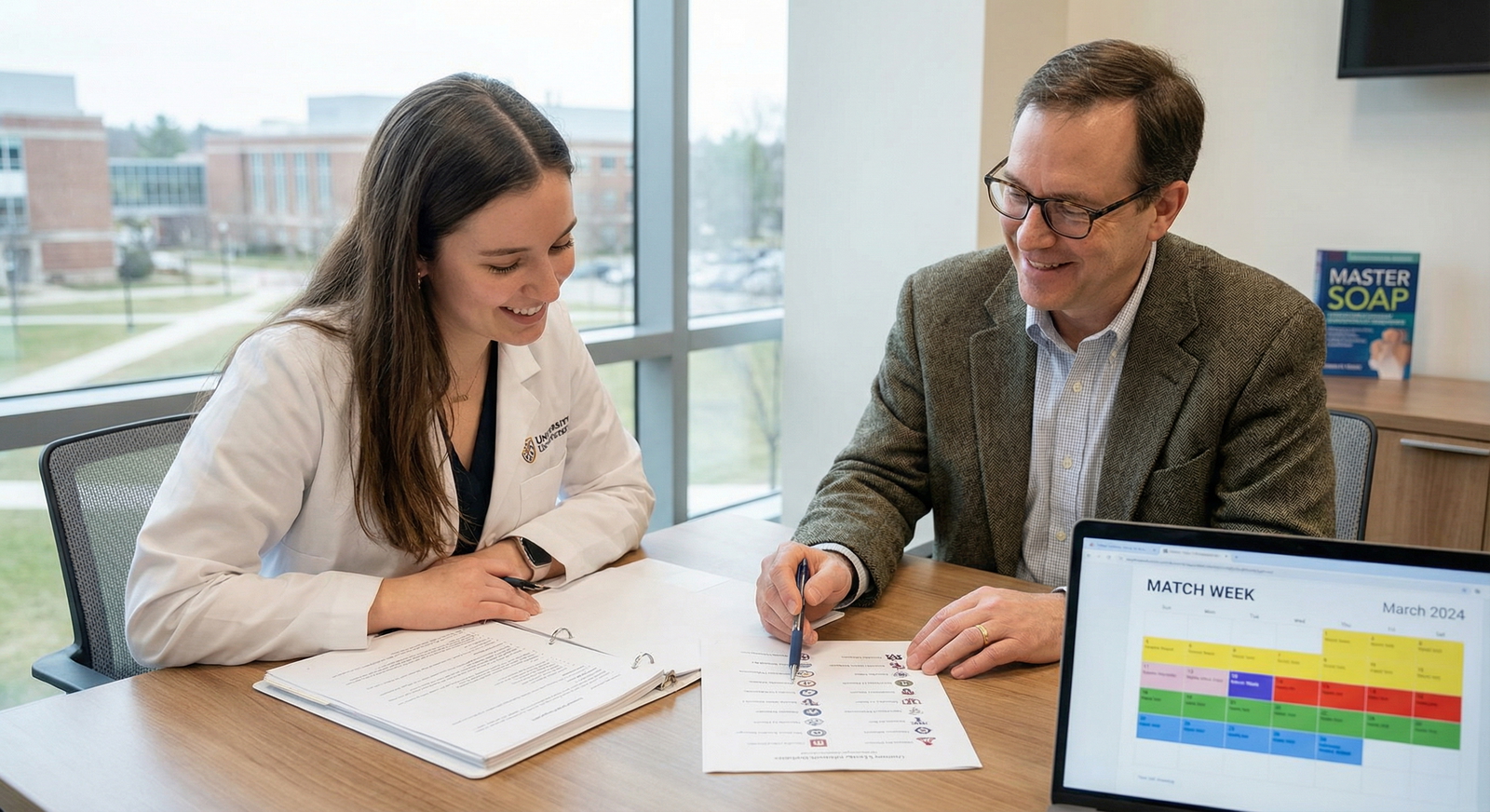
Understanding SOAP for MD Graduates in Medicine-Pediatrics
The Supplemental Offer and Acceptance Program (SOAP) can feel overwhelming—especially if you’re an MD graduate who carefully targeted Medicine-Pediatrics (Med-Peds) programs in the main allopathic medical school match and then learns on Monday of Match Week that you are unmatched or partially matched.
To be effective in SOAP, you need:
- A clear understanding of what SOAP is,
- How it specifically impacts Med-Peds applicants, and
- A step-by-step preparation plan you can execute before and during Match Week.
This article walks you through SOAP preparation tailored to an MD graduate interested in Med-Peds, with concrete strategies, timelines, and examples you can apply immediately.
What Is SOAP? (And How It Differs from the Main Match)
SOAP is an NRMP-managed process during Match Week that connects eligible unmatched or partially matched applicants with unfilled residency positions. It is not a separate match but a structured, time-limited system of applications and multiple offer rounds.
Key features of SOAP:
- Eligibility-based: Only applicants who are unmatched or partially matched and registered for the Main Match are eligible.
- Limited applications: You can apply to up to 45 programs total through ERAS during SOAP.
- Multiple offer rounds: Programs review applications and may extend offers in several rounds (Monday–Thursday of Match Week).
- No direct cold-calling programs: Communication is restricted and programs may contact you, but you cannot cold-call or email them unless they reach out first (with some exceptions for pre-existing relationships—always verify current NRMP rules).
For an MD graduate in Medicine-Pediatrics, SOAP can serve three main purposes:
- Obtain a categorical Med-Peds residency position (if any remain available, though Med-Peds is often very competitive with few or no SOAP spots).
- Secure a categorical IM or Pediatrics position as an alternative that still aligns with your long-term career.
- Enter a preliminary or transitional program strategically (for example, a prelim year in internal medicine) while planning a future reapplication to Med-Peds.
Understanding these paths and preparing for all of them is the core of effective SOAP preparation.
Pre-SOAP Preparation: What to Do Months Before Match Week
SOAP is most successful when you’ve prepared well before Match Week. Think of this as building a “SOAP-ready” application and playbook you can activate if needed.
1. Clarify Your Career Priorities Within Med-Peds
You targeted Med-Peds for a reason; your SOAP strategy should be consistent with those motivations.
Reflect on:
Why Med-Peds?
- Longitudinal care across the lifespan?
- Interest in complex chronic disease management?
- Desire to work with underserved populations?
- Interest in combined adult and pediatric subspecialties (e.g., rheumatology, cardiology, hospitalist work)?
Your acceptable alternatives if Med-Peds is unavailable in SOAP:
- Categorical Internal Medicine (IM)?
- Categorical Pediatrics?
- Combined training in another pathway?
- Prelim year with reapplication?
Write down a priority list before Match Week, for example:
- Categorical Med-Peds
- Categorical Internal Medicine in a program with strong Med-Peds culture or Med-Peds faculty
- Categorical Pediatrics in a program with strong continuity clinic and complex care
- Preliminary Internal Medicine in a supportive teaching hospital
This clarity helps you make rapid, rational decisions when SOAP positions are released and time pressure is high.
2. Optimize Your Application for SOAP
Most of your ERAS and allopathic medical school match materials carry over into SOAP, but tightening and tailoring them can significantly improve your chances.
Focus areas:
Personal Statement Strategy
Have two to three pre-written statements saved and ready to deploy:
Version A: Med-Peds–focused
Emphasize:- Bimodal training interest (adults and children)
- Longitudinal care
- Transitions of care
- Combined adult and pediatric experiences in medical school
Version B: Internal Medicine–focused
Emphasize:- Adult medicine, inpatient and outpatient
- Chronic disease management, complex co-morbidities
- Clinical reasoning and evidence-based practice
- Any IM sub-I’s, QI projects, or research
Version C: Pediatrics–focused
Emphasize:- Child development, family-centered care
- Communication with families and children
- Pediatric electives, advocacy, community health
You can also create a short “general personal statement” if you anticipate applying broadly to prelim or transitional year positions.
Actionable tip:
Write and edit these statements before February. Have your dean’s office, advisor, or a Med-Peds faculty mentor review them for alignment and clarity.
CV and ERAS Application Tightening
Even though you can’t rewrite everything during SOAP, you can make small but impactful edits before ERAS locks prior to Match Week:
Ensure Med-Peds–relevant experiences are clearly labeled:
- Combined adult/peds rotations
- Transition-of-care clinics
- Global health with wide age range
- Continuity experiences where you saw patients across age groups
Reword experience descriptions to highlight:
- Leadership, teamwork, adaptability
- Procedural skills and systems-based practice
- Communication with both adult and pediatric patients/families
Confirm accuracy of:
- USMLE scores
- Graduation date and status
- Contact information
- Visa status (if applicable)
Letters of Recommendation (LoRs)
For Med-Peds, ideally you have:
- At least one strong IM letter
- At least one strong Pediatrics letter
- A Med-Peds letter, if your school has a Med-Peds program or faculty
If possible, secure LoRs that are flexible—letters that speak to your strengths in both adult and pediatric settings can help for Med-Peds, IM, and Peds programs.
3. Build a Realistic SOAP Contingency Plan
Take a best- and worst-case planning approach:
- Best case: A few Med-Peds SOAP positions open.
- More common case: No Med-Peds SOAP positions, but IM and Peds spots are available.
- Worst case: Only prelim IM, transitional year, or non–Med-Peds categorical specialties remain.
Plan now:
- Which geographic regions are you open to in SOAP that you did not rank highly in the main match?
- Which program types (community vs academic, size, patient population) are acceptable?
- How far are you willing to deviate from Med-Peds to ensure you start residency this year?
Share this plan with a trusted advisor or Med-Peds program director so they can help you quickly prioritize when the list of unfilled programs goes live.

Step-by-Step SOAP Preparation During Match Week
When Monday of Match Week arrives and you learn you are unmatched or partially matched, emotions run high. Having a structured operational plan is crucial.
Monday Morning: Confirm Status and Gather Support
Check NRMP results immediately when released.
- Are you fully unmatched or partially matched (e.g., advanced position but no prelim year)?
Contact your Dean’s office or student affairs as soon as possible.
- Most allopathic medical schools have a SOAP response team: deans, advisors, and sometimes faculty from multiple specialties.
- Specifically request someone familiar with Med-Peds or combined training if available.
Secure private space and technology:
- Reliable internet
- Laptop with access to ERAS and NRMP
- Phone for potential program-initiated calls
Treat this like a high-stakes job-hunt war room for the week.
Monday Midday: Analyzing the Unfilled List
Once the List of Unfilled Programs becomes available (to schools and candidates via ERAS/NRMP per current rules), take a systematic approach.
Prioritize Categories
Work with your advisor to divide programs into tiers:
Tier 1: Med-Peds programs
- These are rare in SOAP; if any appear, they should be top priority.
- Review:
- Location
- Program size (e.g., 4–6 per class vs small)
- Clinical settings (academic, community, hybrid)
- Past acceptance of SOAP candidates
Tier 2: Categorical Internal Medicine and Pediatrics
- Preference to programs that:
- Have or are affiliated with a Med-Peds residency
- Have Med-Peds faculty
- Offer robust combined clinics or transition-of-care experiences
- These settings may allow you to maintain Med-Peds–oriented career goals even without dual boarding.
- Preference to programs that:
Tier 3: Transitional and Preliminary Year Spots
- Internal Medicine prelim year is usually most relevant to later Med-Peds or IM reapplication.
- Transitional year can be useful for broad exposure and time to reapply, but verify:
- Support for residents reapplying
- Historical success of past prelims/transitionals in landing categorical spots
- Other prelims (e.g., surgery, anesthesiology) may be less aligned with Med-Peds goals.
Tier 4: Other categorical specialties
- Consider only if you’re truly open to changing long-term career direction.
Create a shared list (e.g., spreadsheet) with columns:
- Program name
- Specialty (Med-Peds, IM, Peds, TY, Prelim)
- State/region
- Program characteristics (academic/community, Med-Peds faculty?)
- Priority rank (1–3)
- Notes for tailored application content
Monday Afternoon–Evening: Crafting a Targeted Application Strategy
You can send up to 45 SOAP applications total. Use them intentionally.
Recommended Distribution for a Med-Peds–Focused MD Graduate
Numbers will vary by year, but a general framework:
- Up to 5–10 applications to Med-Peds (if they exist in SOAP; often it will be 0–5).
- 15–25 applications to categorical Internal Medicine programs that align well with your Med-Peds interests.
- 10–15 applications to Pediatrics programs that fit your career goals.
- Remaining applications (if any) to transitional and preliminary IM spots as strategic backup.
Adjust in real-time based on actual unfilled list. Don’t waste all 45 slots on a single category if those programs are highly competitive and few in number; diversify enough to maximize the chance of securing a position.
Tailoring Your Materials in ERAS During SOAP
For each specialty:
Med-Peds programs
- Use your Med-Peds personal statement.
- In ERAS, highlight combined experiences and transitions of care in CV narrative fields.
- If space allows in supplemental questions, explicitly connect your goals to their program structure.
Internal Medicine programs
- Use your IM-focused statement.
- Emphasize how your interest in Med-Peds translates into:
- Strong commitment to adult complex care
- Comfort with vulnerable and underserved populations
- Avoid framing Med-Peds as a “backup lost”; instead, present IM as a core component of your original interest.
Pediatrics programs
- Use your Peds-focused statement.
- Highlight:
- Passion for child health and advocacy
- Longitudinal relationships with families
- Experiences with chronic pediatric conditions, NICU, PICU (if applicable)
Transitional/Prelim programs
- Use a concise, honest statement that:
- Acknowledges your long-term interest in Med-Peds/IM/Peds
- Emphasizes your hard work, team orientation, and adaptability
- Stresses your motivation to make the most of a one-year position
- Use a concise, honest statement that:
Work quickly but carefully. Small customizations—even a single targeted paragraph—can differentiate you from applicants using generic materials.

Navigating SOAP Communications and Offers
Communication Rules and Professionalism
During SOAP, programs may initiate contact with you. You generally:
- Can respond to program-initiated messages or calls
- Cannot cold-call or email programs that haven’t contacted you (check the latest NRMP rules each year)
- Should maintain professionalism and courtesy at all times
If a Med-Peds, IM, or Peds program reaches out:
- Answer promptly and politely
- Be prepared to articulate:
- Why their program fits your goals
- How your med-peds orientation enhances your suitability
- Your readiness to start immediately in July
Have a SOAP talking-points document printed or open on your screen:
- 3 key strengths
- 2–3 examples of resilience or adaptability
- 1 succinct explanation of why you’re in SOAP that is honest but positive:
- Example:
“I applied to a relatively narrow set of Med-Peds programs, and in hindsight I may have under-ranked some great programs. I’m very committed to combined or closely related training and am excited about the opportunity to contribute and grow in your program.”
- Example:
Rapid Interview Preparation
Some programs conduct brief telephone or video interviews during SOAP. Prepare as you would for any residency interview but with a focus on:
- Concise responses (SOAP timelines are tight)
- Honest but tactful explanation of:
- Why you went unmatched
- Why you’re applying to that specific specialty/program in SOAP
- Emphasis on:
- Work ethic
- Ability to adapt under pressure
- Teamwork and communication
Common SOAP interview questions for Med-Peds–oriented applicants:
- “Tell me about your interest in Med-Peds and how it relates to applying here.”
- “Why do you think you did not match initially?”
- “What have you learned from this process?”
- “If you join us, how will you approach this year and your long-term career goals?”
Craft 30–60 second answers and practice out loud with a friend, advisor, or mirror.
Handling SOAP Offer Rounds Strategically
SOAP offers are extended in rounds throughout Wednesday and Thursday of Match Week. When you receive an offer, you have a very limited time window to:
- Accept
- Reject
- Or let it expire (never recommended)
Key principles for MD graduates in Med-Peds:
Know your hierarchy before offers arrive
Example:- Any categorical Med-Peds offer from an accredited program you can realistically attend = Accept immediately
- Categorical IM/Peds at a supportive program that aligns with your goals may be better long-term than a random Med-Peds program that’s a poor fit—but realistically, any Med-Peds offer is usually extremely valuable.
Avoid waiting for a “perfect” offer that may never come
If you receive a strong categorical IM or Peds offer from a program you can see yourself attending, it may be wiser to accept than to gamble on a later round.Discuss offers with your advisor quickly
Many schools have advisors on-call specifically during SOAP rounds to help you decide in real-time.
Remember: the goal is to secure a solid training environment where you can grow into the kind of Med-Peds-oriented physician you envisioned—even if the pathway becomes IM or Peds alone.
Post-SOAP Outcomes and Long-Term Med-Peds Career Strategy
Your SOAP outcome is important, but it does not fully define your career. Think ahead about each scenario.
If You Match into Categorical Med-Peds via SOAP
- Celebrate—and quickly pivot to onboarding:
- Complete required paperwork
- Reach out to program coordinator to introduce yourself
- Ask about reading lists or pre-arrival preparation
- Recognize that your route (MD graduate residency via SOAP) is not unusual in competitive fields.
- Be proactive from day one:
- Seek mentorship
- Engage in projects or QI early
- Demonstrate reliability and resilience—your SOAP journey becomes a story of perseverance.
If You Match into Categorical IM or Peds
You can still embody much of what drew you to Med-Peds:
Focus on:
- Adult chronic disease, transitions of care, or complex adult-pediatric conditions (IM)
- Longitudinal pediatric care, high-risk groups, and transitional services (Peds)
Seek:
- Programs or faculty who have Med-Peds backgrounds or strong collaboration with the complementary department
- Electives in the “other” age group (e.g., pediatric experiences during IM residency via electives, or adult subspecialty exposure during Peds)
You may:
- Develop a career in hospitalist medicine, primary care, or subspecialty fields that work closely with the other age group.
- Consider fellowships that engage both adults and children (e.g., palliative care, global health, adolescent medicine, complex care).
If You Match into a Preliminary or Transitional Year
This path can still be very strategic:
Excel clinically
- Become a resident known for work ethic, reliability, and teachability.
- Secure strong letters of recommendation from faculty in IM or Peds.
Plan your reapplication early in the year
- Meet with Med-Peds and IM/Peds program directors to refine your SOAP and application strategy.
- Address any application deficits:
- Step scores
- Gaps in clinical performance
- Limited interview presence or personal statement quality
Update your application materials
- New LoRs
- Updated personal statements reflecting what you’ve learned
- Evidence of professional growth and resilience
Many Med-Peds and categorical IM/Peds programs see perseverance and improvement after a prelim year as a positive attribute, not a liability.
Practical SOAP Preparation Checklist for MD Graduates in Med-Peds
Use this as a working list:
3–6 Months Before Match Week
- Clarify long-term goals: Med-Peds vs IM vs Peds vs prelim strategy
- Draft 2–3 personal statements (Med-Peds, IM, Peds, optional general)
- Confirm strong LoRs from IM and Peds (and Med-Peds if possible)
- Optimize ERAS entries for Med-Peds–relevant experiences
- Discuss SOAP possibilities with your dean or advisor even if you expect to match
1–2 Months Before Match Week
- Update CV and ensure no errors in ERAS
- Create a preliminary list of programs of interest in IM and Peds that you’d consider in SOAP
- Ask advisors what your “risk profile” for going unmatched might be (scores, geographic limits, etc.)
1–2 Weeks Before Match Week
- Review NRMP SOAP rules for the current year
- Prepare template notes for prioritizing programs (spreadsheet)
- Draft 4–5 SOAP phone/video interview answers and practice them
Match Week
- Confirm unmatched/partially matched status on Monday
- Meet with SOAP advisor/committee immediately
- Analyze unfilled list and categorize programs into tiers
- Select up to 45 programs strategically, with a Med-Peds/IM/Peds emphasis
- Tailor personal statements and submit applications as early as allowed
- Stay available for program-initiated communication; keep phone and email monitored
- Evaluate offers in each SOAP round with your advisor; accept a strong, realistic offer rather than waiting for perfect
FAQs: SOAP Preparation for MD Graduates in Medicine-Pediatrics
1. As an MD graduate in Med-Peds, should I apply only to Med-Peds positions in SOAP?
No. Med-Peds positions in SOAP are rare and usually very limited in number. If there are any Med-Peds spots, you should prioritize them, but it’s risky to use all 45 applications on Med-Peds alone. A balanced approach typically includes:
- Med-Peds programs (if any)
- Categorical Internal Medicine programs
- Categorical Pediatrics programs
- Transitional or preliminary IM programs as backup
This diversified strategy increases your chance of securing a strong MD graduate residency position while staying close to your original Med-Peds goals.
2. How should I explain being in SOAP during interviews or to programs?
Be honest, concise, and constructive. Example:
“I applied to a fairly focused set of Med-Peds programs and in hindsight was probably too restrictive geographically. I’ve taken this as an opportunity to reflect on my priorities and broaden where I’m willing to train. My interest in caring for complex patients across the lifespan remains strong, and I’m very motivated to bring that commitment to your program.”
Avoid blaming programs or the system. Emphasize what you’ve learned and how you’re moving forward.
3. What if I don’t get a Medicine-Pediatrics or categorical IM/Peds position through SOAP?
If you accept a preliminary or transitional year:
- Focus on excelling clinically.
- Build strong faculty relationships and LoRs.
- Start planning a reapplication strategy early, ideally with guidance from Med-Peds or IM/Peds program directors.
Your route may be longer, but many physicians reach fulfilling Med-Peds-like careers through IM or Peds training plus carefully chosen fellowships or practice settings.
4. Is SOAP viewed negatively by future programs or employers?
Not inherently. Many applicants enter their MD graduate residency through SOAP and go on to successful careers. Programs and employers tend to focus far more on:
- Your performance as a resident
- Reliability, professionalism, and teamwork
- Clinical competence and patient care
- Commitment to growth and improvement
If anything, navigating SOAP successfully can showcase resilience, maturity, and adaptability—qualities highly valued in Medicine-Pediatrics and all of medicine.
By understanding what SOAP is, preparing early, and executing a clear, Med-Peds–informed strategy during Match Week, you give yourself the best chance of securing a residency position that aligns with your skills, values, and long-term aspirations.