
Understanding SOAP for the EM‑IM Applicant
The Supplemental Offer and Acceptance Program (SOAP) can feel intense, especially for an MD graduate targeting a competitive combined specialty like Emergency Medicine-Internal Medicine (EM IM). Yet, with deliberate SOAP preparation, the process becomes structured and manageable.
The key points to understand up front:
- SOAP is not a second match; it is a rapid, structured series of offer rounds to fill unfilled positions in accredited programs.
- Timing is compressed—critical decisions are made in hours, not weeks.
- Preparation must begin well before Match Week—ideally when you finalize your ERAS application.
For an MD graduate from an allopathic medical school, the SOAP pathway can be a powerful safety net—but only if you understand what it is, how it works, and how to tailor it to the unique realities of emergency medicine internal medicine training.
What Is SOAP?
SOAP (Supplemental Offer and Acceptance Program) is the process NRMP uses to:
- Allow unmatched or partially matched applicants to apply to unfilled residency positions.
- Allow programs with unfilled slots to rapidly review applicants and extend offers.
Key elements of what is SOAP:
- Who is eligible?
- Registered for the Main Residency Match.
- Unmatched or partially matched on Monday of Match Week.
- Not withdrawn, not barred by NRMP.
- Where does SOAP happen?
- All through ERAS and NRMP systems—no direct offers outside the process.
- When?
- Starts Monday of Match Week (unmatched status notification).
- Application window opens a few hours later.
- Offer rounds run Wednesday–Thursday.
For an MD graduate residency applicant, particularly from an LCME-accredited allopathic medical school, SOAP is often more favorable than for some other applicant groups because:
- Many programs explicitly prefer US MD graduates.
- You may have a stronger record of core clerkships and standardized exams.
- You are already fully aligned with the ACGME training environment.
However, combined EM IM residency programs rarely enter SOAP due to their small size and strong demand. Your SOAP strategy must therefore be broader than “EM IM or bust” while still making use of your dual-interest profile.
Strategic Framework: Planning for SOAP Before You Need It
Effective SOAP preparation should begin months before Match Week—even if you are confident you will match. Planning early is a sign of professionalism, not pessimism.
1. Risk Assessment: Where Do You Stand?
Before you can build a backup plan, you need an honest evaluation of your match risk in EM-IM and related fields.
Factors that increase risk for allopathic medical school match in EM IM:
- EM or IM exam scores below a program’s typical range (USMLE Step 1/2, COMLEX if applicable).
- Limited or no EM rotations at academic centers with EM-IM combined programs.
- Mixed or modest SLOEs (Standardized Letters of Evaluation) in EM.
- Late career decision for EM or EM IM, with minimal track record in the field.
- Prior exam failures or academic struggles.
- Narrow geographic restrictions or only a small number of applications.
- Heavy emphasis on only EM IM combined programs with few categorical backups.
If you see multiple risk factors, you should treat SOAP preparation as essential.
2. Define Your “Plan B” and “Plan C”
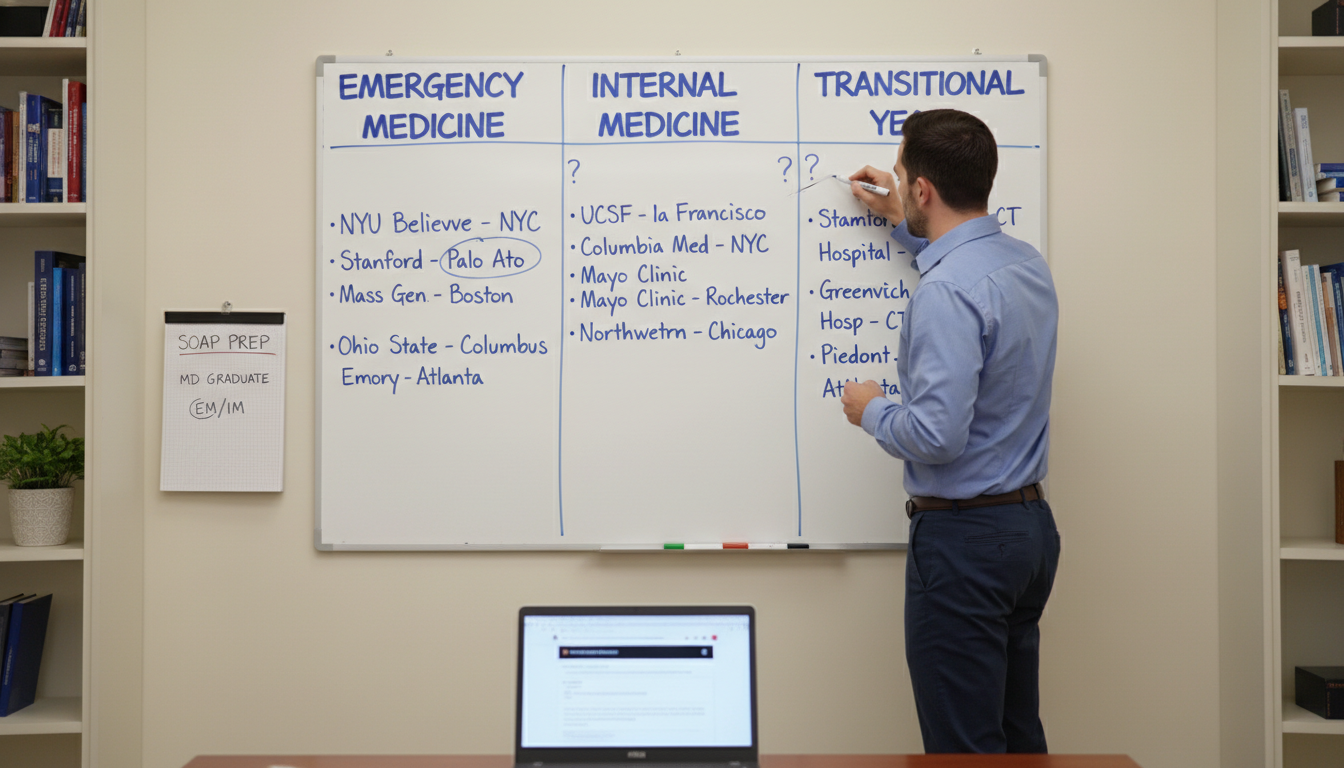
For an EM-IM–focused MD graduate, consider realistic backup pathways:
- Plan A (primary goal)
- EM IM combined residency.
- Plan B (closely related, still aligned with your interests)
- Categorical Emergency Medicine.
- Categorical Internal Medicine.
- Preliminary medicine year with later EM or critical care possibilities.
- Plan C (more flexible options)
- Transitional year (if available in SOAP).
- Other core specialties where your application is competitive and your interests are acceptable (e.g., family medicine with EM fellowship aspirations, internal medicine with plans for critical care, hospital medicine, etc.).
Your SOAP strategy will most likely draw from Plan B and Plan C, because EM IM combined spots almost never appear in the SOAP residency lists. However, your EM‑IM profile—broad clinical interests, high acuity comfort, strong medicine and acute care exposure—can be highly appealing to:
- EM programs that need residents comfortable with complicated inpatient medicine.
- IM programs that value interest in acute care, ICU, or hospitalist careers.
Building Your SOAP Toolkit: Documents, Messaging, and Logistics
The compressed SOAP timeline means you will not have time to rewrite documents from scratch. Your goal is to enter Match Week with a fully prepared, flexible application toolkit.
1. Personal Statement Strategy for SOAP
You should have at least three personal statements prepared by late January or early February:
Core EM-IM Statement
- Already used for combined EM IM programs and possibly some EM applications.
- Focuses on your passion for acute care and longitudinal internal medicine complexity.
Emergency Medicine–Focused Statement
- Removes heavy emphasis on longitudinal clinic, rounds, and chronic disease management.
- Emphasizes:
- Rapid decision‑making.
- High-acuity environments.
- Team-based care in the ED.
- Experience in EM rotations and SLOEs.
- Useful if unfilled EM positions appear in SOAP.
Internal Medicine–Focused Statement
- Emphasizes:
- Thorough diagnostic thinking.
- Longitudinal relationships.
- Inpatient and outpatient experiences.
- Interest in critical care, hospital medicine, or subspecialty training.
- Useful if unfilled IM positions are present.
- Emphasizes:
Optional additional statements:
- Transitional or Preliminary Year PS
- If you would accept a high-quality prelim or TY year as part of your long-term path.
- Geographically tailored PS
- For example, if you have strong ties to a particular region more likely to have unfilled spots.
Actionable tip:
Keep all versions updated with:
- Correct year.
- No specialty mismatches (e.g., “I want to be an emergency physician” in your IM PS).
- Current experiences and no errors in program names.
You can upload all versions into ERAS early; during SOAP you simply assign the right statement to each program.
2. Letters of Recommendation (LoRs) and SLOEs
For combined EM IM and SOAP backup into EM or IM, aim for:
- At least two EM SLOEs (for EM or EM IM interest).
- At least one IM letter (especially from an inpatient IM attending or program director).
- An additional letter showing character, work ethic, or leadership (surgery, ICU, or sub‑I can work well).
For SOAP:
- Ensure all LoRs are uploaded and released to ERAS well before Match Week.
- Avoid letters that are obviously specialty‑specific in the wrong way (e.g., a strongly surgical‑oriented letter for an IM SOAP plan, unless it speaks to your clinical reasoning and internal medicine‑relevant skills).
Programs understand SOAP is a second‑chance process. A slightly imperfect letter mix is not fatal, but missing core EM or IM evaluations can limit options.
3. CV, ERAS Application, and Updates
Your ERAS application is locked in before SOAP—there is no separate SOAP application form. However, you can:
- Upload additional documents (e.g., updated personal statements).
- Sometimes communicate significant updates via email if programs allow (e.g., new publication, post‑Match Week exam pass).
Before February:
- Review your ERAS for:
- Clarity of your clinical interests (EM, IM, or both).
- Any red flags that might need addressing in interviews (gaps, failures, professionalism issues).
- Consistent narrative: EM‑IM applicants should show both acute care and longitudinal internal medicine engagement.
Maintain an updated CV or “SOAP summary” (for your own use) so you can quickly:
- Tailor your talking points before interviews.
- Provide details if a program asks you to email additional materials.
4. Communication Templates
You will need concise, professional templates ready for:
- Reaching out to potential SOAP programs (if allowed).
- Responding quickly to interview invitations during SOAP.
- Expressing sincere interest and fit.
Prepare short, modifiable messages:
- 3–4 sentences highlighting:
- Who you are (MD graduate, year, school).
- Your core interests (e.g., emergency medicine internal medicine, acute care).
- One or two specific reasons you fit that program (geography, patient population, training style).
- Clear statement of interest (e.g., “I would be very enthusiastic to join your program through SOAP if offered the opportunity.”).
You can then rapidly personalize with the program name and one program‑specific detail.
Navigating SOAP Week: Step‑by‑Step for the EM‑IM–Minded MD
Once Match Week begins, your preparation turns into action. Understanding each phase makes the process more controlled and less overwhelming.
Monday: Unmatched Notification and Eligibility Confirmation
On Monday of Match Week:
- Check NRMP: You learn whether you are:
- Matched.
- Partially matched.
- Unmatched.
If you are unmatched or partially matched (without a full PGY‑1 or PGY‑2 position), you may be eligible for SOAP.
Immediate steps if you are SOAP‑eligible:
Emotional reset (briefly)
- Take a short, deliberate break to process feelings.
- Avoid catastrophizing; MD graduates from allopathic schools frequently secure strong positions via SOAP.
Confirm logistics
- Reliable internet, computer, and phone.
- Quiet workspace for the next several days.
Open ERAS/NRMP at the release time for unfilled positions.
Monday Midday: Reviewing the List of Unfilled Positions
You gain access to the List of Unfilled Programs. Here’s how to approach it as an EM‑IM–focused MD graduate:
Prioritize by specialty clusters:
- Look for:
- Emergency Medicine.
- Internal Medicine (categorical).
- Preliminary IM or transitional year.
- EM IM combined is very unlikely but still worth a quick search.
- Look for:
Identify realistic targets:
- Consider:
- US MD friendliness (some programs note preferences).
- Geographic acceptability.
- Program type (academic vs community, EM vs IM emphasis).
- Don’t dismiss programs solely because they are community‑based; many offer excellent training and will value your EM‑IM orientation.
- Consider:
Make initial tiers:
- Tier 1: Strong fit; you would be happy to train there.
- Tier 2: Acceptable fit; solid training, some reservations but still good options.
- Tier 3: Safety net; locations or structures you like less but would still consider to avoid going unmatched.
You can apply to up to 45 programs total during SOAP. Choose carefully but assertively.

Monday Afternoon to Tuesday: Submitting SOAP Applications
Once applications can be submitted:
Assign the appropriate personal statement to each program:
- EM → EM‑focused PS.
- Categorical IM → IM‑focused PS.
- Prelim/TY → Prelim/TY or IM‑focused PS, depending on your long‑term path.
Double‑check LoR assignments:
- EM programs: prioritize SLOEs and EM‑relevant letters.
- IM programs: ensure at least one strong IM letter is assigned, plus any that highlight clinical reasoning and reliability.
Submit as early as feasible
- Programs begin reviewing immediately.
- You want to be in the first wave of applications.
Tuesday: Preparing for Interviews
Programs conduct SOAP interviews via:
- Phone calls.
- Video (Zoom, Teams, etc.).
- Occasionally quick, structured virtual interviews.
Prepare as if it were a standard residency interview—but faster and more focused.
Common SOAP interview themes for EM/IM:
- “Tell me about yourself and how you became interested in EM and IM.”
- “Why would our EM or IM program be a good fit for your goals?”
- “You applied to EM IM combined—how do you see categorical EM or IM fitting your long‑term plan?”
- “How do you handle high‑stress, high‑acuity situations?”
- “Tell me about a challenging clinical case in the ED or inpatient ward and what you learned.”
Key messaging strategy:
- Be honest about your initial EM‑IM goals, but show genuine enthusiasm for categorical EM or IM:
- EM: Emphasize love for the ED environment and acute care.
- IM: Emphasize diagnostic depth, longitudinal patient relationships, and possible future critical care or hospitalist roles.
- Avoid sounding like you see the program as “second best” or purely a backup; highlight concrete positives about their training environment.
Have:
- Professional attire ready.
- A quiet, well‑lit space for video calls.
- A one‑page quick reference about each program on your shortlist (core features, faculty you may mention, unique strengths).
Wednesday–Thursday: Offer Rounds
SOAP offers occur in several rounds:
- In each round:
- Programs submit lists of preferred applicants.
- Applicants receive offers (if any).
- You have a short, fixed time window (often 2 hours) to accept or reject each offer.
Critical rules:
- You may accept only one offer. Accepting an offer ends your SOAP participation.
- If you reject an offer, you cannot receive that program’s offer again.
- If you let an offer expire, it is treated as a rejection.
How to handle offers strategically as an EM‑IM–oriented MD graduate:
- Clarify your minimum acceptable outcome before offers appear. For example:
- “I will accept any categorical EM or IM program that offers me a position.”
- “I would only accept a prelim year if it has strong placement into EM/IM or if I have a concrete plan B after prelim.”
- If you receive multiple offers in a round:
- Choose the program that maximizes:
- Training quality.
- Fit with your long‑term EM or acute care goals.
- Personal and geographic considerations.
- Choose the program that maximizes:
- Once you accept, fully commit mentally and professionally to that program.
Specialty-Specific Considerations for EM‑IM SOAP Preparation
Your dual interest in emergency medicine internal medicine can be a distinct advantage during SOAP, when framed correctly.
1. Messaging for EM Programs
When SOAPing into Emergency Medicine:
- Highlight:
- ED rotations (especially at academic sites).
- Skills in rapid assessment and decision‑making.
- Comfort managing complex medical patients in high‑acuity settings.
- Show that your IM interest will improve your emergency care:
- “My strong interest in internal medicine enhances my ability to work up complex ED presentations, consider broad differentials, and coordinate safe dispositions.”
Reassure them you are fully committed to EM as a career if you join their program.
2. Messaging for IM Programs
When SOAPing into Internal Medicine:
- Emphasize:
- Love for diagnostic reasoning and longitudinal care.
- Experiences on inpatient wards, ICU, and ambulatory IM.
- Interest in possible subspecialties (e.g., cardiology, critical care, hospital medicine, infectious disease).
Frame your EM exposure as:
- A strength in managing acutely decompensating floor patients.
- Ability to handle rapid changes in patient status.
- Comfort in cross‑service communication (ED–IM handoffs, ICU transfers).
3. Considering Prelim or Transitional Year Options
If categorical EM or IM positions are limited in SOAP, a strong prelim IM or transitional year can still keep you on track:
- Use the year to:
- Strengthen your clinical record.
- Reapply to EM, IM, or even EM IM with a more robust portfolio.
- Obtain powerful letters from program leadership.
However:
- Investigate the prelim program’s historical placement of residents into PGY‑2+ positions.
- Understand that this path requires additional resilience and planning.
Post-SOAP: Adapting and Moving Forward
Whether you match through SOAP or not, you need a structured post‑SOAP plan.
If You Match in SOAP
- Embrace your new specialty and program fully.
- Learn as much as possible about the curriculum.
- Reach out to your new program coordinator and PD with gratitude and professionalism.
- Reframe your narrative:
- If you land in categorical EM or IM instead of EM IM, remember:
- Many EM and IM graduates build EM‑IM‑like careers through specific fellowships, dual roles, and academic paths.
- Hospitalist roles, ED leadership, critical care, and urgent care all let you blend acute care and internal medicine skills.
- If you land in categorical EM or IM instead of EM IM, remember:
If You Do Not Match After SOAP
This is understandably difficult, but not the end of your path as a physician.
Next steps:
Debrief with advisors and mentors:
- EM, IM, or EM‑IM faculty who know your file.
- School’s career advising office or GME counselors.
Analyze your application:
- Were there academic red flags?
- Were SLOEs or IM letters lukewarm?
- Were specialty choices too narrow or late?
- Did geographic limitations hurt your odds?
Plan a structured gap year:
- Clinical research in EM or IM.
- A non‑ACGME clinical fellowship, if available.
- Additional rotations, observerships, or sub‑internships.
- Step 3 or other exam improvements (if needed).
Rebuild a stronger narrative for the next cycle using lessons learned from SOAP.
FAQs: SOAP Preparation for MD Graduates in EM‑IM
1. As an EM‑IM–focused MD graduate, should I apply broadly to categorical EM and IM programs in the main match, or rely on SOAP as my backup?
Apply broadly in the main match. SOAP should be a contingency, not your primary plan. Competitive fields like EM and combined EM IM can leave many strong applicants unmatched. Categorical EM and IM applications during the main cycle give you significantly more control and options than relying on the limited and unpredictable SOAP residency pool.
2. Do programs view applicants who go through SOAP negatively in future applications?
Generally, no—if you handle SOAP professionally. Many residents and attendings matched via SOAP. If you reapply later, programs mainly care about how you used your time after not matching, how your application has improved, and whether your narrative is mature and honest. Being an unmatched MD graduate once is not inherently disqualifying; lack of growth or insight afterward is more concerning.
3. How different should my personal statements be for EM, IM, and EM‑IM?
The core story (who you are, why medicine, your values) can be similar, but you must tailor the emphasis:
- EM‑IM: Focus on enjoying both acute care and longitudinal complexity; show clear examples where both came together.
- EM: Emphasize ED workflow, rapid triage, and acute resuscitation; keep long‑term care as a secondary theme.
- IM: Emphasize diagnostic reasoning, continuity, and managing chronic and complex medical conditions; reference acute care mainly as a complement.
Programs notice when a personal statement clearly speaks their language.
4. What are the most important elements of SOAP preparation I should have completed before Match Week?
For an EM‑IM–oriented MD graduate, the essentials are:
- Multiple tailored personal statements (EM, IM, and possibly prelim/TY).
- Complete and uploaded LoRs, including EM SLOEs and at least one strong IM letter.
- Clear backup strategy (which specialties and geographies you will realistically pursue in SOAP).
- Interview practice specifically addressing your dual EM‑IM interests and how they translate into categorical EM or IM.
- Logistics ready: stable internet, quiet space, up‑to‑date contact information, and flexible schedule during Match Week.
With these foundations in place, you’ll be well positioned to navigate SOAP efficiently and secure a strong training opportunity aligned with your emergency medicine internal medicine aspirations.