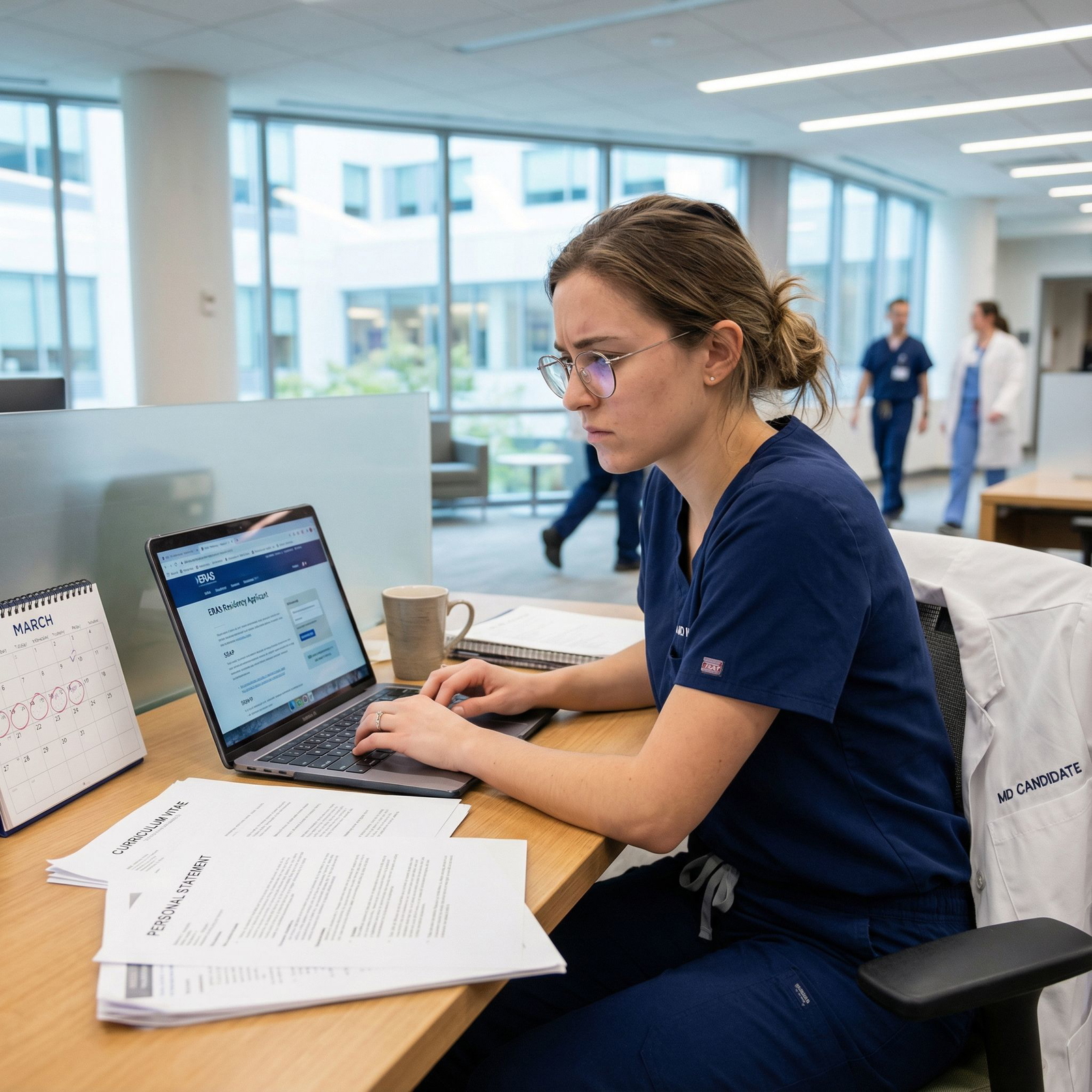
Understanding SOAP for the Non-US Citizen IMG in Interventional Radiology
For a non-US citizen IMG aiming for interventional radiology residency, the Supplemental Offer and Acceptance Program (SOAP) can feel like a high‑pressure, last‑chance process. In reality, strong SOAP preparation can turn a disappointing Match Week start into a viable path toward US training—sometimes in IR, more often via transitional or diagnostic radiology tracks that can later lead to IR.
This guide is written specifically for the foreign national medical graduate targeting interventional radiology residency who may face the IR match, not receive a position on Monday, and need a structured plan for SOAP residency success.
We will walk through:
- What SOAP is (and what it is not)
- How SOAP works step-by-step
- Pre‑Match Week preparation dates and documents
- A SOAP strategy tailored to IR applicants (including “back‑door IR” routes)
- Visa‑related considerations for non‑US citizen IMGs
- Concrete timelines, sample email scripts, and practical tips
What Is SOAP and How Does It Work?
Before building your SOAP preparation strategy, it’s essential to clearly understand what is SOAP and how it functions within Match Week.
SOAP in Plain Terms
The Supplemental Offer and Acceptance Program (SOAP) is an NRMP‑run process during Match Week that helps unmatched or partially matched applicants connect with residency programs that have unfilled positions.
Key points:
- It happens only during Match Week (Monday–Thursday).
- You can apply only through ERAS; no outside applications are allowed.
- You can communicate with programs only through allowed channels and time windows.
- It is not a separate match; it’s a structured series of offer rounds.
- It is used by US grads and IMGs, including non‑US citizen IMGs.
For a non-US citizen IMG, SOAP is particularly important because:
- You often compete for fewer visa‑sponsoring positions.
- Your IR match options may be more limited, but SOAP opens doors to transitional, preliminary, and diagnostic radiology spots that keep your IR path alive.
- You must obey strict communication and visa rules to avoid NRMP violations.
Who Is Eligible for SOAP?
You are SOAP‑eligible if all of the following are true:
- You registered for the Main Residency Match and submitted a certified rank order list.
- You are partially matched or unmatched as of Match Week Monday.
- You have your ECFMG certification status as required (for IMGs).
- You have no NRMP violations that bar participation.
On Monday of Match Week, the NRMP sends you an email indicating:
- Matched
- Partially matched
- Unmatched
- Or ineligible for SOAP
If you are unmatched or partially matched AND SOAP‑eligible, you may participate.
Pre–Match Week SOAP Preparation: What to Do Before Monday
SOAP moves extremely fast. The mistake many IR applicants make is waiting until Monday to think about SOAP. Real SOAP preparation begins weeks to months before Match Week.
1. Clarify Your IR‑Related Plan B and Plan C
As an aspiring IR physician, your goal is to practice interventional radiology, not just to match into one particular PGY‑1 slot. For a foreign national medical graduate, this reality is crucial.
Ask yourself:
- “If I don’t match directly into integrated interventional radiology, what is my best alternative route?”
- “Which specialties (and which institutions) would still keep me on track for IR?”
Common IR‑consistent backup routes:
Diagnostic Radiology (DR) Categorical
- 4‑year DR residency with the option to apply for independent IR residency later.
- Strongly IR‑compatible and often the most direct Plan B.
Diagnostic Radiology (DR) Advanced + Transitional/Preliminary Year
- You complete a separate intern year (medicine/surgery/transitional) followed by DR.
- Also compatible with future IR training.
Transitional Year (TY) or Preliminary Internal Medicine / Surgery
- Good option if you still plan to reapply for integrated IR or DR next year.
- Choose programs with strong radiology or IR exposure and mentorship.
Internal Medicine or Surgery Categorical
- Less direct but can still lead to IR via independent programs if you later complete a DR residency; this is less common and more complex but not impossible.
- More realistic if you are open to hybrid careers (e.g., vascular medicine plus IR skills where possible).
Actionable step:
Make a ranked list of Plan B and Plan C specialty types and program characteristics (e.g., “visa sponsorship + strong IR department + DR program on site”).
2. Optimize Your Documents for SOAP
You do not have time during SOAP week to rebuild your ERAS application from scratch. You need:
- A primary ERAS application that remains broadly competitive.
- Targeted SOAP versions of key documents like your personal statement.
Key document strategies:
Personal Statements
Create at least two versions in advance:
IR/DR‑oriented statement
- Emphasize:
- Your interest in image‑guided procedures
- Research or electives in IR/DR
- Your understanding of the IR role (clinic + procedures + longitudinal care)
- Use this for diagnostic radiology, IR‑interested prelim or TY, and any IR‑heavy internal medicine or surgery programs.
- Emphasize:
General Internal Medicine or Surgery statement (if open to these fields)
- Emphasize:
- Patient‑centered care and continuity (for IM)
- Technical and procedural skills (for Surgery)
- Still subtly highlight your IR interest, but in a way that doesn’t seem like you’ll leave immediately.
- Emphasize:
You can also consider a third “generic preliminary/TY” statement that blends your interest in procedures, radiology, and broad training.
Letters of Recommendation (LoRs)
By SOAP, your LoRs are mostly fixed. However, before the season:
- Aim for at least one strong letter from an interventional radiologist or diagnostic radiologist.
- Add one to two letters from core clerkships (IM, Surgery) or subspecialty attendings who know you well.
- Make sure letters:
- Address your clinical judgment, work ethic, and teamwork.
- For IR/DR letters, highlight your analytical skills, imaging comprehension, and procedural aptitude.
CV and Experiences
For a non-US citizen IMG, highlight:
- Any US clinical experience, especially in radiology or procedural fields.
- IR‑relevant projects:
- Quality improvement projects in vascular access, embolization, oncology.
- Imaging‑based research.
- Technical skills: ultrasound‑guided procedures, central lines, thoracentesis, etc.
Avoid last‑minute editing chaos by locking your core ERAS content 1–2 weeks before Match Week.
3. Understand the SOAP Timeline and Rules
Know the basic flow (dates vary slightly each year—always confirm on NRMP/ERAS sites):
- Monday, 11:00 AM ET: You learn if you’re matched/unmatched.
- Monday, Noon–3:00 PM ET (approx.):
- ERAS opens the List of Unfilled Programs to SOAP‑eligible applicants.
- You may begin preparing applications.
- Monday, 3:00 PM ET:
- You can begin submitting your up to 45 applications to SOAP‑participating programs.
- Tuesday–Thursday:
- Program review, limited interviews (often virtual/phone), and multiple offer rounds.
Rules you must know:
- No unsolicited contact: You cannot cold‑email, call, or message programs about SOAP positions unless they contact you first or explicitly invite contact per NRMP rules.
- Max 45 ERAS applications during SOAP.
- You can receive, accept, or reject offers in defined rounds. An accepted offer is binding; you exit SOAP once you accept a position.
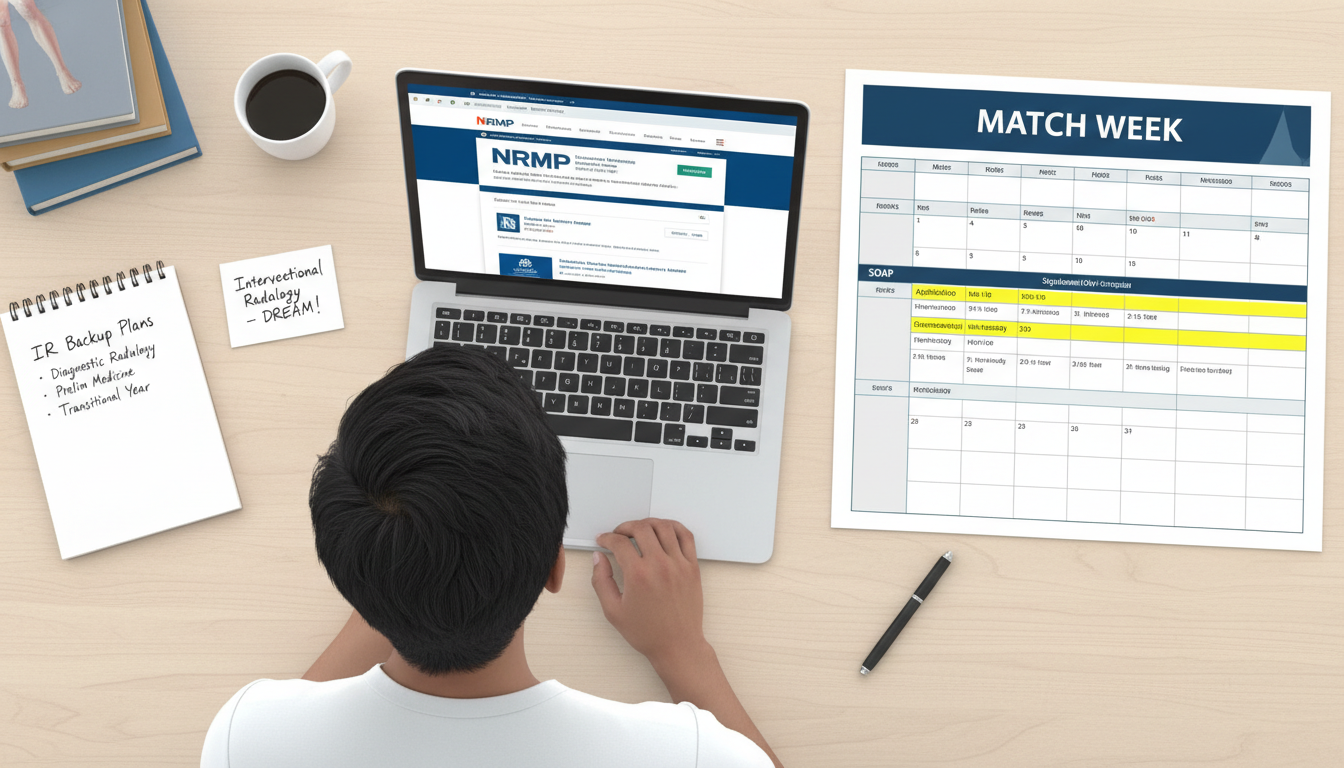
Building a SOAP Strategy as an IR Applicant (Non-US Citizen IMG Focus)
For an interventional radiology residency aspirant, the SOAP strategy must balance:
- Realism about IR availability,
- Flexibility about related specialties,
- And the visa constraints that affect a foreign national medical graduate.
1. Know the Reality: IR Positions in SOAP Are Rare
Integrated IR positions are highly competitive and relatively few in number. Most fill in the main match. Occasionally, a small number of IR or DR positions may appear on the unfilled list, but you should not depend on this.
Typical pattern:
- A few diagnostic radiology categorical or advanced positions may appear.
- A very small or zero number of integrated IR positions may be available.
- Several transitional year or preliminary IM/Surgery positions may be on the list.
Implication:
Your SOAP strategy should:
- Target any IR‑friendly DR positions first.
- Then prioritize high‑quality intern year programs that:
- Sponsor visas,
- Have strong radiology or IR exposure,
- Are associated with a DR or IR program.
2. Pre‑Select Program Types You Will Target
When the unfilled list appears, you will have only hours to decide where to apply.
Create a targeting framework:
Tier 1: DR programs and any IR opportunities
- Diagnostic radiology categorical or advanced programs.
- Rare integrated IR positions (if any).
- DR programs with known pathways to IR (e.g., house IR division, established independent IR residency).
For each, pre‑decide:
- Minimum USMLE scores.
- Willingness to sponsor J‑1 (and possibly H‑1B) visas.
- Preferred geographic regions (if you have visa or support constraints).
Tier 2: Transitional and preliminary programs with strong IR/DR connections
Look for:
- Transitional Year or Preliminary Internal Medicine/Surgery at institutions with:
- A robust radiology department.
- IR service where you might rotate.
- DR or IR training programs where you could build mentorship.
Tier 3: Categorical IM or Surgery (if you are open to broader careers)
These positions are typically more numerous in SOAP. As a non‑US citizen IMG:
- Ensure they sponsor visas.
- Evaluate if you could imagine building a satisfying career even if IR is not guaranteed.
3. Create a “Filtering Checklist” for the Unfilled List
When the unfilled positions become visible, use a quick checklist to decide where to send applications:
- Does the program list visa sponsorship (J‑1/H‑1B)?
- If unclear, check FREIDA / program website / past applicants’ reports.
- Is the specialty on my Tier 1, 2, or 3 list?
- Does the institution have:
- An IR division?
- A diagnostic radiology residency?
- A track record with non-US citizen IMG residents?
Give top priority to:
- DR and transitional/preliminary programs with IR exposure.
- Programs at academic centers with IR attendings involved in education.
4. Calibrating Expectations During SOAP
As a non-US citizen IMG, you may feel pressure to accept any offer just to secure a visa‑eligible position. Yet, balance is necessary.
Points to consider:
- A Transitional or Preliminary year at a strong academic site can be an excellent launchpad for re‑applying to IR/DR.
- A categorical IM or Surgery position can provide stability and visa continuity but may pull you into a different career path if IR opportunities later remain limited.
- Conversely, remaining unmatched after SOAP is high risk and usually to be avoided unless you have a strong non‑US backup plan.
Actionable mindset:
Enter SOAP with:
- A clear priority list (e.g., “DR > TY/Prelim at IR sites > IM categorical at high‑quality teaching hospital”).
- A flexible but bounded plan of what you are willing to accept.
Execution During SOAP Week: Step‑by‑Step
This is how to operationalize your preparation when Match Week begins.
Monday: Decision and Application Preparation
11:00 AM ET – Status notification
- If you’re unmatched or partially matched and SOAP‑eligible:
- Take a short pause; emotional regulation matters.
- Shift to “operational mode” using your pre‑planned strategy.
- If you’re unmatched or partially matched and SOAP‑eligible:
Noon ET – Access to Unfilled List
- Download or view the list of unfilled programs.
- Apply your filtering checklist (visa + IR/DR compatibility + tier).
- Start building your SOAP application list.
Before 3:00 PM ET – Finalize Applications
- Assign appropriate personal statement versions to each specialty:
- DR and IR‑adjacent: IR/DR‑oriented statement.
- IM or Surgery: corresponding tailored statements.
- Confirm LoRs are assigned in a way that strengthens your IR angle where appropriate (e.g., IR letters to DR/TY, IM letters to IM programs).
- Assign appropriate personal statement versions to each specialty:
3:00 PM ET – Submit Applications (up to 45)
- Prioritize your highest‑tier options early—programs start reviewing quickly.
- Double‑check:
- Correct documents attached.
- No duplicate or non‑strategic applications consuming slots.
Tuesday to Thursday: Communication, Interviews, and Offers
Communication Rules
Under NRMP SOAP rules, during SOAP:
- You may not initiate contact with programs about specific SOAP positions unless:
- The program has contacted you first, or
- The program’s public instructions allow certain contact.
Common allowed communications:
- Responding to:
- Program coordinator or PD emails.
- Phone calls or virtual interview invitations.
- Participating in:
- Short video interviews.
- Phone screen calls.
- Quick Q&A sessions.
Never:
- Spam programs with unsolicited emails.
- Ask non‑SOAP programs (e.g., via LinkedIn or social media) for positions or favors.
Preparing for Rapid Interviews
Interviews during SOAP are often brief and focused:
Common questions for IR/DR‑oriented positions:
- “You applied for IR—why are you now considering DR or a transitional year?”
- Emphasize that:
- IR requires a strong imaging foundation.
- DR and a strong intern year are integral to your long‑term IR goals.
- Emphasize that:
- “What is your long‑term career plan?”
- Answer honestly:
- You want to become an interventional radiologist.
- You value comprehensive training and are committed to contributing to the department regardless of final subspecialty.
- Answer honestly:
- “How do you see yourself fitting into our program as a non-US citizen IMG?”
- Highlight cultural adaptability, prior US experience, and your understanding of the system.
Practice a 60–90 second “SOAP pitch” that includes:
- Who you are (non-US citizen IMG, training background).
- Your IR motivation and relevant experiences.
- Why this program (even if not IR) is a rational, enthusiastic choice.
Handling Offers
SOAP offers come in rounds:
- You may:
- Receive multiple offers (rare but possible).
- Accept one.
- Or reject all within a round’s time window.
- If you accept an offer:
- You are bound to that program.
- You exit SOAP and cannot pursue other offers.
Strategy for offer acceptance:
- If you receive an offer from a Tier 1 DR or IR‑adjacent program that sponsors visas → strongly consider immediate acceptance.
- If you receive an offer from a Tier 2 program reasonably aligned with your IR future (e.g., TY at a major IR center) → likely accept unless you have reason to believe a DR offer is imminent.
- If you only see offers from lower‑tier categorical programs with weaker IR connections:
- Consider your risk tolerance.
- Factor in your prospects if you were to reapply from abroad without any US training seat.

Visa and Legal Considerations for the Foreign National Medical Graduate
For a non-US citizen IMG, visa issues heavily influence SOAP strategy.
Common Visas in Residency
- J‑1 Visa (ECFMG‑sponsored)
- Most common for IMGs.
- Requires return to home country for 2 years after training unless a waiver is obtained.
- H‑1B Visa
- Less common in SOAP, more paperwork and cost for programs.
- Often requires all USMLE Steps passed, including Step 3, by the time of application.
SOAP‑Specific Visa Tips
Pre‑check visa policies of target institutions
Before Match Week:
- Use FREIDA, program websites, and alumni networks to identify:
- Programs with a history of sponsoring J‑1 or H‑1B.
- Programs known to accept non-US citizen IMG residents regularly.
- Use FREIDA, program websites, and alumni networks to identify:
During SOAP, filter aggressively
- You don’t have application slots to waste on programs that explicitly do not sponsor visas.
- If visa information is unclear:
- It may still be worth applying if all other factors are excellent.
- Be ready to clarify quickly if the program contacts you.
Be ready to discuss visa status
In interviews, expect questions such as:
- “Do you need visa sponsorship?”
- Answer clearly: “Yes, I will require J‑1 visa sponsorship” (or H‑1B if appropriate and viable).
- “Have you taken Step 3?”
- If you’re aiming at H‑1B‑friendly programs, Step 3 completion strengthens your case.
- “Do you need visa sponsorship?”
Plan for contingencies if SOAP fails
As difficult as it is, you must think ahead:
- If you remain unmatched:
- Will you return home and practice or do research?
- Can you pursue research or an observership in the US to strengthen next year’s application?
- Visa status will limit what you can do in the US without a training position.
- If you remain unmatched:
Practical Examples and Scenarios
Scenario 1: IR Applicant Unmatched, Finds DR Slots in SOAP
You are a non-US citizen IMG with:
- Step 1: 232 (pass/fail depending on year)
- Step 2 CK: 245
- Strong IR observerships and 2 IR LoRs
- No prior US residency
On Monday, you are unmatched. The unfilled list shows:
- 2 Diagnostic Radiology advanced positions at mid‑tier academic centers that sponsor J‑1.
- Several transitional year programs at hospitals with DR residencies.
- Many categorical IM programs.
Strategy:
- Apply to:
- Both DR programs (Tier 1) with IR/DR‑oriented statement.
- 10–15 transitional year programs at institutions with DR/IR (Tier 2).
- A selective set of strong IM categorical programs that sponsor J‑1 (Tier 3).
- If offered any DR position → accept.
- If offered a TY at a strong DR/IR center and no immediate DR offer → seriously consider accepting, depending on later rounds.
Scenario 2: No DR or IR in SOAP, Only TY and Categorical IM
Unfilled list:
- 0 DR or IR.
- 20 Transitional Year and prelim IM/Surgery.
- 300+ categorical IM programs.
Strategy:
- Focus your applications on:
- TY/prelim programs at residencies with radiology departments and IR services.
- A smaller number of categorical IM programs at academic medical centers with IR exposure.
- Goal: Secure a strong intern year that keeps IR and DR re‑application viable next year.
FAQs: SOAP Preparation for Non-US Citizen IMG in Interventional Radiology
1. As a non-US citizen IMG interested in IR, should I apply only to IR and DR programs in SOAP?
No. Because interventional radiology residency spots almost always fill in the main match and diagnostic radiology positions are limited in SOAP, you need a broader, tiered strategy:
- Prioritize IR/DR if available.
- Aggressively target transitional year and preliminary programs at institutions with IR or DR departments.
- Consider categorical IM or Surgery at strong centers if you are open to a broader career or re‑application later.
Limiting yourself only to IR/DR in SOAP is very risky and frequently results in remaining unmatched.
2. How can I show programs during SOAP that I am serious about their specialty if my ERAS is IR‑focused?
Use specialty‑specific personal statements to present a coherent story:
- For DR:
Emphasize that you see DR as the essential foundation for IR and that you are genuinely excited to practice diagnostic radiology and imaging‑based patient care. - For TY/Prelim IM/Surgery:
Explain that you value comprehensive clinical training and procedural foundations that will make you a better IR physician in the long run. - For IM/Surgery categorical:
Discuss long‑term interest in procedural care, chronic disease management or perioperative care, and being open to careers where you integrate imaging and interventions without insisting that IR is the only acceptable outcome.
Programs understand that IR‑oriented applicants may pivot during SOAP, as long as your explanation is mature and consistent.
3. What is SOAP preparation I should complete at least 1–2 months before Match Week?
At a minimum:
- Clarify your backup routes (DR, TY/Prelim, IM/Surgery) and create a tiered strategy.
- Write at least two personal statement versions (IR/DR‑oriented and one for IM/Surgery).
- Confirm LoR assignments so IR letters go to DR/TY and general letters to IM/Surgery.
- Research programs’ visa policies and identify institutions likely to sponsor J‑1 (and H‑1B if applicable).
- Familiarize yourself with NRMP SOAP rules, including communication restrictions and offer rounds.
Having these ready allows you to move quickly when the unfilled list appears.
4. If I remain unmatched after SOAP, how can I still pursue interventional radiology as a non-US citizen IMG?
If SOAP does not result in a position:
- Consider research fellowships in IR or DR to strengthen your CV (often on J‑1 research visa).
- Seek observerships or externships at centers with strong IR programs.
- Improve your application:
- Enhance US clinical experience.
- Publish or present research in IR‑related areas.
- Strengthen USMLE scores if you have not yet taken or passed all exams.
- Reapply in the next cycle, possibly targeting diagnostic radiology more broadly and considering less competitive geographic regions.
Your path may be longer and require creativity, but a well‑planned strategy can still move you toward an IR‑aligned career, even if not via the traditional straight line.
By approaching SOAP with realistic expectations, structured preparation, and an IR‑aligned backup strategy, a non-US citizen IMG can turn a challenging Match Week into a meaningful step toward a future in interventional radiology.