Understanding SOAP for the Non‑US Citizen IMG Targeting Clinical Informatics
The Supplemental Offer and Acceptance Program (SOAP) can be both a lifeline and a pressure cooker, especially if you are a non‑US citizen IMG aiming for a technology‑heavy path like Clinical Informatics. To prepare effectively, you must understand what SOAP is, how it works in practice, and how your immigration status and specialty interests shape your strategy.
What Is SOAP?
SOAP is an NRMP‑run process that helps unmatched or partially matched candidates obtain unfilled residency positions during Match Week. It is not a separate match; it is a controlled, time‑pressured recruitment cycle over four rounds of offers.
During SOAP:
- You learn whether you are unmatched or partially matched on Monday of Match Week.
- You can see the List of Unfilled Programs (SOAP‑participating programs only).
- You can submit up to 45 applications to unfilled programs via ERAS.
- Programs review applications and may contact you for phone or video interviews.
- Offers are extended in four rounds; you can accept only one offer at a time.
Why SOAP Is Different for a Non‑US Citizen IMG
As a foreign national medical graduate, you face additional constraints:
- Visa sponsorship: Not all SOAP programs sponsor J‑1 or H‑1B visas.
- Time pressure: Confirming visa feasibility within tight SOAP timelines is hard.
- Bias and risk perception: Some program directors hesitate to take on new visa cases during a hectic week.
- Credentialing and start‑date logistics: GME offices may worry about your ability to start on time.
Because Clinical Informatics is a subspecialty fellowship (not an entry‑level residency), your SOAP strategy must be staged:
- Short‑term goal: Secure a categorical or preliminary residency position in a specialty that can lead to Clinical Informatics (e.g., Internal Medicine, Family Medicine, Pediatrics, Pathology, Emergency Medicine, Psychiatry).
- Medium‑term goal: Build a profile with strong health IT exposure, QI projects, and data‑driven work during residency.
- Long‑term goal: Apply competitively for a Clinical Informatics fellowship or alternative health IT training pathways.
In other words, during SOAP, you are not applying directly to a clinical informatics fellowship; you are choosing the residency foundation on which your future Clinical Informatics career will be built.
Pre‑SOAP Preparation: Build Your Clinical Informatics Narrative Early
The most successful IMG SOAP candidates treat SOAP as a planned contingency rather than a panic move. This is especially important for those intent on a hybrid career combining patient care and informatics.
1. Clarify Your Informatics‑Driven Career Story
Before Match Week, be ready to clearly articulate why Clinical Informatics, and how residency is a critical step toward that goal.
Reflect on:
- Past experiences related to health IT:
- EMR optimization, data entry process improvements
- Telemedicine projects, digital health initiatives
- Research using large datasets or biostatistics
- Work with registries, dashboards, or decision support tools
- Skills that map to informatics:
- Comfort with technology and analytics
- Working across disciplines (IT, administration, clinical teams)
- Quality improvement and systems thinking
Write out a short 2–3 paragraph narrative covering:
- Where you trained and your clinical strengths as a non‑US citizen IMG
- How you first became interested in informatics
- Concrete experiences linking patient outcomes to data and systems
- How a core residency (e.g., internal medicine) will prepare you to ultimately join or lead clinical informatics initiatives or pursue a clinical informatics fellowship
You will adapt this narrative for:
- Updated personal statement(s)
- Email communications to programs
- SOAP interviews (where “Tell me about yourself” is common)
2. Pre‑Draft Targeted SOAP Personal Statements
During SOAP, you will have almost no time to write thoughtful statements. Prepare ahead:
- Create 2–3 versions of your personal statement:
- Internal Medicine / Family Medicine / Pediatrics version
Emphasize chronic disease management, care coordination, population health and how informatics can improve these. - Emergency Medicine / Psychiatry version
Emphasize acute decision‑making, risk stratification, and real‑time decision support. - Pathology / Other specialties
Emphasize lab information systems, data pipelines, AI, and analytics.
- Internal Medicine / Family Medicine / Pediatrics version
Each version should include:
- 1 short paragraph explaining your background as a non‑US citizen IMG, including:
- Medical school and year of graduation
- Any gaps explained with professional or academic activities
- 1 paragraph on why the specialty is the right clinical base for your future in Clinical Informatics.
- 1–2 paragraphs on specific informatics‑aligned experiences (e.g., EMR improvement projects, data audits, QI projects).
Save these as templates you can quickly tailor to specific SOAP programs.
3. Prepare a SOAP‑Optimized CV and ERAS Profile
Your ERAS is already submitted, but you can:
- Update certain sections (depending on the timeline and ERAS rules that year).
- Re‑emphasize your informatics‑related achievements in experiences and descriptions:
- “Implemented an Excel‑based patient tracking tool that reduced missed follow‑up by 20%”
- “Led a small team to standardize documentation templates in outpatient clinic”
- “Performed chart audits using EMR data to analyze antibiotic usage patterns”
- Ensure that your US clinical experience (USCE) is described clearly, especially any time you worked with:
- EMR systems (Epic, Cerner, Meditech, etc.)
- Registries or databases
- Telehealth platforms
As a foreign national medical graduate, also double‑check:
- All visa‑relevant fields are accurate (citizenship, need for visa).
- You have uploaded scan(s) of necessary exams and ECFMG certification documentation.
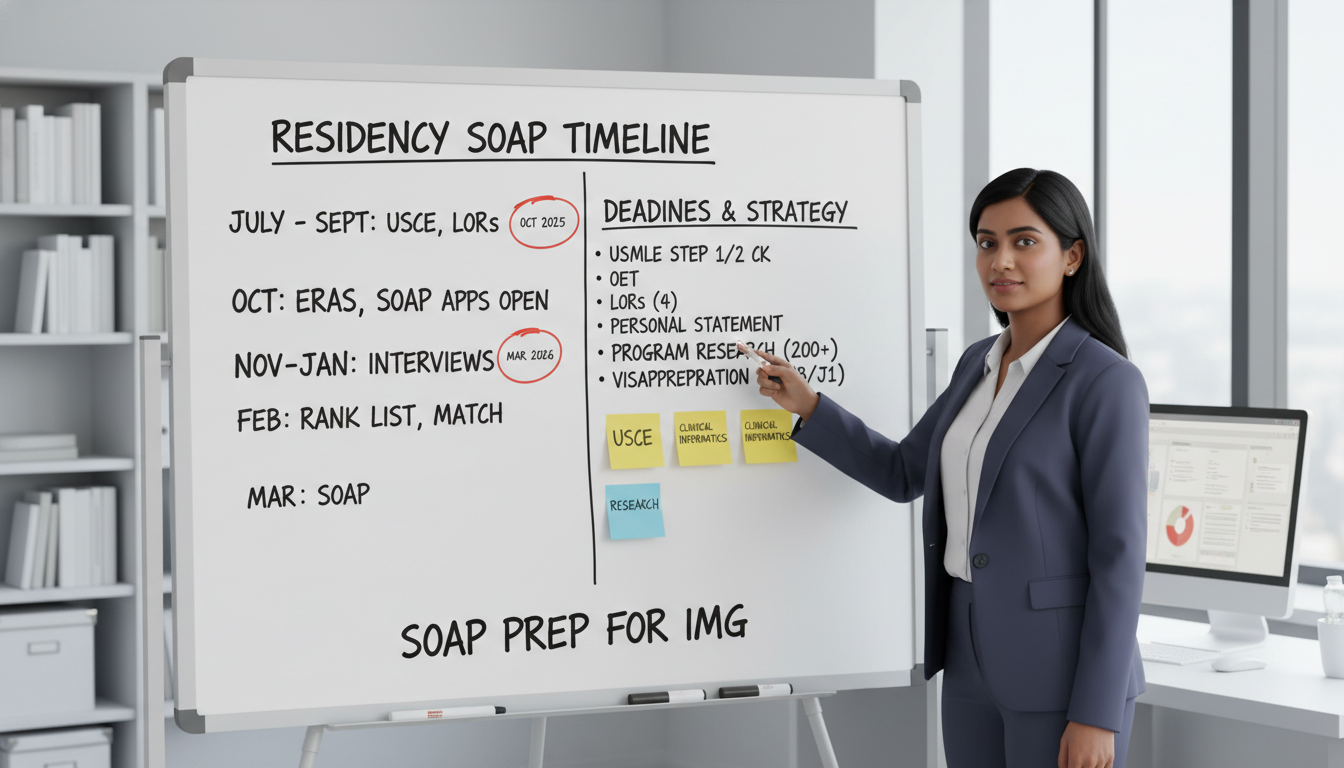
4. Understand the SOAP Timeline and Rules
You must know:
- Eligibility rules: You must be registered for the Main Match, certified your rank list, and be unmatched/partially matched after Monday’s results. You must be SOAP‑eligible according to NRMP.
- Application caps: You can submit no more than 45 applications during SOAP.
- Contact rules: You cannot contact programs proactively; programs may contact you.
- Offer rounds: Learn the exact times (Eastern Time) of each offer round and decision deadlines.
Keep a printed or digital SOAP checklist ready so you don’t have to recall details under stress.
Strategic SOAP Targeting: Choosing Programs That Fit an Informatics Path
Your SOAP applications must balance match probability and future informatics potential. Because you have only 45 applications and very little time, you need a clear targeting framework.
1. Decide Your Specialty Flexibility
Clinical Informatics is a multi‑specialty fellowship. Most programs accept applicants from:
- Internal Medicine
- Family Medicine
- Pediatrics
- Emergency Medicine
- Anesthesiology
- Pathology
- Psychiatry
- Sometimes Radiology or other specialties
For SOAP, consider:
- Primary specialty target: The field you are best prepared for and most interested in clinically (e.g., Internal Medicine).
- Secondary specialties you can realistically accept: Those that still allow a pathway into informatics and where your application is competitive.
As a non‑US citizen IMG, you may need to be somewhat more flexible about specialty and geographic location, especially if you have multiple red flags (older YOG, low scores, attempts, limited USCE). However, do not apply randomly:
- Focus on categorical positions when possible; these provide a full pathway to board eligibility and, later, a clinical informatics fellowship.
- Consider preliminary positions as a last resort, particularly if they reasonably position you to secure a categorical spot later.
2. Filter Programs for Visa Feasibility
Not all SOAP‑participating programs will consider non‑US citizen IMGs. Create a fast, systematic method to screen:
Before Match Week (if possible):
- Build a spreadsheet of programs you originally applied to, with:
- Visa types they sponsor (J‑1, H‑1B, both, or none)
- Historical IMG friendliness (from websites, forums, or match lists)
- Highlight those with:
- Known J‑1 sponsorship (most common)
- History of accepting foreign national medical graduates
- Build a spreadsheet of programs you originally applied to, with:
During SOAP:
- Cross‑check the unfilled list against your spreadsheet.
- For new programs, rapidly review their website:
- Look specifically for “International Medical Graduates” or “Visa Policy.”
- If unclear, you may still apply, but prioritize known sponsors.
Your goal: Use as few applications as possible on programs unlikely to sponsor a visa, so you can maximize realistic opportunities.
3. Prioritize Programs with Health IT or QI Culture
In SOAP, you won’t often find programs advertising “strong clinical informatics track,” but some indicators suggest a fertile environment for informatics‑minded residents:
Look for programs with:
- Mention of:
- EMR optimization committees
- Quality improvement curriculum
- Data analytics, population health, or value‑based care
- Telemedicine programs
- Affiliation with:
- A university or health system known to host a clinical informatics fellowship.
- A robust health IT department or innovation hub.
- Opportunities listed for:
- Resident involvement in QI, dashboards, or research.
- Exposure to clinical decision support, order set development, or workflow redesign.
During SOAP you won’t have time for in‑depth research, but even a quick 2–3 minute scan of a program’s website can tell you whether they:
- Mention data, quality, EMRs, or digital health at all.
- Have current or former residents presenting at informatics or QI conferences.
These programs will better support your long‑term clinical informatics fellowship or health IT training ambitions.
Executing During SOAP Week: High‑Intensity, High‑Focus
SOAP Week is a fast, structured process. Preparation pays off most here.
1. Monday: Assess, Stabilize, and Plan
Once you receive your “Did I Match?” result:
- Confirm SOAP eligibility in your NRMP account.
- Access the unfilled programs list when it becomes available.
- Quickly categorize programs you might consider by:
- Specialty
- Visa status (known vs unknown)
- Informatics or QI friendliness (from quick website review)
- Decide a tiered application strategy:
- Tier 1: Programs that sponsor your visa type, within your primary specialty, and show some systems/QI emphasis.
- Tier 2: Programs that sponsor your visa and are secondary specialties or less ideal locations.
- Tier 3: Programs with unknown visa policy but potentially open to IMGs.
Do this early to avoid decision fatigue later.
2. Submitting Up to 45 Targeted Applications
When the ERAS SOAP application window opens:
- Use your pre‑written personal statements and attach the best‑fitting one per specialty.
- Make small edits for key programs:
- Mention any regional ties or specific reason you are drawn to that type of patient population.
- Briefly allude to interest in QI/data‑driven care where appropriate.
- Aim to submit most applications early in the window, so programs see you sooner in their review process.
Resist the temptation to “spray and pray.” Even under pressure, choose programs where at least one of the following is true:
- They have a record of accepting non‑US citizen IMG residents.
- They are less competitive geographic areas where your profile is more likely to stand out.
- They show signs of a data‑ or quality‑oriented culture.
3. Preparing for Rapid‑Fire SOAP Interviews
During SOAP, programs contact you; you must be ready for:
- Unschedule phone calls
- Very short notice video interviews
- Group Q&A sessions
As a non‑US citizen IMG with a niche interest in Clinical Informatics, you must:
- Communicate your immediate clinical contribution clearly.
- Position your informatics goals as an asset, not a distraction.
Prepare concise, focused answers for:
“Tell me about yourself.”
Structure:- 1–2 sentences: Who you are (non‑US citizen IMG, med school, key strengths).
- 2–3 sentences: Your clinical path and why this specialty.
- 2–3 sentences: Informatic interest linked to improving systems, safety, and efficiency.
- 1 sentence: Why that kind of work fits well at their type of program.
“Why our specialty, especially given your interest in Clinical Informatics?”
Emphasize:- How strong clinical judgment in this field is essential to design or evaluate health IT.
- Desire to be a physician who understands both bedside and systems‑level care.
“How do you see your career evolving?”
Example framing:- “First and foremost, I want to be an excellent clinician. Over time, I’d like to contribute to quality improvement and EMR‑based projects. Later, I hope to pursue a clinical informatics fellowship or formal health IT training, ideally building on experiences I gain during residency here.”
“Why did you go unmatched?” (if asked directly)
Be honest and succinct:- Focus on structural issues (score profile, late graduation, limited USCE) rather than blaming others.
- Emphasize growth and readiness now, plus strong interest in their program.
4. Addressing Visa Questions Professionally
You might be asked:
- “What visa will you need?”
- “Have you looked into J‑1 vs H‑1B?”
Your approach:
- Be clear and factual: “I will require a J‑1 visa through ECFMG sponsorship” or “I am already in the US on [visa type] and would need a transfer.”
- Show proactivity: Mention that you are familiar with general timelines and have your documents ready.
- Reassure them that you understand GME’s responsibility and are prepared to respond quickly to any document requests.
Avoid over‑complicating the discussion or appearing uncertain about your own status.

After You Receive Offers: Decision‑Making with Informatics in Mind
If you receive one or more SOAP offers, you will have only a short time to decide whether to accept. This is where you must align pragmatism (securing a residency) with your longer‑term Clinical Informatics ambitions.
1. Evaluate Each Offer Quickly but Strategically
Consider:
Visa feasibility and administrative reliability
- Does the institution routinely handle visas for residents?
- University or large teaching hospitals are often more experienced.
Board‑eligible pathway
- Is the program categorical (full specialty training) or preliminary?
- For clinical informatics fellowship eligibility, a full primary board (e.g., ABIM, ABFM) is usually required.
Informatics‑friendly environment While you may not get all details, ask during interviews or via follow‑up:
- Are there resident QI projects involving data or EMR changes?
- Does the program use a major EMR (Epic, Cerner), where informatics innovations are common?
- Are there faculty involved in QI, population health, or IT‑clinical liaison roles?
Personal fit and support
- Geographic location (cost of living, support network).
- Program culture (small vs large, academic vs community).
If your top priority is simply entering the US GME system, especially if you’ve had multiple unsuccessful attempts, it can be wise to accept a reasonable offer even if the explicit informatics environment is modest. You can still create informatics‑related opportunities through:
- QI projects using EMR data
- Working with the hospital’s IT or QI department
- Online health IT training or informatics coursework during residency
2. If You Do Not Receive Offers
If you go through SOAP without securing a position:
Request feedback (where possible):
- From mentors, observership supervisors, or faculty who know your application.
- From advisors at your medical school or IMG support organizations.
Strengthen your profile with a Clinical Informatics angle:
- Seek positions as clinical data analyst, research coordinator, or QI assistant.
- Engage in health IT projects, EMR optimization initiatives, or analytics internships.
- Consider obtaining basic programming or data skills (e.g., SQL, R, Python for health data) through reputable courses.
Reapply with a more targeted strategy:
- Reassess specialty choices: Are there fields more receptive to your profile and still compatible with Clinical Informatics?
- Increase your USCE and letters of recommendation, ideally from faculty involved in digital health or quality improvement.
Use the year to move closer to a clinical informatics fellowship profile, not further away.
Building Toward Clinical Informatics During Residency (Post‑SOAP)
Once you secure a residency through SOAP, your path to Clinical Informatics or structured health IT training continues.
Actionable steps during residency:
Join or start QI projects that:
- Use EMR data for measuring outcomes.
- Involve documentation optimization, order set redesign, or clinical decision support.
Collaborate with the hospital’s IT or informatics team:
- Volunteer as a physician champion for EMR upgrades or pilot workflows.
- Attend meetings where clinicians, IT, and administrators discuss metrics and workflows.
Seek mentors in informatics or data‑heavy roles:
- Ask if any faculty are involved in analytics, registries, telehealth, or health IT governance.
- Request to participate in or observe their projects.
Formal education:
- Consider short courses or certificates in health informatics, clinical data science, or health IT management.
- Many Clinical Informatics fellowship programs value applicants who have demonstrated sustained interest and foundational knowledge.
By aligning your residency activities with informatics—even if the program is not overtly “informatics‑heavy”—you can build a compelling application for a clinical informatics fellowship later.
FAQs: SOAP Preparation for Non‑US Citizen IMGs Interested in Clinical Informatics
1. As a non‑US citizen IMG, should I limit my SOAP applications only to programs that clearly mention Clinical Informatics?
No. During SOAP, explicit Clinical Informatics branding is rare. Instead, prioritize:
- Programs that sponsor your visa type and accept foreign national medical graduates.
- Specialties that can lead to Clinical Informatics (IM, FM, Peds, EM, Path, Psych, etc.).
- Programs with QI, data, or EMR‑focused culture.
You can create informatics‑related experiences during residency, even if they are not formally labeled as such.
2. Will going through SOAP hurt my future chances of getting a Clinical Informatics fellowship or health IT training?
Not inherently. Many residents who matched via SOAP go on to successful fellowships. Fellowship programs will care more about:
- Your board eligibility and performance in residency.
- Your sustained informatics and QI engagement.
- Any research, projects, or leadership in health IT or data‑driven care.
Your SOAP history itself is usually not a major factor.
3. Should I mention my Clinical Informatics career goal in SOAP interviews, or will programs worry I’m not focused on clinical care?
Mention it, but frame it correctly. Emphasize:
- Your commitment to becoming a strong clinician first.
- How informatics work supports better patient care, safety, and efficiency.
- Your interest in contributing to QI and EMR projects during residency.
Programs often appreciate applicants who think at the systems level, as long as they are clearly focused on bedside excellence.
4. What can I do in the year after an unsuccessful SOAP to stay on track for Clinical Informatics?
Consider roles such as:
- Research assistant or coordinator in outcomes research or health services.
- QI or clinical data analyst assistant.
- Positions involving EMR use, data extraction, or reporting.
Simultaneously: - Strengthen USCE and seek new letters of recommendation.
- Take structured courses in health informatics or data science.
- Prepare a more targeted application strategy for the next Match and SOAP cycle, emphasizing your growing informatics and systems‑oriented competencies.
By approaching SOAP with a clear understanding of what SOAP is, a well‑developed informatics‑aligned narrative, and a realistic appreciation of your constraints as a non‑US citizen IMG, you can navigate Match Week more strategically. Even under severe time pressure, structured preparation allows you to protect both your immediate goal—securing a residency—and your long‑term ambition in Clinical Informatics and health IT.