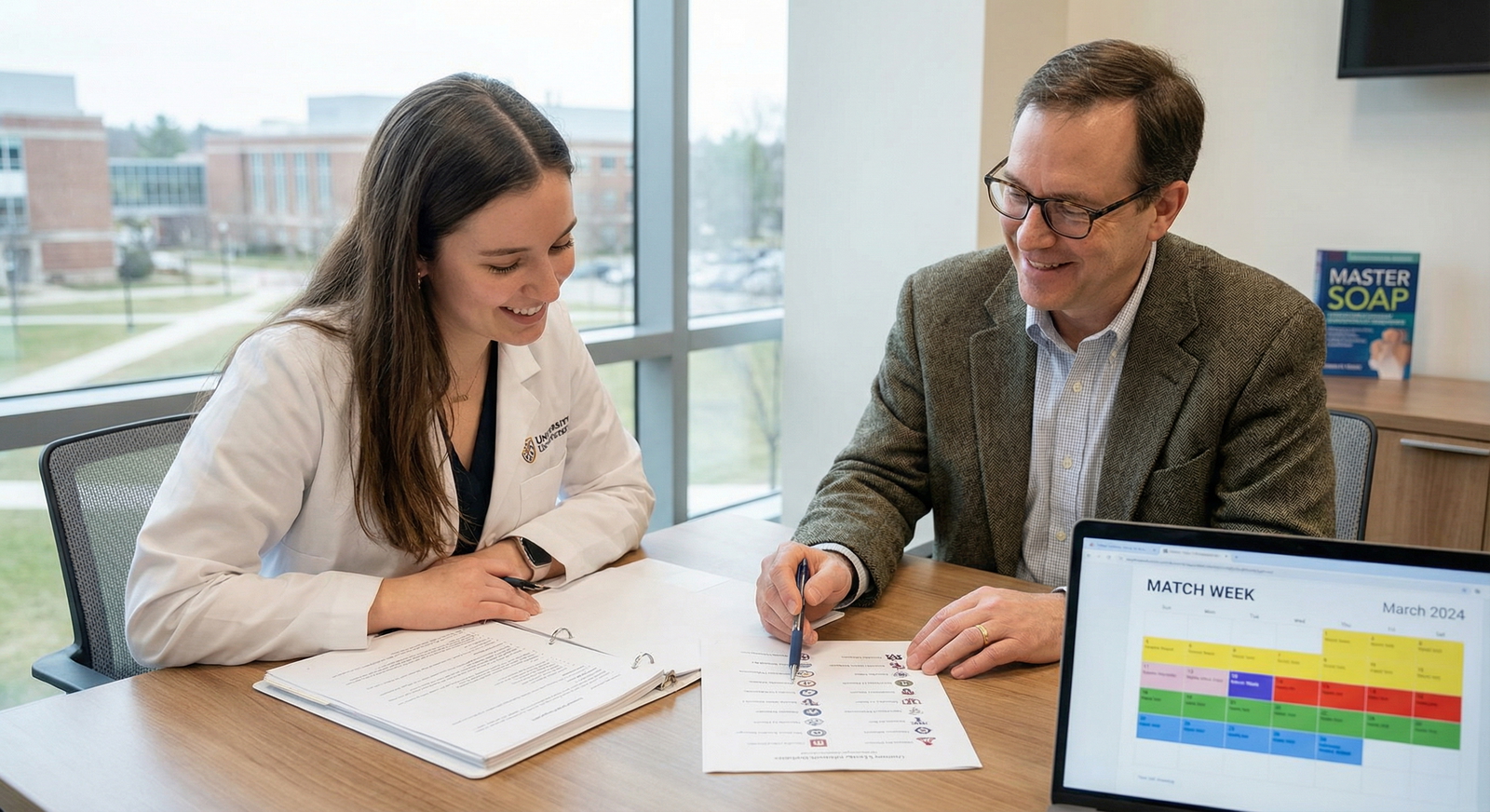
Understanding SOAP for Non‑US Citizen IMGs Targeting Emergency Medicine
The Supplemental Offer and Acceptance Program (SOAP) is often the most intense week of the residency application cycle—especially for a non-US citizen IMG aiming for an emergency medicine residency. To use SOAP effectively, you need to understand what SOAP is, how it works, and how your visa status and EM-specific factors shape your strategy.
What is SOAP?
SOAP is the formal, structured process NRMP uses to match unmatched or partially matched applicants to unfilled residency positions during Match Week. It takes place from Monday of Match Week (when you learn your “Matched/Unmatched” status) through Thursday (when SOAP offers conclude).
Key points about SOAP:
- You must be SOAP-eligible (registered for NRMP and ERAS, meet all other criteria).
- You can apply only to programs with unfilled positions on the NRMP List of Unfilled Programs.
- You have a cap on the number of applications you can send during SOAP (historically 45).
- Communication with programs is highly regulated; cold-calling outside the rules can get you disqualified.
For a foreign national medical graduate focusing on EM, SOAP is both an opportunity and a challenge:
- Opportunity: Programs that didn’t fill may become more flexible on profiles, especially for applicants with strong clinical skills and genuine EM commitment.
- Challenge: Some programs may become more restrictive about visas under the pressure of tight timelines and onboarding constraints.
Understanding these dynamics early allows you to prepare well before Match Week.
Step 1: Pre‑SOAP Self‑Assessment for the Non‑US Citizen EM Applicant
Before you design a SOAP strategy, you need a brutally honest, data-driven self-assessment. Your decisions during SOAP may need to be made in minutes; your thinking needs to be done weeks or months in advance.
1. Assess Your SOAP Eligibility and Timing
Confirm the following before rank order list (ROL) certification:
- You are registered with NRMP and certified your rank list on time.
- Your ERAS application is complete, with:
- USMLE/COMLEX scores transmitted
- MSPE and medical school transcript uploaded
- Letters of recommendation (ideally EM-focused) assigned
- Your ECFMG certification status:
- If not yet certified, confirm that all exams are passed and documents received so that you will be certified before residency start. Some programs will SOAP-interview you if certification is pending, others will not.
If any of these are uncertain, assume you may need to rely heavily on SOAP, and prepare aggressively.
2. Analyze Your EM Application Profile
For a non-US citizen IMG targeting an emergency medicine residency, evaluate:
- USMLE scores and attempts
- Any failed attempts on Step 1/Step 2 CK?
- Step 2 CK score relative to typical EM averages (often >240 in competitive programs, but SOAP programs may be more flexible).
- Emergency Medicine exposure
- US EM electives or observerships?
- SLOEs (Standardized Letters of Evaluation) from EM rotations?
- US-based EM research or QI projects?
- Clinical currency
- How many years since graduation (YOG)?
- Any recent clinical work (US or abroad)?
- Visa and immigration
- Type of visa you need: usually J-1 (via ECFMG) or sometimes H-1B.
- Prior visa denials or complications?
- Any US work/education history that makes onboarding easier?
This self-assessment tells you how realistic an EM SOAP position is versus needing a broader backup strategy.
3. Define Your Non‑Negotiables vs Flexibilities
Before Match Week, decide:
- Non‑negotiables
- Minimum visa type (e.g., willing to accept J-1 or H-1B only?).
- Absolute cannot-do specialties (e.g., if you are certain you cannot thrive in preliminary surgery or transitional year).
- Flexibilities
- Willingness to accept:
- Preliminary year in internal medicine or surgery as a bridge to reapplying to EM.
- Another specialty (e.g., IM, FM) if EM is unavailable.
- Geographic moves to less popular states or rural areas.
- Willingness to accept:
Document your decisions clearly. Under SOAP pressure, it is easy to make panicked, inconsistent choices without this framework.

Step 2: Building a SOAP‑Specific Strategy for Emergency Medicine
SOAP moves quickly. Having a specialty and program targeting plan ready before Match Week gives you a major advantage.
1. Realistic Expectations About EM in SOAP
Emergency medicine has fluctuated in competitiveness. In recent cycles, some EM programs have had unfilled positions due to shifting applicant preferences and broader systemic changes. This can create openings for strong non-US citizen IMGs—but:
- Many EM programs still prefer US grads and US-IMGs.
- Some EM programs do not sponsor visas at all, or only sponsor J-1.
- Programs may prioritize:
- At least one US EM rotation.
- SLOEs from EM faculty.
- Clear evidence the applicant truly understands US EM.
For a foreign national medical graduate, EM in SOAP is usually most realistic if you have:
- 1–2 strong US EM rotations with powerfully supportive letters.
- Good Step 2 CK score and no major red flags.
- Some flexibility on geography and hospital type (e.g., community EM vs major urban academic center).
If you lack these, maintain EM as your top preference, but simultaneously prepare plans B and C.
2. Mapping Potential SOAP Targets Before Match Week
You won’t know which programs are unfilled until Monday of Match Week. But you can still pre‑plan:
Compile an EM program master list
- Include:
- Visa policies (J-1 only, J-1/H-1B, no visa).
- Historical friendliness to IMGs or non-US citizen IMGs (from FREIDA, program websites, forums, alumni).
- Program type: academic vs community, trauma level, urban vs rural.
- Highlight:
- Programs that explicitly mention sponsoring J-1 or H-1B.
- Programs where you already have connections (rotations, mentors, alumni).
- Include:
Tier your EM targets
- Tier 1: Strongly IMG- and visa-friendly, prior history of taking non-US citizen IMGs.
- Tier 2: Some IMGs, uncertain about non-US citizens, or limited visa information.
- Tier 3: Rare/zero IMG presence, no clear visa statements—only consider if there are few options.
Prepare parallel specialty lists
- Internal Medicine (categorical & preliminary)
- Family Medicine
- Transitional Year
- Preliminary Surgery (if you can handle a surgical year as a bridge)
For each, identify:
- Visa friendliness
- IMG track record
- Geographic flexibility
You are not committing to these programs yet; you are building a map so that when the Unfilled List appears, you can act in hours, not days.
3. Decide Your Application Mix in SOAP
Because your SOAP applications are limited in number, you must balance ambition with safety.
A plausible distribution for a non-US citizen IMG with some EM strength might be:
- 15–20 EM programs (prioritized by visa sponsorship + IMG friendliness).
- 15–20 IM/FM programs (visa-friendly, categorical positions).
- 5–10 preliminary or transitional year programs (as absolute backup).
Adapt based on your profile:
- If your EM chances are relatively strong, allocate more to EM.
- If your EM profile is weak (no US rotations, low scores), limit EM to a smaller but targeted subset and invest more in IM/FM.
Decide these ranges before Match Week, so you can quickly slot real programs into your predetermined structure once the unfilled list appears.
Step 3: Document Preparation: Tailoring for SOAP and EM
SOAP moves too quickly to be writing documents from scratch that week. For a non-US citizen IMG targeting emergency medicine, you should have multiple pre-written, specialty-specific versions of key documents.
1. Personal Statements: Multiple Targeted Versions
Prepare at least four personal statements (PS):
EM-focused personal statement
- Emphasize:
- Why emergency medicine specifically (patient stories, procedural enthusiasm, acute care mindset).
- US EM experiences, even if observerships.
- Teamwork in high-acuity, high-pressure environments.
- Adaptability and cultural competence—especially relevant as a foreign national.
- Address:
- If applicable, a concise explanation of red flags (e.g., exam failures) with reflection and evidence of improvement.
- Emphasize:
IM-focused personal statement
- Highlight continuity of care, diagnostic thinking, critical care exposure.
FM-focused personal statement
- Emphasize broad-spectrum care, community orientation, preventive medicine.
Preliminary/Transitional year personal statement
- Clarify:
- Your genuine intention to contribute fully in that year.
- Career goals (e.g., ultimately EM) without devaluing the prelim year.
- Make it honest but professional. Programs want to see that you’ll be reliable and engaged, not just “passing through.”
- Clarify:
Label these clearly in ERAS and be ready to assign appropriate PSs to each SOAP program.
2. Emergency Medicine–Oriented CV Refinements
Your ERAS CV is largely fixed, but you can:
- Ensure EM-relevant experiences are clearly described:
- EM rotations, EM shadowing, ED volunteering.
- Experience in acute care, triage, critical care units.
- List procedures and skills relevant to EM:
- Suturing, airway management assistant roles, ultrasound exposure, resuscitation participation (within scope).
- Highlight:
- Leadership in high-stress or decision-heavy roles: disaster response, rapid response teams, trauma care in your home country.
- Research or QI related to:
- Emergency systems
- Trauma
- Time-critical care
- Public health emergencies
3. Letters of Recommendation (LORs) and SLOEs
In EM, SLOEs carry significant weight. For SOAP:
- Ensure:
- All EM SLOEs are uploaded and fully assigned to EM programs in ERAS (you won’t have time to fix this during SOAP).
- For non-EM programs:
- Strong IM/FM/surgical letters can be reassigned appropriately.
- If you lack SLOEs:
- Use the strongest letters that reflect acute care competence, teamwork, and communication—especially from US clinicians.
4. Visa and Documentation Readiness
Programs are often anxious about visa logistics during SOAP. Prepare:
- A concise “visa status summary” you can mention in interviews:
- “I am a non-US citizen IMG who will require J-1 sponsorship. I have no prior visa denials and have maintained full compliance with US visa laws. I understand the ECFMG J-1 requirements and am prepared to complete all documentation promptly.”
- Digital copies of:
- Passport
- Previous visas/I-20/DS-2019 (if any)
- Any immigration-related documents that could be requested later
You usually won’t upload these to ERAS, but you’ll be ready to respond quickly if programs ask post-SOAP.

Step 4: Executing During Match Week: EM‑Focused SOAP Tactics
By the time Match Week begins, your preparation should allow you to execute a clear plan. Here’s how to manage each phase as a non-US citizen IMG going for EM.
1. Monday: Processing Results and Finalizing Target List
On Monday, you’ll learn whether you are:
- Unmatched, or
- Partially matched (e.g., matched to an advanced position without a prelim year).
For many EM applicants, it’s usually simply unmatched. Then:
- Access the List of Unfilled Programs (noon ET, usually).
- Filter quickly:
- Specialty = Emergency Medicine.
- Check program websites or FREIDA for:
- Visa sponsorship
- IMG or non-US citizen IMG history.
- Cross-reference with your pre-made tier list.
- Assign your EM applications first, starting from:
- Tier 1 EM programs that:
- Sponsor your visa type.
- Historically accept IMGs/non-US citizens.
- Then Tier 2, then Tier 3 as needed.
- Tier 1 EM programs that:
Once EM applications are assigned, use remaining slots for IM/FM and prelim/TY positions as per your pre-planned distribution.
2. Application and Communication Rules During SOAP
NRMP strictly regulates SOAP contact:
- Programs can initiate contact with you after receiving your application.
- You must not cold-email or call programs before they contact you (unless explicitly allowed by that year’s rules).
- When contacted:
- Respond quickly, professionally, and concisely.
- Confirm interest and be clear about your visa needs without making it the first or only topic.
Be familiar with the year’s official NRMP SOAP communication guidelines, as violations can jeopardize your participation.
3. EM‑Focused SOAP Interview Preparation
Emergency medicine SOAP interviews are often short and focused—sometimes 10–20 minutes. Common themes include:
- “Why EM?” and “Why now?”—they want to ensure you’re committed and realistic.
- Experience in high-acuity settings.
- Teamwork under pressure and communication skills.
- Handling night shifts and high-volume ED environments.
- For non-US citizens:
- Clarification of visa needs.
- Understanding of US healthcare systems and EM practice.
Prepare concise, high‑yield talking points:
EM commitment narrative
- A short story illustrating:
- A critical case you participated in.
- Your role.
- What you learned about EM.
- Emphasize insight into:
- Multi-disciplinary teamwork (nurses, consultants, residents).
- Risk stratification and rapid decision-making.
- A short story illustrating:
Non-US citizen perspective
- How your international background adds value:
- Language skills.
- Cultural competence.
- Flexibility from practicing or training in resource-limited settings.
- How your international background adds value:
Visa clarity
- A 1–2 sentence explanation, e.g.:
- “I require J-1 sponsorship through ECFMG. I have reviewed the process and timing and am prepared to complete documentation promptly. I have no prior immigration issues or visa denials.”
- A 1–2 sentence explanation, e.g.:
Avoid over-focusing on visa issues; show you are primarily an excellent EM candidate who happens to need a visa, not the other way around.
4. Ranking SOAP Offers and Considering Trade‑offs
SOAP offers occur in several rounds. You might have to decide quickly between:
- A lower‑tier EM program.
- A stronger IM categorical program.
- A good transitional/prelim year with a potential path back to EM.
Questions to ask yourself when choosing:
- Is my priority absolute EM training now, regardless of program prestige or location?
- If yes, a safe EM spot (even in a smaller or rural program) may be worth more than a prestigious IM position.
- Can I realistically re-apply to EM later from another specialty or prelim year?
- Re-entry into EM from another field is possible but can be challenging, especially as a non-US citizen IMG.
- What are my long‑term immigration and career goals?
- If you rely on J-1 and plan for a waiver job, an EM residency—even at a less well-known site—may be strategically powerful.
- If you’re open to other Internal Medicine–based careers (e.g., hospitalist), a strong IM categorical spot may be excellent.
Make these principles explicit in writing before SOAP so that decisions during offer rounds align with your values and long‑term plans.
Step 5: Post‑SOAP Planning: If You Match via SOAP—or You Don’t
If You Secure an EM Position Through SOAP
Confirm and celebrate briefly, then:
- Review onboarding steps and visa paperwork timelines.
- Communicate clearly with GME about your J-1/H-1B needs.
Prepare for EM residency
- Strengthen knowledge in:
- ACLS/BLS, ATLS (if possible).
- Core EM topics (trauma, sepsis, chest pain, stroke).
- Familiarize yourself with US EM culture:
- Charting standards.
- Interdepartmental communication.
- Basic ED workflow.
- Strengthen knowledge in:
Connect with senior residents and other IMGs
- Ask specifically about:
- Visa logistics and timelines.
- Tips for international graduates in that ED.
- Ask specifically about:
If You Match into a Non‑EM Specialty Through SOAP
Use the year to strengthen your candidacy:
- If in IM/FM:
- Seek ED rotations, ICU rotations, code team involvement.
- Build EM-oriented mentorship and research.
- If in a transitional or preliminary program:
- Prioritize rotations that keep you close to EM (ED, ICU, trauma).
- Maintain excellent evaluations—future EM PDs will notice.
You may choose to reapply to EM later or decide that your new specialty aligns well with your goals. Keep future options open.
If You Do Not Match Through SOAP
This is difficult but not the end of your career. For a non-US citizen IMG:
Analyze what happened
- Application volume and specialty mix.
- Feedback from mentors or programs, if any.
- Weaknesses: scores, timing, clinical gaps, visa concerns, or EM experience.
Create a 12‑month plan
- Aim for:
- US clinical experience (if visa allows).
- Research positions related to EM or acute care.
- Strengthening English communication and presentation skills.
- Reassess specialty choice:
- Is EM still viable and worth the risk of another cycle?
- Would IM/FM be a better primary target next year?
- Aim for:
Consider immigration realities
- Without a training or work visa, maintaining lawful presence in the US may be difficult.
- Discuss options with:
- Legal counsel (immigration attorney).
- ECFMG (for J-1 pathways).
- Any prospective US employers or research supervisors.
Being strategic and emotionally resilient after an unsuccessful SOAP can transform your long‑term prospects.
FAQs: SOAP Preparation for Non‑US Citizen IMGs in Emergency Medicine
1. As a non‑US citizen IMG, how realistic is it to get an emergency medicine residency through SOAP?
It is possible but highly variable year to year. EM has had unfilled positions in recent cycles, which opens doors for strong non-US citizen IMGs, especially those with good Step 2 CK scores, at least one US EM rotation, and supportive SLOEs. However, visa limitations and program preferences mean you should not rely solely on EM; build a diversified SOAP list including visa-friendly IM/FM/TY options while still giving EM a serious targeted attempt.
2. How should I prioritize programs during SOAP if I need visa sponsorship?
Start by filtering unfilled programs for explicit visa sponsorship (J-1 or H-1B) and any history of accepting non-US citizen IMGs. Triage them into tiers based on:
- Visa policy (J-1 easier than H-1B for most EM programs).
- IMG friendliness.
- Strength of program and your geographic constraints.
Allocate your limited SOAP applications first to EM programs that meet your visa needs, then to other specialties (IM/FM) with clear visa support.
3. What can I do now to improve my chances in EM SOAP if I haven’t matched yet?
Before Match Week:
- Prepare multiple personal statements (EM, IM, FM, prelim/TY).
- Optimize your ERAS to highlight EM-related experiences and skills.
- Gather and assign your best EM letters or SLOEs.
- Build a pre-SOAP program map with visa and IMG information.
During Match Week, respond rapidly to EM program contacts, articulate a concise, convincing EM narrative, and be transparent (but not obsessive) about visa needs.
4. If I accept a non-EM SOAP spot, can I still pursue emergency medicine later?
Yes, but it’s more complex. Many physicians enter EM after time in another specialty or prelim year, but as a non-US citizen IMG you must consider:
- Visa continuity (J-1 max years, waiver obligations later).
- Competitiveness when re-applying to EM from another field.
- Whether your new program allows ED/ICU rotations and EM-focused research.
If you take a non-EM SOAP spot and still want EM, intentionally choose rotations and mentors that keep you connected to acute care and emergency settings, while excelling in your current specialty.
By preparing deliberately—understanding what SOAP is, designing a realistic EM-focused strategy, and aligning that strategy with your visa and long-term goals—you can navigate the EM match and SOAP residency process far more effectively as a non-US citizen IMG.