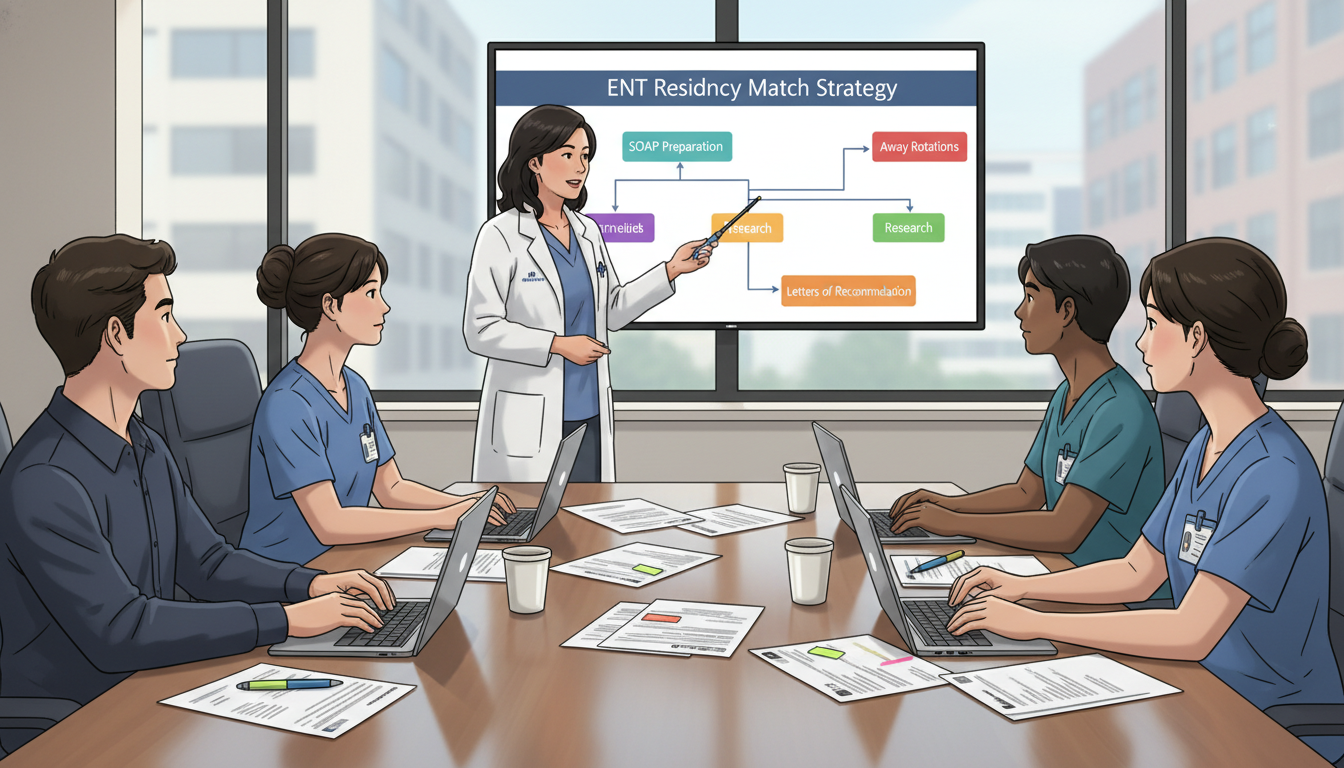
Understanding SOAP in the Context of ENT Residency
The Supplemental Offer and Acceptance Program (SOAP) is the structured process that allows unmatched or partially matched applicants to obtain residency positions that remain unfilled after the main Match. For competitive specialties like otolaryngology–head and neck surgery (ENT), understanding what is SOAP and how to prepare for it months in advance is essential risk management—even if your primary goal is to match outright.
What Is SOAP?
SOAP is:
- A tightly scheduled, NRMP‑run process during Match Week
- The only legal/ethical way to apply to unfilled NRMP-participating residency positions after results are released
- Conducted entirely through ERAS and NRMP, with rules about communication and offers
- Open to applicants who are SOAP-eligible (more on this below)
In practical terms, SOAP is a 3–4 day sprint where you:
- See a list of unfilled programs.
- Apply (up to a maximum number) via ERAS.
- Interview—often by phone or video—on very short notice.
- Receive offers in several “rounds” and decide quickly whether to accept.
SOAP and Otolaryngology (ENT): Why It Matters
ENT is highly competitive; many strong applicants do not match each year. Historically, otolaryngology residency positions have had very few unfilled spots. However, ENT applicants often use SOAP to:
- Transition to a different specialty (e.g., preliminary surgery, transitional year, internal medicine)
- Obtain a preliminary or categorical position that keeps them clinically active and eligible to reapply
- Enter related fields (e.g., general surgery prelim, research-track positions, or other specialties)
Because there may be few or no otolaryngology match SOAP positions in a given year, you must prepare for:
- Plan A: You match ENT—SOAP irrelevant.
- Plan B: You don’t match ENT but SOAP into a backup specialty.
- Plan C: You don’t match and don’t SOAP into anything; you pivot to a research or non‑ACGME role and prepare to reapply.
Being ready for all three plans is the essence of effective SOAP preparation for ENT applicants.
Determining SOAP Eligibility and Strategic Goals
Who Is SOAP-Eligible?
You are eligible for SOAP if:
- You registered for the NRMP Match and did not withdraw.
- You are partially matched (e.g., advanced position but no prelim) or unmatched.
- You are not matched to any position outside NRMP that would violate rules.
- You meet all ERAS and program-specific requirements (e.g., graduation date, exams).
If you are uncertain, you can confirm your SOAP status in your NRMP account on Match Week Monday at 10:00 AM ET when results are released.
Strategic Goal Setting for ENT Applicants
Before SOAP week, define your hierarchy of goals. For most ENT candidates, the order looks like this:
- Primary Goal – Match ENT directly through the main Match.
- Secondary Goal – If unmatched, obtain a position that preserves or enhances ENT competitiveness.
Common options:- Preliminary surgery
- Transitional year
- Internal medicine prelim
- Research-oriented transitional programs
- Tertiary Goal – If no clinical spot via SOAP, secure a 1-year opportunity that strengthens your ENT reapplication:
- Dedicated research fellowship in otolaryngology or related field
- Quality improvement fellowship
- Teaching or clinical instructor roles (depending on country/institution)
Being explicit about your hierarchy before Match Week helps you make fast, rational decisions under pressure.
Pre‑Match SOAP Preparation: What to Do Months Early
The worst time to start thinking about SOAP residency strategy is Match Week. For ENT, the stakes are high enough that you should begin SOAP preparation no later than December–January.
1. Build a Realistic Backup Specialty Strategy
You need to answer two questions clearly:
- What specialties or types of positions am I willing to SOAP into?
- Which choices genuinely help my long‑term ENT goals?
Common and strategically sound options for ENT reapplicants:
Preliminary General Surgery
- Pros: Overlapping skill set (airway, operative experience, perioperative care); viewed favorably by ENT PDs; strong clinical exposure.
- Cons: Intense workload; may not guarantee PGY-2+ position anywhere.
Transitional Year (TY)
- Pros: Broad exposure, some flexibility for research electives, easier step into a wide range of specialties.
- Cons: Quality varies widely; must ensure it is ACGME‑accredited and has a good educational reputation.
Internal Medicine Prelim
- Pros: Strong foundation in inpatient medicine; helpful for ENT with complex medical patients; often more available in SOAP.
- Cons: Less procedural/surgical experience; may require extra work to maintain ENT‑relevant skills.
Categorical IM, Pediatrics, or FM
If you are open to changing specialties permanently, categorical SOAP positions can lead to a satisfying career outside ENT.
Discuss these options with:
- Your ENT mentor or PD (if available)
- A trusted advisor in academic surgery or medicine
- Your medical school’s Dean of Student Affairs or career advisor
Write your preferences down in a SOAP playbook (even just a one-page document) that you can revisit during Match Week.

2. Optimize and “Parallel‑Prepare” Your Application Materials
For SOAP, you must use the same ERAS application infrastructure, but you can tailor some parts. Months before SOAP:
a. Personal Statements
Prepare at least two polished personal statements:
Primary ENT Personal Statement
- Focus on your commitment to otolaryngology, ENT‑specific experiences, and career goals.
Backup Specialty Statement or “General” Surgical/Clinical Statement
Use this if you SOAP into:- Preliminary surgery
- Transitional year
- Internal medicine prelim
Key elements:
- Emphasize dedication to patient care and clinical growth.
- Highlight skills transferable from ENT interest: operative discipline, head and neck anatomy, teamwork in OR, critical thinking.
- Avoid sounding like ENT is your only interest; you should present genuine enthusiasm for the backup role.
You can further refine by having:
- A surgery‑leaning statement (for prelim general surgery, TY heavy in surgery)
- A medicine‑leaning statement (for IM prelim/categorical)
b. CV and Experiences
Your ERAS CV won’t dramatically change, but you can:
- Update any new publications, posters, presentations, especially in ENT.
- Clarify leadership roles and teaching activities.
- Emphasize experiences showing resilience, adaptability, and teamwork—qualities valued in intense prelim/TY roles.
c. Letters of Recommendation (LoRs)
You cannot easily add new LoRs during SOAP; what you have at ERAS lock‑in is what you’ll use.
Aim to have by the time ERAS is initially submitted:
- 2–3 strong ENT letters (home ENT faculty, away rotation attendings)
- 1 letter from a non‑ENT clinician, ideally:
- Surgery (general, plastic, neurosurgery)
- Internal medicine
- Program leadership (e.g., Department Chair or Clerkship Director)
This gives you flexibility so that your application does not appear “too narrow” for non‑ENT SOAP programs.
Discuss with letter writers that you’re applying ENT but may need your letter to serve as a generic support for strong clinical potential in any residency.
d. USMLE/COMLEX and Other Documentation
Before Match Week:
- Confirm all exam scores are released and visible in ERAS.
- Resolve any ECFMG certification issues if you’re an IMG.
- Ensure there are no outstanding professionalism or disciplinary flags; if any exist, prepare a concise, honest explanation you can use during SOAP interviews if asked.
3. Build a Communication Plan and Logistics
SOAP is logistically intense. Prepare:
- Updated contact information in ERAS (phone, email you check hourly).
- A quiet space with good internet and phone reception reserved for Match Week, especially Wednesday–Thursday.
- A brief, adaptable interview script (more below).
- A calendar block for the entire week; avoid major personal commitments.
Tell supportive people (family, close friends) that:
- You may be under extreme time pressure.
- You might need to make sudden decisions.
- You may also need emotional support if unmatched.
Conducting SOAP During Match Week: Step‑by‑Step
Monday: Learning Your Status and Emotional Reset
On Monday at 10:00 AM ET, you learn whether you are:
- Fully matched
- Partially matched
- Unmatched
If you are unmatched or partially matched and SOAP‑eligible:
- Allow yourself a short emotional reaction; disappointment is normal.
- Quickly transition to problem‑solving:
- Reach out to your Dean’s office or career advisor.
- Notify your ENT mentors that you are SOAP‑eligible and request rapid guidance.
- Review your pre‑written SOAP playbook to reacquaint yourself with your plan.
Tuesday: Reviewing Unfilled Positions and Submitting Applications
On Tuesday at 9:00 AM ET, you see the list of unfilled programs (through NRMP/ERAS). For ENT applicants:
- There may be 0–very few ENT positions.
- You will likely see more:
- Prelim surgery
- TY
- Internal medicine prelim/categorical
- Other specialties
You can submit applications (up to a limit, often 45) through ERAS.
Strategy for ENT applicants:
Prioritize programs that align with eventual ENT reapplication:
- Strong academic centers.
- Hospitals with active ENT departments or otolaryngology research.
- Programs known for robust mentoring culture.
Balance geography and opportunity:
- If your main goal is a reapplication year, prestige and ENT exposure may matter more than location.
- If you’d be happy long term in a different specialty, think about where you’d want to live and train.
Use tailored personal statements:
- ENT PS only for genuine ENT openings (if any exist).
- Backup PS for prelim/TY/IM applications.
Work quickly but systematically; you have only a few hours to decide.
Wednesday–Thursday: Interviews and Rapid‑Fire Communication
Programs that receive your application will:
- Screen quickly.
- Reach out via email or phone to schedule brief virtual or phone interviews.
Your role:
- Be constantly available—phone on loud, email open.
- Respond professionally and promptly.
- Maintain a running list (spreadsheet) of:
- Programs that contacted you
- Interview times
- Key notes or impressions
- Fit with your long‑term goals
Interview Focus for ENT Applicants
Programs may ask:
- “Why are you interested in our prelim/TY/IM position?”
- “You applied ENT; are you still committed to ENT or open to other paths?”
- “How would you handle a demanding clinical schedule?”
Model framing:
- Be honest that you applied ENT because of your passion for that field.
- Emphasize core motivations that apply to all specialties: patient care, teamwork, intellectual challenge, procedural interest.
- Communicate gratitude and genuine interest in their program, even if it is a stepping stone.
Example response:
“Yes, my initial application focus was otolaryngology because I love complex anatomy and procedural care. At the same time, my fundamental motivation is to be an excellent clinician and teammate in a rigorous environment. Your preliminary surgery program would give me strong operative and perioperative training that will make me a better physician, whether I continue on a surgical path or ultimately find my home in another specialty.”
Red Flags to Avoid
- Saying you only care about ENT and view their program as a consolation prize.
- Appearing disorganized, late, or distracted during interviews.
- Over‑sharing frustration about the ENT match process.
Thursday–Friday: Offers and Acceptance Rounds
SOAP has several offer rounds (exact schedule can change by year). In each round:
- You may receive 0, 1, or multiple offers.
- You must make decisions quickly (often within 2 hours).
- If you accept an offer, you are bound to that program and exit SOAP.
Key decision tips:
- Revisit your hierarchy (Plan B vs Plan C).
- Consider:
- Program quality and reputation
- Presence of ENT department and research
- Mentorship opportunities
- Your long‑term openness to that specialty if you stay
If you receive no offers:
- Continue interviewing if programs contact you between rounds.
- Work with your Dean’s office and mentors to plan post‑SOAP steps.

Post‑SOAP Outcomes: Rebuilding Toward Otolaryngology
No matter the outcome of SOAP, you can still build a path toward a fulfilling career—potentially still in ENT.
If You SOAP into a Prelim/TY/IM Position
Maximize the year:
Excel Clinically
- Show up early, be prepared, volunteer for cases.
- Earn strong evaluations and new letters of recommendation.
- Demonstrate reliability and resilience.
Stay Connected to ENT
- Introduce yourself to the ENT department at your new institution.
- Ask about research or QI projects you can help with.
- Attend ENT grand rounds or conferences when possible.
Plan Your ENT Reapplication Early
- Meet with ENT faculty to discuss your timeline and application gaps.
- Start projects or case reports that are realistic to complete in 6–9 months.
- Gather feedback on your previous ENT application: scores, experiences, personal statement, interview skills.
If You Do Not Secure a SOAP Position
This is emotionally difficult, but many have recovered from this trajectory.
Steps:
Seek Immediate Support
- Talk to your school’s Dean or career office.
- Reach out to your ENT mentors; many are willing to help unmatched students.
Identify a 1-Year Gap Opportunity Valuable options for future ENT reapplication:
- Full‑time ENT research fellowship at an academic center.
- Clinical research coordinator role in ENT or related surgical specialty.
- Non‑ACGME clinical position (e.g., surgical assistant roles where allowed).
Systematically Strengthen Your Application Common areas to improve:
- Standardized exams: Step 2 or COMLEX Level 2 performance, particularly if initial scores were marginal.
- Research: ENT‑focused publications, posters, or abstracts.
- Clinical experiences: Additional ENT rotations or observerships.
- Professional narrative: A clear, honest way to explain your unmatched year that shows growth and insight.
Consider Realigning Your Goals After reflection and mentorship, some applicants decide:
- To reapply ENT with a stronger profile.
- To switch to another specialty that fits their skills and interests.
- To pursue non‑clinical pathways (public health, research careers).
The key is not to make these decisions in isolation; leverage mentors who understand both ENT and the wider residency landscape.
Practical Tips and Common Mistakes in SOAP for ENT Applicants
High‑Yield Practical Tips
- Start SOAP preparation early (December or earlier).
- Have multiple personal statements ready to deploy.
- Clarify your backup preferences and write them down.
- Keep mentors in the loop—they can advocate for you and help you think clearly.
- Practice short, focused interviews: 10–15 minute phone calls are typical in SOAP.
- Stay professional under stress: Program directors notice composure.
Common Mistakes to Avoid
Ignoring SOAP because you’re “sure” you’ll match ENT.
Even top candidates should have a contingency plan.Failing to prepare a backup specialty‑appropriate personal statement.
Using a very ENT‑specific statement to apply to prelim medicine or TY can undermine your credibility.Over‑applying indiscriminately.
Throwing applications at every unfilled program without strategy may waste limited slots.Burning bridges.
Being dismissive about non‑ENT positions or venting frustration to interviewers can close doors—both immediately and for future reapplications.Poor logistics.
Missing calls, not checking email frequently, or having tech issues during interviews can cost opportunities.
FAQ: SOAP Preparation in Otolaryngology (ENT)
1. Are there usually otolaryngology residency positions available in SOAP?
In most years, very few or no ENT residency positions are available in SOAP. ENT is highly competitive and tends to fill in the main Match. That’s why ENT applicants must be proactive about backup specialties (prelim surgery, TY, IM) that maintain or enhance their competitiveness for a future otolaryngology match cycle.
2. How should I explain my ENT interest when applying to non‑ENT SOAP positions?
Acknowledge that you originally applied ENT, then pivot to universal motivations: dedication to patient care, love of complex clinical problems, commitment to hard work and teamwork. Emphasize that you genuinely value the training offered by the backup program (surgical skill, broad clinical exposure, rigorous inpatient experience), and that you will give your full effort regardless of your long‑term path.
3. What is SOAP vs. the post‑Match scramble of the past?
SOAP replaced the old “scramble” with a structured, rules‑based process managed by NRMP and ERAS. Instead of chaotic, simultaneous calling of programs, SOAP uses:
- Centralized applications through ERAS
- Defined interview and communication rules
- Several formal offer rounds
Understanding what is SOAP is critical so you can remain compliant with NRMP policies and avoid inappropriate direct solicitation of programs outside the allowed channels.
4. If I fail to match ENT and also fail to SOAP, should I reapply to ENT or switch specialties?
It depends on your overall profile and feedback from mentors:
- If you were close (strong scores, good letters, some interviews) and can significantly strengthen research or clinical experience in a gap year, reapplying ENT may be reasonable.
- If you had substantial weaknesses (limited interviews, significant academic hurdles) and ENT PDs express concern about competitiveness, you may consider pivoting to a different specialty that better matches your record and interests.
In either case, use the unmatched/SOAP outcome as data—not as a verdict on your worth—and base your decision on careful conversations with ENT faculty and your school’s advising team.
Thoughtful, early SOAP preparation does not undermine your commitment to otolaryngology; it demonstrates maturity and foresight. By building a realistic backup strategy, optimizing your application materials, and understanding the mechanics of SOAP residency processes, you can navigate Match Week confidently and keep multiple viable paths open toward a meaningful career in or alongside ENT.