
Understanding SOAP for the Anesthesiology Applicant
For a US citizen IMG with a strong interest in anesthesiology, the Supplemental Offer and Acceptance Program (SOAP) can feel like a high‑pressure, last‑chance window. In reality, it is a structured, rule‑driven process where good preparation can significantly improve your outcomes—even if you ultimately pivot to a backup specialty or transitional/preliminary year.
Before you can prepare properly, you must be very clear on what SOAP is, how it works, and how anesthesiology fits into the bigger picture.
What Is SOAP?
The Supplemental Offer and Acceptance Program is an organized process run by NRMP in Match Week for applicants who:
- Are unmatched or partially matched (e.g., matched to an advanced position without a PGY‑1 or vice versa), and
- Are SOAP-eligible according to NRMP rules.
During SOAP:
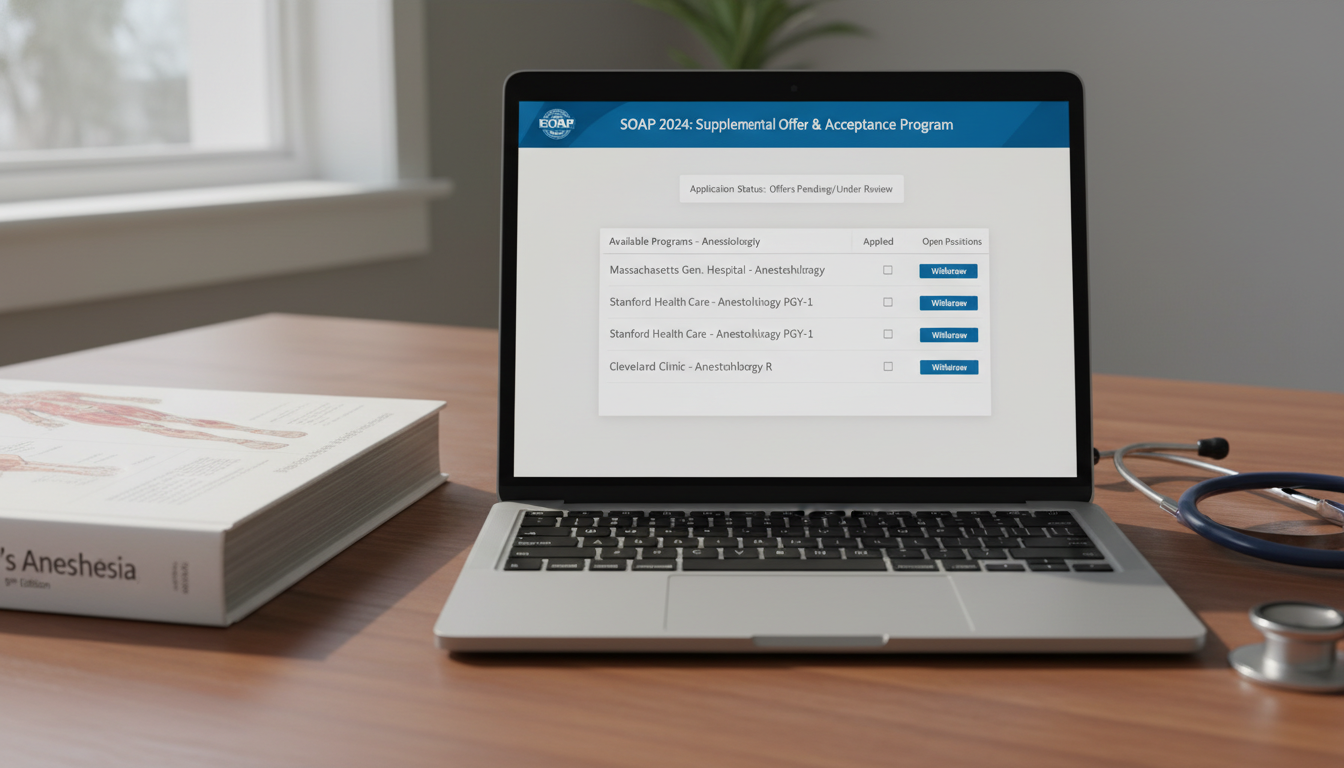
- Programs with unfilled positions post them in the NRMP’s List of Unfilled Programs.
- Eligible applicants submit up to 45 applications total through ERAS to participating programs.
- There are several offer rounds where programs extend offers and applicants accept or decline in real time.
- Outside solicitation of programs and “back‑channel” communication is strictly limited or prohibited.
Knowing what is SOAP and its guardrails is essential because violations can jeopardize your eligibility and even your future participation in the Match.
Where Does Anesthesiology Fit in SOAP?
Historically, anesthesiology residency rarely has a large number of unfilled categorical positions. However, several points matter for you as a US citizen IMG:
- Some years, there are a small number of anesthesiology categorical or advanced spots in SOAP—often in less competitive regions or new programs.
- There may be preliminary or transitional year positions that can keep you clinically active while you reapply to the anesthesia match.
- A small number of preliminary surgical or medicine years in SOAP can be strategically valuable as a foundation for future anesthesiology training if you re‑enter the Match.
Your SOAP preparation must therefore be two‑tiered:
- Tier A – Direct Anesthesiology Opportunities (if available and realistic).
- Tier B – Strategic Backup (TY/Prelim/Other specialities) that keep your long‑term anesthesiology goals alive.
Step 1: Pre‑SOAP Reality Check for US Citizen IMGs in Anesthesiology
Before Match Week, you should already have a clear picture of how competitive you are as an American studying abroad applying to anesthesiology.
Understand Your Applicant Profile
As a US citizen IMG, programs often look carefully at:
- USMLE scores (especially Step 2 CK now that Step 1 is Pass/Fail).
- Number of attempts on any exam.
- Recency of graduation (within 3–5 years is typically preferred).
- US clinical experience (USCE), especially in anesthesiology or relevant fields (IM, surgery, ICU).
- Letters of recommendation from US faculty—ideally including at least one anesthesiologist.
- Red flags: Leaves of absence, failures, disciplinary issues, significant unexplained gaps.
You should categorize yourself honestly:
- Strong for anesthesia: Solid Step 2 CK score (often ≥ 235–240 or above program norms), recent graduate, substantial USCE, strong LORs, no red flags.
- Borderline for anesthesia but strong for TY/preliminary: Moderate scores, some USCE, minor gaps but explainable.
- At risk for no categorical match: Lower scores, older graduate, minimal USCE, or notable red flags.
This assessment affects how aggressively you pursue direct anesthesiology residency positions in SOAP versus pivoting to preliminary/TY options.
Analyze Why You Might Not Match (Before SOAP Starts)
Your SOAP preparation is much stronger when you already understand why you may have gone unmatched:
- Did you apply to too few programs or only to very competitive regions?
- Were your anesthesia applications not targeted (generic personal statement, weak program fit)?
- Did you lack US‑based anesthesiology letters?
- Were your scores below the typical threshold for many programs?
- Did your interview season yield few anesthesia interviews?
Write a brief, honest self‑assessment:
“I’m a US citizen IMG with Step 2 CK of X, 2022 grad, 3 months of USCE (1 in anesthesia), 2 US anesthesiology LORs. I applied to 60 anesthesia programs but got only 3 interviews, mostly in community programs. My likely issues: modest Step 2 CK, limited USCE in big academic centers, and program preference for US MD/DO.”
This clarity informs how you position yourself during SOAP—both in your communication with programs and in selecting realistic targets.

Step 2: Building a SOAP Strategy Tailored to Anesthesiology
A successful SOAP experience is less about improvisation and more about pre‑arranged strategy you activate the moment the Match status opens.
Decide Your Priority: Direct Anesthesia vs. Building a Pathway
You should define a clear goal hierarchy before Match Week:
- Top Goal: Categorical or advanced anesthesiology residency.
- Second Goal: Strong transitional year (TY) or preliminary internal medicine/surgery in a program with:
- A strong anesthesia department, or
- A track record of residents successfully re‑matching into anesthesia.
- Third Goal (if necessary): Another specialty you can commit to or at least complete with professional fulfillment, should anesthesia no longer be realistic.
For most US citizen IMGs, the most pragmatic SOAP preparation is to:
- Actively pursue ANY anesthesiology spots that appear in SOAP (if you are remotely competitive), and
- Rank backup TY/Prelim and possibly Internal Medicine positions highly on your target list.
Understand SOAP Application Limits and Timing
Key elements that shape your SOAP preparation:
- You can submit up to 45 applications total across all rounds of SOAP.
- You cannot send new personal statements or LORs directly to programs outside ERAS during SOAP.
- Time is compressed—programs may interview briefly via phone or video and move quickly to offers.
Therefore, before Match Week you should:
- Prepare multiple versions of your personal statement:
- Anesthesiology‑focused.
- Broad medicine/surgery/TY‑friendly version.
- Prepare program‑grouped target lists, for example:
- Group A: Any anesthesiology programs that might appear.
- Group B: TY programs, especially in hospitals with anesthesia residencies.
- Group C: Preliminary IM/Surgery in hospitals with strong ICU, perioperative care, or pain services.
Even though you will not know exactly which programs will be unfilled, having a framework lets you act quickly.
Step 3: Document Preparation Before Match Week
Your SOAP preparation should be essentially complete well before Match Day. Treat it as an insurance policy you hope not to use.
Personal Statements: Anesthesia and Beyond
As a US citizen IMG pursuing anesthesiology, you should have at least two polished personal statements ready in ERAS:
Anesthesiology-Specific Personal Statement
- Emphasize:
- Motivation for anesthesia: OR environment, physiology, acute care, patient advocacy.
- Exposure: anesthesia electives, OR shadowing, ICU rotations, pain clinics.
- Relevant competencies: teamwork, crisis management, communication, calm under pressure.
- Address any IMG‑related concerns briefly:
- Why you trained abroad as an American studying abroad.
- How your international training brings value (resilience, adaptability, multicultural communication).
- Emphasize:
General Internal Medicine/Surgery/TY Personal Statement
- Focus on your interest in broad clinical exposure, strong foundational training, and your readiness to handle diverse inpatient and outpatient cases.
- This statement should be flexible enough for TY or prelim positions.
Assign each personal statement within ERAS to the appropriate program categories in advance where possible. In SOAP, you may need to adjust attachments rapidly as you apply.
CV and Experience Sections
Make sure your ERAS application:
Highlights:
- US clinical experience with clear roles, responsibilities, and procedures observed/assisted.
- Any OR, ICU, or perioperative exposure.
- Research or QI projects tied to anesthesia, critical care, pharmacology, or patient safety.
- Volunteer or leadership that demonstrates communication, reliability, and teamwork.
Minimizes:
- Long, unexplained gaps (brief explanation in the experiences or additional info section if needed).
- Irrelevant details that distract from your core strengths.
Letters of Recommendation (LORs)
For a US citizen IMG in anesthesiology:
- Ideally have:
- At least one US anesthesiologist letter.
- One or two additional letters from IM, surgery, or ICU attendings.
- Ensure:
- The letters are assigned in ERAS and ready to use for both anesthesia and alternative program types.
- No letter reveals major concerns or red flags; if so, de‑emphasize that letter.
You cannot obtain new letters quickly during SOAP, so having a strong mix now is essential.
Step 4: Executing on Match Week – SOAP Preparation in Action
Match Week is emotionally intense. The key is to switch from emotion to execution quickly once you see “Did not match” or “Partially matched.”
Monday: Status Release and Immediate Response
When the NRMP releases Match results:
- Check your status calmly:
- Unmatched, partially matched (e.g., advanced without PGY‑1), or fully unmatched.
- If eligible for SOAP:
- You will receive confirmation and instructions.
- Immediately:
- Connect with your school’s dean’s office or IMG advisor (if available).
- Notify mentors in anesthesiology or related fields who may offer guidance (within NRMP rules).
Emotional reaction is normal, but give yourself a strict time limit (e.g., 2–3 hours) to process, then switch into structured action.
Accessing the List of Unfilled Programs
Once the SOAP‑participating unfilled program list appears:
- Filter by:
- Specialty: Anesthesiology (categorical and advanced).
- Transitional year, preliminary internal medicine, preliminary surgery.
- Geographic preferences—but keep an open mind; this is not the time to be overly selective.
- Mark:
- Tier 1: Any anesthesiology programs for which you are remotely competitive.
- Tier 2: TY and prelims linked to institutions with anesthesia residencies.
- Tier 3: Other prelims or specialties you are willing to enter.
Allocating Your 45 SOAP Applications
As a US citizen IMG aiming for anesthesia, a common strategy is:
- 10–15 applications to any anesthesiology positions (if available).
- 20–25 applications to TY and prelims in institutions with anesthesia exposure.
- Remaining applications to:
- Internal medicine categorical, if you would seriously consider it, or
- Additional prelims at reputable centers.
Avoid scattering applications to specialties you would not actually pursue. Programs can sense lack of genuine interest.
Communication with Programs During SOAP
NRMP rules during SOAP strictly limit unsolicited contact. Typically:
- Programs may contact you for brief interviews.
- You should not cold‑call or email programs unless explicitly allowed by updated NRMP guidelines or the program’s instructions.
Prepare for rapid‑fire phone or video interviews:
- Have a 2–3 sentence elevator pitch ready:
- Who you are (US citizen IMG, school, year of graduation).
- Why anesthesiology/TY/prelim at their institution.
- What you bring (exam performance, USCE, work ethic, communication skills).
- Be prepared to:
- Explain why you went unmatched without sounding bitter or blaming.
- Emphasize your growth, reflection, and readiness to work hard.
Example elevator pitch for an anesthesia program:
“I’m a US citizen IMG from [School], Class of 2023, with a Step 2 CK score of 240 and three months of US anesthesia and ICU experience. I did not match this cycle likely due to limited initial interviews, but my evaluations and letters consistently highlight my work ethic and strong performance in the OR and ICU. I’m very interested in your program’s focus on [X feature], and I’m committed to contributing as a reliable, team‑oriented resident.”
Step 5: Anesthesiology-Specific Considerations and Long‑Term Planning
Even with excellent SOAP preparation, anesthesiology positions may be scarce or absent in a given year. You must be ready to protect your long‑term anesthesia goals through smart choices.
If You See Anesthesiology Spots in SOAP
If there are anesthesiology residency positions listed:
- Apply promptly, attaching your anesthesia‑specific personal statement and strongest anesthesia‑related LORs.
- Be ready to:
- Talk concretely about your anesthesia experiences.
- Highlight any procedural skills, ICU exposure, or perioperative medicine involvement.
- Demonstrate that you understand the demands of anesthesia: long OR days, emergencies, responsibility for critical decisions.
If you receive offers:
- Consider location and program reputation, but remember:
A solid anesthesia position nearly anywhere is worth strong consideration if the program is ACGME‑accredited, stable, and has no major red flags.
If No Anesthesiology Positions Appear or You Do Not Receive Offers
This is where a backup plan aligned with anesthesiology becomes critical.
Strategic choices:
- Transitional Year (TY) in a hospital with:
- A strong anesthesia department.
- Exposure to OR, ICU, and perioperative services.
- Opportunities to network with anesthesia faculty, do research, and get new LORs.
- Preliminary Internal Medicine or Surgery with:
- Rich ICU experience.
- Regular interaction with anesthesia and critical care teams.
- Internal Medicine Categorical in a program where anesthesia or critical care cross‑collaboration is strong.
Each of these can set you up to:
- Strengthen your USCE and letters.
- Improve your Step 3 score (if you choose to take it).
- Re‑enter the anesthesia match with a stronger file.
The Role of SOAP Preparation in a Reapplication Year
Even if SOAP does not yield an anesthesiology spot, the same preparation mindset carries into your reapplication:
- Analyze feedback from interviews (if you had any).
- Secure strong letters from your TY/Prelim attendings and anesthesiologists you meet.
- Update your personal statement to reflect growth and concrete experience.
- Expand or recalibrate your program list for the next anesthesia match cycle.
Being a US citizen IMG can be an advantage when re‑applying because:
- You do not require visa sponsorship, which removes a significant barrier some programs impose on IMGs.
- Your experiences in a US residency year show you can function effectively in the US system.
FAQs: SOAP Preparation for US Citizen IMGs in Anesthesiology
1. As a US citizen IMG, do I have a realistic chance to get anesthesiology through SOAP?
It depends on:
- Whether there are anesthesiology positions in SOAP that year.
- Your USMLE scores, year of graduation, and USCE.
- The strength of your anesthesiology‑focused application materials.
Some US citizen IMGs have successfully obtained anesthesia positions through SOAP, often in community‑based or newer programs. However, anesthesiology positions in SOAP are usually few and highly competitive. You should prepare for SOAP as a way to maximize any available opportunity, while also designing a robust backup pathway through TY or prelim training.
2. How should I explain being unmatched to programs during SOAP?
Use a concise, reflective, and non‑defensive explanation, for example:
“My application was competitive but I applied relatively narrowly, and I think my limited number of anesthesia interviews contributed to going unmatched. I’ve taken time to review my application with mentors, and I’m focusing on strengthening [specific areas: e.g., clinical exposure, communication skills, exam preparation]. I’m fully committed to working hard and being a reliable, teachable resident.”
Avoid:
- Blaming specific programs or the system.
- Over‑sharing personal grievances.
- Appearing unsure about anesthesiology or your backup choices.
3. If I end up in a transitional or preliminary year, can I still become an anesthesiologist?
Yes. Many anesthesiology residents have:
- Completed a preliminary medicine or surgery year, or
- Done a transitional year before starting anesthesia.
To keep your anesthesia ambitions realistic and strong:
- Seek rotations with anesthesia, ICU, and perioperative services.
- Let anesthesia faculty know your interest professionally and within institutional rules.
- Request letters of recommendation based on your actual performance.
- Maintain excellent performance evaluations and strong exam results (including Step 3 if applicable).
Then, re‑apply to the anesthesia match with an upgraded profile.
4. What are the biggest SOAP preparation mistakes US citizen IMGs make?
Common pitfalls include:
- Starting SOAP preparation too late, scrambling to write new personal statements or reorganize ERAS.
- Applying too narrowly during SOAP—only to one specialty or a few programs instead of using the full 45 applications wisely.
- Ignoring transitional or prelim options that can preserve long‑term anesthesiology goals.
- Violating SOAP communication rules, which can harm your reputation and eligibility.
- Failing to reflect on why they went unmatched, leading to repeated cycles with the same weaknesses.
Early, honest, and structured SOAP preparation gives you the best chance not only to salvage the current cycle but also to build a sustainable path toward an anesthesiology residency, even if that path is indirect.