
Understanding SOAP and the Transitional Year Landscape
For a US citizen IMG, the Supplemental Offer and Acceptance Program (SOAP) can be both a second chance and a high‑pressure sprint. If you are an American studying abroad and targeting a transitional year residency (TY program), effective SOAP preparation can be the difference between securing a position and going unmatched.
What Is SOAP?
The Supplemental Offer and Acceptance Program (SOAP) is the structured process NRMP uses during Match Week to fill unfilled residency positions with unmatched or partially matched applicants. It replaces the old “scramble” and is governed by strict rules and timelines.
Key features:
Who can participate?
- Registered for the Main Residency Match
- Eligible to enter GME on July 1 (passed required USMLE/COMLEX exams, ECFMG certified if applicable)
- Unmatched or partially matched as of Monday of Match Week
What happens?
- You learn your match status on Monday (but not where you matched).
- If you are eligible for SOAP and not fully matched, you gain access to the List of Unfilled Programs in ERAS at 11 a.m. ET Monday.
- Programs review applications and send offers during several rounds of offers from Wednesday to Thursday.
- You can receive multiple offers in a round but can accept only one.
Why it matters for TY programs
Transitional year residency positions are often used by applicants targeting advanced specialties (e.g., radiology, anesthesia, derm, ophthalmology). That means:- Many TY spots fill in the main Match.
- The TY positions that remain during SOAP may be more limited, more competitive, or geographically scattered.
- You may need to balance your desire for a “true TY” (broad clinical exposure, good schedule) with the reality of needing any accredited PGY‑1 position to stay on track.
Understanding what SOAP is—procedurally and strategically—is the first step in effective SOAP preparation.
Why US Citizen IMGs Are Frequently in SOAP
As a US citizen IMG (US citizen who is an international medical graduate—often an American studying abroad at a Caribbean or other foreign medical school), you’re statistically more likely to land in SOAP than US MD seniors. Reasons include:
- Higher competition for categorical and TY positions
- Variable school reputation and clinical exposure
- Visa issues for non‑US citizen IMGs (not your issue, but it still shapes the market)
- Step score cutoffs used as quick filters
The good news: Programs are often more comfortable with US citizen IMGs than non‑US‑citizen IMGs because there are no visa concerns. In SOAP, this can be a significant advantage, especially for community transitional year programs and prelim medicine or surgery tracks.
Pre‑Match SOAP Preparation: What To Do Before Match Week
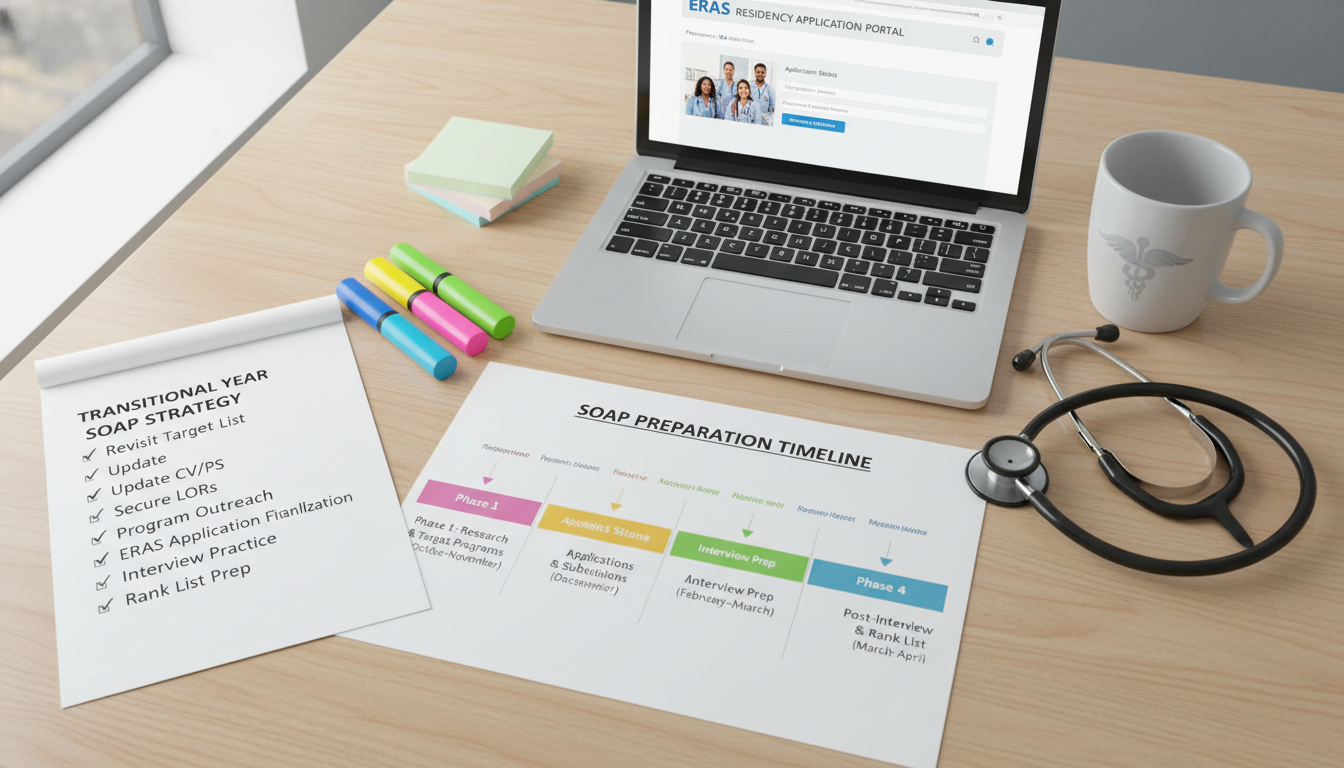
Effective SOAP preparation starts months before Match Week. Think of it as creating a SOAP readiness kit that you can activate quickly if needed.
1. Clarify Your Priorities and Backup Plan
Before Rank Order List (ROL) certification, define your realistic backup plan:
- Primary goal: Transitional year residency (TY program) vs categorical internal medicine vs prelim medicine vs prelim surgery.
- Hard constraints:
- Geographic no‑go zones (family, financial, immigration reasons).
- Personal limitations (significant health needs, childcare, etc.).
- Flexibility points:
- Willing to do prelim medicine instead of TY to stay on track?
- Willing to relocate anywhere in the US?
- Willing to accept a more demanding schedule in exchange for any PGY‑1?
Write this down. In the chaos of Match Week, clear, pre‑defined priorities prevent emotional, last‑minute decisions that you might regret.
Example:
“Plan A: Transitional year residency in any accredited ACGME program.
Plan B: Prelim internal medicine anywhere in the continental US.
Plan C: Prelim surgery only if no medicine/TY options and location is acceptable.”
2. Optimize ERAS for SOAP
Your ERAS application is the central document programs see during SOAP. By the time SOAP starts, you cannot rewrite your entire application, but you can prepare it to be SOAP‑ready ahead of time.
Key steps:
Ensure all scores and ECFMG status are updated.
- USMLE Step 1 (pass) and Step 2 CK scores uploaded
- OET/ECFMG certification completed, if required
- No missing score releases
Polish your Personal Statement strategy:
- Create one strong generic statement that fits transitional year, prelim IM, and prelim surgery (if you’re willing to consider those).
- Optionally, draft a TY‑focused personal statement emphasizing broad clinical interests and your value as a future specialist who needs strong foundational training.
- Keep them saved and ready; in SOAP you can assign different statements to different programs.
Letters of Recommendation (LoRs):
- Aim for 3–4 strong US clinical letters, ideally from IM, FM, or surgery attendings who know you well.
- Make sure they are uploaded and assigned in ERAS well before Match Week.
- For SOAP, avoid letters that are overly sub‑specialized or off‑topic (e.g., pure research letters unrelated to clinical performance, unless exceptionally strong).
Update CV and Experience sections:
- Include recent US clinical experience, observerships, and sub‑internships.
- Highlight skills valuable to a transitional year residency: versatility, teamwork, adaptability, communication.
- If you have quality improvement (QI) or EMR experience, feature it—it’s highly relevant to TY programs.
3. Build a Target List Template Before Results
You won’t know which programs are unfilled until Monday of Match Week, but you can pre‑build a target program template:
Make a spreadsheet with columns for:
- Program name
- State / city
- Program type (Transitional Year, Prelim IM, Prelim Surgery, Categorical IM/FM)
- Minimum Step scores (from program websites or FREIDA, if listed)
- Past IMG friendliness (look at prior resident lists, match data, or forums)
- Program size and hospital type (community vs university‑affiliated)
- Your priority score (1–5, based on fit and preferences)
Pre‑identify:
- Historically IMG‑friendly TY programs
- Community hospitals that take US citizen IMGs
- Regions where you have family or support
During SOAP, when the list of unfilled programs appears, you can quickly populate this template and prioritize where to apply instead of starting from scratch.
4. Technical and Logistical Readiness
SOAP is time‑critical. Technical issues can derail you.
ERAS account:
- Confirm your login works on multiple devices (laptop + backup).
- Update your email and phone number in ERAS and NRMP.
Document library:
- Save your personal statements, CV, transcripts, and any PDFs in a well‑organized local folder and cloud backup (e.g., Google Drive).
Communication plan:
- Check voicemail greeting (professional, clear).
- Use a professional email address.
- Keep your phone and email notifications on during Match Week.
- Inform family/roommates that Match Week is a high‑priority period with potential calls and emails at odd times.
Match Week: Step‑by‑Step SOAP Strategy for a US Citizen IMG Targeting TY
SOAP unfolds along a strict timeline from Monday to Thursday of Match Week. Here’s how to manage it strategically as an American studying abroad aiming for a transitional year residency.
Monday Morning: Discovering Your Status and Staying Grounded
At 10 a.m. ET Monday, you receive an email indicating one of several scenarios:
- Unmatched: Eligible for SOAP if all other criteria are met.
- Partially matched (e.g., advanced only, no PGY‑1): Possibly eligible for SOAP to fill the missing year (exact rules depend on NRMP year; check current guidelines).
- Fully matched: Not eligible for SOAP (you’re done).
If you’re unmatched or partially matched and SOAP‑eligible:
Take an hour to decompress.
Emotional reactions are normal. But you need a clear head for high‑stakes decisions.Confirm SOAP eligibility in NRMP and ERAS.
- Verify that “SOAP Eligible” is visible in your NRMP/ERAS dashboards.
- If you suspect an error (e.g., exam status issue), contact NRMP/ERAS immediately.
Monday 11 a.m. ET: Reviewing the List of Unfilled Programs
At 11 a.m., ERAS releases the List of Unfilled Programs.
Your tasks:
Filter for TY and relevant PGY‑1 positions:
- Transitional Year (PGY‑1)
- Preliminary Internal Medicine
- Preliminary Surgery
- Possibly Family Medicine (as a categorical backup if you’d consider it)
Apply your pre‑built spreadsheet:
- Copy programs from the list into your template.
- Prioritize by:
- TY programs first if that’s your primary goal.
- Prelim IM as the next best alternative for strong clinical foundation.
- Prelim surgery if surgery is your intended specialty or if you’re open and competitive there.
Check program characteristics quickly:
- Website for mission, call schedule, and structure.
- FREIDA / program data for size, benefits, and IMG friendliness.
- Look at past residents—are there US citizen IMGs or Caribbean graduates?
Monday Afternoon: Application Strategy and Submission
During SOAP, you are limited in the number of applications you can send (commonly 45 programs total, but always confirm current NRMP rules).
For a US citizen IMG focused on transitional year:
Allocate applications wisely:
- ~15–25 to Transitional Year residency programs
- ~10–20 to Prelim Internal Medicine
- Remaining to selected Prelim Surgery or categorical IM/FM, depending on your flexibility
Tailor personal statements by program type:
- Assign your TY‑focused statement to all TY programs.
- Use a general medicine‑focused statement for prelim IM and categorical IM/FM.
- If you’re serious about prelim surgery, consider a surgery‑oriented generic PS indicating interest in a surgical career but emphasizing teamwork and resilience.
Update geographic and specialty preferences in ERAS (if editable):
- Some programs scan for applicants’ indicated interests. Be truthful but strategic.
Important:
Contacting programs during SOAP is tightly regulated. Read the NRMP “Communication Code of Conduct” for the current year. Generally:
- Programs can initiate contact with you.
- You must not solicit positions or pressure programs before they contact you.
- You can respond if a program reaches out and may express genuine interest if they ask.
Tuesday: Responding to Interest and Interview Invitations
Some programs will schedule phone or virtual interviews on Tuesday or early Wednesday before offers are extended.
Preparation:
Standardized SOAP interview pitch (60–90 seconds):
- Who you are (US citizen IMG, school, graduation year)
- Why you want a transitional year residency (or prelim IM)
- Why this specific program (location, community, training style)
- What you bring (reliability, strong work ethic, good evaluations, communication skills)
Key points for TY programs:
- Emphasize adaptability and broad clinical interest.
- Clarify long‑term goals (e.g., radiology, anesthesia) but stress that you are fully committed to being an excellent intern and team member now, not just using the year as a stepping stone.
- Highlight US clinical experience and strong teamwork comments from attendings.
Example mini‑script:
“I’m a US citizen IMG who completed my MD at [School Name] with recent US clinical experience in internal medicine and surgery. I’m seeking a transitional year residency because I value a broad, well‑supervised clinical foundation before specializing in [future specialty, if known]. Your program’s mix of inpatient rotations, resident camaraderie, and focus on education aligns strongly with how I want to train. My attendings consistently describe me as reliable, hard‑working, and easy to work with, and I’d be excited to contribute positively to your call team from day one.”
Wednesday–Thursday: Understanding and Responding to SOAP Offers
SOAP offers are released in multiple rounds over Wednesday and Thursday.
Core rules:
- You may receive multiple offers in the same round, but you can accept only one.
- Once you accept an offer, you are locked into that position and are removed from further SOAP participation.
- Offers expire if you do not respond within the time window for that round.
Strategic considerations for a US citizen IMG seeking a transitional year:
Rank your realistic options ahead of time.
Make a simple list like:- Top TY program(s)
- Acceptable TY programs
- Strong prelim IM programs
- Other prelims / categoricals
If you receive a TY offer you’d be comfortable working in → strongly consider accepting.
- TY spots may not be available in later rounds.
- Waiting for a “slightly better” TY may risk ending up with no spot.
If you receive only prelim IM or prelim surgery offers in Round 1:
- Compare them to your pre‑defined backup plan.
- If a program meets your baseline criteria (location, reputation, workload), it may be rational to accept in Round 1 rather than gamble on later rounds.
If no offers in early rounds:
- Don’t panic. Programs may move slowly or prioritize applicants with prior connections.
- Continue to be reachable and responsive.
- Reflect calmly on whether you might expand to other program types in later rounds.

Crafting Your Application Narrative as a US Citizen IMG
SOAP is compressed; programs scan quickly. Your narrative must be instantly understandable and reassuring.
Emphasize Strengths Typical for US Citizen IMGs
As an American studying abroad, highlight:
Cultural and language familiarity with US healthcare.
You understand patient expectations, documentation norms, and healthcare system structure.US clinical experience (USCE):
- Sub‑internships, clerkships, observerships
- Specific hospitals and dates
- Any above‑average evaluation comments (e.g., “works at the level of an intern”)
Reliability and work ethic:
Transitional year residency programs value residents who show up, take ownership, and support the team.
Addressing Weaknesses Honestly but Strategically
If you landed in SOAP, there may be red flags or soft spots:
- Low Step scores
- Gaps in training
- No prior US experience
- Limited research or extracurriculars
In interviews or emails (if the program initiates contact):
- Acknowledge, don’t dwell.
- “My Step 1 score is lower than I hoped, and I’ve taken responsibility for that by…”
- Show growth and recent performance.
- Highlight strong Step 2 CK, excellent clerkship evaluations, or recent USCE.
- Reframe in terms of resilience.
- “This experience pushed me to improve my time management and study strategies, which I’ve since applied successfully during my clinical rotations.”
Tailoring to Transitional Year vs Prelim Positions
Transitional Year narrative:
- Interest in broad clinical exposure (IM, EM, surgery, electives).
- Emphasis on flexibility and desire to work across services.
- Future specialty aspirations, if known, but paired with concrete commitment to intern‑level responsibilities.
Prelim IM narrative:
- Strong interest in internal medicine fundamentals.
- Desire to develop diagnostic reasoning and inpatient management skills.
- Fit for medicine ward workflow and longitudinal patient care.
Prelim Surgery narrative:
- Interest in operative fields and acute care.
- Comfort with demanding schedules and procedures.
- Evidence of manual dexterity, OR exposure, and team‑based resilience.
After SOAP: Next Steps Whether You Match or Not
If You Accept a Transitional Year (or Prelim) Position Through SOAP
Confirm details in writing.
Your NRMP status will update, and the program will send onboarding information.Reach out with a professional thank‑you.
A concise email expressing appreciation and enthusiasm sets a positive tone.Start planning for your PGY‑2 or advanced specialty, if relevant.
- For advanced specialties (e.g., radiology, anesthesia), coordinate timelines for future applications with your TY PD and mentors.
- Ask about research or elective opportunities that align with your long‑term goals.
Prepare for intern year logistics:
- Housing, transportation, licensure paperwork, certifications (BLS/ACLS), immunizations.
- Mental and physical preparation for a demanding but growth‑filled year.
If You Do Not Match Through SOAP
This is deeply disappointing but not career‑ending. As a US citizen IMG, you still have options.
Debrief honestly.
- Seek feedback from mentors, advisors, or your dean’s office.
- Analyze objectively: scores, timing, LoRs, specialty choice, geographic limitations.
Consider a targeted gap year plan:
- Research fellowships or clinical research positions in the US
- Additional US clinical experience (hands‑on, if possible)
- Step 3 planning and completion (can strengthen future applications)
- Focused improvement of weak areas (e.g., communication skills, clinical reasoning)
Reassess specialty and program type choices.
- Categorical family medicine or internal medicine may offer more positions for future cycles.
- You can still aim for your eventual specialty later via fellowships or alternative pathways.
Stay connected and maintain professionalism.
- Do not burn bridges with programs or faculty.
- Keep your CV updated and continue improving your application profile before the next cycle.
Practical SOAP Preparation Checklist for US Citizen IMGs (Transitional Year Focus)
Use this as a quick run‑through in the months leading up to Match Week:
- Confirm NRMP registration and ERAS application completeness
- Verify USMLE scores are released; complete ECFMG certification if needed
- Secure 3–4 strong LoRs (ideal mix: internal medicine, surgery, possibly EM/FM)
- Finalize at least:
- 1 TY‑focused personal statement
- 1 general IM/FM personal statement
- Optional: 1 surgery‑focused personal statement
- Build a pre‑Match spreadsheet of potential IMG‑friendly TY and prelim programs
- Confirm contact information and professional voicemail/email
- Set expectations with family/household for Match Week availability
- Practice a 60–90 second SOAP interview introduction
- Review NRMP rules on SOAP and communication restrictions
- Mentally rehearse your backup plan hierarchy (TY vs prelim IM vs other options)
FAQ: SOAP Preparation for US Citizen IMGs in Transitional Year
1. As a US citizen IMG, do I have an advantage in SOAP compared to non‑US citizen IMGs?
Yes, in many cases. Because you do not require visa sponsorship, programs often see US citizen IMGs as logistically easier to hire. During SOAP, when time is short and paperwork must be streamlined, that advantage can be significant—especially for community transitional year and prelim programs. However, you still compete against US MD/DO seniors and strong IMGs, so overall competitiveness matters.
2. Should I only apply to transitional year programs during SOAP?
No. While your primary goal might be a transitional year residency, limiting yourself exclusively to TY programs during SOAP is usually risky. The number of unfilled TY positions may be small and highly competitive. A balanced strategy for most US citizen IMGs is:
- Prioritize TY programs
- Include prelim internal medicine programs
- Consider prelim surgery and possibly categorical IM/FM depending on your long‑term goals and flexibility
This increases your chances of securing a PGY‑1 spot while still targeting your ideal PGY‑1 structure.
3. How different should my SOAP personal statement be from my main Match statement?
You don’t need a completely new personal statement, but modest tailoring helps:
- For TY programs: emphasize broad clinical exposure, adaptability, and how a varied intern year supports your future specialty goals.
- For prelim IM: stress interest in internal medicine fundamentals and inpatient care.
- Keep statements concise, positive, and focused on what you bring to a team rather than retelling your entire life story.
Having 2–3 targeted versions ready before Match Week is a core element of smart SOAP preparation.
4. What is the most common mistake US citizen IMGs make in SOAP?
Common pitfalls include:
- Waiting until Match Week to think about SOAP strategy
- Applying too narrowly (only a few TY programs) despite limited spots
- Being unreachable or unprepared for rapid‑fire virtual interviews
- Letting disappointment overshadow professionalism when speaking with programs
- Failing to pre‑define an acceptance hierarchy, leading to indecision or missed offers
Proactive planning, realistic flexibility, and professional communication are the best antidotes to these mistakes.
By approaching SOAP as a structured, high‑intensity process rather than a desperate scramble, you greatly increase your chances of landing a transitional year residency—or a strong alternative PGY‑1—despite an initial unmatched outcome. As a US citizen IMG, your background and flexibility can be powerful assets if you prepare thoughtfully and execute calmly during Match Week.