
Understanding SOAP for US Citizen IMGs Interested in Addiction Medicine
The Supplemental Offer and Acceptance Program (SOAP) can feel intimidating, especially when your long-term goal is an addiction medicine fellowship and a career caring for patients with substance use disorders. As a US citizen IMG or American studying abroad, you face unique challenges and opportunities in SOAP. Solid SOAP preparation can transform Match Week from a crisis into a carefully managed second chance.
This guide explains what SOAP is, how it works specifically for US citizen IMGs, and how to leverage it to improve your chances of entering a residency pathway that can later lead to an addiction medicine fellowship. You will find practical checklists, timelines, and strategies tailored to your situation and specialty interest.
1. What Is SOAP and Why It Matters for Addiction Medicine–Bound IMGs
1.1 What is SOAP?
SOAP (Supplemental Offer and Acceptance Program) is an organized process run by the NRMP during Match Week to help:
- Unmatched or partially matched applicants, and
- Unfilled residency programs
connect in a structured, time-limited way.
In SOAP:
- Applicants do not apply through ERAS as usual; instead they apply only to programs listed as unfilled in ERAS/NRMP.
- There are multiple offer rounds (usually four on Wednesday–Thursday of Match Week).
- Once you accept a SOAP offer, you are legally bound to that program and cannot receive or accept further offers.
If you’re asking yourself, “What is SOAP and how is it different from the regular Match?”, the core differences are:
- It only involves unfilled positions and eligible unmatched applicants.
- Communication is tightly controlled: no direct outreach to programs until they contact you.
- The speed is intense: decisions sometimes need to be made in minutes.
1.2 Why SOAP Matters for US Citizen IMGs
As a US citizen IMG or American studying abroad, you are often:
- Competing for fewer interview spots compared to US MD/DOs
- More vulnerable to going unmatched even with solid credentials
- Simultaneously attractive to programs that prefer US citizens but value the perseverance and diversity of IMGs
SOAP preparation gives you:
- A second structured chance to secure a residency spot
- A way to pivot toward specialties or institutions that are more IMG-friendly
- A bridge toward your long-term goal: substance abuse training and eventual addiction medicine fellowship
1.3 SOAP and the Addiction Medicine Pathway
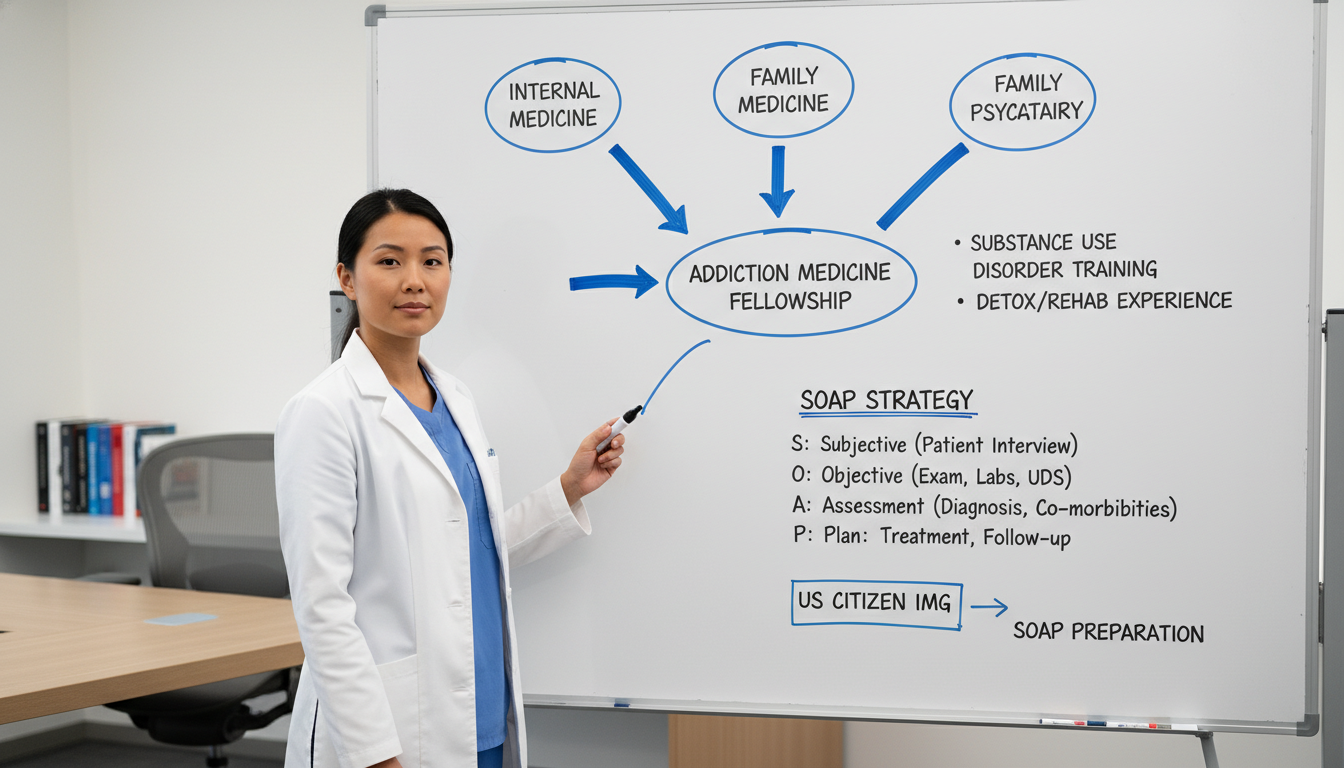
Addiction medicine in the US is primarily entered through:
- Internal Medicine (IM)
- Family Medicine (FM)
- Psychiatry
- Occasionally Emergency Medicine, Pediatrics, or Obstetrics & Gynecology with later subspecialization
Residency programs in these core specialties lay the groundwork for:
- Substance abuse training during residency (rotations, electives, QI projects)
- Strong letters and experience for an addiction medicine fellowship
In SOAP, your target is not usually “addiction medicine residency” (because addiction medicine is a fellowship), but rather:
- An IMG-friendly categorical residency that positions you well for future addiction medicine training.
2. Pre–Match Week SOAP Preparation (Months Before Results)
Preparing for SOAP should begin before you even know whether you matched. Think of it as insurance: you hope you won’t need it, but you’ll be grateful for it if you do.
2.1 Eligibility Checklist for SOAP
For SOAP eligibility, you generally must:
- Be registered with NRMP for the Main Match
- Be partially matched or unmatched as of Monday of Match Week
- Have certification from ECFMG (for IMGs) by the NRMP rank order list certification deadline (or meet current NRMP rules)
- Have no NRMP violations or bars
As a US citizen IMG, confirm:
- ECFMG certification is fully complete (including English proficiency and primary source verification)
- USMLE scores are all reported and meet program cut-offs where possible
- Your NRMP account is current and your Match participation is confirmed
2.2 Build a SOAP-Ready ERAS Application
Your ERAS application is frozen for much of the cycle, but during SOAP you can:
- Update your Personal Statement
- Update some experiences and add new entries
- Upload new Letters of Recommendation (LoRs) if available
Before Match Week:
Create at least one SOAP-specific personal statement
Focus on broad fields that are addiction-medicine–aligned, such as IM, FM, or Psychiatry. Emphasize:- Interest in substance use disorders and public health
- Experience with addiction-related research, rotations, or volunteer work
- Your commitment to vulnerable and stigmatized populations
Gather flexible Letters of Recommendation
- At least 1–2 letters from US clinical experiences (USCE), ideally inpatient or outpatient in IM/FM/Psych.
- If possible, one letter referencing substance use or behavioral health experience, but still broadly applicable.
Polish your CV and experience descriptions Highlight:
- Any addiction-related research, quality improvement, or community work
- Work in detox centers, methadone/buprenorphine clinics, needle-exchange programs, homeless shelters, etc.
- Leadership in interest groups related to mental health or substance abuse training
2.3 Strategic Mindset: Flexibility with Focus
You must balance:
- Flexibility in specialty choice to increase your odds of matching in SOAP
- Focus on core specialties that lead reliably to an addiction medicine fellowship
Residencies that commonly have unfilled positions and can lead to addiction medicine include:
- Family Medicine (often more unfilled positions, IMG-friendly)
- Internal Medicine (community programs)
- Psychiatry (increasingly competitive, but still some unfilled spots)
- Occasionally Transitional Year or Preliminary Medicine, if paired with a later categorical slot
Create a ranked preference list now (for yourself, not NRMP) of specialties and locations you’d be willing to accept during SOAP.
3. Match Week: Step-by-Step SOAP Strategy
Once Match Week begins, time moves very fast. Having a clear plan is essential.
3.1 Monday Morning: You Learn You Are Unmatched or Partially Matched
If the NRMP email shows you are unmatched or partially matched:
- Take 30–60 minutes to process the emotion. This is normal and expected.
- Quickly connect with:
- Your dean’s office or IMG advisor
- A trusted mentor or recent graduate who successfully navigated SOAP
- Confirm your SOAP eligibility in NRMP and ERAS systems.
3.2 Review the List of Unfilled Programs
On Monday, a list of unfilled programs becomes accessible to SOAP-eligible applicants in ERAS. Rapidly:
- Sort programs by:
- Specialty: prioritize IM, FM, Psych, Transitional/Prelim Medicine
- Visa policy: usually not a problem for US citizen IMG, but still check for IMG-friendliness
- Geography: be flexible, but identify absolute no-go regions if any
- Identify which programs have a track record with IMGs:
- Use websites, forums, and alumni experiences
- Prioritize community and university-affiliated community programs
3.3 Create Tiered Target Lists
Build a tiered list within 4–6 hours of seeing the unfilled list:
Tier 1: Top targets
Programs where:- Addiction-related rotations, clinics, or research are visible on the website
- They mention behavioral health integration, MAT (medication-assisted treatment), or substance abuse training
- They list IMGs among current residents (especially US citizen IMG profiles)
Tier 2: Acceptable programs
- Less explicit addiction focus, but core specialties that will still qualify you for addiction medicine fellowship later
- Reasonable training environment and outcomes
Tier 3: Safety programs
- Less desirable location or fewer academic resources, but still ACGME-accredited core residency positions
- May not advertise addiction work, but you can create opportunities later
3.4 Tailor Application Materials Rapidly
You typically have a short window (Monday–Tuesday) to submit applications.
Actions:
- Update personal statement(s) with clear mention that:
- You are committed to a career serving patients with substance use disorders
- You are highly adaptable and ready to train in varied settings (rural, underserved, community)
- Assign appropriate LoRs to each specialty:
- IM programs: internal medicine–oriented LoRs
- FM programs: family medicine or primary care–oriented LoRs
- Psych programs: psychiatry, behavioral health, or strong primary care letters
You cannot write a unique letter per program, but you can still:
- Use specialty-specific personal statements (e.g., one for IM, one for FM)
- Slightly reframe your experiences in ERAS descriptions to highlight:
- Longitudinal care, motivational interviewing, harm reduction exposure
- Systems-based practice, interdisciplinary teamwork (critical in addiction medicine)
3.5 Interview Preparation Under Time Pressure
SOAP interviews are often:
- Short (10–20 minutes)
- Conducted by phone or video
- Scheduled with very little notice
Prepare in advance:
Core Talking Points
- Why you went to medical school abroad as an American studying abroad, and what you gained from that experience
- Why you are passionate about addiction medicine and substance abuse training
- Why this residency (IM/FM/Psych) is the right starting point
- Evidence of resilience, adaptability, and reliability
Behavioral Questions for Addiction-Relevant Scenarios
- A time you dealt with a patient who was non-adherent or struggled with substance use
- A situation where you managed stigma or advocated for a vulnerable patient
- How you respond to burnout, heavy emotional cases, and complex psychosocial issues
Program-Specific Fit
- For FM: Emphasize full-spectrum care, continuity, community engagement
- For IM: Emphasize complex inpatient management, chronic disease plus SUD, liaison with psych and social work
- For Psych: Emphasize therapeutic communication, understanding of co-occurring disorders, harm reduction philosophy
Keep a SOAP interview notebook ready with:
- Bullet-point answers
- Notes on each program (location, distinctive features)
- 2–3 thoughtful questions for each program (e.g., “What opportunities do residents have to work in substance use clinics or with MAT?”)

4. Aligning SOAP Choices With Future Addiction Medicine Goals
4.1 Evaluating Programs Through an Addiction Medicine Lens
While time is short, you should still examine each potential SOAP program for:
Exposure to substance use disorders
- Dedicated addiction consult services
- Inpatient detox or dual diagnosis units
- Outpatient MAT (buprenorphine, methadone, naltrexone)
Public health and community engagement
- Partnerships with community clinics, shelters, harm reduction programs
- Rotations in underserved or rural settings
Interprofessional care
- Access to social work, psychology, and counseling services
- Strong collaboration with psychiatry and pain management
Red flags:
- Programs that dismiss or stigmatize patients with SUDs in their public-facing materials
- Very limited outpatient or longitudinal care exposure (especially problematic for FM and Psych)
4.2 Specialty-Specific Considerations for Addiction Medicine
Family Medicine
Advantages:
- Frequent SOAP unfilled positions
- Strong fit for whole-person, community-centered addiction care
- Broad scope: you can combine addiction medicine with primary care, women’s health, adolescent medicine, etc.
In SOAP:
- Prioritize FM programs that highlight:
- Behavioral health integration
- Suboxone clinics or MAT services
- Community or rural training tracks
Internal Medicine
Advantages:
- Deep exposure to complex medical comorbidities (HIV, hepatitis C, endocarditis, chronic pain) associated with substance use
- Common platform for academic addiction medicine fellowships
In SOAP:
- Target community IM programs with:
- Some link to academic centers or addiction services
- Strong continuity clinic structures where you might later integrate SUD management
Psychiatry
Advantages:
- Directly aligned with mental health and substance use disorders
- Strong training in psychotherapy, motivational interviewing, and co-occurring disorders
In SOAP:
- Psych often fills, but if any unfilled spots exist:
- Move them to your Tier 1 list
- Highlight your commitment to integrated mental health–addiction care
4.3 Realistic Flexibility vs. Long-Term Goals
As a US citizen IMG, you may need to be more flexible than US grads during SOAP. Ask yourself:
- Am I willing to train in a less desirable location if the residency offers solid clinical training?
- Would I accept a program with limited visible addiction exposure if it still gives me the core training needed for future fellowship?
In many cases, the quality of your clinical performance and your ability to create addiction-related opportunities (research, electives, QI projects) during residency matter more than the program name alone.
Even a small community IM or FM program can support your addiction medicine path if:
- You secure mentors interested in addiction or behavioral health
- You develop electives or projects around SUD (and many programs will support this if you show initiative)
5. Managing Logistics, Time, and Emotions During SOAP
5.1 Staying Organized Under Pressure
Use a SOAP command center:
Spreadsheet with columns:
- Program name, specialty, location
- Tier (1, 2, 3)
- Application submitted? (Y/N)
- Interview offered? (Y/N + date/time)
- Interview completed notes
- Impressions and priority rank
Calendar (digital) with:
- All interview times and time zones
- Offer round times and deadlines
5.2 Understanding SOAP Offer Rounds and Decisions
Once programs rank candidates, NRMP manages multiple offer rounds (e.g., four rounds Wednesday–Thursday). Key points:
- You may receive no offers, one offer, or multiple offers in a given round.
- If you receive an offer, you have a short, fixed window (often a couple of hours or less) to accept or reject.
- If you accept, you are done with SOAP and the Match; all other offers vanish.
- If you reject, you cannot get that specific position again, but you remain eligible for later rounds.
Decision-making strategy:
- Define non-negotiables in advance (e.g., must be ACGME-accredited categorical position; must be IM/FM/Psych, etc.)
- Accept a solid program that meets your career and lifestyle minima rather than gambling on a ‘perfect’ program that may never offer.
- Remember: a completed residency in a core specialty is your key to future addiction medicine fellowship.
5.3 Emotional Resilience and Support
SOAP is emotionally intense. As a US citizen IMG, you may already have navigated:
- Cultural transitions
- Stigma about being an IMG or American studying abroad
- Financial and family pressures
During Match Week:
- Set up daily check-ins with:
- A trusted friend or family member
- A mentor or advisor
- Maintain basic self-care:
- Sleep at least 6–7 hours if possible
- Eat regularly, hydrate, and take short walks
- Avoid:
- Doom-scrolling social media about the Match
- Comparing your path to others in a self-defeating way
Remember: many successful addiction medicine specialists did not follow a straight-line path. SOAP is not a failure; it is a structured second opportunity.
6. After SOAP: Next Steps, Regardless of Outcome
6.1 If You Match Through SOAP
Congratulations—now it’s time to maximize your residency for a future addiction medicine fellowship.
During residency:
- Seek addiction-related rotations early: inpatient consults, SUD clinics, co-occurring disorders.
- Request mentors interested in SUD, psychiatry, public health, or pain medicine.
- Build a portfolio:
- QI project on opioid prescribing, naloxone distribution, or MAT access
- Research or posters on outcomes for patients with SUD
- Teaching medical students or peers about stigma and harm reduction
By PGY-2 (or early PGY-3 in IM/FM), start exploring specific addiction medicine fellowship programs that accept graduates from your specialty.
6.2 If You Do Not Match Through SOAP
If SOAP does not result in a position:
Debrief deeply
- Analyze step scores, attempts, recency of graduation, USCE, LoRs, and interview performance.
- Seek candid feedback from program directors or advisors where possible.
Plan a strengthening year
Consider:- US-based clinical research in addiction or mental health
- USCE as a research assistant or observer in addiction clinics
- A master’s or certificate emphasizing public health, epidemiology, or behavioral health (if financially feasible)
Reapply more strategically
- Apply early and broadly to IMG-friendly IM/FM programs, with a clear narrative focused on addiction medicine as a long-term goal and a demonstrated year of growth.
- Use your new experiences to upgrade LoRs and your personal statement.
Failure to match one year does not end your path to addiction medicine. Many fellows and attendings had non-linear journeys.
FAQs: SOAP Preparation for US Citizen IMGs Interested in Addiction Medicine
1. As a US citizen IMG, do I have any advantage in SOAP compared to IMGs who need visas?
Yes. Programs that are reluctant or unable to sponsor visas often prefer US citizens, even if they trained abroad. This can expand your pool of SOAP-available programs. However, you still compete with US MD/DOs and strong non-US IMGs, so preparation and strategy remain critical.
2. Which specialty should I prioritize in SOAP if my goal is an addiction medicine fellowship?
Focus first on Family Medicine, Internal Medicine, or Psychiatry, in that order of likelihood of unfilled positions and alignment with addiction medicine. All three are accepted backgrounds for most addiction medicine fellowships and offer pathways to robust substance abuse training.
3. How can I show my interest in addiction medicine in a SOAP interview without seeming too narrow or inflexible?
Frame addiction medicine as a core component of modern primary and hospital care, not an isolated niche. Emphasize that:
- You value learning the full scope of the specialty (IM/FM/Psych),
- You see SUD as a common and important comorbidity,
- Your interest in addiction medicine will enhance your contribution to the residency, not limit it.
4. What is the biggest mistake US citizen IMGs make during SOAP preparation?
Common mistakes include:
- Waiting until after they learn they’re unmatched to think about SOAP,
- Applying only to a very narrow list of “dream” programs,
- Failing to align their SOAP applications with realistic, IMG-friendly specialties,
- Neglecting to integrate their long-term interest (like addiction medicine) into a coherent, adaptable narrative.
Thorough SOAP preparation, realistic program targeting, and a flexible but focused career story can significantly improve your chances of securing a residency that ultimately leads to your desired addiction medicine fellowship.