
Understanding SOAP and How It Applies to US Citizen IMGs in Cardiothoracic Surgery
The Supplemental Offer and Acceptance Program (SOAP) is the NRMP’s structured process that allows unmatched or partially matched applicants to obtain unfilled residency positions during Match Week. As a US citizen IMG and an American studying abroad, you are in a unique position: you have the legal and cultural familiarity of a US applicant but face the same structural challenges as other IMGs—especially in a hyper‑competitive field like cardiothoracic surgery.
Most US citizen IMGs interested in heart surgery training will not match directly into an integrated cardiothoracic surgery residency (I‑6). Instead, the realistic path is:
- Match (or SOAP) into a strong categorical general surgery program
- Build a robust surgical and research portfolio
- Apply for traditional cardiothoracic surgery fellowship after residency
Because of how few cardiothoracic surgery residency positions exist—and how rarely they go unfilled—SOAP preparation for this specialty is really about:
- Maximizing your chances to SOAP into a categorical or prelim general surgery spot
- Targeting programs that offer strong exposure to cardiothoracic and heart surgery training
- Avoiding panic decisions during SOAP that permanently limit your future options
Before anything else, you must know what is SOAP in precise terms and whether you are eligible.
SOAP Basics for Residency Applicants
Key elements of SOAP:
Eligibility: You must be
- Unmatched OR partially matched (e.g., matched to a prelim, not categorical)
- Registered for the NRMP Main Match
- ERAS‑participating with verified USMLE/COMLEX scores
- Determined “SOAP‑eligible” by NRMP on the Monday of Match Week
Timeline (high‑level):
- Monday 11:00 AM ET: You learn you are Unmatched or Partially Matched
- Monday 11:00 AM–Tuesday: Review the List of Unfilled Programs, finalize and send applications via ERAS
- Wednesday–Thursday: Multiple SOAP Rounds of Offers
- Friday: SOAP ends; unmatched applicants may pursue post‑SOAP options
Application Limit: 45 programs throughout SOAP (total, not per round).
For a US citizen IMG seeking cardiothoracic surgery exposure, your SOAP strategy must be ready before Match Week so that when the list of unfilled programs opens, you are executing—not improvising.
Strategic Mindset: How a US Citizen IMG Should Approach SOAP in Cardiothoracic Surgery
SOAP week is emotionally intense. The shock of not matching can quickly turn into rushed, poorly thought-out decisions. A clear, pre‑planned strategy is your best protection.
Clarify Your Long-Term Goal
If you are serious about cardiothoracic surgery, define your primary objective:
- Goal A: Become a cardiothoracic surgeon in the US
- Goal B: Work in an advanced surgical field with cardiothoracic exposure (but open to career flexibility)
Your SOAP choices will differ:
If Goal A:
- Prioritize categorical general surgery positions in strong academic or high‑volume community programs
- Then prelim general surgery in places with cardiothoracic surgery presence (or easy research access)
- Avoid locking yourself into specialties with minimal pathway to CT surgery unless you have fully reconsidered your career goals
If Goal B:
- Consider adjacent pathways such as:
- Vascular surgery, interventional cardiology (via internal medicine), or critical care
- Anesthesiology with focus on cardiac anesthesia
- Still prioritize general surgery first, but be more flexible during later SOAP rounds
- Consider adjacent pathways such as:
Understand the Reality of Cardiothoracic Positions in SOAP
Integrated CT surgery (I‑6) positions almost never appear in SOAP.
If they do, they are likely:- Programs with very specific selection criteria
- Highly competitive even in SOAP
What realistically appears that relates to heart surgery training:
- Categorical general surgery (the primary target)
- Preliminary general surgery (a stepping stone)
- Occasionally:
- Surgical critical care prelim positions
- Internal medicine with strong cardiology programs (for those open to a redirected path)
Plan with the assumption:
Your SOAP “cardiothoracic path” will almost certainly begin in general surgery, not integrated CT.
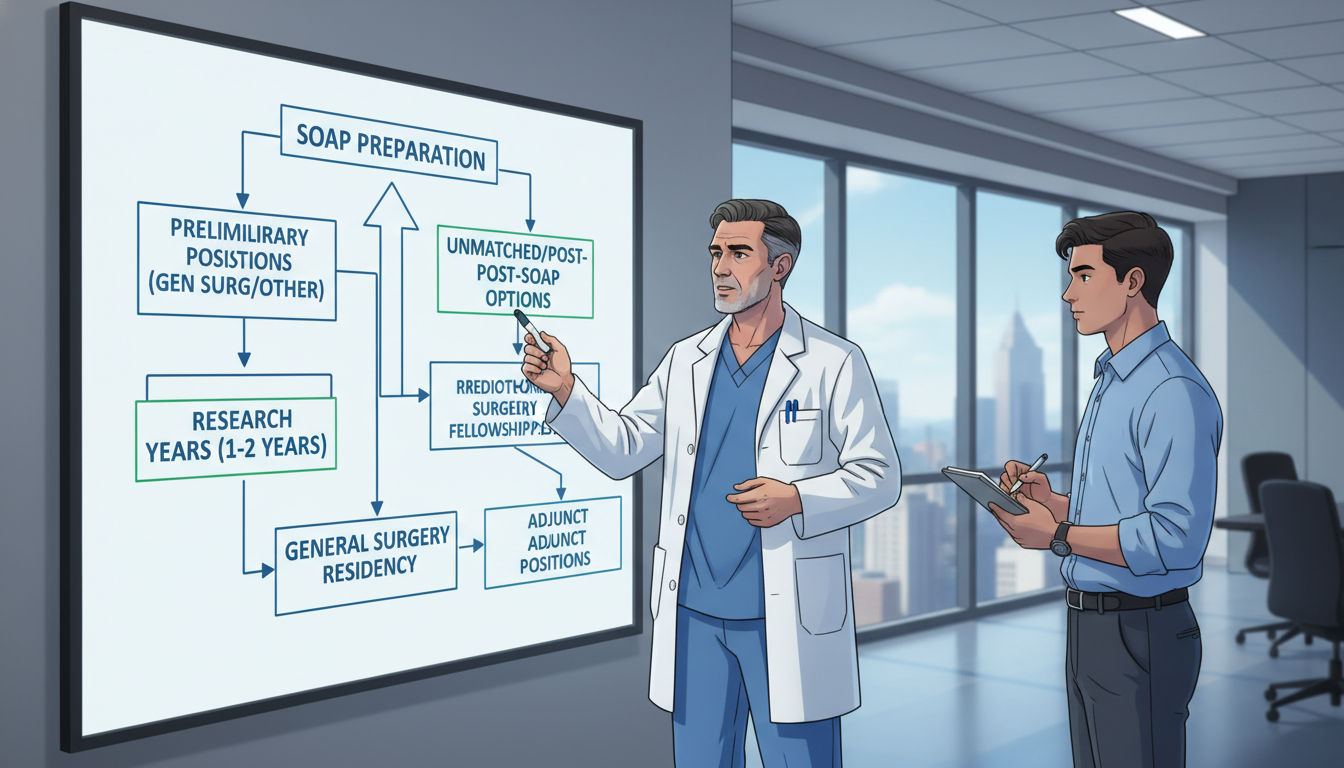
Pre–Match Week SOAP Preparation: What You Must Have Ready
Your SOAP success depends heavily on groundwork done weeks to months before Match Week. As an American studying abroad, your time zone and scheduling differences make this pre‑work even more important.
1. Build a Targeted SOAP Playbook
Create a written document (even a simple spreadsheet) that includes:
Priority order of specialties you’re willing to accept in SOAP
- Tier 1: Categorical general surgery (goal-aligned)
- Tier 2: Prelim general surgery
- Tier 3: Other surgery‑adjacent fields (anesthesia, IM in strong cardiac centers)
- Tier 4: Transitional/prelim medicine only if strongly justified
Geographic flexibility:
- Rank regions: “Will go anywhere,” “Prefer not,” and “Only if desperate”
- Remember: For cardiothoracic ambitions, program quality and CT exposure matter more than location
Red‑line boundaries:
- What you will not accept (for example: categorical family medicine if you will be unhappy and never practice it)
- Be honest. Taking a position you intend to abandon is unfair to programs and to yourself.
This prevents emotional decision‑making when SOAP offers suddenly appear with tight expiration windows.
2. Optimize Documents for SOAP-Specific Use
Even if you already submitted polished ERAS materials, SOAP calls for some adaptation.
a. SOAP-Focused Personal Statement(s)
You cannot upload new documents once SOAP begins, so prepare:
One primary personal statement emphasizing:
- Commitment to surgery and ultimately cardiothoracic surgery
- Evidence of durability: long hours, complex cases, working under pressure
- Understanding of US health systems (important as a US citizen IMG)
- Maturity and teachability
If possible, an alternate personal statement:
- Focused on internal medicine or anesthesia (if those are your Tier 3 backup plans)
For general surgery, a short paragraph can mention:
“My long‑term ambition is to pursue cardiothoracic surgery. I am deeply aware that this begins with becoming an outstanding general surgeon. I am committed to rigorous general surgical training, team-based care, and continuous growth in the OR and ICU.”
Keep it enthusiastic about surgery broadly; not so narrow that you sound uninterested in general surgery itself.
b. Update Your CV and ERAS Experiences
Make sure your ERAS entries highlight:
Surgical interest and exposure:
- Surgical clerkships, sub‑internships, or electives—especially in general surgery or CT surgery
- Case logs if available
Cardiothoracic‑relevant activities:
- Research related to cardiac, thoracic, or vascular disease
- Presentations or posters in surgery or cardiology
US clinical experience (USCE):
- Particularly valuable for a US citizen IMG—highlight any rotations in American hospitals, especially surgical services
c. Letters of Recommendation (LoRs)
Programs cannot receive new LoRs during SOAP, but you can decide which letters to assign:
Prioritize:
- Letters from US surgeons, especially general or cardiothoracic surgeons
- Letters commenting on technical skills, work ethic, communication, and reliability
If you also prepared letters for internal medicine/anesthesiology:
- Assign them only to those specialty applications as needed
3. Know the SOAP Mechanics in Detail
As a US citizen IMG, you may be balancing time zones, limited advisor access, or hospital duties. Master the logistics before Match Week:
ERAS Functionality:
- Understand how to assign documents and select programs in bulk
- Practice “test runs” in your head: If you have 45 applications, how will you divide them among specialties?
NRMP Timing:
- Know exactly when:
- Unmatched status is released
- Unfilled list is published
- Each SOAP round of offers occurs
- Know exactly when:
Communication Rules:
- During SOAP, direct, applicant‑initiated contact with programs is prohibited
- Programs may contact you; you must be responsive but professional
Create a one-page SOAP timeline sheet you can print or keep visible on your computer.
Specialty Strategy: Positioning Yourself for Future Cardiothoracic Surgery During SOAP
Because integrated cardiothoracic surgery residency is almost never obtainable through SOAP, you need to think in terms of pathways, not single events.
Best-Case SOAP Outcome for an Aspiring Cardiothoracic Surgeon
Categorical General Surgery at a Program with:
- An in-house cardiothoracic surgery service
- Strong ICU exposure
- Opportunities for research (especially cardiac/thoracic, outcomes research, or critical care)
When reviewing the list of unfilled programs:
- Search first by specialty: Surgery – Categorical
- Then investigate:
- Does the institution have:
- A cardiothoracic surgery fellowship?
- A busy cardiac surgery OR?
- Dedicated CT surgery faculty?
- Even if not integrated CT, a strong general surgery program with CT exposure is gold.
- Does the institution have:
Example:
- Program A: Small community hospital, no CT surgery service
- Program B: University-affiliated community program with visiting CT surgeons and an academic partner
Program B is far more favorable for long-term heart surgery training, even if the location is less desirable.
Second-Best SOAP Outcome: Prelim General Surgery
A preliminary general surgery position can still be an excellent stepping stone if:
- The program is well-regarded
- There is a reasonable track record of prelim residents:
- Securing categorical spots later (either at the same institution or elsewhere)
- Engaging in meaningful research or networking
When evaluating prelim offers:
- Ask yourself:
- Will this program advocate for its prelims?
- Are there PGY‑2 categorical spots historically available?
- Do they have cardiothoracic surgery faculty you could work with?
If yes, a prelim can be a powerful bridge year—you gain US surgical experience, references, and possibly a new application cycle with a stronger profile.
SOAP and Alternative Specialty Pathways
If surgical options seem unlikely (late rounds, minimal unfilled surgery positions), consider how other specialties might still position you near cardiothoracic care:
Anesthesiology:
- Cardiac anesthesia is deeply embedded in heart surgery training environments
- You can work closely with CT surgeons and in cardiac ORs
Internal Medicine:
- Pathway to cardiology, then interventional cardiology or advanced heart failure/transplant
- Not surgery, but still heart‑centered complex care
Critical Care / Pulmonology (eventual):
- Through internal medicine, you might become an intensivist involved in post‑cardiac surgery ICU care
These are significant career shifts. Reserve them for situations where:
- No viable surgery options remain
- You have thoughtfully reassessed your goals
- You are prepared to fully commit to the new path, not see it as a mere placeholder

Execution During Match Week: Step-by-Step SOAP Preparation in Action
Once Match Week begins and you discover you are unmatched or partially matched, you will move rapidly through several phases. Having a checklist is crucial.
Step 1: Emotional Stabilization and Rapid Debrief (Monday)
- Allow yourself a brief emotional reaction; then quickly move to analysis
- If possible, speak with:
- A trusted faculty mentor (especially surgeons)
- Your school’s dean or advising office
- Mentors from US rotations if you’re an American studying abroad
Key questions for your quick debrief:
Why do I think I didn’t match?
- USMLE scores?
- Limited US clinical experience?
- Late application or few programs applied to?
- Weak or generic letters?
Does this change my long-term goal of cardiothoracic surgery?
- If still yes, reaffirm your commitment and move forward with a surgery‑focused SOAP plan.
Step 2: Reviewing the List of Unfilled Programs
When the list opens:
Filter by Specialty:
- Start with: Surgery – Categorical
- Then: Surgery – Preliminary
- Finally: any backup specialties you pre‑defined
Triage Programs:
- Tier 1: Categorical general surgery at hospitals with CT surgery presence
- Tier 2: Prelim general surgery at reputable or academic‑affiliated centers
- Tier 3: Other reasonable career paths you defined in your SOAP playbook
Research Rapidly but Systematically:
- Check each program’s website:
- Do they list CT surgery faculty or services?
- Are there CT surgery or thoracic surgery rotations?
- Is there an established surgery residency with academic ties?
- Check each program’s website:
Don’t get lost in minutiae—you have limited time. Focus on core criteria that matter for your future heart surgery training.
Step 3: Allocating Your 45 SOAP Applications
Use your 45 program limit strategically:
Example allocation for a US citizen IMG strongly focused on surgery:
- 25–30: Categorical General Surgery
- 10–15: Prelim General Surgery
- Up to 5–10: Backup specialty (e.g., anesthesiology or IM in strong cardiac centers), if part of your pre‑defined plan
Avoid scattering applications thinly across many unrelated specialties; it dilutes your message and preparation.
Step 4: Preparing for SOAP Interviews and Contacts
Once programs review SOAP applications, they may:
- Email you
- Call you
- Schedule brief virtual interviews (by phone or video)
Prepare your SOAP interview talking points in advance, with focus on:
Why They Should Choose You in a Compressed Process:
- You bring US cultural familiarity as a US citizen IMG
- Strong work ethic and adaptability from training abroad
- Clear interest in surgery and capacity for hard work
How You Handle Pressure and Setbacks:
- Be honest but positive about not matching
- Show reflection and growth rather than blame
Your Commitment to the Program:
- Mention:
- Willingness to relocate
- Desire to invest 100% in their training environment
- Long-term goals, but emphasize you will first become the best resident possible
- Mention:
If a program is heavily involved in cardiothoracic surgery, you can say:
“My long-term goal is to pursue cardiothoracic surgery. I’m especially excited by your program’s exposure to cardiac and thoracic cases, and I would work hard to contribute to those services while fully embracing all aspects of general surgery.”
Step 5: Handling SOAP Offers Ethically and Strategically
During the SOAP offer rounds:
- Offers have a short expiration time (usually 2 hours)
- You may receive multiple offers across different rounds
Decision framework:
If you receive a categorical general surgery offer from a decent program:
- It is almost always wise to accept immediately if it aligns with your basic criteria
If you receive a prelim general surgery offer early:
- Ask: Is there still a realistic chance of a categorical offer later?
- Consider:
- Your overall profile strength
- How many categorical spots remain unfilled
Avoid declining a solid prelim in hopes of a categorical offer if:
- Your application has major red flags
- You have no strong differentiators
- Surgical positions are rapidly disappearing
Once you accept an offer, you are bound. Do not accept hoping you can change later in SOAP.
Post-SOAP Planning: If You Don’t Land a Surgery Spot
Even with perfect SOAP preparation, you might not obtain a surgery-related position. This is painful, but not necessarily the end of your cardiothoracic aspirations—especially as a motivated US citizen IMG.
Option 1: Dedicated Research Year(s)
If you remain unmatched:
- Seek research positions in:
- Cardiothoracic surgery
- General surgery
- Cardiology or thoracic oncology
Benefits:
Strengthens your CV with:
- Publications, abstracts, and presentations
- Strong surgical or cardiac faculty references
Allows you to:
- Gain US clinical/scholarly credibility
- Reapply more competitively next cycle
Target large academic centers with CT surgery divisions known for taking on research fellows.
Option 2: Improve Application Weaknesses and Reapply
Conduct a thorough post-cycle debrief:
- Scores: USMLE Step 1 pass/fail now, but Step 2 CK still matters; consider an improvement attempt if low
- USCE: Add more US surgical rotations or sub‑internships
- Letters: Obtain strong, detailed LoRs from US surgeons
- Personal Statement: Refine your narrative to show growth and resilience
As an American studying abroad, emphasize:
- Your understanding of US patient expectations and healthcare culture
- Why choosing to train abroad has broadened your perspective—not limited it
Option 3: Redefine—but Still Honor—Your Passion
If repeated cycles support the conclusion that a surgical training path is unlikely, you may:
Explore cardiac‑related medical specialties:
- Cardiology
- Pulmonology and critical care
- Cardiac anesthesia
Focus on roles that keep you close to the heart and thoracic disease spectrum, aligning with your original interest, even if not as an operating surgeon.
FAQs: SOAP Preparation for US Citizen IMGs in Cardiothoracic Surgery
1. As a US citizen IMG interested in cardiothoracic surgery, should I only apply to surgery programs during SOAP?
Not necessarily. Your first priority should be categorical and prelim general surgery, especially at hospitals with strong heart surgery training exposure. However, if surgical options are extremely limited and you reach later SOAP rounds, it can be rational to include backup specialties (e.g., anesthesiology or internal medicine in cardiac centers) as long as you are genuinely willing to train and practice in those fields.
2. Is a prelim general surgery position worth taking if my long-term goal is cardiothoracic surgery?
Yes—if the prelim is at a reputable program that values and supports its prelim residents. A strong prelim year can provide US operative experience, relationships with surgeons, letters of recommendation, and sometimes transition into a categorical seat. It can be a powerful stepping stone toward both general surgery and future CT surgery fellowship applications.
3. How can I show programs in SOAP that I’m serious about surgery but not “too narrow” on cardiothoracic?
Frame cardiothoracic surgery as your long-term interest, but emphasize that your current priority is to become an excellent general surgery resident. On interviews and in your personal statement, state clearly that you respect all facets of general surgery practice and are committed to the team, education, and patient care—while also being enthusiastic about any cardiothoracic exposure the program offers.
4. What specific advantages do US citizen IMGs have in SOAP compared with non‑US IMGs?
As a US citizen IMG, you avoid visa-related concerns, making you administratively easier to onboard during the compressed SOAP timeline. Programs know you are already familiar with US culture, communication styles, and often the healthcare system. Highlight these points subtly—focus on your ability to integrate quickly, communicate effectively with patients and teams, and commit long‑term to practice in the US.
By preparing your documents early, building a realistic SOAP strategy focused on general surgery pathways, and maintaining flexibility without abandoning your core goals, you can navigate SOAP in a way that preserves—and often strengthens—your long-term trajectory toward cardiothoracic surgery.