
The brand name of a residency doesn’t guarantee you’ll end up where you want to practice. The alumni map does.
If you’re trying to choose between programs and you care where you’ll work after training (you should), then you need to stop obsessing over vague “reputation” and start studying alumni outcomes like a hawk.
This is exactly what almost nobody does well. Programs bury this data on their websites. Applicants glance at it, maybe say “cool map,” and then go back to Step scores and faculty lists. That’s a mistake.
Here’s the answer you’re actually looking for: yes, it absolutely matters where graduates practice, and you should use alumni maps like a decision tool, not a decoration.
Let’s break down how.
1. Why practice location outcomes matter more than you think
Where a program’s graduates end up tells you three critical things:
- How strong the program’s regional reputation really is
- What kinds of jobs you’re likely to get (academic vs community, rural vs urban, high vs low resource)
- How portable your training will be if you change your mind about geography or subspecialty
Forget what the glossy brochure says. If 80% of graduates stay in one state or region, that program is essentially a feeder for that area. That’s not bad. It’s just reality. And you need to decide if that reality matches your goals.
Here’s the key rule:
If your dream is to practice in Region X, then a good-enough program with a track record of sending grads to Region X beats a “top” program that rarely places people there.
I’ve watched this play out over and over:
- The student from the Midwest who goes to a big coastal name-brand residency, then struggles to get a job back home because nobody in that market has worked with their faculty, but everyone knows the local regional powerhouse.
- The IMG who matches into a community program with a strong pipeline into local hospital jobs and ends up with three offers before graduation because alumni are everywhere in that city.
- The resident who never looked at alumni data, assumed they’d “figure it out later,” and only realized in PGY-3 that nobody from their program has gone into the hyper-competitive fellowship they want in the last 10 years.
Your future geography is not random. It’s patterned. Alumni maps show the pattern.
2. How to actually read an alumni map (not just glance at it)
Most programs show alumni destinations in one of three ways:
– A map with pins
– A list of “recent graduates” with job or fellowship placements
– A vague paragraph like “Our residents go on to competitive fellowships and practices nationwide”
Only the first two are useful. The third is marketing fluff.
Here’s exactly how to dissect an alumni map or destination list.
A. Start with the raw geography
Ask yourself four questions:
- Are most grads staying in-state, in-region, or truly scattered nationwide?
- Is there a dominant city or health system that keeps appearing?
- Are there any obvious clusters (Northeast corridor, West Coast, Texas, etc.)?
- Are there any places you care about that never show up?
If 70% of their dots are within 200 miles, this is a regional program. That’s not a criticism. It might be perfect for you if you want to stay there. But don’t pretend it’s a national launching pad if the data says otherwise.
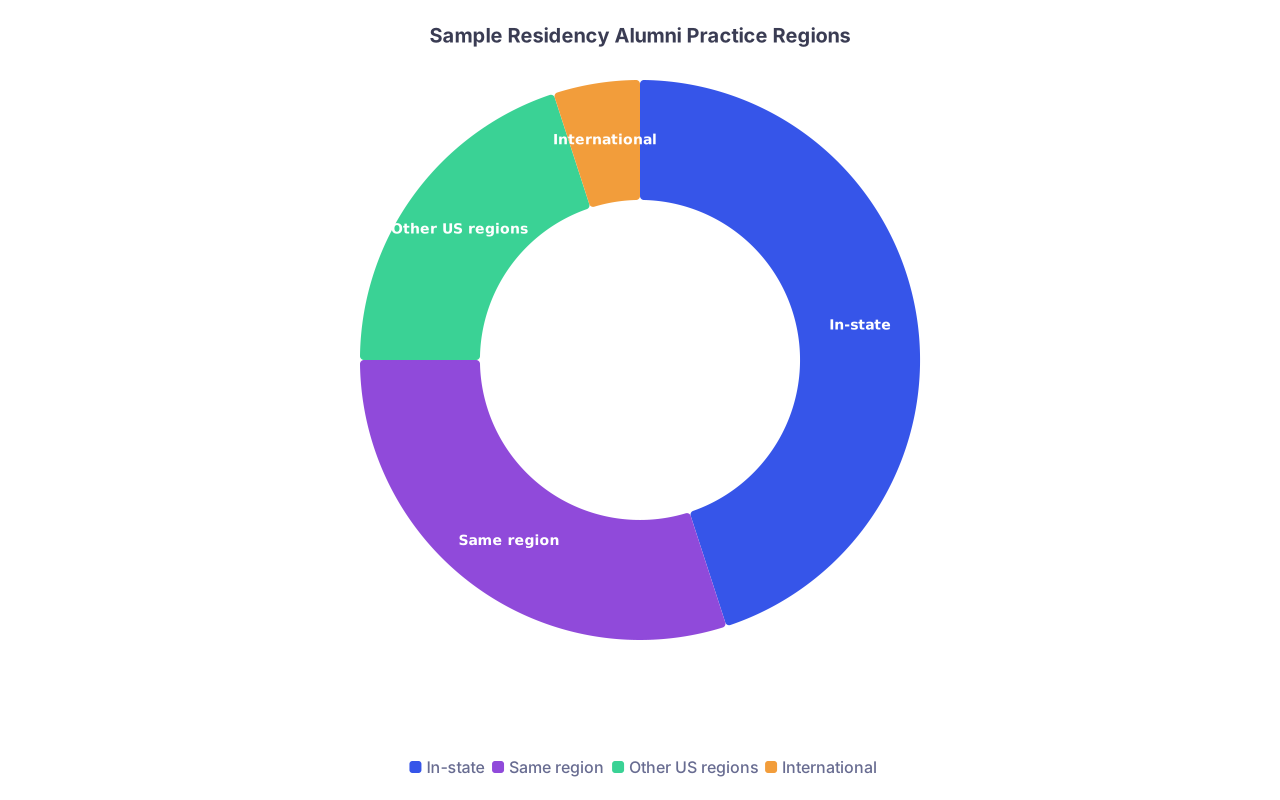
| Category | Value |
|---|---|
| In-state | 45 |
| Same region | 30 |
| Other US regions | 20 |
| International | 5 |
This is what a typical mid-to-strong regional program might look like. If the program you’re evaluating claims “our graduates practice all over the country” but their map looks 80–90% in-state, believe the map, not the sentence.
B. Then look at type of first job
Good alumni pages will say things like:
- Assistant Professor – University X
- Community Hospitalist – City, State
- Private Practice – Group Name – City, State
- Fellowship – Specialty – Institution
You care about FIRST destination, not “where someone eventually ended up 10 years later after five moves.”
Patterns to look for:
- Heavy academic placements = strong academic reputation and faculty connections
- Mostly local community jobs = strong local network, maybe weaker national brand, but great if you want to stay local
- Many graduates going into fellowship in a few specific subspecialties = clear pipelines and mentorship in those areas
If you want fellowship, you should be scanning for: How many people in the last 3–5 years did the fellowship you want? Where? Is it the same two regional programs, or is it a mix that includes places you’d be thrilled to match?
3. Matching alumni outcomes to YOUR goals (step-by-step)
Here’s a simple process that actually works, not the hand-wavy “find a good fit” advice you get on forums.

| Step | Description |
|---|---|
| Step 1 | Define practice goal |
| Step 2 | Collect alumni maps |
| Step 3 | Check region match |
| Step 4 | Check job type patterns |
| Step 5 | Deprioritize program |
| Step 6 | Check fellowship outcomes |
| Step 7 | High priority |
| Step 8 | Medium priority |
Step 1: Define your practice target (even if it’s rough)
You don’t need a 20-year life plan. You need a rough statement like:
- “I want to practice outpatient IM or hospitalist in the Pacific Northwest.”
- “I really want a cardiology fellowship, preferably staying on the East Coast.”
- “My partner’s job is in Chicago. I need to be in the Midwest long-term.”
- “I want academic peds with research in a major metro area.”
Write this down. That’s the lens for interpreting every alumni map.
Step 2: Gather alumni data for your top 10–15 programs
Don’t just rely on one website page. Do this:
- Search “[Program name] residency alumni” or “graduates”
- Check department newsletters or annual reports
- Look at LinkedIn: search for “Residency Program – Past Company” or “former resident”
- Ask at interview day: “Where have grads gone in the last 3–5 years?”
Step 3: Code each program on three axes
Keep this simple. Make a little table for yourself.
| Program | Region Match For You | Job Type Pattern | Fellowship Pipeline |
|---|---|---|---|
| A | Strong | Mixed academic | Strong in cards |
| B | Medium | Mostly community | Weak |
| C | Weak | Mixed | Strong in heme/onc |
“Region Match” is:
- Strong: Many alumni in states/cities you want
- Medium: Some representation, but not dominant
- Weak: Almost nobody ends up where you want to be
“Job Type Pattern” is:
- Mostly academic, mostly community, or mixed
“Fellowship Pipeline” is:
- Strong if there’s a steady track record in the fields you care about
- Weak if it’s rare or nonexistent
Programs with Strong region match + job type aligned with your goals + at least decent fellowship pipeline (if you care about fellowship) should immediately rise on your list.
4. Common patterns and what they really mean
Let’s decode a few typical alumni-map patterns you’ll see and what they usually imply.
Pattern 1: “Almost everyone stays within 1–2 hours”
This is your classic strong regional program. Often:
- Great for people who want to live and work locally
- Deep alumni presence in local hospitals = easy job hunting
- Outside the region, name recognition drops off
If your life is anchored to that region (family, spouse, kids, mortgage), this might actually be ideal. The alumni map is basically showing you your next 20 years of colleagues.
Pattern 2: “Sprinkled across the country, heavy in a couple metro areas”
This is a mid- to large academic program with a broader reach. You’ll see clusters in:
- Major cities where faculty trained or have relationships
- Popular fellowship centers
- Coastal or big urban markets
Translation: Your options are more portable, but you’re still more likely to end up in their usual pipelines. That’s not random. Those are the networks your attendings pick up the phone for.
Pattern 3: “All fellowship, very few direct-to-practice jobs”
You see this more in competitive academic specialties or very research-heavy programs.
Pros:
- Strong fellowship match track record
- You’ll be in an environment where fellowship is the norm
Cons:
- If you’re not 100% sure you want fellowship, you might feel pressure you don’t actually want
- May have weaker support for residents who decide to go straight into community practice
Pattern 4: “Scattered community jobs, few fellowships, heavily local”
You’re looking at a community-focused program where the main strength is local workforce development.
This can be phenomenal if your goal is: “I want to work as a hospitalist or outpatient doc in this general area.”
It’s not ideal if your future self might want an ultra-competitive fellowship on the opposite coast.
5. Red flags and how to question them
There are a few things that should make you slow down and think.
No alumni map, no list, no specifics
- Either they didn’t prioritize it (which is data in itself), or the outcomes aren’t impressive. Neither is great.
- At interview, ask: “Can you share where recent grads have gone for jobs or fellowships?” If they answer vaguely, that’s telling.
Alumni map with lots of pins, but no job/fellowship labels
- Pretty, but not useful. You don’t know if that pin in Boston is a prestigious fellowship or someone’s spouse’s hometown community job.
- If they’re proud of outcomes, they usually list at least institution names and positions.
Old or cherry-picked data
- “Selected alumni destinations” or “examples of where our grads have gone” is marketing, not data.
- You want to see a near-complete list for the last 3–5 graduating classes, not their single superstar from 2012.
6. What if you don’t know where you want to practice?
Then your job is to optimize for optionality.
If your geography is genuinely open, use alumni maps to find programs that:
- Have graduates in multiple regions (not just one cluster)
- Show a mix of academic and community jobs
- Have at least some track record in fellowships you might want
In other words: pick training that doesn’t box you into a single region or outcome unless you’re sure that’s what you want.
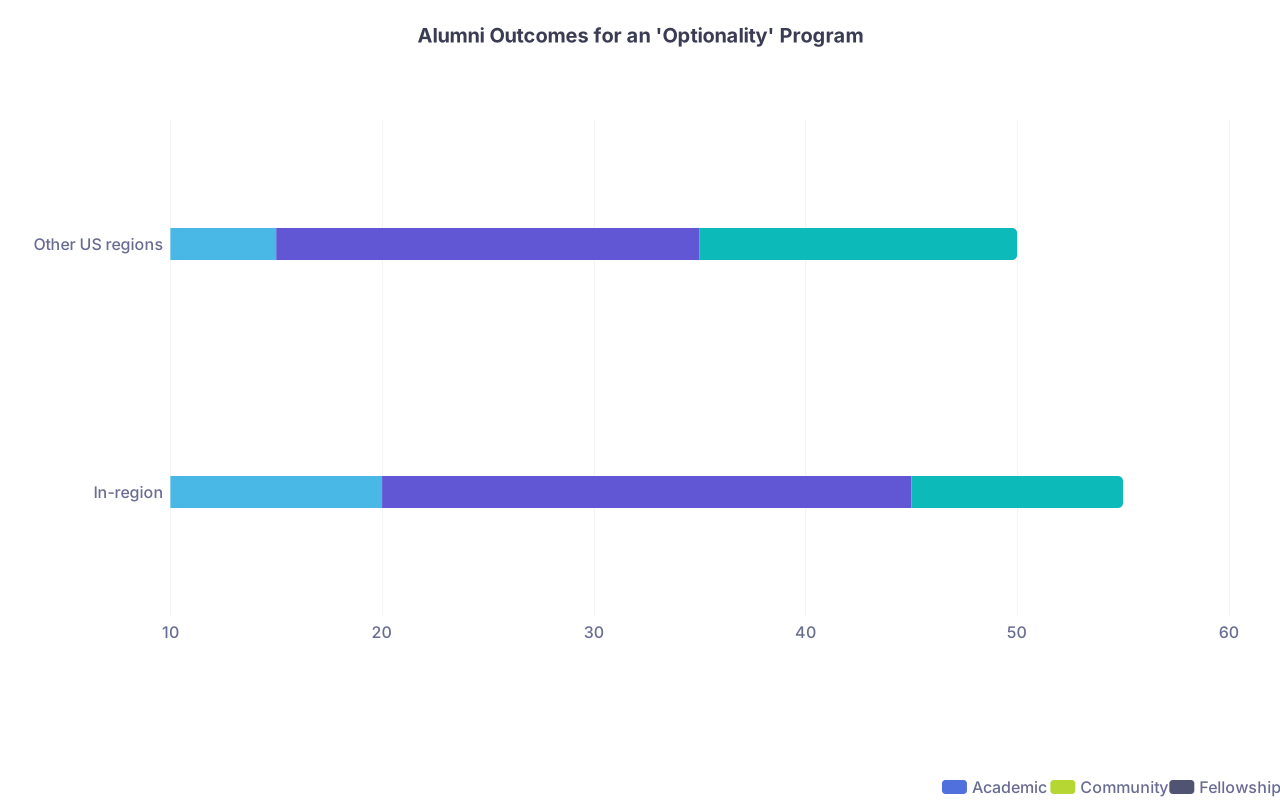
| Category | Academic | Community | Fellowship |
|---|---|---|---|
| In-region | 20 | 25 | 10 |
| Other US regions | 15 | 20 | 15 |
This kind of mixed pattern is your friend if your future is still fuzzy.
7. Using alumni maps to break ties between programs
When you’re down to 2–3 programs that all seem “good,” alumni data is one of the most rational tie-breakers you have.
Here’s how to use it:
- If Program A has 10 alumni in the exact state you want, and Program B has 1, rank Program A higher.
- If Program B has repeatedly placed grads in the fellowship you want, and Program A has never done it, B should probably win.
- If one program has a robust alumni network in a city where your partner’s job might move in 3–5 years, that’s a serious asset.
Raw truth: the email that gets read fastest is the one that starts with, “Hi, I trained at [Program X] too and was hoping to ask your advice.” Alumni clusters make that happen.

FAQ: Alumni maps and residency choices
Does it really matter where graduates practice if the program is highly ranked?
Yes. A big national name helps, but actual job and fellowship offers usually flow through real networks and familiarity. If no one from that program ends up in the region or type of job you want, you’re swimming upstream—even with a fancy brand.My top-choice program doesn’t show alumni data. Is that a dealbreaker?
Not automatically, but it’s a yellow flag. Ask directly on interview day or via email: “Can you share where your last few classes have gone for jobs and fellowships?” If you still can’t get concrete examples, assume the outcomes are average at best and weigh that when ranking.How many years of alumni outcomes should I look at?
Aim for at least 3–5 years. One superstar alum who matched at a top fellowship 9 years ago tells you almost nothing about your chances. Consistency is what matters: repeated placements in similar jobs or fellowships over several classes.If most grads stay local, does that mean I can’t leave the region after residency?
You can leave, but it’ll be harder. The program’s strongest network and name recognition will be local. If you know you want a different region long-term, try to choose a place that has at least some track record of sending people there.How do alumni maps differ between community and academic programs?
Academic programs tend to show more fellowship and academic job placements across broader regions. Community programs often show heavier local community practice outcomes. Neither is “better”—it depends on whether you want fellowship/academia or straight-to-practice locally.What if the alumni map looks great but the program culture seems off for me?
Don’t ignore culture. A perfect alumni map with a toxic or miserable training environment is a bad trade. Ideally you want: acceptable culture + acceptable location outcomes. If culture is a genuine concern, don’t let outcomes alone overrule that.How should alumni outcomes factor into my final rank list?
I’d put them in the top tier of decision factors, right after: 1) personal fit/culture and 2) training quality in your specialty. If two programs are otherwise similar for you, let alumni outcomes and regional placement patterns be the tie-breaker.
Key takeaways:
- Where graduates practice is not random—it’s a map of your most likely future options.
- Alumni maps and destination lists are one of the best reality checks you have when ranking programs.
- Match your long-term goals (region, job type, fellowship interest) to actual alumni patterns, not brochure language, and you’ll make a smarter residency choice.