
The residents with the best operative years are not always the smartest, hardest-working, or most “deserving.” They’re the ones the program quietly decides to invest in.
Let me tell you how that decision actually gets made—and how to spot programs that will give you a knife instead of a mop.
Most applicants think operative experience is some fixed, program-level trait: “Program X is malignant but gives great operative numbers,” “Program Y is chill but light on cases.” That’s not how this really works. The truth is nastier and more targeted:
At most surgical and procedure-heavy residencies, there is a silent caste system.
Certain residents get priority for the big cases and autonomy.
Others get stuck in call-heavy, scut-heavy, clinic-heavy black holes.
And it’s rarely written down. It’s not in the brochure. It sure as hell isn’t in the PowerPoint on interview day.
The Unwritten Tiers: How Programs Really Stratify Residents
There are three unofficial buckets at many programs. No one will say this on the record, but attendings talk this way behind closed doors.

Tier 1: “We’re grooming this one”
These are the residents faculty fight over. The ones they want on their service. The ones who get:
- Early exposure to complex cases
- Extra protected time in the OR
- Looser supervision, more autonomy (“You run this, I’ll be at the head of the bed”)
- Last-minute calls to scrub a great case because “we need someone good”
Sometimes it’s because they’re objectively strong. Sometimes it’s because they fit the culture, trained with the right people, or frankly because they remind an attending of themselves.
What bumps you into this tier at many places:
- A big-name letter writer who personally called the PD (“This kid is one of ours”)
- Research with a powerful surgeon who now advocates for you constantly
- Coming from the “right” medical school that the program historically trusts
- Personality fit: confident but not arrogant, eager but not needy
- Being on top of scut early, so attendings don’t worry about basics and feel safe giving autonomy
Tier 1 residents don’t do less scut. But their scut doesn’t define them. It’s a tax they pay on the way to more and better cases.
Tier 2: “Solid worker bees”
This is the backbone of the program. Most residents sit here.
They get reasonable OR experience, decent autonomy by senior years, and they graduate competent. But they’re not prioritized. When there’s a juicy case and a limited number of spots, they’re second in line to Tier 1.
They get assigned to the “needs coverage” rotations. Somebody has to staff the community site an hour away. Somebody has to cover that miserable consult-heavy service where all the cases get bumped.
Tier 2 does fine. But they don’t get tailored years. They get “coverage years.”
Tier 3: “Keep them out of trouble and get them graduated”
These residents end up with scut-heavy, low-autonomy careers in residency. They’re the ones people talk about with phrases like:
- “Not a bad person, but…”
- “I’m just not comfortable with them doing that case alone”
- “Let’s keep them on clinic-heavy rotations this year”
They get:
- More night float, cross-cover, and ED consult rotations
- Fewer elective OR days with attendings who give independence
- Last-minute case cancellations “for patient safety” that somehow never happen to the Tier 1 people
- Quiet shunting to non-operative fellowships or hospitalist tracks by PGY4-5
Here’s the part that hurts: some people land in Tier 3 not because they’re incompetent, but because of early missteps plus a bad fit with the culture of the program. One rough rotation with the wrong attending can stain you for years in a small shop.
How the “Operative vs Scut” Split Actually Gets Decided
Residents imagine some central scheduling logic where fairness is enforced. No. Schedule committees are human, petty, and political.
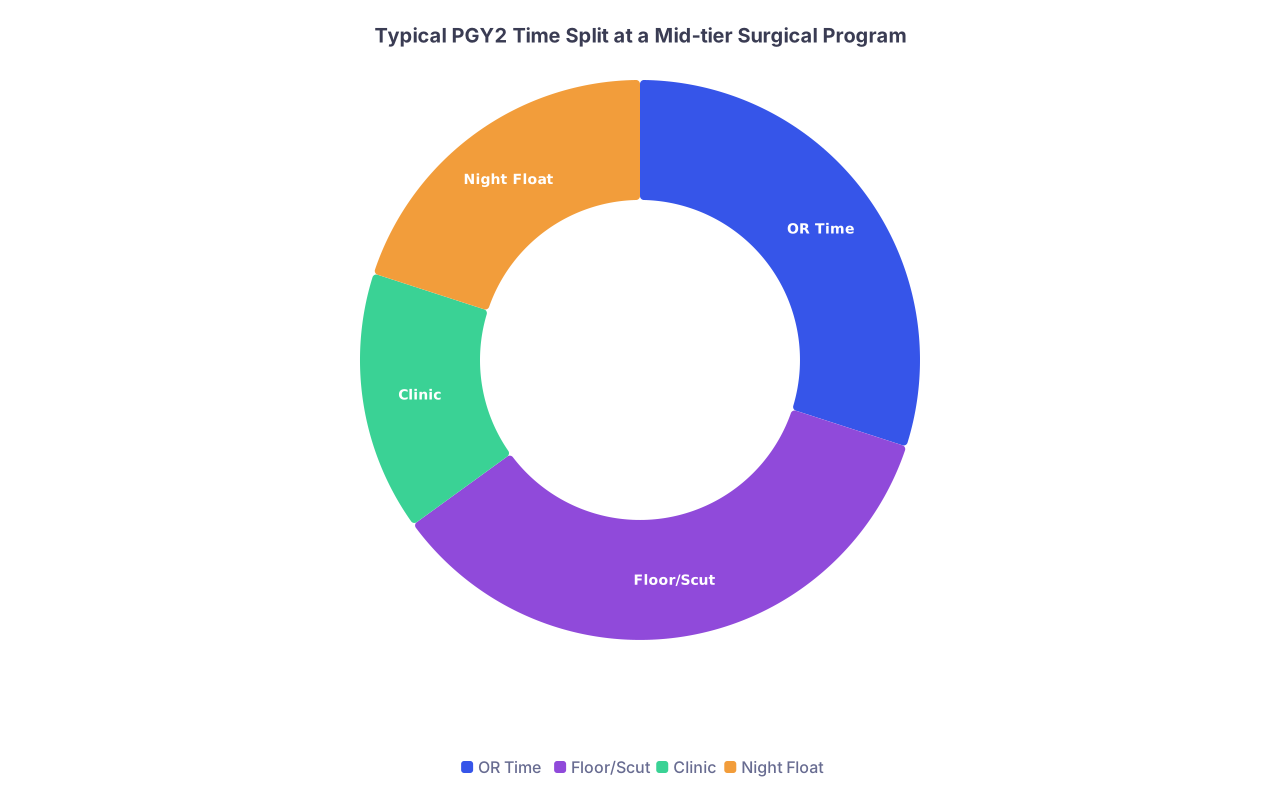
| Category | Value |
|---|---|
| OR Time | 30 |
| Floor/Scut | 35 |
| Clinic | 15 |
| Night Float | 20 |
Let’s walk through how the decision-making really happens.
1. Annual rotation planning: the big chessboard
Around late winter or early spring, the chiefs and administrative chiefs sit down with the APD and maybe the PD. They draft the next academic year’s schedule. Here’s the unsanitized version of that room:
They start with service needs: which hospitals must be covered, which clinics cannot go dark, which community sites are contractually obligated. Nobody asks, “What schedule gives each resident the best education?” The first question is, “How do we not get yelled at by the chair and hospital?”
Then they plug in known problem areas: the trauma service that burns people out, the ICU that eats interns alive, the community general surgery site nobody wants.
Only after that does individual tailoring happen. And that tailoring goes to Tier 1 first.
Comments you’d actually hear:
- “We need Jason on major cases before he applies for CT, don’t bury him on community gen surg again.”
- “Can we protect Priya from another brutal ICU block? She’s been holding that place together for two years.”
- “Just put Ahmed on night float again, he—honestly—functions better there.”
So right there, before anyone talks about “equity,” the schedule is already skewed.
2. Who “needs” what: the narrative game
Residents get labeled early.
Someone is “very strong technically.” Someone else is “book smart but slow in the OR.” Someone is “disorganized on the floor.” Those labels become justification to load more scut or more OR time.
I’ve literally watched an attending argue to keep a PGY3 off a high-volume elective service with:
“He’s still behind on his floor management. He needs more time running the service, not more lap choles.”
Translation: Send him to the land of notes and discharges while the golden children get the scope cases.
3. The “who do I want in my room?” effect
Day-to-day OR assignment is not controlled by the PD. It’s controlled by the attending + whoever runs the board that morning.
In many programs, attendings will say things like:
- “Put Sarah on my Whipple, she’s basically a fellow already.”
- “I’m not comfortable with Joe on this case; give me one of the chiefs or seniors.”
Over a year, those daily micro-decisions compound. One resident gets:
- Every Whipple, esophagectomy, complex vascular case on that service.
Another gets:
- Hernias, ports, appys, and “hold the pager” so the attending feels safe.
Same program. Very different training.
Where Scut Comes From (And Why Some Residents Drown In It)
No one sets out to design a “scut-heavy” year for you. Scut accumulates where systems are broken and someone needs to bail water.

Here’s how certain residents end up holding the bucket more often.
Broken systems = captive labor
If your program:
- Has underfunded mid-level or APP support
- Relies on residents for all documentation, orders, and dispo
- Uses residents as free coverage for multiple hospitals
Then the scut has to land on someone. Often on whoever:
- Complains the least
- Isn’t on the PD’s radar as “rising star”
- Has visa restrictions or fewer external options
- Is seen as “not a surgeon” and therefore safe to load with admin work
The “good soldiers” get punished. Quietly. Because they won’t rage-quit.
The penalty for early mistakes
Miss a couple of pages. Show up underprepared on a couple of cases. Cross the wrong attending. That stuff sticks.
The unconscious response from leadership: “We can’t trust them with a complex case yet; let’s keep them where they can’t hurt anyone.”
So you get slotted into:
- Night float call blocks back-to-back
- High-volume but low-acuity consult roles
- Clinic-heavy rotations where everything is supervised and safe, but nothing is advancing your hands
The story becomes self-fulfilling. Less OR time → slower technical growth → fewer people pushing for you to get good cases.
How to Detect a Scut Factory Before You Rank Them
You cannot change the culture once you’re in. You can only choose where to put yourself. So you need to read between the lines before you rank.
| Signal Type | Red Flag Example | Green Flag Example |
|---|---|---|
| Case Logs | Seniors vague about numbers | Seniors quote real, strong numbers confidently |
| Culture | “We work hard” with nervous laughs | “We operate a lot, here’s how it’s structured” |
| Clinics | “You get a ton of clinic exposure” as selling point | “Clinic is balanced with OR, we cap clinic days” |
| Night Float | Multiple months per year every PGY level | Concentrated early, decreases each year |
| Autonomy | “Always double scrub with attending” | “Graduated autonomy by PGY level, chiefs run rooms” |
1. Listen to how chiefs talk about their operative experience
Not what the PD says. Not the slide deck. The chiefs.
You want specific, unforced comments like:
- “By PGY3 I was running most of the lap choles at the VA.”
- “Our vascular chief basically acts like a fellow on that service.”
- “As a PGY2 I got to do full cases on nights, with backup at home.”
Vagueness is your enemy:
- “We get exposed to a wide variety of cases.”
- “You’ll definitely meet your minimums.”
- “We’re always in the OR… when we’re not on nights or ICU.”
If chiefs can’t quote approximate case numbers off the top of their head, that’s telling. People who operate remember their volume.
2. Pin them down on night float and ward months
Ask exactly:
- “How many months of night float does a typical resident do at each PGY level?”
- “Who actually covers cross-cover at night—residents, NPs, both?”
- “Are there services routinely run by a single resident plus interns, or is there more robust support?”
If you hear:
- “We all pitch in.”
- “You’ll work hard but it’s good for your training.”
- “The interns run the floor; seniors are there to help.”
That last one is a lie at many programs. Seniors get dragged into the scut whenever the system is understaffed.
3. Ask about VA, county, and community sites
Those sites can be gold mines for autonomy—or pure scut hell.
You’re trying to sort:
- Autonomy sites: high case volume, attendings who trust residents, fewer fellows, less competition.
- Dumping grounds: low acuity, endless consults, under-resourced, tons of documentation, minimal big cases.
Ask:
- “What kind of cases do seniors do at the VA/community site?”
- “Who holds the consult pager there?”
- “Which PGY level gets sent there most, and why?”
If juniors are repeatedly shipped off to far-away sites for “coverage” and seniors mysteriously “need to stay at the main campus,” that’s the hierarchy in action.
The Quiet Levers: Who Programs Choose To Reward
Here’s the part applicants underestimate: program leadership wants stars. They’re not neutral. They go out of their way to create them.
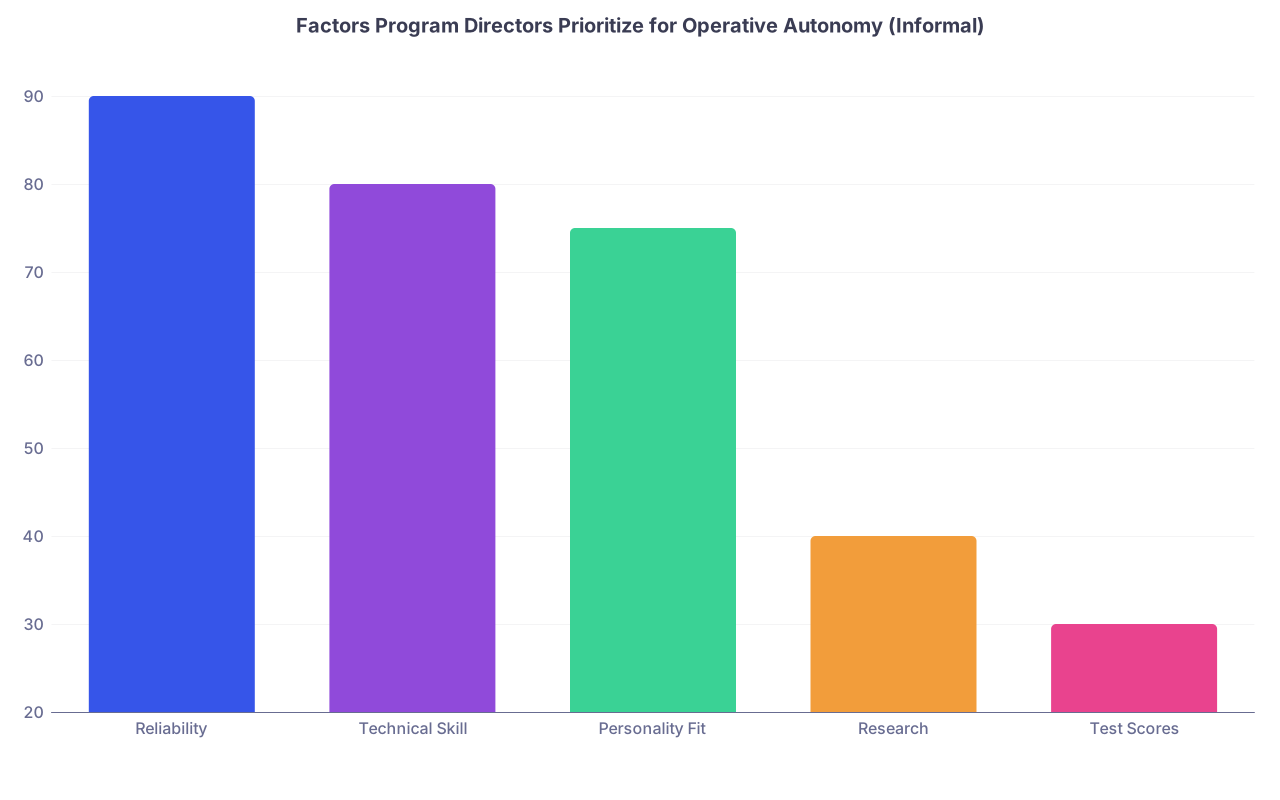
| Category | Value |
|---|---|
| Reliability | 90 |
| Technical Skill | 80 |
| Personality Fit | 75 |
| Research | 40 |
| Test Scores | 30 |
No one ranks these formally, but if you sit in enough CCC (Clinical Competency Committee) meetings, the pattern is clear.
The residents who get rewarded with better years usually have:
- Impeccable reliability
They respond to pages. They show up early. They never vanish from the floor. Attendings say things like: “If she says she did it, it’s done.”
That trust is what makes attendings comfortable stepping back in the OR.
- Calm under pressure
Not genius. Not speed. Calm.
When something bleeds, they don’t flail. They ask for help appropriately. PDs and attendings are much more willing to give hard cases to someone stable in a crisis than someone “brilliant but reactive.”
- A champion
One or two attendings who will go to war for them behind closed doors. The kind who say:
- “We’re wasting him on night float, he should be in my room.”
- “She needs more vascular time if she’s applying to vascular; move her schedule.”
Without a champion, you just get slotted where coverage is needed.
- Alignment with the program’s self-image
Big one. Programs that think of themselves as “old school, hardworking, no-nonsense” will promote residents who mirror that. Programs that brand as academic, research-forward will favor the ones cranking out papers.
You can be objectively excellent and still be starved of cases if you rub against the local culture.
How To Read the Room on Interview Day
You’re not powerless. You can gather a lot more intel than most applicants realize, if you stop asking the scripted questions.

| Step | Description |
|---|---|
| Step 1 | Interview Morning |
| Step 2 | Formal Presentation |
| Step 3 | Faculty Interviews |
| Step 4 | Resident Lunch |
| Step 5 | Tour and Social |
| Step 6 | Post Interview Emails |
| Step 7 | 1 on 1 Questions |
| Step 8 | Operative vs Scut Signals |
Here’s what I’d probe, bluntly.
Ask residents: “Who has the best operative experience in your class—and why?”
They’ll name names. Listen to the reasons.
If they say:
“She just hustles and has earned a lot of trust, so attendings fight to have her in their room”
That’s a culture where effort and reliability get rewarded.
If they say:
“He came in with strong connections, did research with the chair, and always gets the big cases”
Understand what game you’re signing up for.
If they say:
“It’s pretty even; by PGY4 everyone’s got strong numbers”
Push: “Is there anyone who struggles to get cases?” The hesitation in the answer is your data.
Ask: “What are the worst rotations, and who ends up on them more?”
Every program has a garbage rotation. The key is: is the misery shared, or selectively assigned?
If they say:
“Everyone suffers through the same ICU/truama/ED rotation as PGY2”
That’s expected.
If they say:
“Some people seem to end up on nights and floor-heavy rotations a lot more”
You’re hearing that quiet stratification.
Ask a chief directly: “Do you feel the program has favorites when it comes to operative opportunities?”
You’ll get nervous laughter, maybe a “well, every program does.” That’s fine. Then follow with:
“Do those favorites tend to be the hardest workers, or is it more about who you know and where you came from?”
Their answer will tell you everything you need about whether you can earn a good operative year or whether it’s decided on Day 1 based on pedigree.
The Hard Truth: You’re Choosing a Bias, Not a Meritocracy
No residency is truly “fair.” You’re not choosing between fair and unfair. You’re choosing which unfairness you can live with.

Different environments, different hidden rules.
Big-name, highly competitive academic programs:
More fellows. More research. More prestige. Residents may get great complex cases—but you’ll fight fellows and other residents for them. Scut gets offloaded to whoever isn’t part of the “pipeline” to fellowships.Solid mid-tier programs with minimal fellows and heavy VA/county presence:
Often better raw case numbers and autonomy. But systems may be rough, support is thin, and scut is heavy across the board. If the leadership is weak, coverage demands can swallow your OR time.Smaller community programs:
Great autonomy if the attendings trust residents. Or pure service coverage if the hospital sees the residency as cheap labor. Depends entirely on leadership culture.
Your real task is to identify:
- Where do the best cases actually go?
- On what basis does the program decide who gets them?
- Is that a game you can realistically win?
If the hidden rules reward reliability, humility, and hustle—you have leverage.
If they reward pedigree, insider connections, and politics—you’re betting on factors that are mostly frozen before you ever arrive.
How to Protect Yourself Once You Match
You asked about choosing a program, but let me give you one last piece from the inside: what I tell interns quietly in July.
The first 6–9 months write your label. After that, you’re mostly living inside the narrative others have already written for you.
- If you’re late, even once, you’re “the one who cuts it close.”
- If you lose your cool, you’re “emotional under stress.”
- If you never complain and always pick up work, you’re “the rock” (and they will lean on you—hard).
You cannot control who else is in your class. You cannot control whether you have that golden-armed wunderkind co-resident who everyone worships. You can control this:
- Absolute reliability on the basics (pages, notes, signout, follow-up).
- Visible preparation for cases (read, know the steps, anticipate).
- Choosing 1–2 attendings you want as champions and making sure they see your best work.
- Politely but firmly expressing interest in operative exposure: “I’d really like to get more time on vascular this year if there’s any flexibility.”
Programs are more likely to tilt your year toward cases if they believe you’re already safe and useful on the floor. The paradox: the better you are at scut, the more trust you earn to escape it.
But if you pick a program where the best cases always go to someone else for reasons you can’t influence? No amount of hustle will fix that.
So when you’re staring at your rank list, do not just ask, “Who works the hardest?” Ask:
- Who gets protected for cases?
- Who gets quietly used for coverage?
- And which of those people do I resemble in the eyes of this program?
Because that’s who you’ll be standing next to in the OR. Or holding the pager for while they’re scrubbed.
The core truths you need to remember:
- Operative vs scut-heavy years are not random; they’re the product of quiet, very human decisions about who’s “worth” investing in.
- You can’t make a malignant or politically skewed culture fair—but you can choose a program where effort, reliability, and fit actually translate into cases.
- On interview day, your job is to pierce the branding and figure out where the knives go and where the pagers go—and which one they’re likely to hand you.