
It is January. You are staring at two rank list drafts on your laptop.
Program A: busy county hospital, solid training, residents whisper about brutal call.
Program B: cushy suburban academic center, strong fellowship placement, residents mention “we all moonlight PGY-2 and up, easy to clear six figures.”
Your loans are ugly. You are tired of being broke. And that word—moonlighting—sounds like salvation. You find yourself bumping Program B up the list almost automatically.
Here is the problem: you have not read a single actual policy. Not GME moonlighting limits. Not ACGME rules. Not the program’s contract. You are going off hallway chatter from a half-distracted PGY-3 grabbing pizza between cases.
This is exactly how people get burned.
I have watched residents end up on probation, lose visas, violate duty hours, or simply melt down from exhaustion—all because they ranked and signed without understanding how moonlighting really works at that program.
Do not make this mistake.
You are not just choosing “where can I moonlight.” You are choosing:
- Who controls your ability to moonlight
- How much risk you are accepting for your license, your visa, and your sanity
- Whether your “extra” income is real… or fantasy that collapses under policy and politics
Let’s walk through the traps one by one.
The Core Reality Everyone Pretends Not To Hear
Moonlighting is not a right. It is a privilege. And a fragile one.
Residents glide past this line in their contracts every year: “All moonlighting must be approved by the Program Director and GME and must not interfere with the resident’s education or violate ACGME duty hour requirements.”
Translation: they can say no. Or yes, then later no. Or yes, but only under conditions that make it barely worth your time.
The main mistake at the application and ranking stage is simple: you treat “we have moonlighting” as binary. Either a program has it, or it does not.
Reality is more like this:
| Factor | Program X | Program Y |
|---|---|---|
| PGY level allowed | PGY-2+ | PGY-3+ only |
| Internal vs external | Internal only | Both, with approvals |
| Hour limit per week | 8 hours | 16 hours |
| Visa restrictions | No visa moonlighting | H1B allowed, J-1 no |
| PD culture | Supportive | Discouraging |
Two programs can both say “yes, we have moonlighting,” and live on completely different planets.
When you choose a residency thinking moonlighting will solve your financial problems, but you do not understand the details above, you are setting yourself up for one of three painful outcomes:
- You cannot moonlight at all
- You can moonlight, but the pay and hours are so restricted that it barely matters
- You moonlight anyway and quietly violate rules—until someone notices
All three are avoidable if you know what to ask before you rank.
Mistake #1: Believing Resident Rumor Over Written Policy
On interview day, you ask a current resident, “Can you moonlight here?”
They say, “Yeah, people do. It is pretty good.”
You relax. You assume you are safe.
This is how people end up signing contracts that are completely misaligned with what they thought they heard.
I have seen this:
- PGY-1 tells applicants: “Our seniors all moonlight; it is nice extra cash.”
- Actual policy: Only PGY-3+ can moonlight. Must have passed all board exams on first attempt. Must be on good standing, no professionalism concerns. PD can revoke at any time.
- Result: Maybe 2–3 residents per class actually moonlight in practice.
Or this:
- Residents say: “We moonlight at the affiliated community site; it is easy.”
- Policy: Only internal moonlighting is allowed and must be counted toward 80-hour limit.
- Effect: Months with heavy rotations? Impossible to pick up enough shifts to meaningfully change your income without hitting duty hour caps.
If the words “I think” or “I heard” show up when residents talk about moonlighting, assume nothing.
You want concrete, policy-level answers:
- Which PGY year is eligible, formally?
- Is there a written GME or program rule about moonlighting?
- Does moonlighting count toward total duty hours? (It should, by ACGME rules. If they say no, that is a red flag.)
- How many residents in your current PGY level actually moonlight regularly? Not “could.” Actually do.
And then—this is where many people get lazy—you verify.
Use interview follow-up emails. Ask the program coordinator or PD directly. “Can you share the written GME policy regarding resident moonlighting?” This is not an unreasonable ask. If they dodge that, or send vague language where everything is “at the discretion of,” you should treat their supposed moonlighting culture as unreliable.
Mistake #2: Ignoring ACGME Duty Hour Reality
Here is the other fantasy I see every year: “I will do my 70–80 hours of residency, then just moonlight another 20. It will be fine. I worked harder in third year.”
No. ACGME does not care how heroic you feel.
Duty hours include:
- All patient care activities for pay
- All education-related work
- All moonlighting, internal or external
And institutions get audited. Duty hour violations can hurt accreditation. When a program tells ACGME “we are in compliance,” they are promising not to let you turn into a work-hour bomb.
So if a program has:
- Heavy call (q4, frequent 28-hour shifts)
- Chronic understaffing
- Lots of mandatory conferences and documentation
You will not realistically have many safe, policy-compliant hours left for moonlighting. Even if there is a “moonlighting opportunity,” you may not be in a position to use it.
Watch out for this classic trap: programs that brag about moonlighting but have 4-week ICU blocks with 80-hour weeks every third month. Residents “moonlight” in July and August, then disappear from the schedule the rest of the year because they are already at their max.
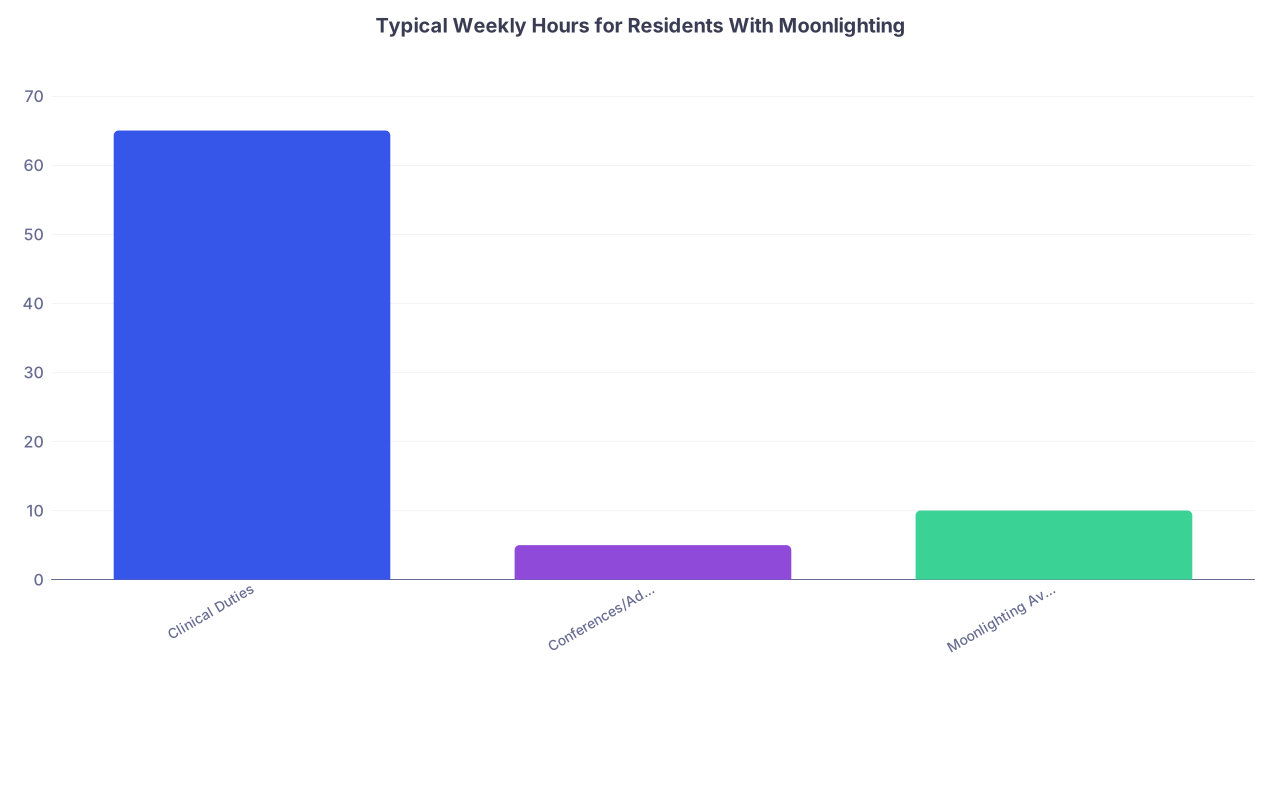
| Category | Value |
|---|---|
| Clinical Duties | 65 |
| Conferences/Admin | 5 |
| Moonlighting Available | 10 |
If you choose a residency mainly for moonlighting, but the baseline work hours are already at the edge, you just locked yourself into an unrealistic plan that collapses as soon as internship hits full speed.
Ask concretely:
- “What are typical weekly hours on your busiest rotations?”
- “Do residents who moonlight ever have duty hour issues logged in MedHub/New Innovations?”
- “Does the program limit how many moonlighting shifts you can pick up per month?”
If the answer is vague or dismissive—“We just manage it”—you are being set up to either underreport hours (bad) or be told “no more shifts” just when you start to rely on that money (also bad).
Mistake #3: Not Matching Moonlighting Reality To Your Visa Status
If you are on a J-1 or H1B, ignoring moonlighting rules when choosing a program is not just a minor error. It can be catastrophic.
I have watched:
- J-1 residents take under-the-table shifts at urgent cares because their friends did. Later, when applying for waivers, those W-2s or 1099s surfaced. Lawyers had to scramble.
- H1B residents assume external moonlighting is allowed “as long as I pay taxes,” when their visa was employer-specific and restricted them to the sponsoring hospital only.
You need to understand two layers:
- Immigration law and your specific visa category
- Your program’s and institution’s policy over and above that
Most J-1s: external moonlighting is effectively off the table. Some internal “extra shift” work may be allowed under very tight rules, but this is not generalizable.
Some H1Bs: external moonlighting would require separate visa sponsorship from the outside institution. Most residents do not have that.
So if you are a visa holder and you are ranking programs based on rosy moonlighting stories from green card or citizen co-residents, you are setting yourself up to be furious later. At yourself.
On interview day, you need to separate your questions by category:
- “What moonlighting is available for residents on J-1 visas?”
- “What about H1B residents?”
- “Has your GME office published explicit guidelines for visa holders and moonlighting?”
Do not accept: “I think it is fine as long as…” from residents. They are not your immigration lawyer.
If a program depends on visa residents heavily and still cannot answer this clearly, that should ding them on your rank list. This is your visa status and your legal risk on the line.
Mistake #4: Confusing Internal Extra Shifts With True Moonlighting
Programs love to blur this line.
They will say “we have moonlighting” when what they really mean is:
- You can pick up extra in-house night float shifts at a lower pay rate than locums
- You can staff an in-house clinic occasionally, with your income bundled strangely through payroll
- Or worst of all: “We let residents cover extra shifts when someone calls out, and we give them a small stipend”
That is not the moonlighting you are dreaming about when you are staring at $300k in loans.
Real moonlighting, the kind that meaningfully changes your finances, usually looks like:
- Independent shifts where you bill or are paid as an attending-level provider under supervision frameworks that satisfy malpractice and credentialing
- Pay rates that actually beat your hourly resident salary by a meaningful margin
- Stability: a predictable pool of shifts you can sign up for, not random scraps
Ask the question directly:
- “Does your program have internal ‘extra coverage’ shifts, or true independent moonlighting with separate credentials?”
- “What is the pay range per shift? Can you give a rough ballpark (e.g., $70–$150/hour)?”
- “Are moonlighting shifts allocated fairly, or do seniors, fellows, or ‘favorites’ get them first?”
I have watched residents discover in September of PGY-3 that yes, there “is moonlighting,” but all the best-paying shifts go to fellows or attendings from another service. Residents fight over leftovers.
Choosing a program for moonlighting without asking how shifts are actually allocated is like choosing a car because “it has access to gas” without checking if you are allowed to use the pump.
Mistake #5: Ignoring The PD’s Attitude Toward Moonlighting
Policies matter. Culture matters more.
Two programs, same written policy: “PGY-2+ may moonlight with PD approval, subject to performance and duty hours.”
Program 1 PD:
“I encourage moonlighting if you are performing well. It is a good way to build autonomy. I sign off routinely, as long as your evals are solid.”
Program 2 PD:
“I technically allow moonlighting, but I think it is usually a distraction. I rarely sign off except for exceptional seniors I trust completely.”
On paper? Identical. In reality? Night and day.
You are not just picking a system. You are picking a person whose signature stands between you and every dollar of moonlighting income.
Watch for red flags in how PDs talk on interview day:
- Do they emphasize “education first” in a way that sounds hostile to any outside work?
- Do they hint that “we keep you busy enough that you will not need moonlighting”? Translation: we will block it.
- When you ask about moonlighting, do they immediately pivot to risk and liability without ever describing actual opportunities residents use?
You want a PD who can say, calmly and concretely:
- “We allow moonlighting starting PGY-2 once you pass Step 3.”
- “Most residents who want to do it can. We review evaluations first, but it is routine.”
- “The only times I have said no are when someone is struggling clinically or with professionalism.”
If they cannot tell you how often they say “yes,” assume the answer is “almost never.”
Mistake #6: Overestimating Future Energy And Underestimating Burnout
You are a fourth-year med student right now, maybe coasting on lighter rotations. You imagine that as a PGY-2, you will be able to:
- Work 60–70 hours
- Study for boards/fellowship
- Have a life
- And still moonlight 16 hours per week at peak cognitive performance
No. You will be tired. Some weeks you will just want to see your family and sleep.
I have seen residents build their entire financial survival plan on moonlighting, then hit reality:
- Chronic fatigue; they are irritable and make small mistakes on routine tasks
- Strained relationships; partners and children barely see them
- PDs noticing performance drops and suggesting “you may want to cut back on outside work”
Remember: moonlighting is optional until it starts affecting your core job. Then it gets taken away. Quickly.
So when you choose a residency, the real question is not “Where can I moonlight the most?”
It is: “Where is the baseline training experience strong enough and humane enough that, if I decide to moonlight, I can do it without destroying myself?”
Programs that brag about aggressive moonlighting might actually be selecting for residents who are already stretched thin and desperate. That culture bleeds into everything: burnout, error rates, and toxicity.
Look at:
- Vacation policies and whether people are allowed to truly disconnect
- Support systems: mentors, wellness, back-up call coverage
- Resident faces when they talk about their weeks. Are they dead-eyed, or do they seem tired but functional?
If the only thing that lights them up is talking about moonlighting checks, that is not a good sign.
Mistake #7: Treating Moonlighting As The Primary Financial Plan
Here is the harsh truth: moonlighting can help, but it will not fix a broken financial foundation.
I have watched residents chase moonlighting so hard they:
- Delay disability insurance because “I need the monthly cash now”
- Push off retirement contributions and keep high-interest debt piling up
- Ignore budgeting and lifestyle creep because “future attending me will handle it”
Then something goes wrong: illness, PD blocks moonlighting, new institutional rule cuts shifts. Suddenly, the “extra” income they were relying on vanishes.
When you pick a residency, financial questions should absolutely matter. But ranking a program higher purely because “they have better moonlighting” while ignoring:
- Cost of living in that city
- State taxes
- Parking, fees, call meal coverage, benefits
- PGY salary progression
…is sloppy.
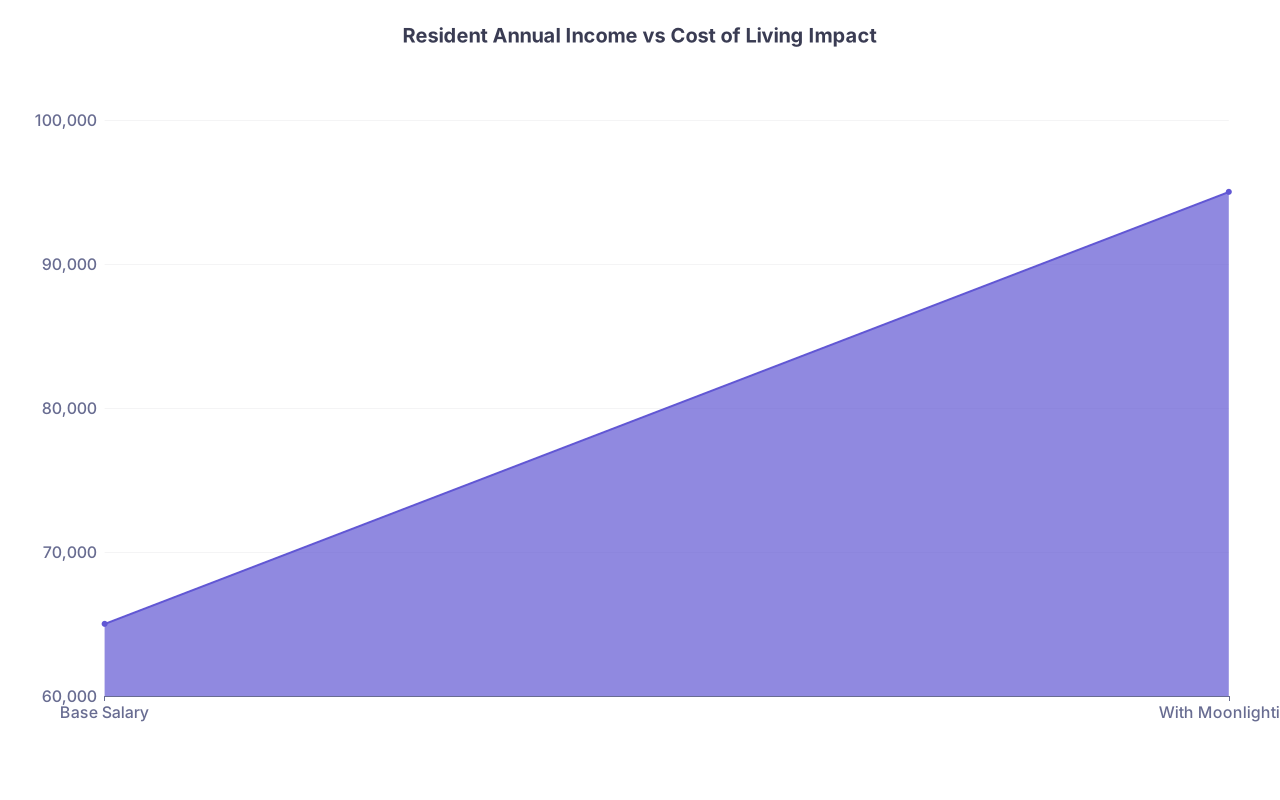
| Category | Value |
|---|---|
| Base Salary | 65000 |
| With Moonlighting | 95000 |
In a high-cost city, that “extra” $30k moonlighting might still leave you more strapped than a lower-paying program in a cheaper city where you do not need to moonlight at all.
You would be smarter to pick a program where:
- The base salary and benefits are reasonable for the region
- The workload is manageable enough that you can safely moonlight if desired
- The program leadership is transparent about what is and is not possible
Moonlighting should be a lever you can pull, not the pillar that holds up your entire house.
How To Actually Evaluate Moonlighting Before You Rank
You want a simple, ruthless process. Something like this:

| Step | Description |
|---|---|
| Step 1 | Identify Top Programs |
| Step 2 | Ask Residents Specific Questions |
| Step 3 | Request Written Moonlighting Policy |
| Step 4 | Clarify Visa and Duty Hour Limits |
| Step 5 | Gauge PD Attitude on Interview |
| Step 6 | Factor Moonlighting Into Rank |
| Step 7 | Do Not Rely on Moonlighting There |
| Step 8 | Consistent and Supportive? |
Concrete questions to include in your notes for each program:
Eligibility
- From which PGY level?
- Any exam/pass requirements (Step 3, in-service)?
Scope
- Internal only, or external too?
- Is it independent practice or just extra internal shifts?
Limits
- Hour caps per week or month?
- Does GME enforce strict reporting in MedHub/New Innovations?
Visa-specific rules
- What is allowed for J-1 and H1B residents, exactly?
Culture
- How many residents in each class actually moonlight regularly?
- Does the PD encourage, tolerate, or quietly block it?
You are not being “difficult” by asking. You are being the only adult in the room before you sign a legally binding training contract.
One Thing To Do Today
Open your current rank list or target program list.
Choose your top three programs where “moonlighting” has influenced your thinking.
For each of those three, write down—honestly—what you actually know versus what you are assuming about their moonlighting rules:
- What year you can start
- Whether it is internal vs external
- How many people actually do it
- Any visa or duty hour constraints
If you have even one blank per program, send an email today to the program coordinator or PD asking for their written moonlighting policy and clarification for your situation (citizen vs visa, intended specialty, etc.).
Do not rank based on rumors. Rank based on rules that can hurt you if you ignore them.