
It’s January of your MS2 year. You’re half in Path, half in UWorld, and every time someone asks, “So what are you thinking about for residency?” you mumble something like “maybe IM… or EM… or honestly I have no idea.”
This is where you are:
- You don’t need a specialty yet.
- You do need a system.
- And you have more control over this than it feels like.
Here’s the long-range, time-stamped game plan to clarify residency fit from MS2 through early MS4. Not vibes. Not panic. A structured, calendar-based way to answer “What should I go into?” before ERAS is breathing down your neck.
Big Picture: The 4-Phase Timeline
At this point you should see the whole road in front of you. Roughly:
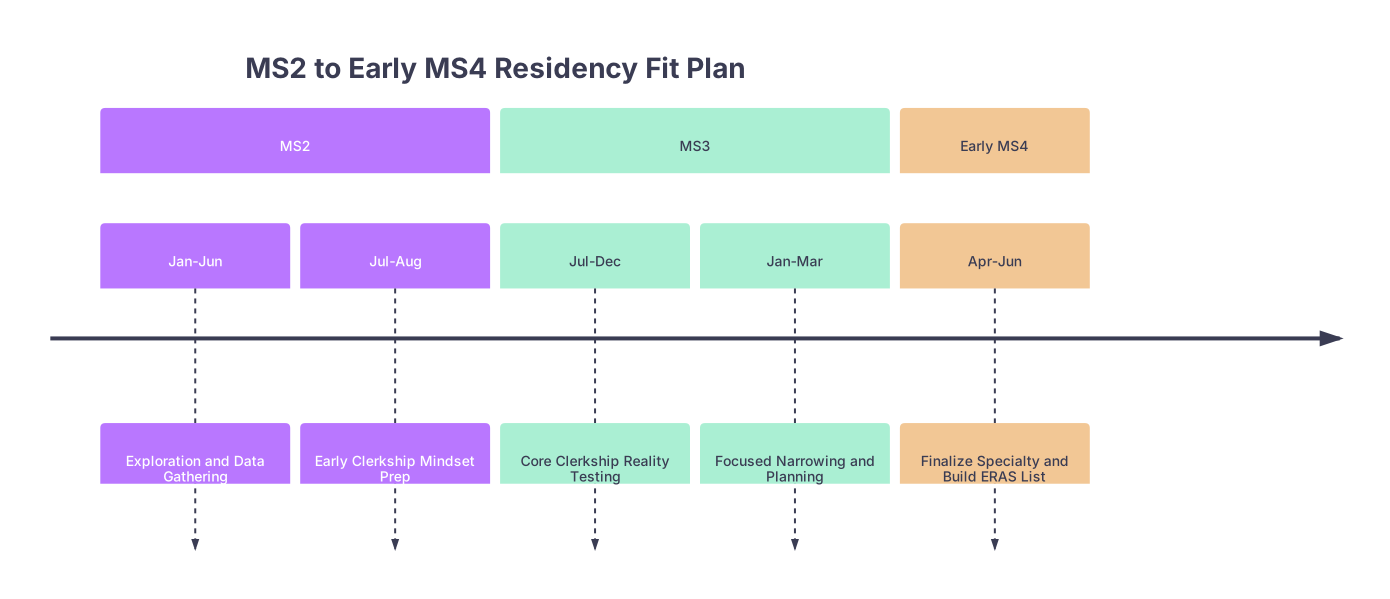
| Period | Event |
|---|---|
| MS2 - Jan-Jun | Exploration and Data Gathering |
| MS2 - Jul-Aug | Early Clerkship Mindset Prep |
| MS3 - Jul-Dec | Core Clerkship Reality Testing |
| MS3 - Jan-Mar | Focused Narrowing and Planning |
| Early MS4 - Apr-Jun | Finalize Specialty and Build ERAS List |
You’ll cycle through three things, over and over:
- Exposure (seeing real life, not Instagram stereotypes)
- Reflection (structured, written, not just “I liked it”)
- Strategy (using what you learn to shape rotations, mentors, and applications)
Now we walk through it, month by month.
MS2: Exploration Without Panic (January–August)
January–March (MS2): Set Up Your “Residency Fit Engine”
At this point you should stop treating specialty choice as a fuzzy future problem and build a simple system.
1. Create a running “specialty fit” document
Google Doc, Notion, OneNote, whatever. One place only. Title it: “Residency Fit – [Your Name].”
Make three sections:
- Section A: “What I Actually Want in Daily Life”
- Section B: “Specialty Snapshots”
- Section C: “Non‑Negotiables and Red Flags”
In Section A, write bullet answers to:
- Hours I can realistically tolerate long-term
- How much I care about:
- Procedures (none / some / many)
- Longitudinal relationships
- Acute vs chronic care
- Inpatient vs outpatient
- Mix of medicine vs surgery vs diagnostic
- My energy peaks (morning person? night shifts okay?)
- My tolerance for chaos (ED) vs slow grind (clinic)
Do not overthink. Just dump what you think is true right now. You’ll revise this 20 times.
2. Build a short list of “test” specialties
At this point you should keep the list broad, not locked in.
Pick 4–6 specialties to actively explore:
- 2–3 “obvious” ones you’re leaning toward (e.g., IM, EM, Peds)
- 1–2 “wild cards” (e.g., Anesthesia, Path, PM&R, Radiology)
- 1 backup broad field (IM or FM) even if you’re convinced you’re going into something else
Put them in Section B of your doc with headings like:
- Internal Medicine – Current status: Curious
- EM – Current status: Tempted but unsure
- Surgery – Current status: Probably not, but will confirm
3. Set up low‑effort, high‑signal exposure
Between now and boards, you don’t have time for shadowing marathons. Fine. Use smarter tools:
Podcasts / YouTube:
Choose 1–2 channels/podcasts where attendings talk real shop (e.g., EM Basic, Curbsiders, anesthesia-focused content).
Rule: 1 episode/week while commuting or cooking.
In your doc under each specialty, jot 2–3 bullets:- “Likes being shift-based”
- “Hates clinic paperwork”
- “Average day = X”
Ask 3 residents one simple question (in person or via email):
“What’s the thing you didn’t understand about your specialty until residency?”
Dump answers into Section B by specialty.
This isn’t about deciding. It’s about building decent mental models instead of stereotypes.
April–June (MS2): Data + Self-Testing
At this point you should start matching who you are with what specialties demand.
1. Do at least one validated specialty-interest tool
Something like:
- AAMC Careers in Medicine
- Specialty preference inventories from your school
You’re not obeying the result. You’re using it as a lens.
Log results in your doc:
- “Top 3 recommended: IM, Peds, Psych”
- “Bottom 3: Surgery, OB/GYN, EM”
Now write one short paragraph:
- “This matches/doesn’t match my gut because…”
If tools say “EM” and your anxiety spikes when the fire alarm test goes off, mark that. Misalignment is data.
2. Attach self-awareness to your study life
Watch yourself under stress.
- Do you enjoy multi-step, puzzle-like problems?
You may tolerate IM, heme/onc, neuro. - Do you get bored with slow, chronic problems?
High-yield for EM, surgery, anesthesia types. - Do you prefer crisp, right-or-wrong answers vs narrative, psycho-social nuance?
Radiology/path vs psych/peds, etc.
Once a week, open Section A and adjust 1–2 bullets:
- “Turns out I hate prolonged ambiguity.”
- “Actually like complex interpersonal stuff more than I expected.”
You’re calibrating, not deciding.
3. Board score reality check (quietly but firmly)
You don’t know your scores yet, but you know your test patterns. Be honest:
- Historically middle-of-the-pack standardized test taker?
Ultra-competitive fields (Derm, Ortho, Plastics) may be possible but will not be a casual choice. - Crush every exam with minimal effort?
You’ll have more leverage in competitive spaces.
Park this in your doc under Section C (Non‑negotiables / constraints):
- “Test performance: solid / average / excellent”
- “May or may not want to play the hyper-competitive game”
This becomes crucial later when fantasy meets NRMP data.
July–August (Pre-clinical → Clinical Transition): Prep Your Clerkship Lens
Once Step/Level 1 is done and you’re heading into rotations, at this point you should treat MS3 as a structured experiment, not random exposure.
1. Build a simple rotation evaluation template
Before clerkships start, make a one-page template you’ll fill after each rotation:
- What I liked:
- What I disliked:
- People: who seemed happy? burned out?
- Daily schedule: tolerable? Draining?
- Specific tasks I enjoyed (procedures, counseling, notes, diagnosis)
- Would I do this daily for 5+ years? Why/why not?
Print 6–8 copies or keep a digital version. Force yourself to fill it within 48 hours of each rotation ending.
2. Know your first 3 rotations = high-signal
Those early blocks (IM, Surgery, Peds, OB, Psych, FM, EM) are where most people decide.
Mark them on your calendar. For each one, write in your doc:
- “Primary question for this rotation:”
- IM: Can I tolerate rounding, complex chronic patients, cognitive grind?
- Surgery: Do I like the OR or just the idea of being ‘a surgeon’?
- Peds: Can I handle kids+parents without wanting to disappear?
- Psych: Does talking all day drain or fuel me?
Then we hit MS3.
MS3: Reality Check and Narrowing (July–March)
This is where you stop guessing. Clinical life will force real decisions if you let it.
July–December (Early–Mid MS3): Rotation-by-Rotation Experiments
At this point you should be actively using each core clerkship to test career fit. Not just chasing honors.
Week 1–2: Observe like a scientist
- Track:
- What do residents complain about most?
- What do they light up about?
- When do you feel time fly vs crawl?
End of Week 2, answer in your doc under that specialty:
- “If I woke up and this was my job today, would I be dreading it, neutral, or excited?”
Week 3–4 (or mid-rotation): Mini-debrief with yourself
Take 10 minutes after a normal day (not the worst or best):
- Rate 1–10:
- Enjoyment of typical day
- Tolerance of lifestyle (hours + calls + pace)
- Interest in subject matter
- Enjoyment of patient population
- Fit with my temperament
Log ratings in a small table like this.
| Rotation | Enjoyment (1-10) | Lifestyle Fit (1-10) | Subject Interest (1-10) | Patient Pop Fit (1-10) |
|---|---|---|---|---|
| IM | 7 | 6 | 8 | 7 |
| Surgery | 4 | 3 | 6 | 5 |
| Peds | 6 | 7 | 6 | 8 |
You’re not chasing perfect 10s. You’re looking for patterns. I’ve seen this hundreds of times—by your fourth rotation, you’ll notice 1–2 specialties consistently scoring higher.
End of rotation: Use your template
Within 48 hours of finishing each clerkship:
- Fill your rotation evaluation sheet.
- Then write one brutally honest sentence in your doc:
- “I could see myself doing this.”
- “Hard no.”
- “Maybe as a subspecialty, not as a core field.”
Lock it in before nostalgia or recency bias rewrites your memory.
Parallel Track: Conversations That Actually Matter
During each rotation, at this point you should be asking targeted questions to 2–3 people:
Ask an intern:
- “What surprised you most about this specialty once you started residency?” Ask a PGY3+:
- “If you were an MS3 again, what would make you not choose this field?” Ask an attending:
- “What kind of student is miserable in this specialty?”
Write down key phrases. They repeat across programs:
- “If you hate uncertainty, don’t do EM.”
- “If you need instant feedback/gratitude, inpatient IM may destroy you.”
- “If you can’t live with middle-of-the-night calls, don’t do OB.”
Those are gold. Throw them into Section C (Red flags / Non‑negotiables).
January–March (Late MS3): Narrowing and Strategy Shift
By now you’ve seen most core rotations. At this point you should move from “What do I like?” to “What am I willing to commit to?”
1. Shortlist 1–3 realistic specialties
Open your doc. Look at:
- Your rotation ratings
- Your written reactions
- Your non‑negotiables and constraints
Force yourself to put specialties into 3 buckets:
- Green: Seriously considering (1–3 specialties)
- Yellow: Only as backup concepts
- Red: Not happening
Be honest. Writing “maybe” for everything is just fear.
2. Do a cold, data-based check against competitiveness
Now bring in actual numbers:
- Look at NRMP Charting Outcomes for your likely graduation year
- Check:
- Step 2 score ranges
- Number of programs ranked for matched vs unmatched
- Research expectations
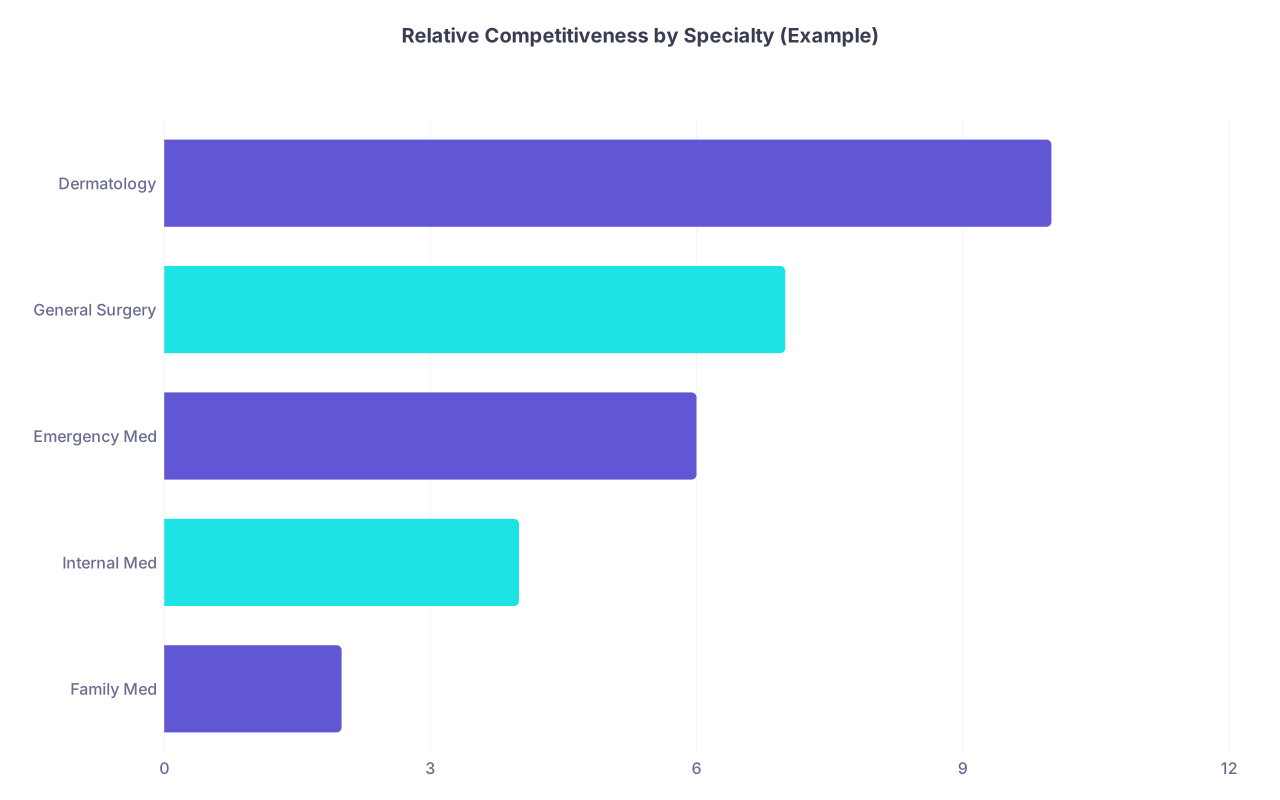
| Category | Value |
|---|---|
| Family Med | 2 |
| Internal Med | 4 |
| Emergency Med | 6 |
| General Surgery | 7 |
| Dermatology | 10 |
(Think of 1 as least competitive, 10 as most.)
Now, combine:
- Your academic profile (Step 2 practice scores, clinical evals)
- Your stamina for a heavy application grind
Write explicit statements:
- “Derm: love the lifestyle/clinic, but my metrics are not close. Would require an enormous uphill push.”
- “IM: aligns with my scores and preferences; safest and still interesting.”
- “EM: possible, but needs strong SLOEs and comfort with nights.”
You’re not killing dreams. You’re refusing to be delusional.
3. Align MS4 schedule with your short list
At this point you should start shaping MS4 into a specialty-testing and application-building year:
For your top specialty:
- Plan:
- 1 home sub-I/acting internship in that field
- 1 away rotation (if field where aways matter: EM, Ortho, Neurosurg, etc.)
- Identify:
- Who could realistically write you strong letters?
For your backup or “close second” specialty:
- Keep:
- Room for at least 1 elective/sub-I in that field early MS4 if your top choice implodes
Put actual months on a calendar:
“July: home IM sub-I
August: away EM
September: heme/onc elective
October: backup IM sub-I if needed”
This is where early planners win. You’re not scrambling in May of MS4.
Early MS4 (April–June): Finalize Fit and Target Programs
By early MS4, at this point you should be able to answer: “I’m applying in X, with Y as a backup (or no backup because of Z rationale).”
Now you turn “which specialty” into “which programs.”
April–May (End of MS3 / Early MS4): Confirm and Commit
1. Use your first sub-I as a final specialty test
During your early sub-I:
- Act like a resident. Watch how it feels.
- Ask yourself after week 2:
- “If my life looked like this for the next 3–7 years, would I be okay with that?”
If the answer is no, better to pivot now than force a bad fit.
2. Start building a program target list
Use four filters:
- Geography (where you actually will live, not fantasy)
- Program type (academic vs community vs hybrid)
- Competitiveness vs your profile
- Lifestyle/culture priorities
Make three tiers for your chosen specialty:
| Tier | Program Type | Quantity Target |
|---|---|---|
| Reach | Big-name academic | 5–7 |
| Solid | Mid-tier academic/hybrid | 10–15 |
| Safety | Community-heavy | 5–10 |
Adjust numbers depending on specialty competitiveness.
Under Section B in your doc, add subheadings:
- “Programs that match my personality”
(e.g., collegial, lots of teaching, not malignant) - “Programs that match my life needs”
(partner job, family proximity, cost of living)
May–June: Clarify What “Fit” Means at Program Level
By now you’re not asking “IM vs EM?” You’re asking “Which IM? Which EM?” Different question. Different criteria.
1. Define your program non‑negotiables
Examples:
- Won’t do:
- Programs with 6+ months ICU/year if you hate critical care
- Programs with consistently brutal scut culture
- Need:
- Reasonable fellowships for your likely interests
- Acceptable call schedule
- At least some evidence residents are not crushed (check social media, alumni, resident turnover)
Write a one-page “Program Fit Checklist” you’ll keep open as you explore websites and talk to residents.
2. Start tracking programs systematically
You’re early. Use it.
Build a simple sheet with columns like:
- Program name
- Location
- Type (academic/community)
- Size
- Call schedule summary
- ICU months
- Fellowship paths
- Vibe notes (from talking to current residents)
You don’t need to fill it completely yet. But as you talk to people and browse websites, start populating.
Putting It Together: Your Long-Range Residency Fit Timeline
Here’s how all of this compresses into what you’re actually doing, step by step.
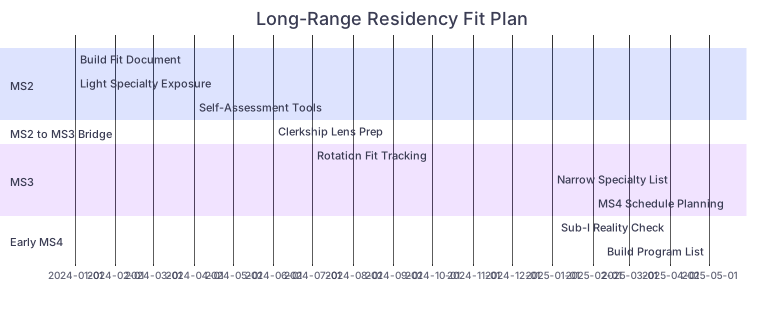
| Task | Details |
|---|---|
| MS2: Build Fit Document | a1, 2024-01, 2m |
| MS2: Light Specialty Exposure | a2, after a1, 4m |
| MS2: Self-Assessment Tools | a3, 2024-04, 2m |
| MS2 to MS3 Bridge: Clerkship Lens Prep | b1, 2024-06, 1m |
| MS3: Rotation Fit Tracking | c1, 2024-07, 8m |
| MS3: Narrow Specialty List | c2, 2025-01, 3m |
| MS3: MS4 Schedule Planning | c3, 2025-02, 2m |
| Early MS4: Sub-I Reality Check | d1, 2025-04, 2m |
| Early MS4: Build Program List | d2, 2025-05, 2m |
If you stick to even 70% of this, you will be miles ahead of the average “I guess I’ll do IM because it’s broad” applicant.
FAQ (Exactly 2 Questions)
Q1: What if I get to late MS3 and still feel totally unsure about my specialty?
Then at this point you should stop trying to think your way out of it and use constraints. Ask:
- Which rotations did I definitely not want to repeat? Cut those.
- Where do my evaluations and attendings say I shine?
- What fields keep me employable and flexible if my interests shift (IM, FM, EM, Peds, Anesthesia)?
Then urgently schedule:
- 1–2 targeted electives in your top 2 realistic specialties early MS4
- Meetings with advisors in those fields to discuss candid feedback
Indecision is normal. Indefinite indecision isn’t. Put deadlines on yourself.
Q2: How much should Step 2 score influence my specialty choice?
More than students admit, less than some advisors threaten. If you’re 40+ points below the median for a hyper-competitive field with no other standout factors, that’s not “motivation”; that’s denial. Use your score as a boundary, not a destiny. It tells you:
- Which specialties will require a risky, all-in application strategy
- Where you’ll be competitive at a broader range of programs
If you love a field that’s now statistically uphill, consider:
- Parallel planning (a realistic backup specialty)
- One extra research year only if you have clear, committed mentorship and a defined plan (not just “buying time”)
Do one concrete thing now:
Open a new document titled “Residency Fit – [Your Name].” Create the three sections: “What I Actually Want,” “Specialty Snapshots,” and “Non‑Negotiables.” Fill each with five bullets today. That’s the first real step from vague anxiety to an actual plan.