
It’s mid‑March of your third year. You just survived your first full winter on the wards. The shelf scores are back, your scrubs are permanently stained, and every resident keeps asking you the same question you hate: “So what are you going into?”
You have strong opinions about which people you liked, which attendings were nightmares, and which days felt weirdly fun despite the 5 a.m. start. But if someone forced you to rank your residency priorities—procedures vs lifestyle, academic vs community, big city vs smaller program—you’d be guessing.
Spring of MS3 is where that guessing needs to stop.
This is the window where your core rotations stop being “see everything” and start being “test what I actually want from training.” If you use March–June correctly, you walk into M4 with:
- A real short list of specialties
- A clear sense of what you want in a residency program
- Concrete stories and data to guide your rank list later
Here’s how to run that process, step by step.
Big Picture Timeline: March–June of MS3
Let’s anchor the calendar first.
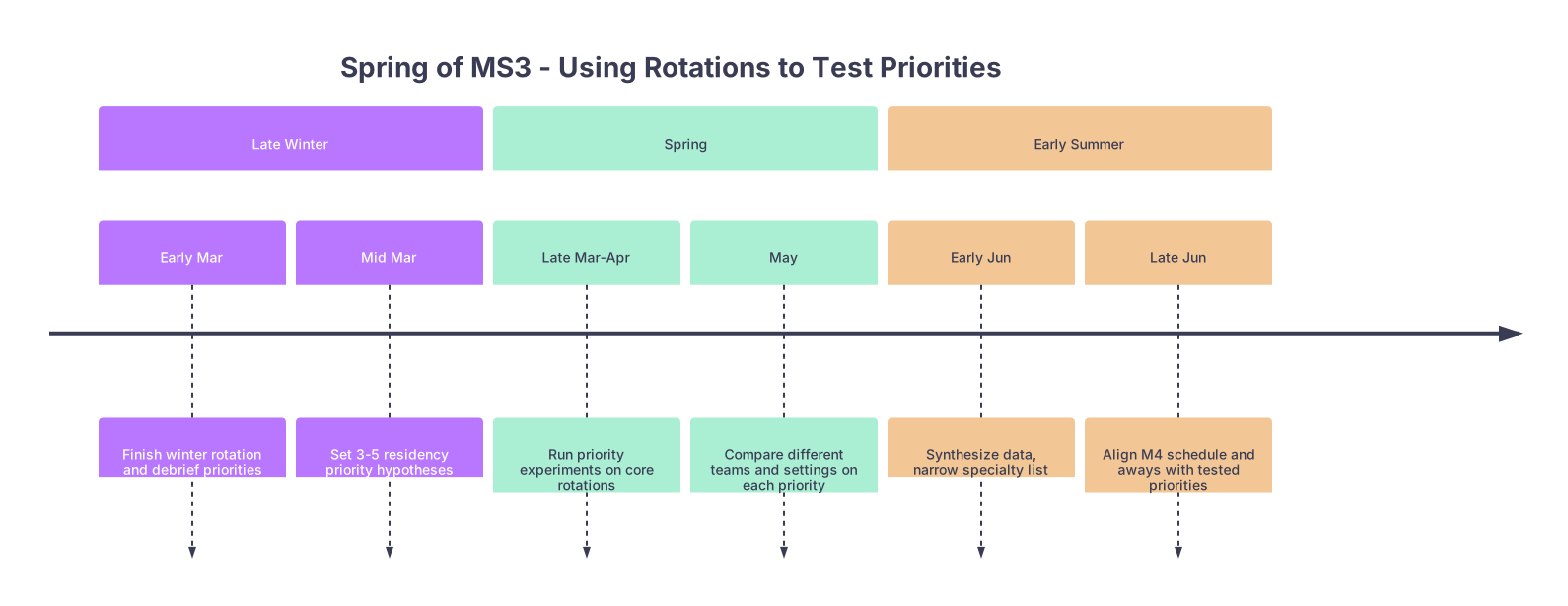
| Period | Event |
|---|---|
| Late Winter - Early Mar | Finish winter rotation and debrief priorities |
| Late Winter - Mid Mar | Set 3-5 residency priority hypotheses |
| Spring - Late Mar-Apr | Run priority experiments on core rotations |
| Spring - May | Compare different teams and settings on each priority |
| Early Summer - Early Jun | Synthesize data, narrow specialty list |
| Early Summer - Late Jun | Align M4 schedule and aways with tested priorities |
At each point, your job is not “be a good student” (that’s baseline). Your job is to run controlled experiments on your own preferences.
Step 1 (Early March): Define What You’re Actually Testing
By this point, you’ve seen at least a few of these: IM, surgery, OB/GYN, peds, psych, family, maybe neuro or EM. You’ve had good days and miserable days in all of them.
At this point you should stop asking “Do I like this specialty?” and start asking “What kind of residency life do I want?”
Sit down for 45 minutes—no phone—and write out three lists:
- Non‑negotiables (must-haves)
- Nice‑to‑haves
- Deal‑breakers
If you need a starting menu, here are common residency priorities you should be explicit about:
- Procedures vs cognitive work
- Inpatient vs outpatient balance
- Schedule predictability vs variety
- Lifestyle: nights/weekends, call frequency, post‑call days
- Academic prestige vs autonomy vs community vibe
- Program size and class size
- Geography and cost of living
- Research expectations (real or performative)
- Fellowship vs straight to practice
- Patient population: complex tertiary vs bread‑and‑butter
Pick 3–5 priorities you’re actually unsure about. Not 15. You’re going to test those this spring.
Example:
- “I think I want a procedure‑heavy field, but I’m not sure I actually enjoy doing procedures vs just liking the idea of them.”
- “I say I want lifestyle, but I also kind of liked the intensity of surgery. Which matters more when it’s my whole life?”
- “I think I want an academic program, but the community hospital team honestly felt happier. Was that a fluke?”
Now translate each priority into something you can measure on the wards.
| Priority | What You’ll Measure on Rotations |
|---|---|
| Procedures vs cognitive | % of time hands-on vs thinking/documenting |
| Lifestyle vs intensity | Your energy, enjoyment on long vs light days |
| Academic vs community | Teaching quality vs autonomy |
| Inpatient vs outpatient | How you feel after clinic vs wards |
| Big vs small program vibe | Sense of team, visibility, mentorship |
At this point you should have: a one‑page “Spring MS3 Testing Plan” with 3–5 priorities and how you’ll test each.
Step 2 (Mid–Late March): Turn Each Rotation into an Experiment
You’re probably on a core rotation now—let’s say IM in March/April. Perfect. That’s your lab.
Your goal this block is to collect data, not vibes. You’re going to do that in three ways:
- Micro‑journaling
- Structured observation
- Intentional conversations
2.1 Micro‑Journaling: 5 Minutes per Day, No Excuses
At this point you should start a stupidly simple log. Not a feelings journal. A data log.
Every day, jot down:
- Start time / end time
- Primary setting (inpatient, clinic, ED, OR)
- One thing that energized you
- One thing that drained you
- Your 0–10 rating of that day as if you lived it as a resident
That last line is key. Not “Was today a good student day?” but “If this was my PGY‑2 life, what would I rate it?”
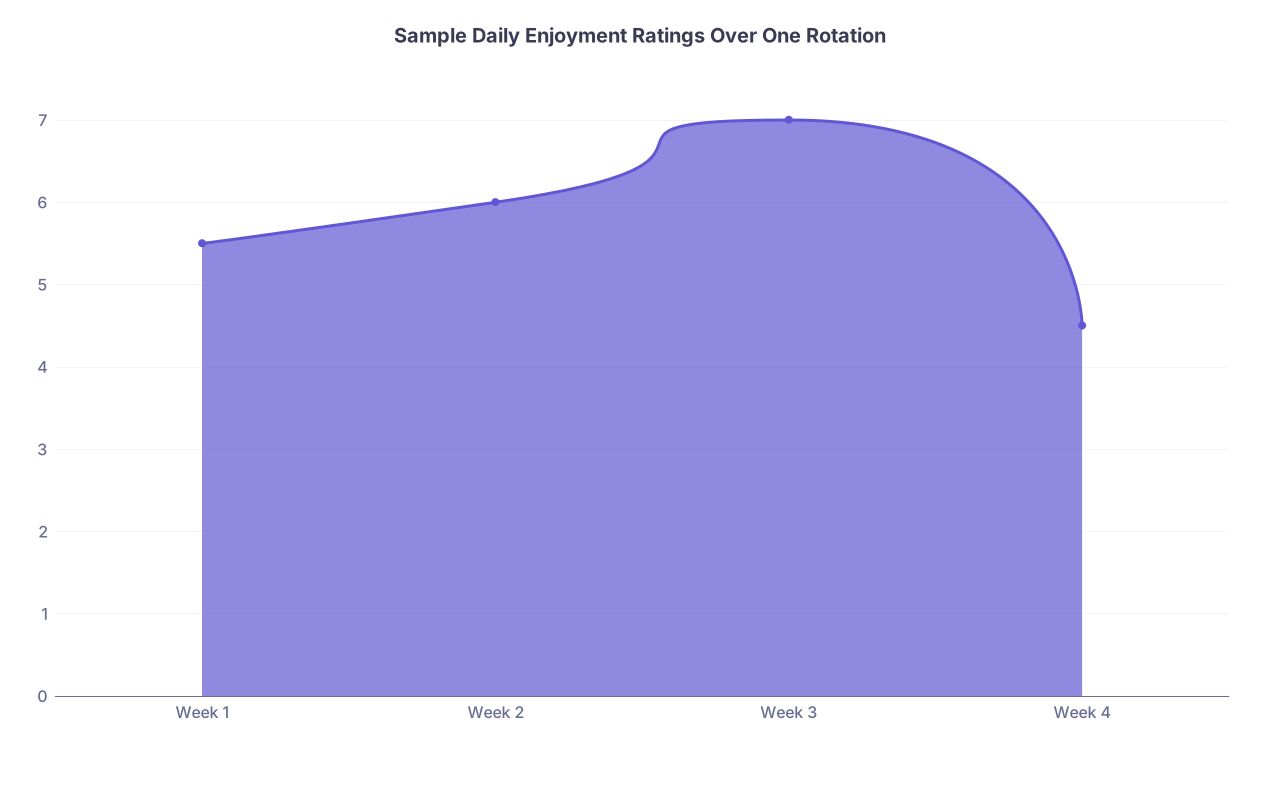
| Category | Value |
|---|---|
| Week 1 | 5.5 |
| Week 2 | 6 |
| Week 3 | 7 |
| Week 4 | 4.5 |
Patterns > memories. By April you’ll swear you “liked” a rotation you actually rated 3/10 half the time.
2.2 Structured Observation: Watch the Residents Like a Hawk
Stop evaluating the attendings. They are misleading outliers. Start watching the residents you’ll actually be.
For each team you’re on, notice:
- When are they actually leaving? Ignore what they say and watch who is still at the computer at 7 p.m.
- How do they talk between themselves on the elevator? Burnt out, dark-humored but okay, genuinely content?
- Who’s doing the procedures vs notes vs scut?
- How many have kids, hobbies, partners that seem intact?
Have a running note in your phone: “Resident Life – IM vs Surgery vs Peds” and collect concrete examples.
2.3 Conversations: 3 Targeted Questions per Resident
At this point, instead of vague “Do you like this program?” small talk, you should ask pointed, repeatable questions that map back to your priorities.
Examples:
- “What made you pick this program over others you interviewed at?”
- “What’s the worst part of this residency that people don’t talk about in interviews?”
- “If you had to rank: autonomy, prestige, lifestyle—how does this program actually stack up?”
Ask the same 3–4 questions of interns, seniors, chiefs. You’ll see patterns fast.
Step 3 (April–May): Stress‑Test Specific Priorities on Different Services
Now you’re moving through late spring blocks. Often some mix of:
- Medicine sub‑services
- Surgery subspecialties
- OB or peds
- Psych or EM
At this point you should deliberately set up each block as a stress test for one or two of your big questions.
3.1 Testing “Procedural vs Cognitive”
If you’re unsure whether you actually like doing procedures vs reading/thinking, you need real exposure on both extremes.
On procedure‑heavy weeks (OR days, OB L&D, EM):
- Track how often you want to scrub in vs secretly hope someone forgets to call you.
- Notice if your energy goes up in the OR or tanks after 2 hours of standing retracting.
- Pay attention to the attendings’ lives: are they running room to room nonstop, or do they seem to have any control?
On cognitive‑heavy weeks (ward months, consults, psych, heme/onc):
- Track whether you find complex decision‑making fun or suffocating.
- Notice how you feel dictating notes and working through differential trees all day.
If by mid‑May your daily ratings are consistently higher on procedural days—even when they’re longer—that’s not an accident.
3.2 Testing “Lifestyle vs Intensity”
Everyone says they want lifestyle until they get bored. Others swear they crave adrenaline, then quietly break down 6 months into nights.
Use spring to separate fantasy from tolerance.
- Identify your longest and shortest days each week. How do you feel on your walk home?
- Monitor your mood across stretches of:
- 6–7 a.m. pre‑rounds starts
- Q4 overnight call weeks
- Clinic‑only days
Example pattern I’ve seen over and over:
- Student A: “I’m fine being here until 7 if it’s busy and interesting, but a 9–3 clinic day with nothing going on makes me want to die.”
- Student B: “I am noticeably a worse human being after 5 consecutive 6 a.m. days. I don’t bounce back.”
Those patterns should directly shape which specialties and which types of programs you actually consider.
3.3 Testing “Academic vs Community”
Many students talk a big “academic” game because that’s what their school pushes. Then they rotate at one community site and suddenly feel human again.
Across your academic vs community experiences this spring, track:
- Teaching quality: actual bedside teaching vs slide decks vs “just read about it”
- Autonomy: who’s making decisions, fussy micro‑management vs real responsibility
- Culture: constant research talk vs “how’s your weekend?” chat
- System feel: bloated bureaucracy vs lean but sometimes messy

If an academic powerhouse feels exhilarating rather than exhausting, you’re the kind of person who probably will be happy in a bigger name program. If the community month is the only time you felt like yourself, take that seriously.
At this point (by early May) you should have 6–8 weeks of data across different settings, not just vague memories.
Step 4 (Late May): Convert Rotation Data into Residency Priorities
You’ve collected daily ratings, observed residents, and grilled them politely. Now you need to turn that mess into decisions.
Block off a weekend afternoon. Pull up:
- Your daily logs
- Your “Resident Life” notes
- Your original 3–5 priority hypotheses
Then, for each priority, answer:
- What did I think I wanted in February?
- What does my actual data suggest I actually tolerate/enjoy?
- What surprised me?
Example:
Priority: Procedures vs Cognitive
- February story: “I want something hands‑on, hate being at a desk.”
- Data: My average enjoyment:
- OR days longer than 8 hours – 5/10
- Mixed floor + small procedures – 7/10
- Pure clinic – 4/10
- Complex inpatient cases – 8/10 even with no procedures
Conclusion: I don’t actually need to be doing big procedures all day. I want variety and complex decision‑making, with some hands‑on. That nudges me away from super OR‑heavy, maybe toward fields like IM with procedures (cards, pulm/crit), EM, or maybe anesthesiology.
Turn this into a small table for yourself:
| Priority | Pre‑Spring Assumption | Post‑Spring Reality |
|---|---|---|
| Procedures | Need heavy procedures | Want mix; too much OR drains me |
| Lifestyle vs grind | Can handle brutal schedules | Okay with busy, hate chronic sleep loss |
| Academic vs community | Must be at top‑tier academic | Mid‑size academic or strong community |
At this point you should update your “non‑negotiables / nice‑to‑haves / deal‑breakers” list based on evidence, not fantasy.
Step 5 (Early June): Narrow Your Specialty Shortlist
You’re not choosing a specific residency program yet. You’re choosing which types of training to pursue.
Based on your refined priorities, you should now:
- Narrow to 1–3 realistic specialties you’d actually be okay matching into.
- Map each specialty against your new priorities.
Do this bluntly. Use a grid.
| Specialty | Procedures | Lifestyle | Academic vs Community Fit | Inpatient vs Outpatient |
|---|---|---|---|---|
| IM | Low–mod | Mod | Flexible | Inpatient‑heavy early |
| EM | Mod–high | Shift‑based | Both, but fewer ivory towers | ED only |
| Gen Surg | High | Tough | Skews academic | Inpatient/OR‑heavy |
| Peds | Low–mod | Mod | Both | Mix wards/clinic |
Then, using your own data, cross out the specialties that clearly clash with your proven preferences.
Example:
- You crash on night shifts and your daily scores plummet after 2 a.m. call? Be honest about EM or surgical fields with q2–q3 trauma nights.
- You consistently rated psych clinic days 8/10, medicine wards 4/10? Stop pretending “I just like variety” and acknowledge where you’re actually happy.
By mid‑June you should have:
- A primary target specialty
- A backup that still basically fits your priorities
- A short list of program characteristics you’ll seek or avoid within that specialty
This is the foundation for everything that comes next—aways, letters, and eventually your rank list.
Step 6 (Late June): Translate Priorities into Program Filters
Now we move from “What specialty fits me?” to “What kind of program in that specialty fits me?”
At this point you should take your tested priorities and turn them into concrete filters you’ll apply when:
- Choosing away rotations
- Skimming program websites
- Talking with mentors
Examples of concrete filters:
- “I rated big, chaotic teams low. I’m going to focus on mid‑size programs with class size under 15 per year.”
- “I thrived with strong supervision and teaching. I’ll prioritize programs with explicit protected didactics and good board pass rates.”
- “Every time I was in a big city tertiary center, I was exhausted by the chaos. I’m going to look hard at secondary/tertiary centers in smaller cities.”
Here’s how your tested priorities translate into filters:
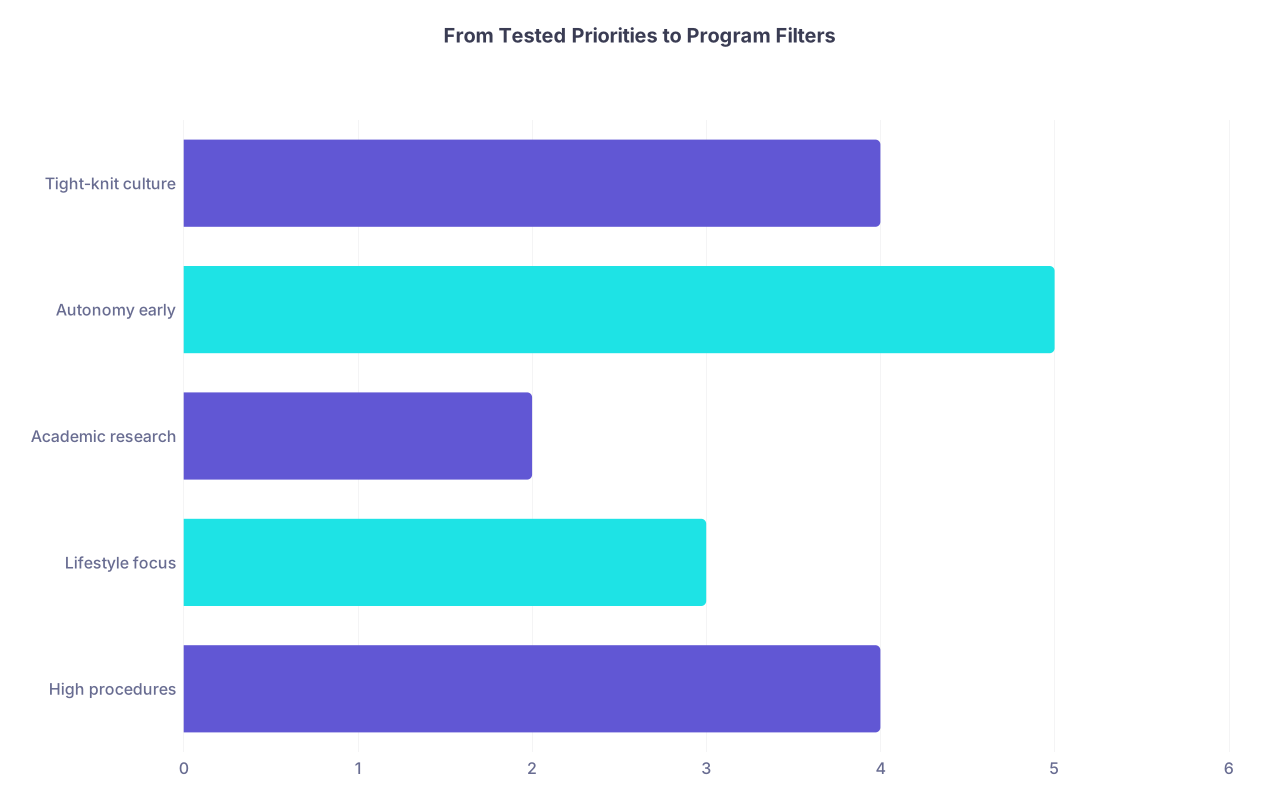
| Category | Value |
|---|---|
| High procedures | 4 |
| Lifestyle focus | 3 |
| Academic research | 2 |
| Autonomy early | 5 |
| Tight-knit culture | 4 |
(Think of those numbers as “importance to you” now, not theoretical values.)
Once these are clear, you can:
- Choose away rotations at program archetypes (big academic vs smaller community) that represent what you’re considering.
- Ask residents/employees at those away sites direct, priority‑based questions:
- “How many weekends are you here per month?”
- “Who actually runs the codes here?”
- “How easy is it to call in backup when the ED is drowning?”
Step 7: Use Remaining MS3 Time Week‑by‑Week
Let’s get hyper‑practical. Assume you’re reading this mid‑March. Here’s what your next few months should look like.
Week 1–2 (Now)
At this point you should:
- Draft your 3–5 testing priorities
- Set up your micro‑journal template (paper, Notion, whatever)
- Start asking every resident 2–3 consistent, targeted questions
Week 3–6 (Remainder of Current Rotation)
- Log every day with a 0–10 “residency life rating”
- Note specific moments that made you think “I could/could not do this for 3 years”
- After each week, write 3 bullets:
- What I liked this week
- What I hated this week
- What I learned about my priorities
Week 7–12 (Next Rotation)
- Pick one priority to really stress‑test this block (e.g., lifestyle vs intensity)
- Try to experience both extremes: early mornings, late nights, heavy call if available
- Pay obsessive attention to resident mood, turnover, and how attendings treat them
Week 13–16 (Early Summer)
- Block a 2–3 hour session to synthesize your logs and decisions
- Refine your specialty list and program filters
- Meet with at least one advisor or senior resident to reality‑check your conclusions
What You’re Avoiding by Doing This Now
Most MS3s do the opposite: they drift, they “see what happens,” then panic in August of MS4 and pick programs based on brand names and vibes from interview days.
That’s how you end up as:
- The social medicine‑loving student who matches into a grind‑y surgical program they hate by January
- The procedure‑junkie stuck in a clinic‑heavy field
- The person who swore they wanted “top tier” then burns out in a malignant big‑name program they never should’ve ranked that high
Spring of MS3 is the last time you can experiment with low stakes. As a resident, changing your mind is a full life reset.
Use this window.
Your Next Action Today
Do this right now:
- Open a blank page and write three headers: Non‑negotiables, Nice‑to‑haves, Deal‑breakers.
- Under each, list 3 items based on your rotation experiences so far.
- Then, at the top of that page, write: “Spring MS3 Testing Plan – [Your Name].”
Tomorrow on rounds, watch the residents like you’re studying an animal species. When you get home, rate your day 0–10 as if you were them.
That’s how you stop guessing and start actually choosing the right residency life for you.